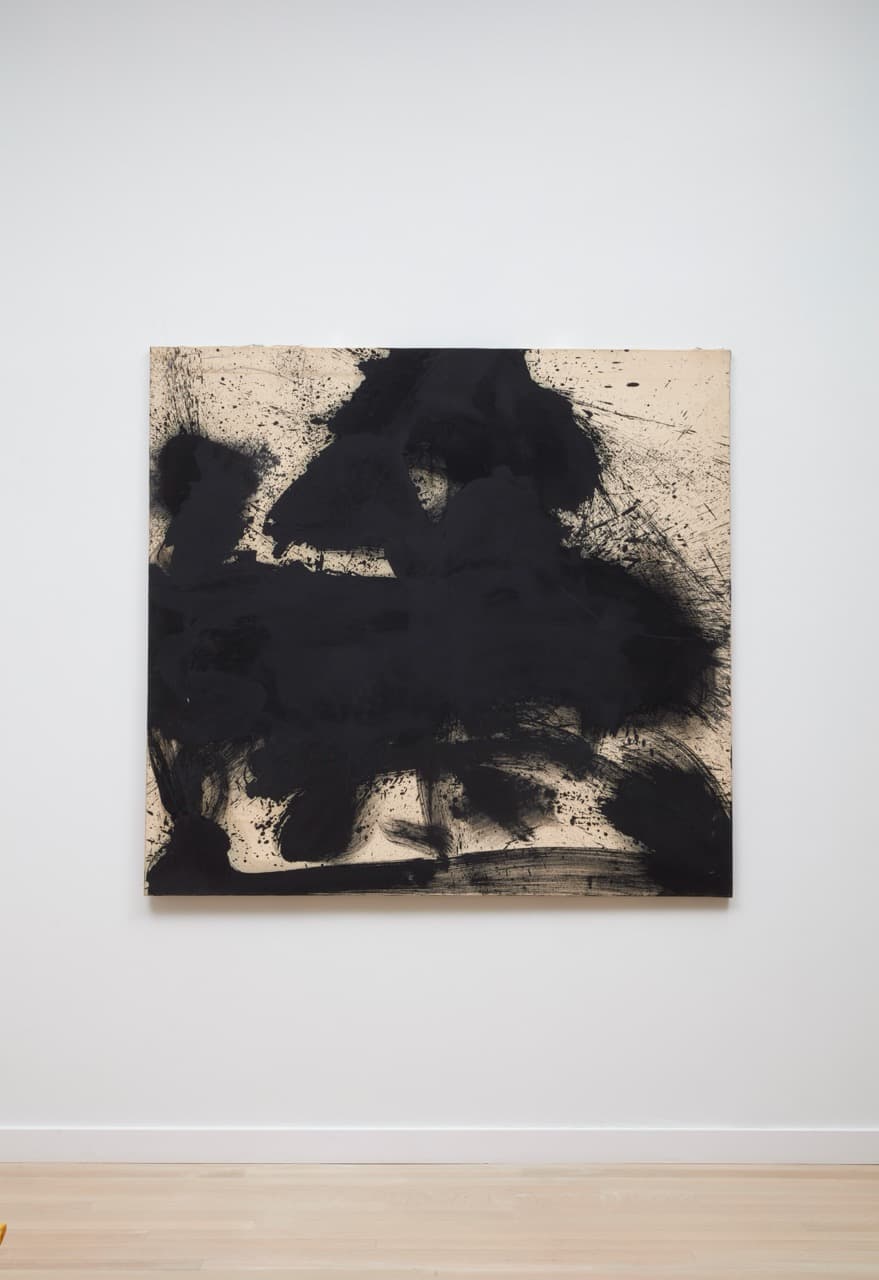
Walasse Ting, Untitled, 1959. Oil on canvas, 59 × 63 inches. Courtesy the artist; Alisan Fine Arts, New York; and the Milton Resnick and Pat Passlof Foundation.
Word count: 909
Paragraphs: 5
The Milton Resnick and Pat Passlof Foundation
February 13–July 11, 2026
New York
How Asian Is it? is not a critical exhibition of paintings interpreting a concept of Asian-ness, but is instead a question cheekily aimed at the perception of the viewer, critic, curator, and art dealer who have historically, and are currently, looking at the work. Starting with a painting from 1959, Untitled by Walasse Ting, curator Lilly Wei has organized her show of twelve artists conceptually by when the artists arrived in the United States (seven of the twelve were born outside the US), how, as immigrants or the children of immigrants, immersed as they were in mainstream American culture, and how they interacted with the art scene, primarily in New York. What the show reveals is not surprising at all, if one is familiar with artists: these painters are not (or were not) loners seeking to express a personal narrative, but active cultural producers, looking to engage with what was, at the time, mainstream painting—but because of their ethnicity, they were for the most part sidelined. Wei’s aim is to interpret how these artists’ contributions are appreciated and incorporated into the wider art historical and cultural landscape, as well as to present artists whose work for the most part remains under-acknowledged. Still, despite the heavy anthropological baggage, stylistic aspects of the art inevitably take center-stage and we experience a primer of sorts into varieties of abstraction over the past sixty-plus years, starting with Ting’s Abstract Expressionism, through the cosmic geometries of Emily Cheng and Il Lee, and the hard-edge abstractions of Kim Uchiyama and Shirley Kaneda painted in 2024.

Installation view: How Asian Is It?, the Milton Resnick and Pat Passlof Foundation, New York, 2026. Courtesy the Milton Resnick and Pat Passlof Foundation. Photo: Jason Wyche.
The paintings in Wei’s selection are visually stunning: It’s easy to become engrossed in the placid aquatic depths of Robert Yasuda’s Pacific (2011) or Richard Tsao’s lighthearted inferno Sci-Fi (2004). Both artists’ pieces are about surface and its seductive potential—Yasuda’s glistens while Tsao’s is a mottled matte satin, and both position the canvas as an object simultaneously more and less than a painting. These works sit easily among Shen Chen’s Untitled No.32238-13 (2013), a precise but diaphanous mist of pigment descending, composed of carefully colored-in overlapping rectangles of dissonant color, which cause a pleasing but tensely vibrating haze. Il Lee’s BL-2403 (2024) engages increasingly with the illusion of depth—but he uses a strangely reminiscent medium, ballpoint pen (if one still writes with a pen these days) that connects handwriting with doodling and a nihilistic collapse into the existential abyss. Barbara Takenaga reverses this in Hovenweep (2016), in which myriad protozoa-like forms explode from a pale, deep-space supernova. The curator selected artists who engage with color field, Ab Ex, Minimalism, and Finish Fetish, blending between the typologies as well as branching out on alternative pathways. Cheng’s four lilliputian jewel-like works, A Force Like Gravity, #2, #5, #8, #9 (all 2022) are cosmic geometries, two Gordian knot/mobius strip configurations and two wire-mesh toruses, abstract for sure, but the most concise volumetric representations in How Asian is It?

Charles Yuen, Touring Xanadu, 2025. Oil on canvas, 66 × 54 inches. Courtesy the artist and the Milton Resnick and Pat Passlof Foundation.
David Diao, Kikuo Saito, Uchiyama, and Kaneda, and Ting are all innovators and practitioners who fall less in the in-between spaces. Ting’s contribution is solidly Ab Ex and in dialogue with Franz Kline, and Saito’s lovely Island and Piano (1980) is a murmurous color field meditation on a pale orange sea with blooming streaks of green, scarlet, and aquamarine, heavier in application than Helen Frankenthaler and more linear than Ronnie Landfield. Diao’s Grandsweep (1970) is a completely different take on the color field genre: He presents us a thick, lugubrious, and literal field of gooey acrylic that the exhibition catalogue essay calls “olive green/terre verte” paint. Diao goes even further than Yasuda and Tsao, making this about the depth of color—varying areas of thickness caused by the artist’s method of applying paint with a squeegee or broom. Kaneda’s The Presence of Absence (2024), like Diao’s painting, relies partly on the thickness of application. Her hard-edged undulating forms are divided from each other by precise narrow borders that exist coloristically, but also more poignantly through the razor-sharp edges of the masses of color they circumscribe. Within these borders, the paint further oscillates between different hues and tints, creating a multi-dimensional paint space. Uchiyama’s Apadana (2024) plays with geometry and familiarity. Uchiyama has laid out a precise, light pastel segment of what could be an endless pattern or a doorway, suggesting architecture. She doesn’t relent in her illusion though; instead, she traces a faint pencil line down the top of the central doorway. Is she hinting at a break in the masonry, or just centering the canvas with a line? Touring Xanadu (2025) by Charles Yuen is the hardest to pin down. He incorporates patterns, spirograph-like forms as well as a rainbow checkerboard. He engages with textured paint like Diao and Kaneda and employs broad swathes of color in the lower right hand corner; he also, unique among the artists represented, includes two small supine figures. They have become abstract forms, but their humanness is still detectable, and Yuen has drawn a meandering line around them to somehow include them among the irregular shapes on his canvas but also to distinguish them as separate entities. It’s a bit of sweet comic relief in this very purposeful abstraction, and as is the intent of the show, it reminds us of people, the twelve very distinct artists, represented in Wei’s exhibition.
William Corwin is a sculptor and writer based in New York. He has been writing for the Rail for fifteen years.