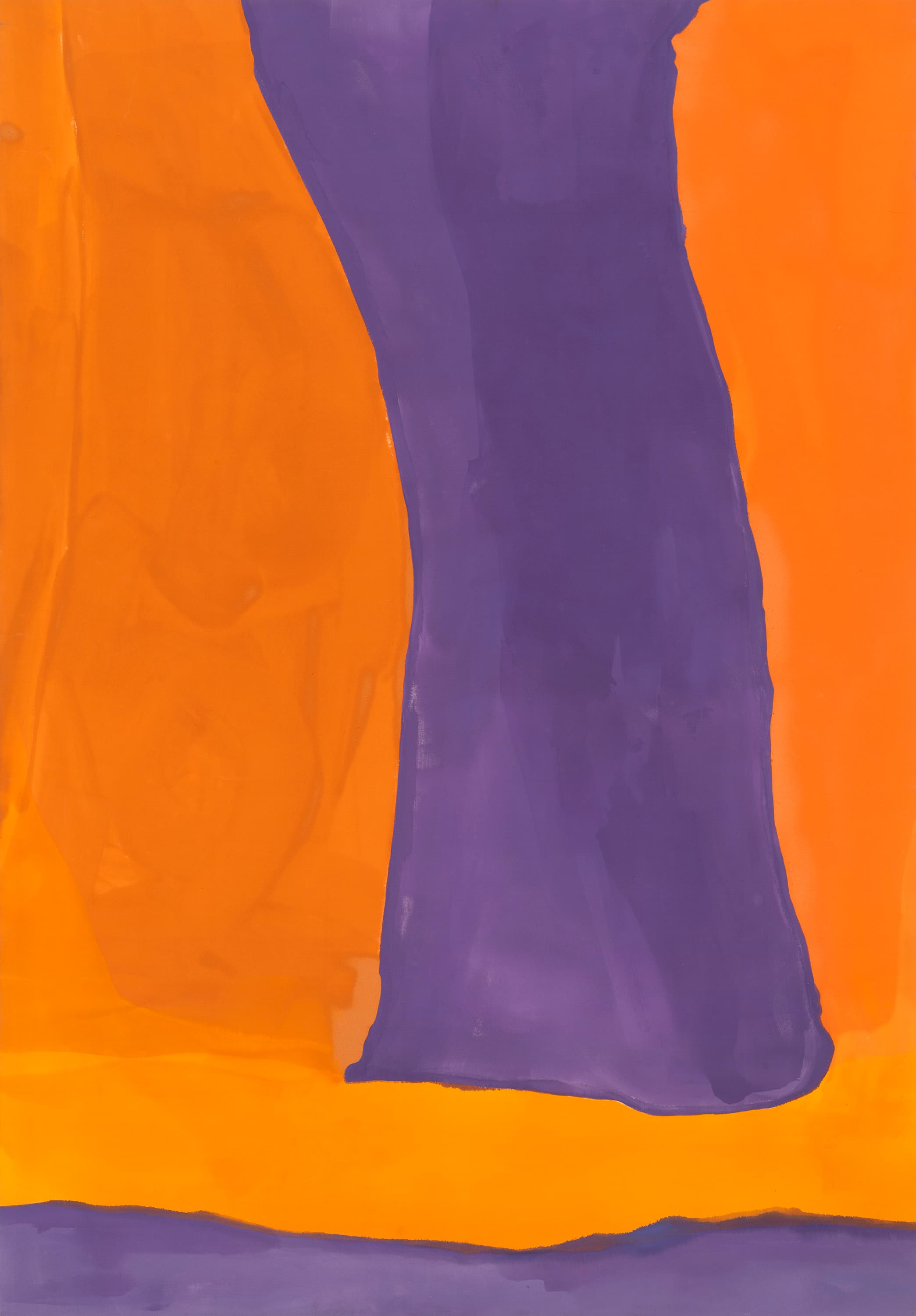
Helen Frankenthaler, Gamut, 1968. Acrylic on canvas, 134 × 93 inches. © 2026 Helen Frankenthaler Foundation, Inc./Artists Rights Society (ARS), New York. Courtesy Gagosian. Photo: Rob McKeever.
Word count: 711
Paragraphs: 6
Gagosian
April 30–July 2, 2026
New York
Standing among the soaring paintings by Helen Frankenthaler on view at Gagosian puts one in the position of a Lilliputian among titans. Aside from two works made in the early 1960s that provide an originating reference point, Frankenthaler made the other paintings in this imposing and impressive show between 1968 and ’92, a quarter century that saw the artist at the height of her powers. From the outset of her career in 1950, Frankenthaler knew innately that her painterly skill was deft, innovative, and irrefutable. She also knew she’d need moxie, perspicacity, and fortitude to gain traction in the renegade New York scene of the fifties and sixties, an accretion of self-assurance gained through the tough trial-and-error of making her way through what was indisputably a man’s world. At Gagosian, we witness an artist with full command of, and confidence in her practice.
Alassio (1960) and Provincetown I (1961) open the exhibition by grounding the viewer in Frankenthaler’s initial innovation, her soak-stain method of applying paint. She applied oil paints thinned by turpentine directly to unprimed surfaces so that the paint absorbed into the weave of her canvas, diluting lines and forms to dreamy, sometimes hallucinatory, effect. This pair hangs alongside Moontide and Gamut, works from the later end of the decade (both 1968), establishing a relationship that reveals how radically Frankenthaler’s work morphed in just a few years. Though Alassio and Provincetown I are by no means modest canvases, the later two are manifestly oversized in scale, and Gamut is a painting whose immensity you feel in your body. They are rendered in acrylic rather than oil (as are the rest of the exhibition’s offerings), which intrinsically alters the character of the work. The strata of color across the horizontally situated Moontide bleeds from a hazy blue into layers of pink-based hues—salmon, puce, and terra cotta—that put one in mind of a seascape, though there are no marks that ever define it as such. In Gamut, Frankenthaler restricted herself to a palette of saturated plum and disco gold, which cascade from the heights of the eleven-foot vertical in swashbuckling bands. Not only do these bold works make the case for Frankenthaler as an artist emergent from the Color Field painters, but a pioneer among them.

Helen Frankenthaler, Alassio, 1960. Oil on linen, 85 ¼ × 131 inches. © 2026 Helen Frankenthaler Foundation, Inc./Artists Rights Society (ARS), New York. Courtesy Gagosian. Photo: Rob McKeever.
Art historian Ara Merjian observes in his essay in the exhibition’s catalogue that “even the metaphoric language we use vis-à-vis her paintings entails a hybridity of scales and spaces—big and small, inner and exterior, depth and surface—that refuses fixity even as the paint has dried.” This dexterity in balancing scale and color, another of Frankenthaler’s achievements, has the effect of creating immersive atmospheres while remaining true to abstraction. Proceeding through the show substantiates this; it’s easy to become engrossed in a work like Ocean Drive West #1 (1974), where a surface of marine blue is interrupted only by sparing stripes of a lighter shade, a few of them edged with tantalizing, tawny hints of color, as if another universe lay just beyond this expanse. Or try to resist being swept up by Green Thought in a Green Shade (1981), where a verdant surface is conspicuously pocked by marked blotches of paint applied in a way that conjures dry leaves scattering to the wind. Frankenthaler was shrewd in knowing when to allow her paint to chance, and when to make the decisive gesture. A work like Eastern Light (1982), where intermingling misty pinks and greys are somehow united by a few purposeful brushstrokes in black and white, crystallizes this push-and-pull of possibility. Frankenthaler’s paintings seem to be worldbuilding, but of a deeply interior variety.

Installation view: Helen Frankenthaler: The Moment and the Distance, Gagosian, New York, 2026. © 2026 Helen Frankenthaler Foundation, Inc./Artists Rights Society (ARS), New York. Courtesy Gagosian. Photo: Maris Hutchinson.
Perhaps nowhere is this plainer than in the moody Borrowed Dream (1992), the latest work in the show. Here, Frankenthaler has applied a swathe of creamy blue to the lefthand side of the canvas, ensconcing it with thick ridges of dark paint that rise palpably from the surface. These corrugated, angry reds and murky browns are at once in contest with the more serene blue but also somehow in unity with it. The eye combs the plane in reverie, captivated by the intrigue produced with only color and gesture.
Jessica Holmes is a New York-based writer and critic. She is an Art Editor and ArTonic Editor for the Brooklyn Rail.