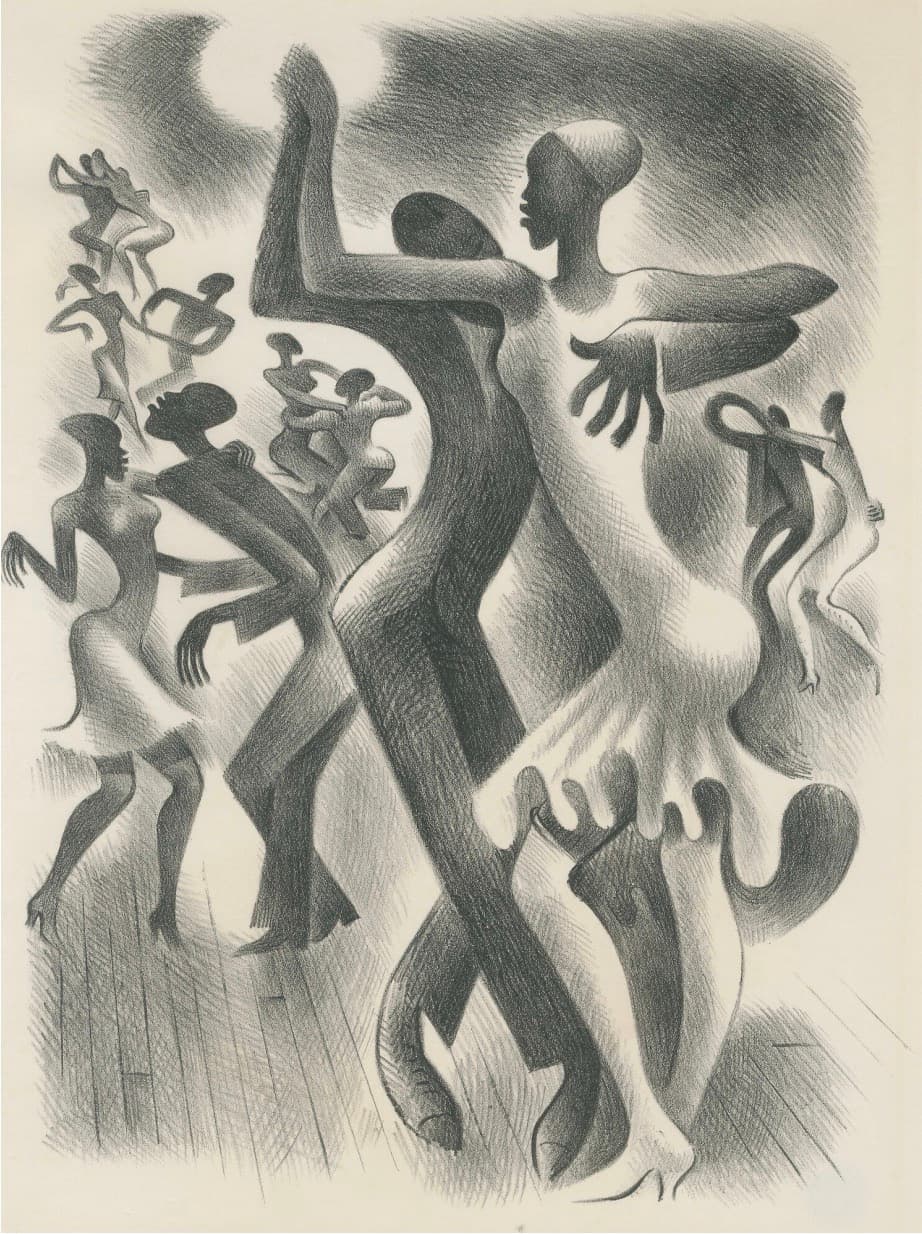
Miguel Covarrubias, The Lindy Hop, 1936. Lithograph, 13 ½ × 10 ¼ inches. © Miguel Covarrubias. Courtesy the artist and Kurimanzutto Mexico City / New York.
Word count: 927
Paragraphs: 7
Kurimanzutto
May 9–June 13, 2026
New York
Contracorrientes [Countercurrents] brings together two Mexican artists of different generations who might easily be discounted as mere illustrators, but are revealed here in a common and compelling exploration of cultural indebtedness. The title of this entrancing exhibition, curated by Emily King, is something of a misnomer. The work of Miguel Covarrubias (aka El Chamaco—“The Kid”— b. 1904, d. 1957) and Jerónimo López Ramírez (aka Dr. Lakra, b. 1972) does not run against the main current of modern Mexican art but rides it, celebrates it, and globalizes it. That current, which was modified and sometimes obscured by European abstraction, could be termed adopted indigeneity. A friend of Diego Rivera, Frida Kahlo, and José Clemente Orozco, Covarrubias especially deepened and widened the current. In two books The Eagle, the Jaguar, and the Serpent and Indian Art of Mexico & Central America, published just before his death, Covarrubias presented his own illustrations of pre-Columbian imagery, and his theories about the relations of its various epochs and cultures. It would be credit enough that seventy years after their publication they are still considered foundational by scholars, even though Covarrubias was not himself a professional academic. But the books did more than that. In them, an artist used his talent to recreate ancient imagery, taking it out of the archaeology textbooks and into the realm of aesthetic appreciation. Unlike Pablo Picasso and European appropriators of “the primitive,” Covarrubias never let go of the content of those symbols, even as he made a case for their artistic relevance.

Installation view: Dr. Lakra &, Miguel Covarrubias: Contracorrientes, Kurimanzutto, New York, 2026. Courtesy Kurimanzutto Mexico City / New York. Photo: Zach Hyman.
As far as I could tell, the exhibition contained only one of those illustrations, but a few of the drawings related to ancient motifs and revealed the thread that connects his work more broadly. In particular, a small drawing of what looks like a jaguar (ca. 1930s), heralded a considerable group of portraits that Covarrubias made in Mexico and the South Pacific. The feline and the portraits display a stunning economy and mobility of line. These are attributes of caricature, and Covarrubias was such a good caricaturist that he often drew for Vanity Fair and made his living as a commercial illustrator. Caricature, however, tends toward satire and exaggeration. Like the animal image, the Indigenous portraits in the exhibition are more deliberate attempts to capture the essence of a subject in a few formal gestures. The jaguar and the people are linked through this formal sensibility. That is, Covarrubias was attracted to the people that he drew less as recognizable individuals and more as representatives of cultures, in which the forms of animals and people had meaning, and “tradition” meant connecting different orders of being through representation. This allowed him to be equally engaged with the cultures of Bali and of Harlem during its Renaissance period of the 1920s and ’30s (he moved to New York in 1923). The figures he drew in all of these cases represented and embodied legacies that were deeper and longer than most found in modern life.
This made him more than a tourist wherever he went, and the wings of the exhibition are hinged by reproductions of several hand-drawn maps. Four are by Covarrubias and depict the artforms and Indigenous peoples of the Pacific Ocean. The other is by Dr. Lakra, Los mas corrientes del Pacifico (2024). Through its examples of sculpture and somatic display it links the affinities that were held across the Pacific. Raised in an artistic family, Dr. Lakra clearly pays homage to Covarrubias in his map, but more than that, his energetic drawings often seem to channel and stylistically amplify the “currents” of the older artist. His work is more extreme and sexually explicit than Convarrubias’s, but in his travels, especially in the Philippines, Dr. Lakra, like his precursor, sought practices that embody the complex and shifting significance of enduring traditions, the most notable being tattooing.

Dr. Lakra, Los más corrientes del Pacífico, 2024. Ink, acrylic, and shellac on linen canvas, four parts, 157 ½ × 157 ½ inches. © Dr. Lakra. Courtesy the artist and Kurimanzutto Mexico City / New York.
Both Dr. Lakra and Covarrubias are fascinated by the physical appearance of Indigenous people, the sense of human relation and difference. They are especially engaged by the elaborate patterning of body decoration and the ways it can transport viewers through the rendering of the sheer physical energy in motion. Covarrubias’s 1936 image of Lindy Hopping dancers in Harlem defines it as an American archetype, and Dr. Lakra’s over the top riff on Buddhist art, Nagai inkei [long penis] (2017), shows a scowling monk menaced by a flaming serpent. The propensity for exoticism is undeniable with both artists, yet neither Dr. Lakra nor Covarrubias sees tradition as static and precious or the currents as congealed. The point for both is to demonstrate their formal relevance and sociocultural persistence as they find it; not to reclaim or resuscitate but to engage, revise, and carry forward. In Dr. Lakra’s drawings, inspired by his comprehensive study of tattooing, we find the idiosyncrasies of personal mythology combined with formal motifs from South Asian and Japanese Buddhist art, manga, Māori body decoration and more. An extended suite of wild, symbolic narratives reference Nigerian Amos Tutuola’s 1954 novel My Life in the Bush of Ghosts.
However, you can’t step into the same corriente twice. As culture becomes more globalized and artists become more sensitive to the power dynamics that sanction borrowing and appropriation, there can be no naïve embrace of the serpent. Artists like Dr. Lakra and Miguel Covarrubias are acutely aware that authentic differences need not blind us to deeper connections among cultures. Form is the royal road to that understanding, and traveling it can foster respect and nourish imagination.
Lyle Rexer is the author of many books, including How to Look at Outsider Art (2005), The Edge of Vision: The Rise of Abstraction in Photography (2009) and The Critical Eye: 15 Pictures to Understand Photography (2019). The Book of Crow, his first work of fiction, parts of which first appeared in the Brooklyn Rail, has recently been published by Spuyten Duyvil Press.