Word count: 2692
Paragraphs: 55
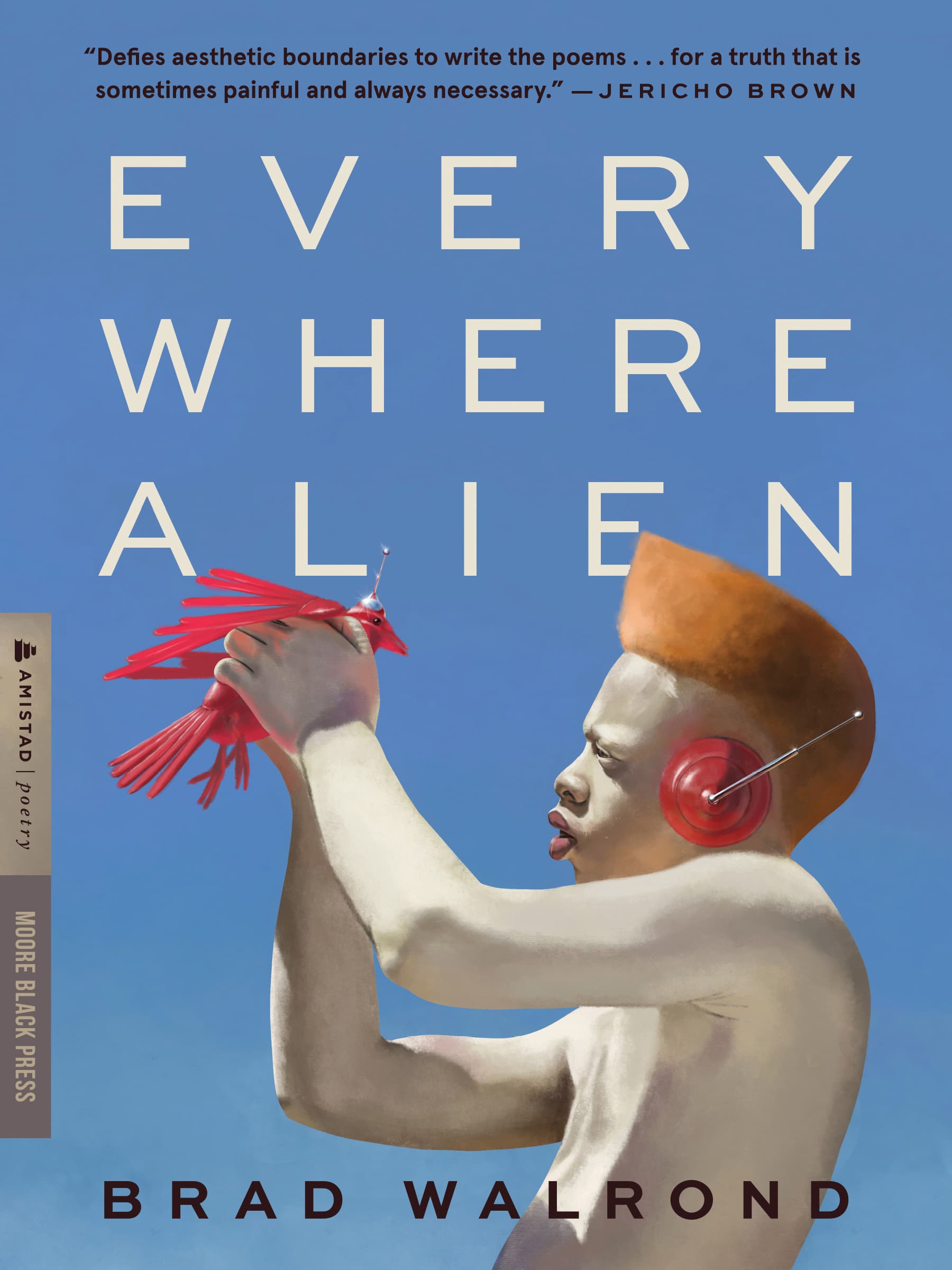
Every Where Alien
Amistad, 2024
Poet Brad Walrond is the keeper of New York collectives and coalitions. His poetry—both spoken and on the page—is an elegant archive of the city’s Neo-Soul arts movements, AIDS organization, cruising network, radical Black activism, Ball Culture, and more. With bombastic aesthetics, he helps audiences remember a time in our city when a lack of varnish meant depth, being an artist meant a chance to mobilize, and digging house music meant having a five-star appetite for freedom.
Although his debut collection, Walrond’s Every Where Alien is a lifelong retrospective that reads like a things-bequeathed-list from seasoned beneficiary to benefactor—all things ancient and innovative, like transtemporal war cries from liminal spaces we loved or don’t yet know we should. His thesis is clear from the book’s title alone, but his TOC also smacks of then, here, now, later, concrete, jungles, tribal DJ sets, and diasporic UFOs. With a section entitled, “Gotham: Where the Kids Raise Themselves,” and poems like, “Vintage Future,” “Under Construction: A Duplex,” and “Barclays Center: The Day Before The Day After Tomorrow,” he confronts our poor, ever-fidgeting New York with the many treasured selves it’s shed over the years. And poems like, “Score: A Sonnet Turnt Out on the Low” confront you with your own transgressions, or unfortunate lack thereof.
My friend Brad Walrond recently came over to my apartment, which he characteristically/paradoxically referred to as “Old New York, but new,” where we talked about his work, his book’s specific yet elusive title, house music as transcendental ritual, and the ongoing and pivotal journey of finding and redefining our Blackness.
Ricky Tucker (Rail): The cover is beautiful. I mean, it’s literally Afrofuturism.
Brad Walrond: Right? What could be more “every where alien”?
Rail: That’s a good place to start—what does the book title mean?
Walrond: Okay, I’m going to give you the longest short answer. Every Where Alien to me is like—I can never remember the name of it, but you know, the Transformers? They have this stuff that they always need to get them going—
Rail: Oh, you’re in the right place for that—energon cubes!
Walrond: Yes, yes! It’s like that. I’ve been on this lifelong journey to find my energon, my spark, my power source, and now I’m trying to discover exactly what it is. That’s what Every Where Alien is for me as a concept.
Rail: And what’s behind splitting the word “everywhere”?
Walrond: It literally and literarily functions as that in-between space. It’s liminal.
Rail: When I think of it, along with the Afrofuturism of the book’s cover, the title functions like a racial and temporal chasm. Reading it made me take pause. It’s only three words, but it smacks of infinity. At one point, I thought to myself, the book could easily be titled Every Black Everywhere, All at Once.
Walrond: Haha, yes! It’s many things. A description. On the high-meta level, it’s me contending with Blackness, queerness, and white supremacy. And so I say this: like energon, I understand what Blackness is because I’m Black—but I’ve come into it. It’s a journey. And that journey is so powerful and transformative, and as we all know, there are Black people among us who have not been on that journey yet. And there’s no arrival—but you have to at least get on the train.
You’re ultimately confronted with the external superstructure and the parts of you you never knew. All that grief and toiling that goes into really becoming who you are and understanding it. Every human being has the prospect of being as utterly dimensional as any other, right? But what does that mean in respect to white supremacy as a phenomenon-product of our collective consciousness? What is it about us as a species that we create this idea we all have to contend with, no matter where we go—it’s interrupting us. It literally disassociates us civilizationally from who we are. Yet, in Blackness, is where all humanity woke up.
And it’s not just about color. It’s anyone’s inheritance to the extent that they’re willing to go on that journey.
Rail: And I’ve found, in the broader capitalist system, whiteness and othering are directly linked to the false specter of deficit. It’s what we don’t have and what you aren’t meant to have.
Walrond: Right. That’s beautiful. And white supremacy is not theoretical; yet, we’re asked to deny it. And even in our best liberal intentions, it’s universally found. It is excruciating. how it anchors to everything in your past and you still get to be so surprised by the inevitability of it popping up.
Rail: That part. You get exhausted from being tired of it—expecting the best and getting the worst.
Walrond: Yes. So, Every Where Alien is that tension. I have come to know and immerse myself in it through the virtue of my lived life and my creative practice. How does everyone claim their inheritance? I think Black queer gayness is ahead of the game with that. We got a head start in these liminal spaces.
Rail: The idea of inheritance automatically brings up the dichotomies of history and future, and based on what I know of your work and read in your book, time is central. Many of your poems are a conversation with a point in time, almost like they’re characters instead of theses. What’s your relationship with time, and what eras do you draw most from in your work?
Walrond: The most compressed way for me to answer that question is through my work with HIV/AIDS. I’m Black, I’m queer, and I grew up in the church. That’s its own very intense journey.
Rail: Which church did you grow up going to in New York City?
Walrond: Hempstead Assembly of God on Long Island. I went to Bible school, and then I was a youth pastor at a Baptist church in East New York, Brooklyn. Internally, I knew I liked guys and girls, but I was ensconced in my faith. Plus, I grew up in a Caribbean home—my parents are from Barbados—so, I contended with all of those tensions. I was a Black queer person in the church, wrestling with the notion of spirituality and sexuality. Then enters HIV. Whether we’re infected or not, since the 1980s, we’ve been living with this imminent threat to our mortality.
I’m walking on Christopher Street one day, and I see a friend of mine that I know through church, and he’s handing out condoms and stuff, and he’s like, “Are you interested in work?” That’s how I got into HIV prevention as assistant coordinator for the Minority Task Force on AIDS. I started some of the first group interventions targeting HIV negative men in the country. This had to be 1994 or 1995.
Then I was part of the New Black Arts Movement. I made a splash and a name for myself in that context. I was still in my in-between place with figuring out my sexuality, and in the course of my creative career jumping off, I discovered the Sunday Tea Party, which was an open mic that happened every Sunday at Frank’s Lounge in Fort Green, Brooklyn. After that, it was a house party. In that space I learned my voice, was exposed to house music, and the notion that the erotic and the spiritual can push up against you, up and inside your body. That’s how I would describe house music.
Rail: I’m glad that you mentioned house music, because there are odes to it throughout your book. I Get Lifted Oh? As soon as I read the table of contents, I was like, okay. That’s one of my favorite songs, that mix of gospel and house. Can you talk about the role house music plays in your writing?
Walrond: You know, house is a commitment to entering the moment and letting the music and the experience and the interaction take you wherever it’s gonna take you. Experiencing a discography in these clubs and underground spaces back in the 1990s was like culture being thrust inside of you. I live with that, and I’m always discovering the elements that are in there. The song, “The World Is a Ghetto” by War starts the poem “Swag on Fleek.” Of course, that song lives out in the world, but every time I encountered it in underground spaces, it lived to me as the sound of Black manhood. And that’s the texture the poem ends up taking up. It’s using the titles from the actual album interwoven as part of the work, talking about a boy, a man probably, from LA, who comes to New York and finds his own experience with desire. So, there are these ways songs come alive concretely. They’re so real, even though they’re so aural and ethereal. I don’t know how people in other contexts, back then or today, would process that War song.
Rail: I know what you mean. Music can transcend time. At the moment, I’m writing this book about queer representation on 1980s and 1990s television, across all media, really. When I was researching the topic for the book proposal, the question, “Who is this book for?” came up. The publishers always want to hear, “Only these two people, plus everybody.” So, I searched the web for 1980s and 1990s nostalgia, and it came back to me that 1980s and 1990s nostalgia is up 40 percent amongst Gen Xers and millennials–naturally—but it’s also up more than 40 percent for Gen Zers, which makes no sense because they weren’t even alive then. Yet, they have nostalgia for a thing that existed before they were born!
I’ve been calling it “osmostalgia”—nostalgia through osmosis. I wasn’t around when Pam Grier was in Coffy, but that album, the Roy Ayers of it all, sends me. I mean, context does matter too, but—
Walrond: Often it’s what folks heard their parents playing. It’s in the bedrock, whether they realize it or not. I released my album Alien Day along with the book, and it has a lot of spoken word. I work with someone who’s maybe twenty six or twenty seven, and he’s taken a liking to my album. Personally, I received no higher compliment with respect to the musical work.
Rail: I get that, because it’s sentiment-free, raw reception.
Walrond: Yes.
Rail: In the book, you write about Nina Simone as an extraterrestrial.
Walrond: She is! She’s above, beneath, and beyond—an absolute musical prodigy. You know, I’m sure her musical influences are broad, but her initial career aspirations were in classical music. So, her training is in there. When you hear early Nina Simone, sometimes you’re hearing Dionne Warwick.
Rail: Or Roberta Flack.
Walrond: All three of them, classically trained. You have Ms. Simone, this prodigy, and her career pops off, and at some point, the Black power/civil rights movement happens, and she answers the call to have her voice be immersed in that work. It took real courage. As you see her work progress, she loses some of the higher timbers of her voice. She was disrupting space and time with her work. I often experience her energy as transgender, like it’s folding in on its own multiplicity. The audacity. The pure feminism. The freedom to be who she was. To know who you are and to demand that the world pay respect to it. She was before her time.
Rail: That brings to mind James Baldwin, who occupies a similar space, where his work precedes him and future culture. Cut to last year, when you and I organized a literary salon celebrating Baldwin’s centennial for NYC Black Pride. Your work is often compared to Baldwin’s—what does that parallel mean to you?
Walrond: It’s everything. These people are disruptors, custodians of a portal, engaging with all of its mystery, and they’re keeping that portal open for us to enter. It’s a deep commitment. It’s everywhere in their work. And then to think of Baldwin and what he was writing, gay books in the 1950s? Yet, somehow it happened.
I would love to interview two hundred men who identify as straight and ask them, “How do you experience Baldwin’s work?” The Eros, the vulnerability, the humanity, the exploration of what it means, what your manhood means from the inside and out. Like in Giovanni’s Room, the writing is so honest, so human. It’s so rooted in truth, that straight or not, they have to be profoundly and erotically moved as I am. To read it means you will have found yourself in that bedroom on some level. To even just imagine a room with two hundred men who identified as straight being able to be that free and honest about their desire—
Rail: Good luck with that.
Walrond: Ha!
Rail: You said you had a sexual awakening in New York’s poetry scene. What was your work like before that? How has it evolved?
Walrond: I first started writing in church. The minister of music at my church was Harry Belafonte’s musical director. He and I would have conversations ad infinitum about art, about ministry. At some point, the pastor had this vision for community-facing events, which basically became kind of canonized as these multi-disciplinary arts celebrations, and Belafonte was the keynote speaker of the first one. The first poem I wrote was for that. We called it “The Epic” at the time, and it does some of the work that the poem "Time Travel" does in this collection, chronicling the middle passage, the culture we carried with us from Africa, and then the culture we birthed into the world through our music.
One could say that was the quintessential architecture of my work at that time. Around then, I didn’t want to be known for a ghettoized version of life. I wanted my art to be regarded for what it was. So, I was very intentional in that space about what I was writing about.
I was dealing with identity, with blackness, but not dealing with queerness. I was dating a woman at that time, and I was increasingly like, “Okay, this gayness isn’t praying away.”
Rail: Haha! I bet not.
Walrond: Then, I discovered an arts community that witnessed and affirmed my voice, the creative person within. I was immersed in this setting where you see all of your people, they’re fucking, they’re falling in love—you know, all the things. It was an internal tipping point for me.
When I came back to my work this time for the book, I said, “I’m not going to censor myself.” Wherever my pen goes, I’m going to go.
Rail: Sex punches through every poem here. Who do you imagine is receiving your work?
Walrond: Unequivocally, I’m writing to queer Black people. The book contends with the boundlessness of queerness and the boundlessness of Blackness. And I’m sure you’ve had this experience many times. It’s in that moment that you, the reader, find an instantaneous witness, the opening of portals.
Rail: I’ve definitely experienced that opening in your work. Another key signature of Blackness is being able to laugh in the face of death, and that theme is throughout your work. Particularly, the lines, “How much longer must we pretend / They taught us how to recycle?,” from the poem “The Untitled, The Unnamed, & The Unnamable,” made me laugh out loud. You balance scathing indictment and absurdity so well.
Walrond: Thank you. I like to write work that you have to touch when you’re crying, and touch when you’re laughing. You have to touch it when you’re aroused. I think it speaks to my intentionality around being extraordinarily open.
A lot of my work stems from a state of emergency. That volleying and disappointment of moments like the Michael Brown verdict. You know what I mean? The breakneck speed at which you have to pronounce the magnitude of it all. It’s an intellectual ideation that comes from folks faced with imminent death. Those quick pivots between humor and magnitude are all part of the Black radical tradition and the Black gay aesthetic. It’s profane—and it’s spiritual.
Ricky Tucker is a passionate literary force and a dedicated scholar of the creative arts. With more than a decade of experience in literature, editorial, education, and cultural criticism, his writing, teaching, and creative direction have amplified and uplifted the voices and narratives of myriad communities around the globe. Tucker has a voracious curiosity for culture and media and mines through it with forensic precision. His musings on pop culture have been featured in prestigious publications and outlets, such as the Paris Review, VOGUE, TIME, New York Magazine, I-D, Brooklyn Rail, NPR, and All of It with Alison Stewart, among others. Tucker is the host and executive producer of Outsider In, a podcast featuring outliers creating the culture. His L.A. Times bestselling debut, And the Category Is... Inside New York's Vogue, House, and Ballroom Community, reveals the history and relevance of the world's largest art collective and its enduring influence across time.