Word count: 2896
Paragraphs: 42
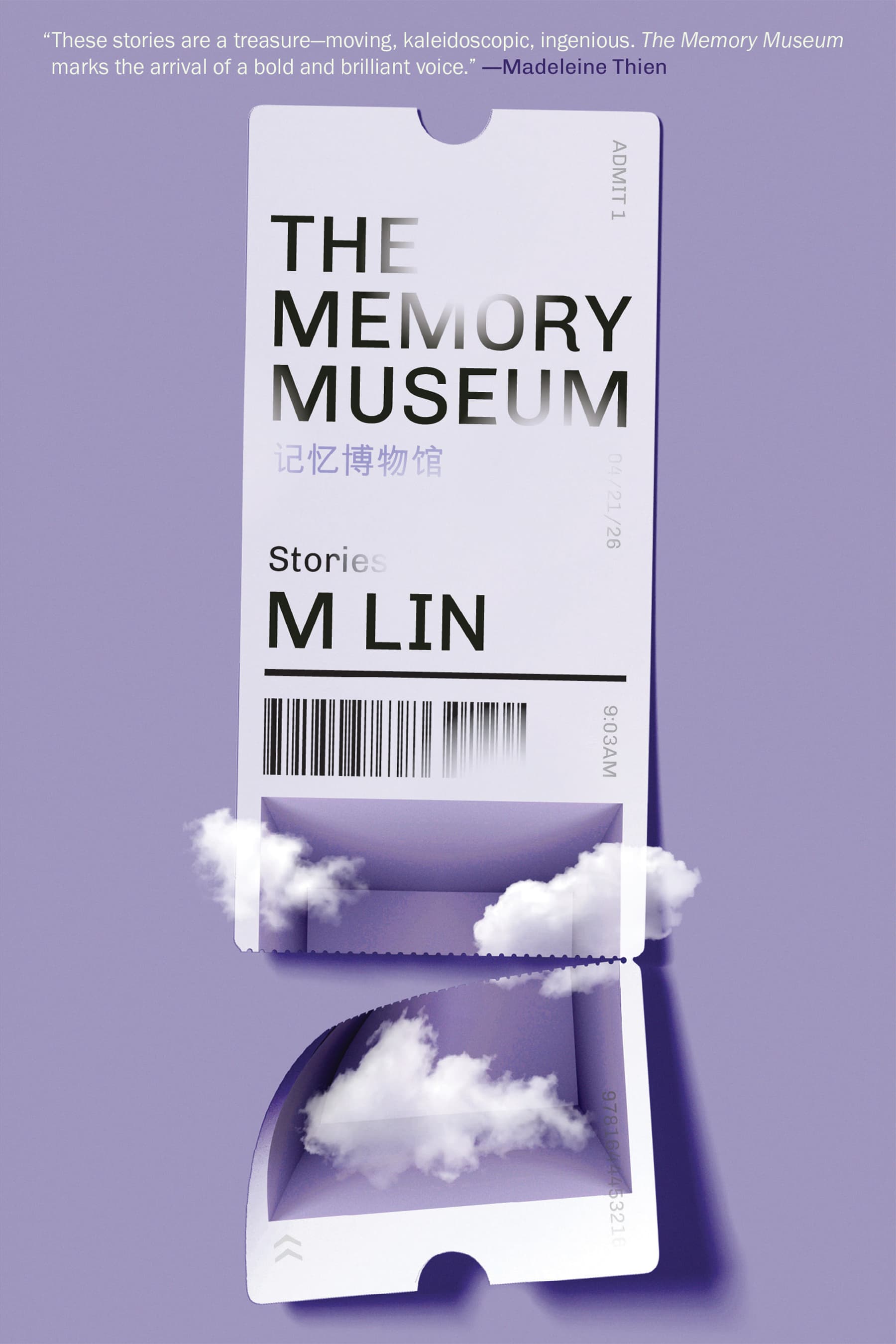
The Memory Museum
Graywolf, 2026
M Lin’s intriguing debut short story collection with Graywolf centers on the lives of mainland Chinese people. The Memory Museum “is not an immigrant book, but an emigrant and diaspora book,” she explained in a recent AWP panel. That distinction is important because of the looming role the Chinese state plays in the lives of these characters, even when they put geographic and temporal distance from their homeland. Yet as political as these narratives are, Lin never loses sight of the personal, exposing faultlines as these characters yearn for the past, the future, and each other.
I met Lin several years ago, when she was enrolled in the MFA program at Brooklyn College. Even then, she’d seemed enviably fully formed as a writer. During our conversation over Zoom, we discussed what the west misunderstands about Chinese people, the influence of film on her work, and what she’s working on next.
James Yu (Rail): How did you go about sequencing and selecting stories for The Memory Museum? One thing I noticed was that the first and final stories present competing visions for the future.
M Lin: Sequencing and selecting were very easy. The stories in the collection were basically all the short stories I had at the time. The manuscript we submitted to editors actually had ten stories and one didn’t make it into the final book.
The sequencing is mostly chronological to when I wrote them. The first story, “Scenes from Childhood” is a rewrite of the first short story I ever wrote. Even though the current version was written after “Magic, or Something Less Assuring,” in my mind, it remains the first. “The Memory Museum” was the last story I wrote for the collection.
The futuristic setting of the first story came from wanting a really old voice and narrative distance. To tell stories of my childhood in the mid-to-late nineties with an “old” voice, the story had to be set in the future. So in a sense I backed my way into this very dystopian, climate-focused vision for that narrator looking back.
Rail: Is there also a political dimension to that?
Lin: Yes. As a Chinese person, she is no longer able to contact her family because of a world war after which China was cut off from the rest of the world. She also had to leave in the first place because she was a journalist. It was not difficult to imagine that world when I started writing the story in 2020 and 2021, when China closed its borders completely, or even if you read the tea leaves of where China and the world is today. Narratively, it was powerful for her to be alive, alone in such a world, looking back at things she once thought were difficult that turned out to be sweet.
And I agree with you on the competing vision for the future. If the first story is dystopian, the last story is utopian. That was intentional. I arrived at “The Memory Museum” after writing the protest story, which had a very dark vision of where China could go. I was shaken by the darkness of that story and wanted to take myself to the other side, I think. So in contrast, I wanted to write about joy, about a future I want to live in instead of a future that I’m scared of. To work toward that utopian future, I had to first be able to imagine it.
I visited a friend’s class recently where the students read “The Memory Museum” and interviewed me about the story. One question asked how I came up with the concept of the museum itself. And I could not remember at all! I only remember my intention—I saw an art exhibition at the Museum of Fine Arts in Boston about an enslaved Black man named David Drake who was a potter and a poet. His ceramics were these huge jars on which he also inscribed words of his own, some light and some profound. You could see the joy he took in making them despite his life being unimaginably difficult. There was a quote on the wall by Glenn Ligon, and I’m paraphrasing: Dave’s work is about a kind of joy which ultimately is about a kind of resistance. I remember that emotional inspiration for the “The Memory Museum,” but I don’t remember how the specific concept of the museum came to be. My friend ‘Pemi said that I’ve traded my own memory for the story, and I liked that.
Rail: One thing I liked is that it introduces the idea of subjectivity. It’s interesting whenever multiple points of view appear within your stories. In “Magic,” we have Ting and Sibo, and they have competing visions of how they should relate to each other and their government.
Lin: Quite a few of these stories have multiple points of view. We are all in our own “box of perception,” which I think I first read in an article about the founder of Catapult. People made fun of how self-evident this idea is, but there’s truth to it, no? We’re trapped in our own perspectives. But not in fiction. I’m interested in the discrepancies and the spaces between characters’ perspectives. How we reconcile those differences is how we connect to each other. It’s also interesting to think about the difference between what characters think and what they actually say and do to each other. There is always so much tension there. We also constantly wrestle with contradictions within us and I want fiction to hold space for these contradictions.
Rail: I was struck by the idea that Sibo is actually a very “sunny” person in Chinese, but because of his lack of English fluency, he doesn’t come across differently in a foreign context. I’ve thought about how that can play into perceptions about one’s culture, or a foreign culture. In some ways, Ting is very international; she has a capacity to be more objective or to weigh things more evenly than Sibo, facilitated by her English language skill. I assume that creates faultlines in how they differ in their perceptions of the pandemic and the relative merits of how China or the United States handled it.
How are you feeling as the author there? I don’t think authors need to be neutral, but I think there’s a nuanced interplay between those perspectives, and I liked that it wasn’t pushing the gas on one side so much.
Lin: I’m wondering if there were hints that you felt the author is on one side or another?
Rail: I think it’s hard to detach myself because I’m reading this as a collection and I know you and your politics. But I thought within the story it was handled quite well. It makes you think about the spectrum of perspectives that exist within the Chinese émigré community. There’s no possible way that any one author can represent the full spectrum of views, nor should they even try to, but this ties nicely to my question around the audience and calibrating the level of detail that you’re giving your readership, because this is being published in English.
Lin: When I started writing, I felt it’s a reader’s responsibility to look up what they don’t know about a different identity, culture, or language. Because I grew up in China and read a lot of translated literature, I always felt like it was my responsibility to do that as a reader. I mostly just followed the characters in the story and didn’t think about the audience when I was writing.
The audience I think about are the people who are in the story—people who I know in real life who are like the characters. If they read this story, are they going to think that I am writing authentically? I feel more responsible to my “ideal readers” than having the burden to explain or present everything in a certain way for a general readership.
Rail: In the editing process, was there any pushback on that? Was there any “Hey, you should do this or that”?
Lin: I don’t think that’s ever happened in my editing experience. I have two editors: one is a white American man, and one is a Chinese American woman. I think that’s very much to the credit of these editors and Graywolf’s larger vision for literature.
Rail: What is mainstream media misunderstanding about the lives of people? I was struck by how political the stories were. There’s so much negativity around China and Chinese culture, but there are people like Sibo—as many dissidents as there are, there are also people who are just doing well, enjoying Shanghai, and living their lives. Everything works; the transportation is great. It’s not your responsibility to represent the full spectrum, but it’s an interesting contrast.
Lin: My intention was very simple: Chinese people are just people. Even though they speak a different language and live in a different political system, they are falling in love, dealing with a divorce, and have polarized political views like people in the US do. We live in a very polarized time. And there are women who are thinking about motherhood, facing the death of themselves and their family—these are universal things that I don’t see in the news about China.
My hope is that the general English readership, whatever that means, would see these characters as people and these stories as human stories, as they should. But at the same time, the characters are dealing with very Chinese things, too—for example, the level of censorship the filmmaker has to navigate in “Tough Egg,” which artists in only a few countries, such as Russia or Iran, have to deal with, though it’s spreading for sure. So these stories are both universal and particular, and I’m looking forward to how readers will respond or relate to them. The other day an interviewer told me that she, as a Jewish American woman, related to the story “Lucy” a lot because she is also an only child. That was unexpected, for her and for me.
Rail: In your New York Times op-ed, you mentioned how the screenplay you’d written about unwed women freezing their eggs wouldn’t pass Chinese state sensors. Did this script form the basis of “Tough Egg”?
Lin: The only thing carried over from that experience is that the script I had to abandon is also called “Tough Egg,” which was an egg story, too, as you know.
But that original screenplay was shot down by producers who said it would not be able to pass the censors because it challenged a national policy. It was actually done in a passive aggressive way. Chinese rarely speak in a straightforward manner. It’s a high-context culture. So the tactic the producer used was actually questioning my attention. She practically interrogated me, asking if I knew enough about the policy to write about it and if I understood why the government would make such a policy, and what would happen if the policy was changed. I was pretty triggered on the call, like I was a student in the principal’s office, and didn’t realize that she was trying to make me give up the idea myself. That’s how the system works: the writers self-censor first, then the producers censor the writers. Everybody is just trying to ensure the project can get made. The more they censor themselves to avoid any red flags, the more likely the actual censors would give it a pass. As a screenwriter, I was very frustrated and decided I was fed up with all of that.
Rail: I know you have a deep passion for films. Ryusuke Hamaguchi’s Happy Hour gets a mention in that story, which I absolutely love. That movie is so good; it has a novelistic sweep.
Lin: I want to rewatch that film actually, because I watched it in 2016 or 2017, and I didn’t start writing until the pandemic. I think I would have a new perspective now, especially about the author reading scene.
Rail: I’m curious what you think about some of the recent criticism circulating online talking about the questionable influence of television and films on fiction. What are your thoughts on that broadly speaking?
Lin: As someone who now writes fiction and still loves movies so much, I definitely think the strengths of fiction and film are very different. I probably would largely agree that it’s not necessarily a good thing—whatever they think the film’s influence is on literary writing.
But I think the best of both forms of art share a lot in common. Fiction is good at interiority, and the inner lives of characters are more difficult for film. But the best films do let us into the inner world of characters, even without narration or voiceover, whether through the performance, the soundtrack, the lighting, a line of dialogue, or a particular composition.
Fiction also moves in time much more nimbly. Film can get very awkward when you want to pass time. There’s the montage or you can do a blackout and a title card that says, “seven years later.” It feels unnatural, disruptive sometimes, and you also have to make it believable with makeup, costume, production design, the tone of the color to show that time has passed. But in fiction, if you say “seven years later,” it’s not awkward at all. The reader takes your word for it and the narrative can just go on.
Something else I learned from film is pacing, timing, silence, which is all somewhat related to editing. For example, when you enter a scene, it affects pacing. In film, we talk about entering a scene as late as possible and exit as early as possible. If you think about it, this is often done in films: for the first couple lines of a scene, the audience might have no idea what is going on, but they catch up with the characters very soon. And the scene ends before they reach their conclusion because once you cut to the next scene, you’d be able to deduce where the previous scene landed. In fiction, I also think about this kind of timing and the transition from one scene to the next—what’s the most effective way to pace a story. But fiction has so much more you can play with than the tangible world; mostly that is the material for film.
I don’t exactly understand what people mean by saying the writing is “cinematic.” Cinema has so many tools that fiction doesn’t. Like sound, which plays such a big part. And you can say writing has sight, but language, words on a page, doesn’t exactly function like an image of the real thing on a silver screen. We have a visceral response to cinema that is difficult to evoke with fiction.
Rail: I agree. When they say cinematic, it often seems to mean overly descriptive. There is a distinct gap between writing that is coming from a Chinese person in China versus a foreigner visiting Shanghai and having to describe all the “exotic” elements.
Lin: For the story “You Won’t Read This in the News,” I made a very cautious decision to write the opening like a film. In film, we see characters and we don’t know their names right away. The opening of the story is very slow; you see this bus and different passengers, and you don’t know who they are. And you don’t know the main characters’ names until they call each other by name. That’s usually not done in fiction. I enjoyed doing that because it served the story—how the two characters enter anonymously and then meet these other people as their worlds coalesce. And it’s okay if the reader’s patience feels tested or challenged.
Rail: What are you working on now?
Lin: I am working on what I hope to be my first novel. I’ve been thinking about how I started writing short stories—I got into an MFA and had nothing to workshop so I had to write new stuff for every deadline. Short stories felt natural to me because a film is roughly the scale of a short story—what can fit in a 90- to 120-minute film. A novel is more like a TV series, which I didn’t really study or write. It’s very different, and it’s something I’m not used to holding in my head, or even accepting that I’m not able to hold it all in my head.
Rail: Do you have an organization system that has helped?
Lin: No. My system so far has been starting over, and I’ve done that twice already. But I might have finally established enough perimeters for the narrative that I can write within. The couple of times I wrote before, the world of the novel felt too big and the possibilities too many, even though I thought I knew the character and roughly what the story was. Now I have narrowed down the time span and clarified the stakes for myself. I feel more solid on my feet. But no, there’s no system. Not yet, anyway. I’m trying to trust myself more and build confidence as I write. I hope it’ll work this time and I won’t have to start over again. But who knows?
James Yu is a writer based in Oakland, CA. His work can be found in Juked, Brooklyn Review, Mekong Review, and elsewhere.