Word count: 951
Paragraphs: 10
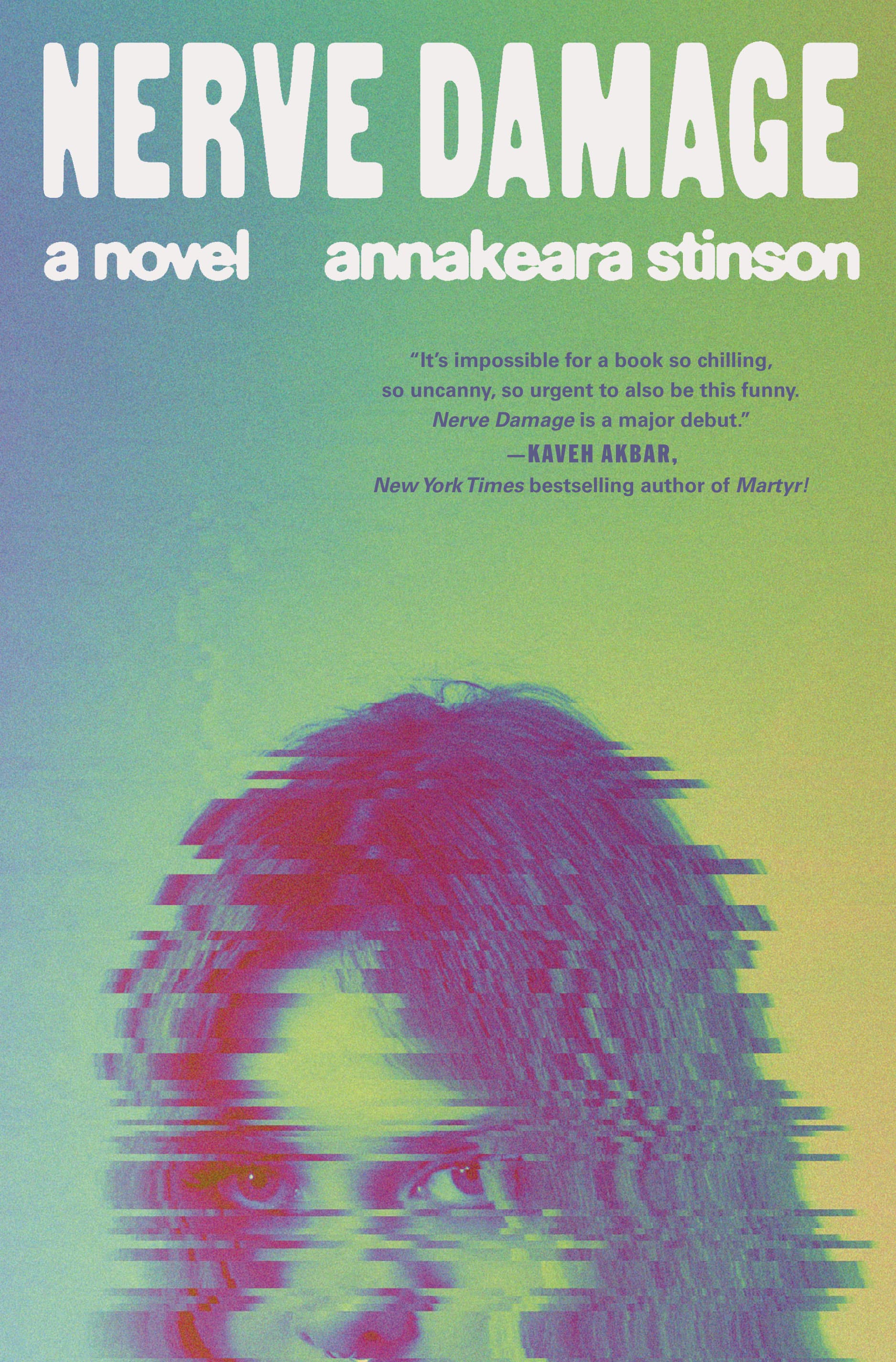
Nerve Damage
Knopf, 2026
Annakeara Stinson’s debut draws you in under the guise of a revenge novel, which grips the reader before revealing itself to be a sharply-written character study. Nerve Damage starts out sprinting, overflowing with humor and paranoia. Clarice, the protagonist, is endlessly self aware: “I go to therapy twice a week and have the sexual prowess of unleavened bread….” What she lacks in confidence, she makes up for in wit and neurotic thought patterns.
The prose is clever—there’s Clarice’s job with an adult toy company MaidenToyage and the text banter with her gay brother (military): “not a judgement but you sometimes cling to these sweaty Rasputin men.” The humor works as a sleight of hand, Clarice’s coping mechanism of choice, while Stinson is building the tension. Amidst comical observations, the reader is introduced to the looming specter that is P.T. He is Clarice’s ex-boyfriend, former stalker, and continual obsession, described as a “disturbed bookworm with a lethal ego.” Relatable ex-boyfriend territory…right?
Every chapter sinks the reader further into the paranoia and dread that P.T. may actually be in Los Angeles and resuming his stalking, but you never wonder how Clarice ended up with him in the first place. Clarice is extremely transparent about her attraction to the kind of person P.T. is, and knows her role in the situation is nuanced (i.e. reflective of her family trauma). She unpacks the nuance at length with a therapist, a clairvoyant-clairsentient named Valentini, and with several other characters that act as her support system. It always comes back to her father, a complex villain. Even more complicated are the brief, glimmering memories where Clarice actually felt happy with P.T. One such scene takes place in a field, searching for four-leaf clovers. But even the happy memory is soured by time, the sinister recall of P.T. saying “you can find anything if you really look for it,” paired with the intrusive thought that he intends to find her, and harm her.
The present action is set in LA, where Clarice’s East Hollywood apartment is the site of strange occurrences. The neighbors next door, who Clarice calls the “Screaming Birds,” are a force of foreboding seeping in through her walls. The man yells at the woman his intentions to harm her, a constant violence Clarice casually absorbs. The B-plot is all things P.T., from early days of dating to the court dates securing a restraining order against him. This backstory is heavy, and rich with character work. Clarice says, “The depression that followed that day in court was almost magnificent in its depth. It started to congeal my blood.” The sneaky C-plot is Clarice’s family trauma, mostly regarding her abusive father and her mother’s failings. These memories are supplied frequently, so the reader feels incredibly close to Clarice and her history.
In Nerve Damage, Stinson is saying a lot about what love is and what love isn’t. Clarice’s friendships model healthy attachment for her, and she admits “that’s more true love than some people ever get.” With her support system, Clarice survived the ordeal with P.T. that dominates the B-plot. She actually got out, which is saying something, but it’s never a clean break. Her fear is realistic: “Sure, there’s the idea he might crawl into my bedroom and slit me down the middle like a hunted duck, ripping out a still-beating heart. But many of my actual dead-of-sleep nightmares about P.T. are that we get back together and I have to explain this choice to my family and friends.”
The PTSD (P.T.—clever) is palpable, leaving the reader questioning Clarice’s judgment despite being on her side. Her phobia of men, stemming from her father, from her mother’s rapist, from all her step fathers and every creep on the street culminates in this “fear so deep it never leaves, only sleeps.” But when everyone in Clarice’s life asks her to stop searching for P.T., whether she saw him in the bar that night or not, she can’t help herself. Clarice says “I’m sick of slow-burn healing. I’m tired of feeling like I can’t rely on my interpretation of things … trauma can skew certain parts of our intuition.” The concept of an unreliable narrator is not new, but to so blatantly connect PTSD with this unreliability felt fresh and resonant in our culture. From Jeffrey Epstein to Sean ‘Diddy’ Combs to Donald Trump, the constant barrage of violence against girls and women is trauma, witnessed, seeping into our permeable minds.
But Nerve Damage isn’t just another revenge fantasy. It is the internal monologue of a character in a full-blown spiral, just out of reach of loved ones and reason. The external stakes are felt: threat of physical harm at the hands of an ex-boyfriend. However, as the stakes become more internal, swept up in the spiral, the tension on the surface of the narrative loosens, leaving the reader floating in backstory. When every strange occurrence is tidied up and the story begins to build toward a heartfelt conversation with Clarice’s mother, which touches on the intergenerational aspects of trauma, saying it’s all in her head is a touch too simple. But it’s true, and a trap, because the reader is still looking for P.T. outside every window Clarice passes.
Stinson’s debut is a darkly funny exploration of a traumatized mind and the arduous path toward healing. Clarice relates, “It’s been proven that repeated childhood trauma alters your neural pathways and affects healthy development, which is a diplomatic way of saying it gives you brain damage.” Spending time in Clarice’s mind may offer readers new neural pathways, which is all that a great work of fiction can ask to do.
Hannah Burns, originally from Charleston, SC, received her MFA in Fiction from the New School. Her writing can be found in Atwood Magazine, The Crawfish, Public Seminar, Platform Review, Y’ALL! Zine, KGB Lit, and the Brooklyn Rail. She lives in Brooklyn and works for the Urbane Arts Club.