Word count: 1072
Paragraphs: 10
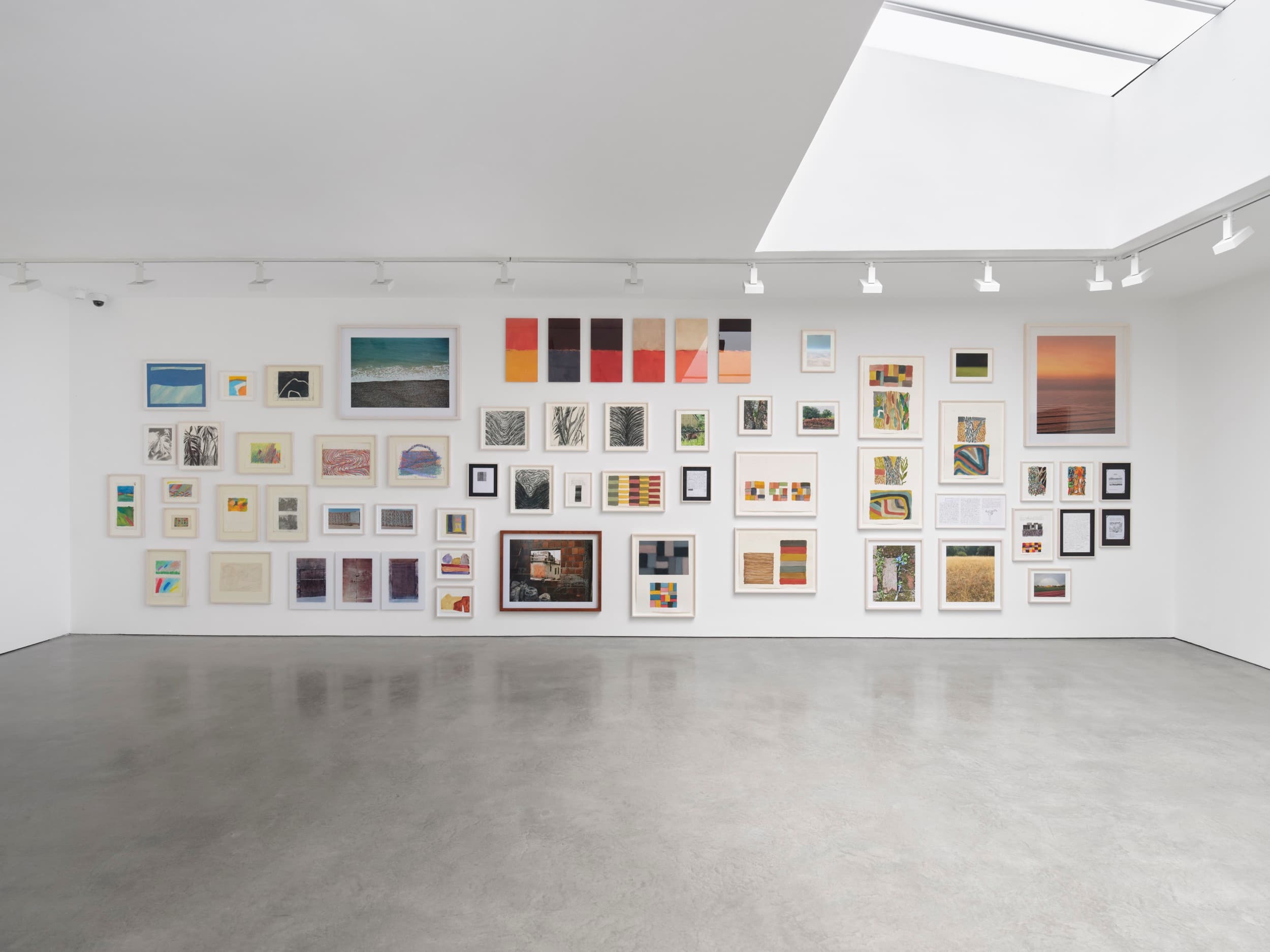
Installation view: Sean Scully: The Nature of Art, Lisson Gallery, London, 2026. © Sean Scully. Courtesy the artist and Lisson Gallery.
Lisson Gallery
February 18–May 9, 2026
London
In 1964 a student at the now-defunct Central School of Art and Design in Holborn drew a houseplant. It was an act of possession—a pencil claiming a leaf. By 1966, his hand was already navigating a radical abstraction that was not exactly a rejection of that leaf, but a shattering of it. This sixty-year trajectory of Sean Scully’s landscape-inflected work exists in that fractured space, where the recorded world and the constructed mark remain in permanent negotiation. In a suite of charcoal works on paper, a vegetal motif takes the title River (2000), a heart-shaped scribble becomes Flood (2000), and a movement of curved lines pulled downward answers to Sea (2000). If the natural world is stated, it is never arrived at but inferred, summoned, and perpetually postponed.

Sean Scully, Aran, 2005. Suite of twenty-four photographs, each, framed: 22 ⅜ × 28 ½ inches. © Sean Scully. Courtesy the artist and Lisson Gallery.
Aran (2005), the twenty-four black-and-white photographs of the eponymous islands, operates on two registers: the mechanical medium stands apart from the manual mark, while their arrangement as a grid on the wall implicitly refers to the central motif of Scully’s abstract paintings and drawings. These stones are photographic observations—the Atlantic shoreline rendered in rough-hewn blocks that already anticipate the weight of the later “Landline” paintings. In this alignment, the camera and the brush are co-conspirators in an effort to fathom vision’s own relationships to figuration and abstraction, its phenomenological realities that supersede language. The lens and the brush perform a visual dialectic that has taken its course since the early nineteenth century—a history where 1839 serves as the conventional threshold—arriving not at resolution but at an aesthetic entanglement that continues to generate meaning.

Installation view: Sean Scully: The Nature of Art, Lisson Gallery, London, 2026. © Sean Scully. Courtesy the artist and Lisson Gallery.
The images, whether manual or captured through a lens, are juxtaposed on the gallery wall as a choreography of the eye—or, in phenomenological terms, that very encounter between the perceiving body and the visual field. The “Aran” series, a grid of twenty-four photographs—a larger compositional window assembled from abutted landscape frames—registers as the perceptual foundation of the notably abstract painting Landline Blue Gray Red (2023) on the adjacent wall. Nearby, Fez (2024) presses the conversation further: its horizontal bands serve as ground for a painterly grid physically embedded within it—the two dominant structures of Scully’s visual language no longer in dialogue but in direct, material union. Painterly facture here asserts its distinction from the photographic print—not as a rejection but as an ongoing desire for dialogue between oppositional mediums, where vision and its epistemic conditions remain in generative suspension.
As ever, we find ourselves in that much-needed Peircean territory—though not comfortably, and not for long. The photograph is a trace of light, the brushstroke a trace of the hand, yet both reach toward the iconic if not the symbolic as well: the Atlantic sediment of stone, the horizon, the tile, the tessellated architecture of Fez, the grid—from Piet Mondrian to Agnes Martin. The categories slip, combine, and refuse to settle, much as Charles Sanders Peirce himself insisted: that no sign can perfectly realize any single type, the categories being like chemical elements that resist absolute purity. Scully’s practice through the decades is a compression of time, where the 1964 botanical study Plant and the recent drawings—from the “Eleuthera” series to the spontaneous, hatched watercolors of 2025, some annotated with text—together frame a sixty-year trajectory of artmaking.
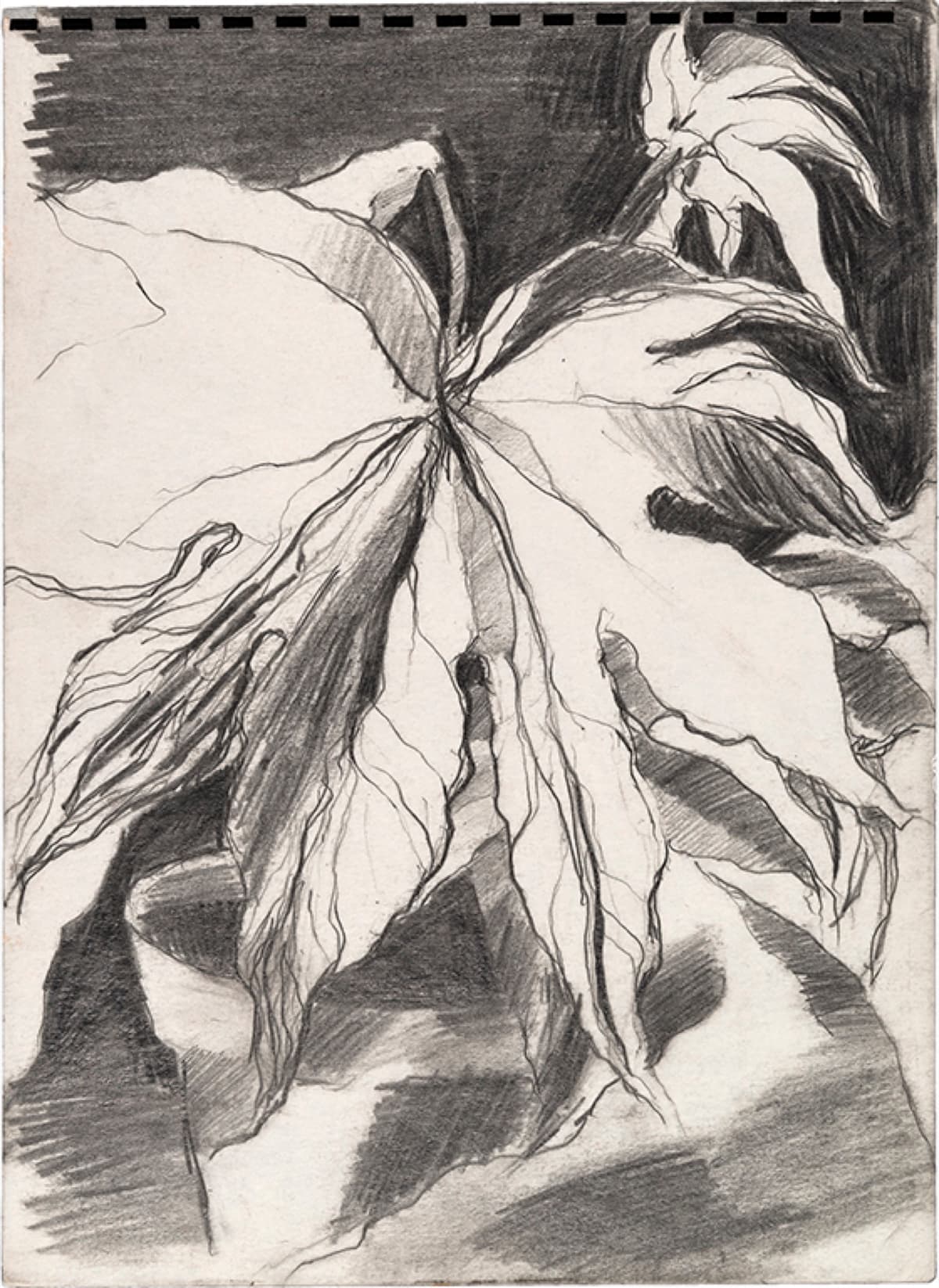
Sean Scully, Plant, 1964. Pencil on paper, 13 ⅜ × 9 ¾ inches. © Sean Scully. Courtesy the artist and Lisson Gallery.
With its simultaneously energetic and hesitant handling, Plant stages the opposite journey to the Aran photographs. The photographs idealize vision—stone walls rendered in equal focus, with a uniformity no human eye has the capacity to register in a given instant. The drawing inverts this: up close it dissolves into pencil traces, abstraction asserting itself over illusion; only at a distance does the play of light and shadow cohere. Abstraction, we come to realize, is not Scully’s imposition on the world but a phenomenological event. Indeed, abstraction is what happens between the eye and the leaf, between the eye and the stone.
These works—at once visual and verbal, image and handwritten aphorism—give the show its existential tone and its material primacy at once. Within this arc, the return to figuration is not a concession but a tribute, if not an urge to compete—with Claude Monet’s Giverny, with Henri Matisse and Vincent van Gogh, and with Paul Cezanne, whose city of Aix-en-Provence Scully has chosen as his Provençal home, settling in a historic bastide on its southern outskirts since 2021. To navigate this output is to see the stripe not as a destination, but as a recurring frequency—a painterly reality that remains as emphatic as it is fragile, whether rendered in student pencil, late-career oil, or watercolor.

Installation view: Sean Scully: The Nature of Art, Lisson Gallery, London, 2026. © Sean Scully. Courtesy the artist and Lisson Gallery.

Sean Scully, The Nature of Art 8.18.25, 2025. Watercolor and pencil on paper, 29 ⅞ × 22 ⅝ inches. © Sean Scully. Courtesy the artist and Lisson Gallery.
At Lisson Street, a chronological salon-style wall functions as a visual map of Scully’s evolution across six decades. The exhibition title, The Nature of Art, suggests a return rather than a departure—back to the 1964 figurations, the early abstractions, and the recurring motifs that Scully has been revisiting and transforming throughout his career. After a long withdrawal from figuration, broken by his 2019 Eleuthera exhibition at the Albertina Museum in Vienna, Scully’s recent works on paper and oil on aluminum allow the representational to bleed back in. Unapologetically painterly and expressive in their individual facture, these works inhabit a space where geometry and fluid outline overlap, unveiling a vocabulary that refuses to resolve. In this light, the title arrestingly poses an ontological claim on the nature of artmaking: that an image, whether arrived at by hand or by an instrument of light, can unfold aspects of our visual perception that we often forget: that the eye is never still, that abstraction and figuration can remain bound to one another, that a stationary image is always postponed.
From the imagery of the dry-stone walls of the Aran Islands to the final drawings made in Eleuthera in the closing weeks of 2025, Scully reveals that his stripes were never merely formal exercises. They were the accretions of the earth and the weight of the horizon, captured by a hand that has finally reconciled the houseplant with the grid. Ultimately, his visual language always revolved around line and vapor. More significantly perhaps, such entities as line and vapor formed a methodology through which Sean Scully attempted to examine his paintings through the lens of the contemporary status of imagery, as much as to examine his photographs through the lens of painting’s archaeology.