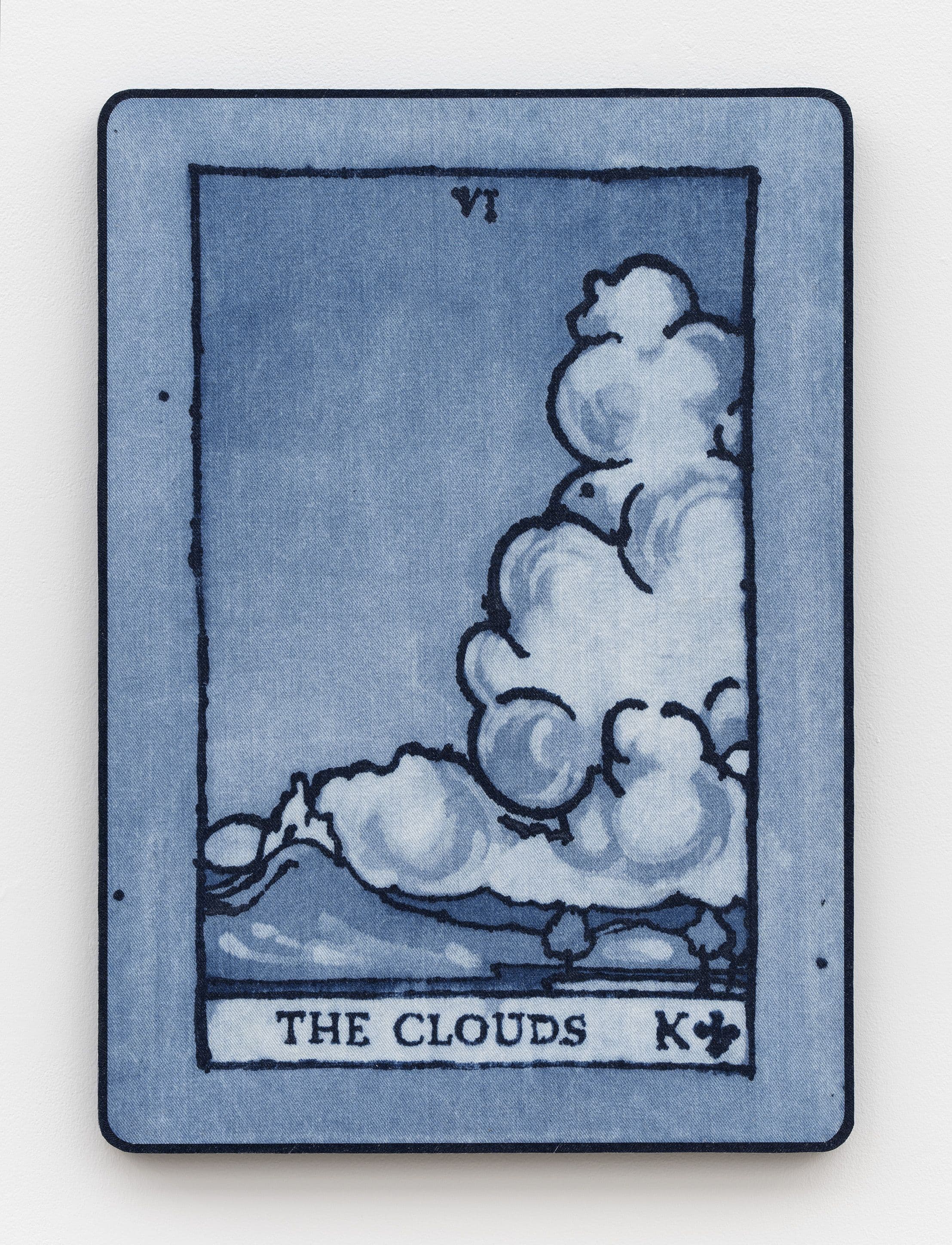
Nick Doyle, The Clouds, 2026. Bleached denim on panel, 24 × 18 inches. Courtesy the artist and Perrotin. Photo: Guillaume Ziccarelli.
Word count: 793
Paragraphs: 8
Perrotin Gallery
April 24–May 30, 2026
New York
No matter the fade or the wash, the blue of indigo-dyed denim fabric has been deemed, in fashion parlance, a neutral like beige or black, something unassuming that blends easily. Everything matches with denim. It is foundational to what we are, who we are. More vibe than color, denim traces its lineage from its current casual-wear ubiquity to the counterculture youth movements of the 1960s, the portrayals of rebelliousness and unrest Marlon Brando and James Dean plumbed on movie screens in the 1950s, all the way back to the American West of the 1880s, when factory workers, farmers, miners, and cattlemen began wearing riveted waist overalls sold in San Francisco by Jacob Davis and Levi Strauss. Never mind that indigo was produced by enslaved people in Southern states; denim became the statement piece of westward expansion and Manifest Destiny.

Installation view: Nick Doyle: Collective Hallucinations, Perrotin, New York, 2026. Courtesy Perrotin. Photo: Guillaume Ziccarelli.
In Nick Doyle: Collective Hallucinations, California-born artist Nick Doyle unravels the mythologies of Americana and the narratives that bolster capitalism and masculinity in eighteen new works produced in what has become his métier: denim fabric. Working with a spectrum of blue jean material that ranges from the darkest wash to a bleachy white, the artist cuts his cloth into shapes and slivers that are then wrapped around architectural structures or collaged into meticulous trompe l’oeil compositions of cacti, car keys, tarot cards, and landscapes pulled from Ansel Adams’s photographs. In Doyle’s hands, the world is cool but familiar, tinted blue like the fading light of an April afternoon, evoking Jack Kerouac and the open road of a California dream.
Three denim collages resembling tarot cards (but of Doyle’s own design) hang along the hallway that leads to the main gallery in a simple three-card spread, a sequence often drawn to gain clarity on the past, the present, and the future. Read in order, The Clouds , The Mountain, and The Sea (all works 2026) evoke the path of early pioneers migrating to the Pacific coast—bringing to mind the fate of the Donner Party—and act as a kind of retro-prophesy of westward expansion, casting a mysterious if gloomy tone over the rest of the show.

Installation view: Nick Doyle: Collective Hallucinations, Perrotin, New York, 2026. Courtesy Perrotin. Photo: Guillaume Ziccarelli.
Doyle reworks a pair of Ansel Adams photographs into large-scale collages in Perimeter and Innocent Industry, recasting the iconic black-and-white imagery in shades of indigo. The artist updates the land of milk and honey mythology Adams created in his views of the American West in Perimeter by overlaying a chain link fence on the billowy clouds and snowy mountains. By moving the viewer out of the landscape and behind a partition, he underscores that the promised land is not promised to all. Innocent Industry similarly blocks access to an idyllic spot overlooking the Tetons, this time framing the view with a brick wall. Looking at it, my mind went to the denim uniforms of the California prison system and how incarceration is the new fall from Eden. Researching this idea once I got home, I had a chilling moment with the algorithm when a vintage prison jacket for sale on Poshmark for $399.99 popped up on my screen.

Installation view: Nick Doyle: Collective Hallucinations, Perrotin, New York, 2026. Courtesy Perrotin. Photo: Guillaume Ziccarelli.
A series of cacti collages proved less unsettling to think about. I was charmed by the flamingo ornament standing within the spires of an organ pipe cactus in Plastic Eden and by the plastic bag caught on the arm of a saguaro in American Beauty. First Come the Dreamers, which features a pair of sunglasses reflecting cumulus clouds, conjured a type of cowboy-cum-Hollywood masculinity while beautifully showcasing Doyle’s immaculate attention to detail.
The showstopper of the exhibition is Mirror, Mirror, an installation featuring Ava, an AI oracle who gives psychic readings within a structure wrapped entirely in denim fabric that approximates a roadside shack. To get things started, visitors are invited to enter the booth to say hello to the video-image blonde woman with Mar-a-Lago lips clad in Uniqlo-grade finery. I sat through four readings with Ava to get a sense of her. She began the first by asking about my favorite breakfast, my perfect day. Her reaction time to anything I said was slow, but of course, that will change. Her dialogue was peppered with the innocuous jargon of a Silicon Valley strategist—“it’s brave of you to espresso-negotiate with life every morning”—and try as she might to encapsulate my identity in pithy retorts, the content she generated predicted no future beyond the flattening of creative possibilities promised by her ilk. Exiting her lair, I let the denim screen door slam behind me and thought about the collective hallucinations promised by this new, artificial frontier and of the previous dreams and deceptions, remembered in denim, that led us here.
Ann C. Collins is a writer living in Brooklyn. She holds an MFA in Art Criticism and Writing from the School of Visual Arts.