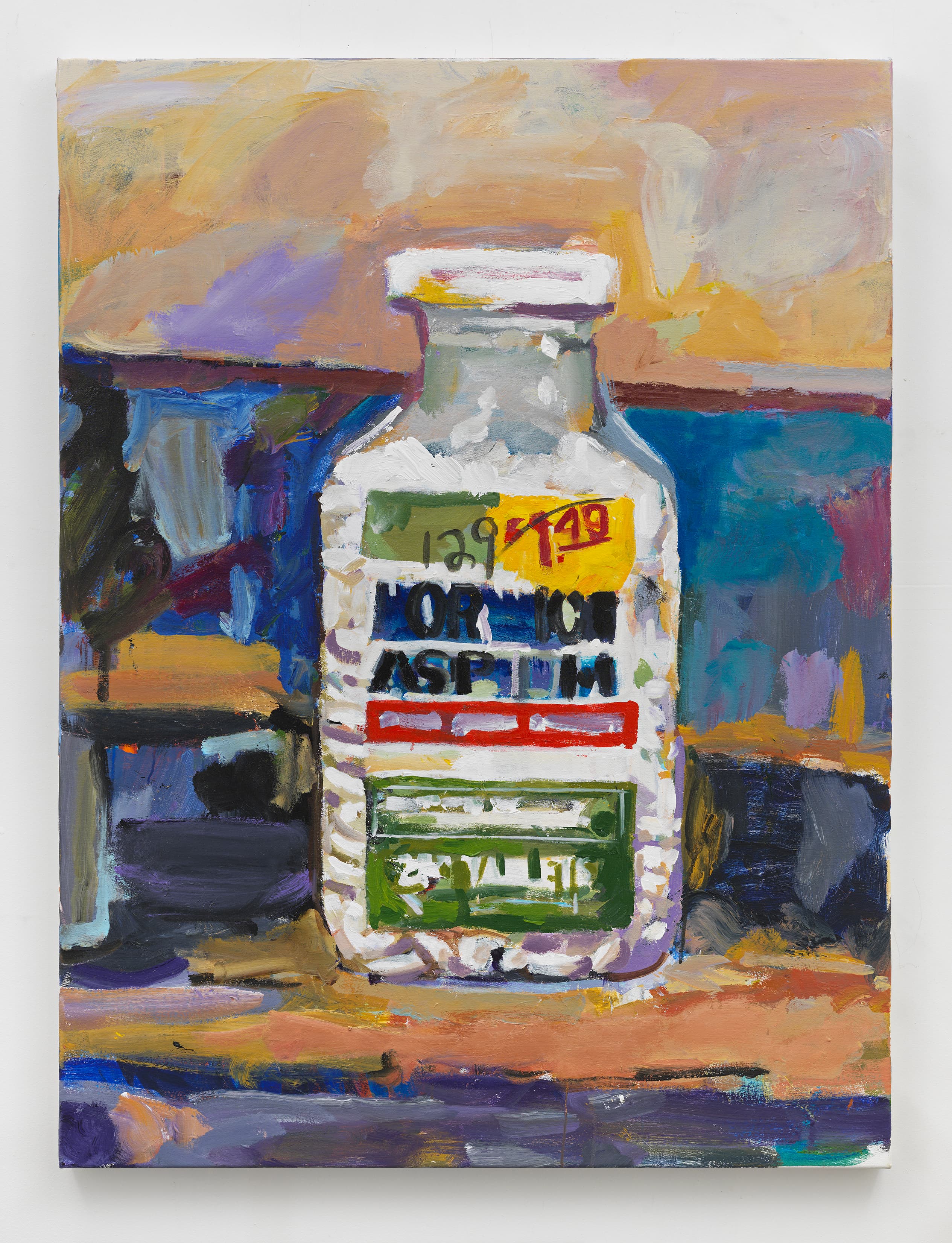
Walter Robinson, Norwich, 2024. Acrylic on canvas, 48 × 36 inches. Courtesy Jeffrey Deitch.
Word count: 801
Paragraphs: 8
Jeffrey Deitch
May 2–June 6, 2026
New York
For the Critics Page in this journal, Walter Robinson once wrote, “Artists want to be called ‘great’ by critics, possibly more than they want anything,” before adding, “critics are failed artists.” Having moved between both roles, Robinson understood the dynamic firsthand. Robinson passed away in February 2025, and Let the Music Play, organized by Carlo McCormick, is a posthumous solo exhibition of his work. On view at Jeffrey Deitch in SoHo, the show features fifty-four paintings spanning roughly from 2011–24, with a few remaining undated. The survey presents various subjects divided into categories such as “Still Lifes,” “Normcore,” “Painter Paintings,” “Romance Paintings,” “Nurses on Paper,” and a singular self-portrait. The intimate, undated self-portrait seems to harken back to the late 1960s, when Robinson would have been about eighteen or nineteen years old. He paints himself with thick brown hair, wavy and coiffed, dressed in a suit jacket and dark purple tie. His gaze is lowered, but the likeness is unmistakably him.
Robinson was a longtime fixture at New York gallery openings, particularly among painters. A tough critic and painter’s painter, his figurative work was as much about paint itself as it was about subject matter. Rising out of Pop art while simultaneously critiquing the genre, his aesthetic could be described as kitschy pulp novels meet Richard Prince nurses, J.Crew catalogues, Wayne Thiebaud sweets, and the absurdity of Claes Oldenburg without the immense scale. He painted representationally using thick brushstrokes, tongue-in-cheek subjects, and a staunch seriousness about painting as a medium.

Installation view: Walter Robinson: Let the Music Play, Jeffrey Deitch, New York, 2026. Courtesy Jeffrey Deitch.
It is not an easy feat to make art while also critiquing art. Somehow Robinson never lost his clout. Or did he? He had very loyal fans and likely just as many detractors. But Let the Music Play is a dedicated exposition of his consistency: subjects who live in a shallow depth of field often engage the viewer with a seductive gaze or through the banality of their objecthood. His Wendy’s Baconator (2021) is as appetizing as it is abject, the greasiness of bacon and beef shimmering in the larger-than-life portrayal. Up close, the burger becomes almost abstract, swaths of subtly shifting color punctuated by highlights made with seemingly singular strokes.
So was Walter Robinson a failed artist and a good critic, or vice versa? According to his own statement, it is impossible—or at least unlikely—to be both. Yet in one of his later paintings, Norwich (2024), he was still coming into his own. There is a frenetic energy to the piece. Less confined to subject matter, the painting depicts an off-brand bottle of aspirin, the regular price of $1.40 crossed out and $1.29 written nearby. The purples and fuchsias dominate the composition; the bottle becomes less about remedy than an excuse to make a painting. It is his Giorgio Morandi moment, but with a Robinson palette. Americana references are unmistakable throughout and Robinson seemed to worship and despise the machine.

Installation view: Walter Robinson: Let the Music Play, Jeffrey Deitch, New York, 2026. Courtesy Jeffrey Deitch.
The gallery installation reinforces this repetition. Hung according to categories, the exhibition almost feels serial, echoing the structure of comic books or the pulp paperbacks he emulated. Over the years, Robinson’s subjects remained rather consistent, particularly his portrayals of women, which now read through a retro-patriarchal point of view. A 2018 series of untitled works on paper bring them from a 1950s playbook into the twenty-first century, one figure sporting purple hair while suggestively holding a syringe. Several paintings from 2023 feature female-artist subjects: one with tattooed arms holding jars of paint, the other painted in black, white, and red (not his typical color palette), staring confidently at the viewer, red polka dots on her shirt and the nearby canvas she sits next to. In 2024 he made two paintings, Old Man Self-Portrait and Cat Painter (Sideways Glance), both depicting a bearded artist in the studio. Even with the title self-portrait, the central figure resembles Ernest Hemingway or Jack Hanley more than Walter Robinson. Was this figure an avatar, how he saw himself? It channels the energy, somewhat, of a Peter Beard photograph.
At its core, criticism is an opinionated voice meant to spark feedback. Painters can do the same, though often less directly. Robinson managed both, writing about art for many years, and retreating into the worlds he made in the studio. Let the Music Play is a time capsule, the work of an artist whose paintings may never be made in the same way again. Our times are just too different. So like a record or celluloid film, they become important objects, documents from a recent past that both capture, and embody that past. His written commentary was far more critical than his painting, yet together these practices sketch a portrait of a man who was unapologetically himself.
Katy Diamond Hamer is a New York based arts writer with a focus on contemporary art and culture and has been actively engaged in the arts community on a global level for over ten years. Beyond writing she lectures at universities including NYU and Sotheby's Institute and has been a panelist on several occasions both as a participant and moderator at the New York Academy of Art and Art Basel Miami amongst others. A graduate of New York University, Hamer has written for magazines including Cultured Mag, Galerie Magazine, Flash Art International, New York Magazine, The Creative Independent, BOMB, and many others, including the Brooklyn Rail. Interview subjects of note include Robert Storr, Courtney Love, Helmut Lang, Cecilia Alemani, and Takashi Murakami.