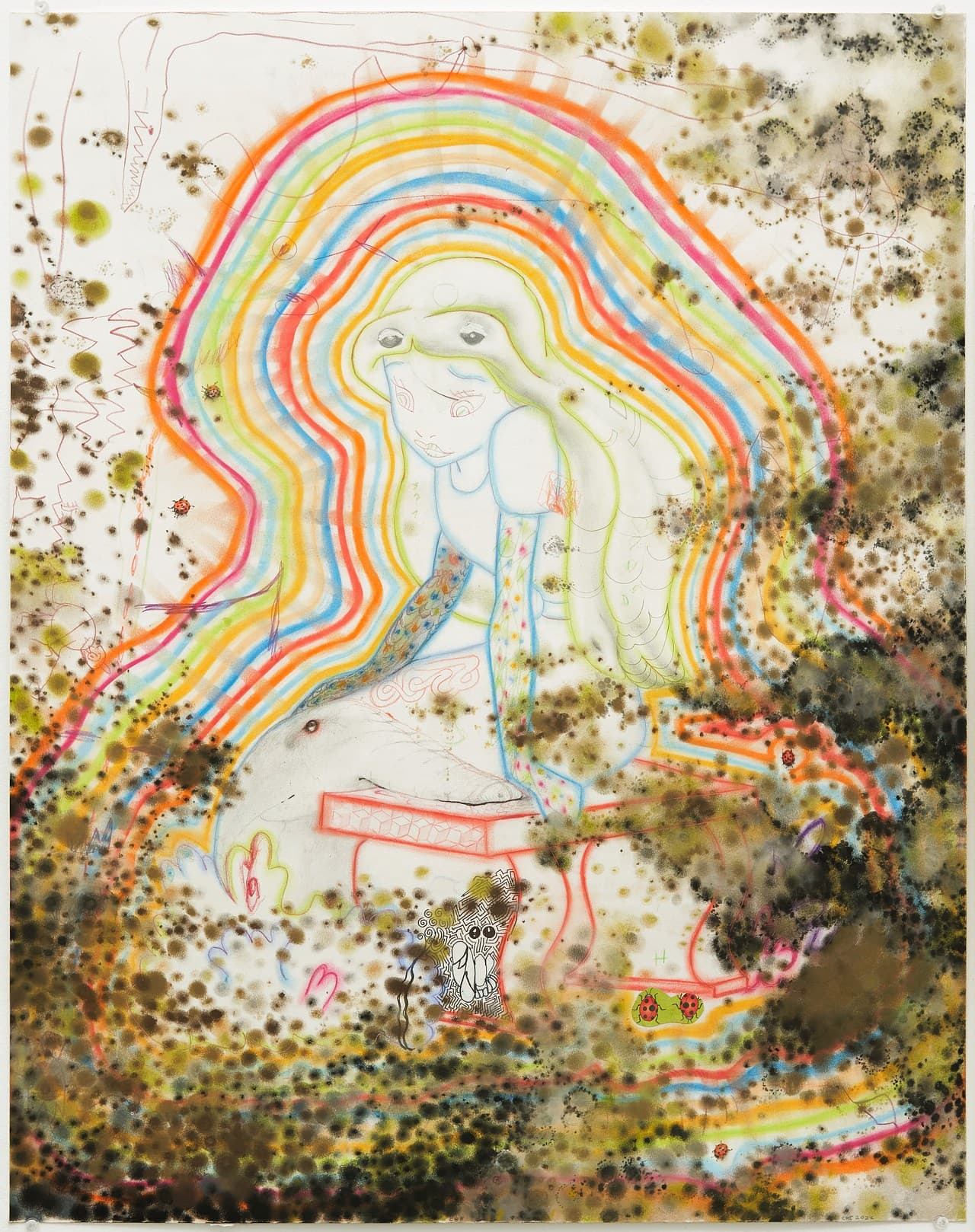
Brock Enright, Untitled (Moldy Girl), 2022. Pastel, pencil, and ink on paper, 29 × 23 inches. Courtesy the artist and Club Rhubarb. Photo: Tyler Mariano.
Word count: 1465
Paragraphs: 8
Club Rhubarb
October 19, 2025–May 17, 2026
New York
When Brock Enright was nine years old, he was introduced to Dada by his art teacher, but when he was twelve he met a witch. On the third floor of a multi-story apartment building on Prince and Bowery is a room of all the wands Enright has ever made, along with the spindly nests of found and connected things that he has hung from the ceiling, which Enright refer to as “activators.” It is one of six distinctly curated rooms put together by the nomadic gallery Club Rhubarb for Enright’s exhibition I AM SO PRETTY, which functions as a survey of the artist’s practice since the early 2000s. Throughout the rooms, stairwells, and hallways, we are able to see Enright at a distance, an artist who has worked through the periods of relational aesthetics and neo-Dada while negotiating the strange affinities that have always existed between the perceived rationality of modern art and the inexplicable impulses of mysticism.
Enright is in many ways the inheritor of the realm developed by Mike Kelley, and later, the sensational abjection of the Young British Artists, that he uses to investigate the raw and libidinal currents of material. In his nearly thirty-year art career, he has worked within the frequencies and non-apparent transmissions that materials carry between them as a way of accessing the deeper forces and drives that define his life and his relationship to culture. Peepholes, bat wings, witch hats, monster prosthetics, geodes, crushed cans, and MTV buttons converge with nineties sand-art and the Hindu god Ganesh to bricolage together the prime matter of paranoid influences. The artist fixates on adolescent ephemera to access a time when making things felt more pure, more uninhibited, and less indoctrinated into the culture of art. In Yellow Instrument (2025), PVC wires, a coin purse, eyeballs, and floating fragments try to make a spell out of the strange configuration, while also mattering the niche interests and frenetic attention of boyhood. Maybe Enright’s belief in the perfection of the Ritz cracker is the revelation to the piece. He will tell you that if you run string through its holes, it makes a perfect, spatialized cube. It is this degree and condition of noticing that is consistent through the show, one that leans toward the strange and wondrous beauty of these pervasive things in our lives—these illusions in the ordinary that add up to either aesthetic experiences or magical ones, and sometimes both.

Installation view: Brock Enright: I AM SO PRETTY, Club Rhubarb, New York, 2026. Courtesy the artist and Club Rhubarb.
All of these souvenirs and friendship bracelets seem to challenge the modernist attempts to formalize societal alienation through monumentality and self-assuredness, but it is the fabric-wrapped headboards that parody these attempts in the most direct way. They exchange in the same pocket-lint and back-of-drawer aesthetics that artists like Liz Magor also traverse, but they are more humorous and avoidant of poetry and existentialism and bypass the poetic contemplation of these daily scraps by throwing them into Harmony Korine’s blender. Warm Blanket (2025) uses a soft flannel blanket and a peephole to make congress between the modernist grid and the sad and frumpy discount rack, dragging the canon through the wayward and sentimental taste of the craft aisle. Similarly, Enright’s “Greetings” installation and the modded guitars see parallels between basement recording sessions and the likes of Curtis Cuffie and readymades.
But there is a dark current to this adolescent play. Enright’s impulses also explore themes of exploitation and aggression. Done over a period of nine years, Imaginary Girl (2016–25) depicts a completely fictitious girl with bacon dripping from her mouth. Made from manually compositing dozens of images from magazines and photos, it’s a dark Pygmalion, and evokes the kind of problematic invention of women you might see in the John Hughes film Weird Science and other adolescent fantasies where women are invented outside of the ethical bounds of representation and responsibility. Enright addresses exploitative imagery by arriving through its simulacrum: a manic eye that conflates the producers of fetishization with our own witnessing of it, in a way that draws parallels with mass surveillance and the image data centers of algorithms.
But there are even more direct engagements with exploitation and aggression within the exhibition. The bathroom at Club Rhubarb has been made into a kind of dungeon that plays two videos from Enright’s early “VIDEOGAMES” series (2002–08), in which he would offer boutique experiences (like kidnapping) to anyone who would pay for the service. Installed here, it is maybe too theatrical and puerile in its simulation of violence and sadism, but its inclusion in the survey may yield the most complex and interesting addition to the show, as it reveals the shift in the art world since its creation—namely what Claire Bishop repudiates as the ethical turn. This work was created in 2002, in Francis Fukuyama’s “post-history” world and the beginnings of reality television, when suburban white Americans felt bored and listless enough to consider paying for someone to kidnap and torture them—a sentiment that feels impossibly distanced and abundantly privileged now. The impulse and desire for this time-capsuled abjection has been well-criticized by writers such as Hannah Black, who in her 2016 Frieze essay “This Is Crap,” pointed to what was left out of the abjection of the largely white position of suburbia, and how it avoided the racialized traumas and experiences of true cultural abjection. But Enright’s transgressions seem to somewhat merit this aestheticized transgression and reveal the underlying currents of violence that delivered us into our current state of politics. It is an early and ominous augur of what existed just below the isolated experience of the cul-de-sac. The videos and their installation don’t consider an audience that has survived real violence and trauma, and prefer exploring the aesthetic conditions of performative violence and the complicated boundaries of consent over this responsibility. It is also a reminder that the language of “care” and its curator-speak was once preceded by the shock art of the Bush and Obama years. But it is these negotiations with the darker aspects of creation and its shadow of destruction that avoids autobiography and allows Enright to examine the moments when our collective futures started to be foreclosed upon. The objectless attention of Enright’s work—the nomadic eye of desire—creates an instability, an un-urgent doubt as to where to go or what to focus our attention on in our current malaise. Instead we are left with the impression of its effect upon us, and the awareness that the malaise is violent, and boredom can at once produce innovation, while also conjuring the latent idiocy and sadism of America.

Brock Enright, Us, 2025. Wood, acrylic, rainbow titanium quartz, aluminum, latex, 17 ¼ × 21 ¼ inches. Courtesy the artist and Club Rhubarb. Photo: Tyler Mariano.
Enright’s formalism makes for an interesting transposition. Immanuel Kant proposed that the pure aesthetic experience was a purposiveness without purpose—a moment where something feels like it has purpose but we cannot know what it is. Enright’s practice is in search of this conflation of aesthetic experience with the realms beyond the periphery of the rational world that also rubs up against the fetish objects of the occult, spiritual talismans, and magic. Simultaneously, there is a need to mystify the overlooked, to build sensuous waves out of push pins, and depict the perfect design of Ritz crackers while walking the tight rope between Dada and magic that he was introduced to at a young age. But Enright’s survey also restages the impulses of an art world that we’ve lost. The survey reminds us of a previous world when artists saw themselves more as filters of culture than as its leaders and were interested more in what responses can be evoked by circulating their interventions into society than the ethical turn of the biennial art world. As Alain Badiou remarked in his 2005 book The Century, we find ourselves yearning for the real as we feel more starved for reality, to the point that we desire abjection, violence, corruption, and transgression. This has been the lament of a number of recent essays by curators, critics, and artists who collectively call for riskier work to be attempted again. However, Enright’s work proves that returning to these previous times isn’t so simple. We still have difficulty reconciling these interactions with our collective traumas, at a time when our imaginary, in the Lacanian sense, is so immersed that we are enveloped in inescapable narcissism, and we continue to witness the dissolution of the symbolic order and our institutions. Enright’s survey is honest with the creative power of artists: that what comes out of the cave is not always towards community and new worlds, but can also be a wild and destructive force. It is a reminder that when we deny the existence of this shadow and attempt to repress it, we can create the societal psychosis we are currently experiencing.
Andrew Paul Woolbright is an artist, gallerist, and Editor-at-Large at the Brooklyn Rail, living and working in Brooklyn, NY. Woolbright is an MFA graduate from the Rhode Island School of Design in painting and is the director of the Lower East Side gallery Below Grand. He currently teaches at Pratt and School of Visual Arts in New York.