Baseball is Back
Word count: 1870
Paragraphs: 13
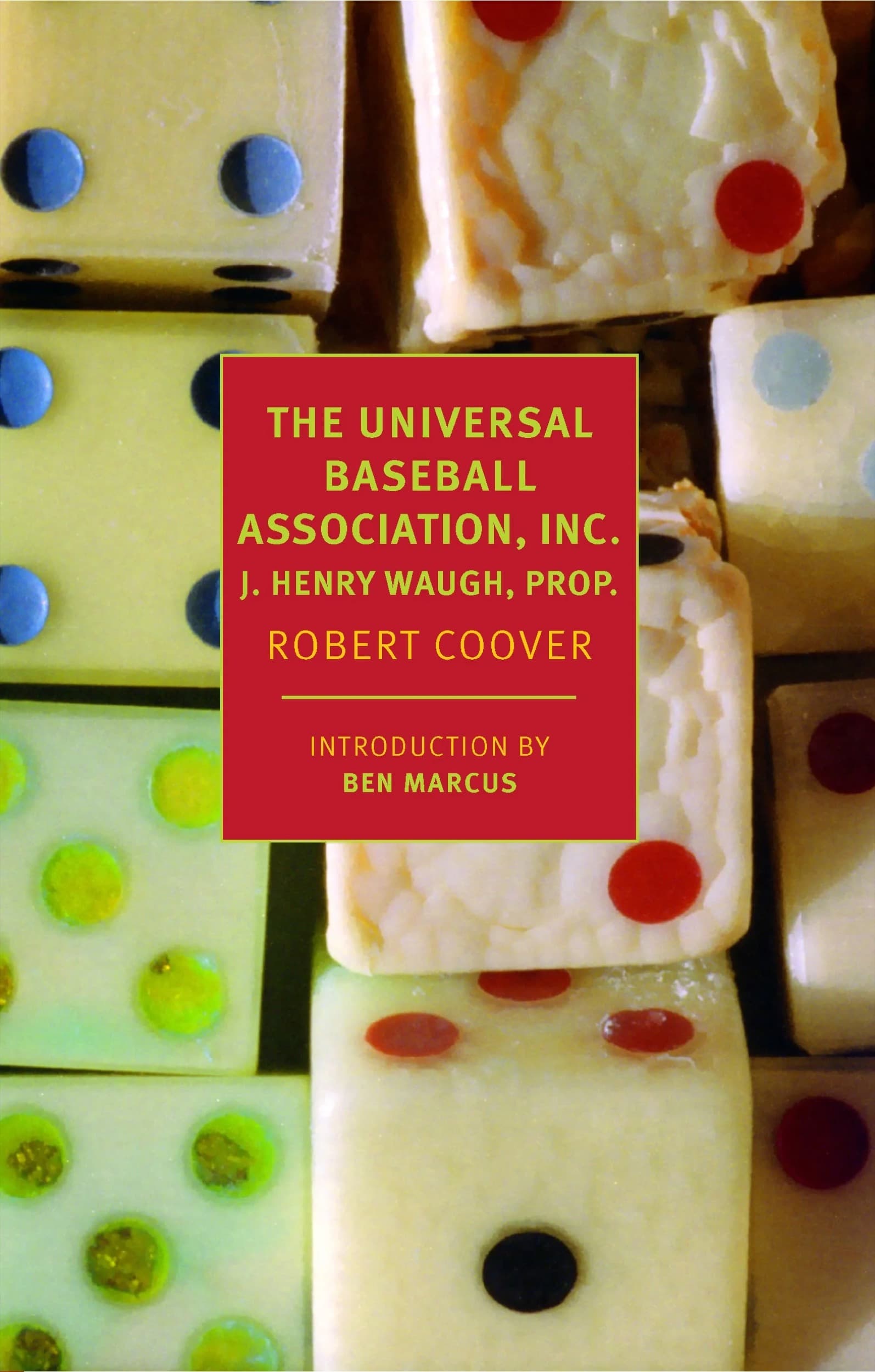
Baseball is back, for those who can stomach all the flag-waving that comes with it. Just in time, NYRB Classics is publishing a new edition of Robert Coover’s The Universal Baseball Association, Inc., J. Henry Waugh, Prop. (1968), which tells in jumpy, punchy prose of the imaginary baseball league Henry runs in his head and in shelves full of record books. The Universal Baseball Association has eight teams and hundreds of individual players past and present whose lives on and off the field he daydreams and documents in the many volumes of the official UBA archives, alongside the scoresheets, standings, and financial ledgers. Each of the 336 scheduled games per season (the novel follows Year LVI) are played by Henry throwing three dice for a total of fifty-six combinations that, matched across nine possible charts, decide every outcome of an encounter between pitcher and batter, including those on the Chart of Extraordinary Occurrences, which might include fistfights, a tossed beer bottle from the crowd, or the sudden death of a player by a beanball to the head.
Spectating the real sport bores Henry; baseball’s wonder is to be found instead in its “accountability—the beauty of the records system which found a place to keep forever each least action,” for “no other activity in the world had so precise and comprehensive a history.” He does much the same work at his day job in the offices of “Dunkelmann, Zauber & Zifferblatt, Licensed Tax & General Accountants, Specializing in Small Firms, Bookkeeping Services & Systems, Payrolls & Payroll Taxes, Monthly, Quarterly & Annual Audits, Enter Without Knocking.” But all his energy goes toward bookkeeping for the UBA, even though it becomes an oppressive commitment. Or maybe because it does, because there’s something addictive about tethering his emotional life to the “turns of the mindless and unpredictable—one might even say, irresponsible—dice,” although it might mean the rules he has set himself break his heart.
Coover’s satire has been called prescient of online fantasy sports and the proliferation of sabermetrics or advanced stats, which, however, make the fifty-six combinations from three dice seem quaint. For those not up to speed, ever more data is collected today in Major League Baseball from each Batted Ball Event on the field by several highspeed cameras. In the eyeblink from the pitcher releasing the baseball to the batter hitting it, those cameras document the pitch’s release point, velocity, spin rate, horizontal and vertical movement, and seam orientation; then the bat’s swing path, length, angle, and speed; then the batted ball’s exit velocity and launch angle. All these and more data combine to inform, next to the statistics based on actual recorded outcomes, probable or “expected” outcomes. A player might get a base hit in 28.7 percent of chances, while these advanced stats say he should have been expected to have a hit in 26.4 percent. Overlaid on the physical ballgame, now, is this spectral, ideal game. I’ve known people to prefer live data visualizations, which are anyway integrated into every broadcast, to watching the actual action.
If Henry’s boxscores are analogous to the general and subsidiary ledgers he writes by hand at his day job, tracking the expenses and sales of a small firm, then almost sixty years later into what Robert Brenner called the “Long Downturn,” these advanced baseball metrics are analogous to the speculation central to the financialized economy. The most obvious symptom is the baleful ubiquity of gambling since sports betting became legal, after which came a flood of advertisements for and official partnerships with betting apps. Especially popular—meaning, meeting the artificial consumer desire especially manufactured—are small proposition bets allowing gambling on any least action, like whether the next pitch will be a ball or strike. The gambler’s dream of money for nothing distills the spirit of the stagnant economy, with its unreliable and limited opportunities for productive investment sending investors, hedge fund managers, and all varieties of swindlers and cheats to try to turn money into more money by speculating on assets whose prices might be raised. Just as the game on the ball field might be calculated as a series of discrete, more or less probable events, so might all of the world, making it nothing but a grand casino in which the savvy player need only place the right bets.
In fact, in The Universal Baseball Association, Henry is reminded of the Vietnam War by a newspaper headline, and, increasingly absorbed in the private world of his game, sees it as another kind of spectator sport with the same logic:
People needed casualty lists, territory footage won and lost, bounded sets with strategies and payoff functions, supply and communication routes disrupted or restored, tonnage totals, and deaths, downed planes, and prisoners socked away like a hoard of calculable runs scored.

Anti-Vietnam war protest and demonstration in front of the White House, 1968.
More prescience. Recently, much has been made of the so-called “prediction markets” in which one can place a prop bet on a baseball game alongside a bet about where the next bomb will be dropped. Widespread criticism of this obscenity is justified, but risks contributing to the hype on which these faddish companies rely; their business model seems to count on liberal moral outrage amplifying attention to and enhancing the transgressive thrill of their products. Beyond the novelty of this latest effort to financialize everything imaginable are more disturbing long-term trends. Coover’s analogy between the advanced statistics of war and baseball suggests not only the US public spectatorship of the wars the nation wages, but also the increasing rationalization and automation of military force in wars that are insulated from public consent or even awareness. In Vietnam, the US employed IBM computers to generate predictive targets for bombing, in the process killing millions. Since then, the “kill chain” and its “autonomous weapons systems” have supposedly become ever more sophisticated and accurate with their development—common to all capitalist production—of increased output in less time with less human labor. The outcome of the latest in automated killing technology was the bombing of a school in Iran, killing nearly two hundred children.
That such decisions—if that is still the right word—are made according to an opaque, impersonal bureaucratic procedure contributes to a larger sense of being ruled by alien forces we cannot control, like the UBA ballplayers at the fatalistic end of Coover’s novel, who begin to wonder about the record keeper in the sky. With the undermining of even minimal public influence over decisions to wage war and the regulation of the capitalist economy, our own fates today seem to be determined by equally arbitrary forces—so why not speculate on which way the dice will roll? In an age of stagnation, as the period of postwar prosperity recedes into a lost object of trite nostalgia, a certain common sense asserts itself: if conscious, collective control over our lives seems impossible—if there seems to be no sustainable future—then the best option appears to be pursuing ruthless self-interested advantage over others. Why not place your bets?
Robert Coover searched for an alternative in his own activity against the Vietnam War. In the same year he published The Universal Baseball Association, he signed the “Writers and Editors War Tax Protest,” refusing to pay surcharge taxes to fund a war that was morally wrong. The next year he made the documentary On a Confrontation in Iowa City (1969), a collage of film, photos, interviews, and folk music to document a spirited student protest against Dow Chemical recruiting on the University of Iowa campus. Their demonstration against the recruiter, with the slogans “Dow shalt not kill” and “No more napalm,” recognizes the university’s entanglement with what one voice in the documentary calls “Eisenhower’s one great phrase”—the military-industrial complex—and their own diffuse complicity in the indiscriminate murder of people far away. One protestor finds their actions necessary to “dramatize the whole vast interconnection and the way decisions and power is wielded,” though they can only come face-to-face with a representative of the chemical company claiming just-doing-business neutrality and police officers metonymized in the film by their brute billy clubs. Another voice declares the importance of learning to “act rather than be acted upon,” which is translated by a county grand jury as indictments of felony conspiracy. In the last lines of the film, protesters debate escalating tactics, risking ever greater repression, to bring about a revolutionary movement. “People would start burning themselves here like they did in Czechoslovakia,” says one. “They’ve already done that,” another replies, “and there’s nothing you can do, it seems. Nothing. I… I really don’t know.”
The ambivalence of the documentary resonates today. On the one hand, its closing note of hopelessness—“there’s nothing you can do”—fits our moment, when there is no mass movement against an egregious war on Iran despite overwhelming public disapproval. That there was no real effort to win approval seems to be the logical conclusion of the endless unauthorized wars of the twenty-first century: since the consolidation of executive power under George W. Bush, US presidents have unilaterally decided on the use of state violence in the War on Terror, which in practice has meant the mass murder of millions. Its racist logic has subjected certain populations to perpetual domination, whether in the form of drone strikes, extrajudicial killing, or torture—all without any regard to international law. Trump and company inherited this sense of impunity and decided they didn’t need to disguise their administration’s own wars of naked aggression, reveling in extortion, conquest, and destruction. The only chance for democratic participation they offer is the license to join in on wielding that violence, at home or abroad, against the racialized enemies of the soon-to-be-great-again American empire.
On the other hand, though, the spirit of resistance captured in the documentary resonates as well. Watching the students in Iowa withstand police brutality of course calls to mind the wave of student protests against genocide in Gaza, which reached its spectacular height in New York City two years ago when police were called to clear the solidarity encampments at Columbia and City College. The far-reaching repression of this movement, combined with right-wing culture war attacks on whatever they understand to be DEI—in effect, attacks on anything that challenges white supremacy—have created a punishing environment for dissent. Still, the protests reinvigorated internationalist and anti-imperialist thinking on the left—more necessary than ever as the US shows itself to be an increasingly irresponsible and incapable superintendent of the global capitalist economy. They dramatized too the way power is wielded today, how its violence is reproduced throughout all of society, and in their best moments they provided a vision of what it might mean to confront that violence—to act rather than be acted upon. Perhaps the most promising example of what we can do came in reports earlier this year from Minneapolis of all the people who together drove ICE out of town with whistles. Finally giving Neighborhood Watch a good name, they managed the spontaneous organization of impressively coordinated patrols, communication and distribution channels, rapid response and mutual aid networks—or, in the simple words of their protest signs: we keep us safe.
Anyway, baseball’s back. At least the embarrassing, wannabe-soldiering US team in this year’s World Baseball Classic was beaten by Venezuela.
Caleb Fridell is a literary scholar living in Berlin.