Mari Katayama’s Synthesis
In these photographs, the studio becomes a place not just of performativity and speculation, but a lived-in exhibitionism.
Word count: 817
Paragraphs: 11
Mari Katayama
SPBH/MACK, 2025
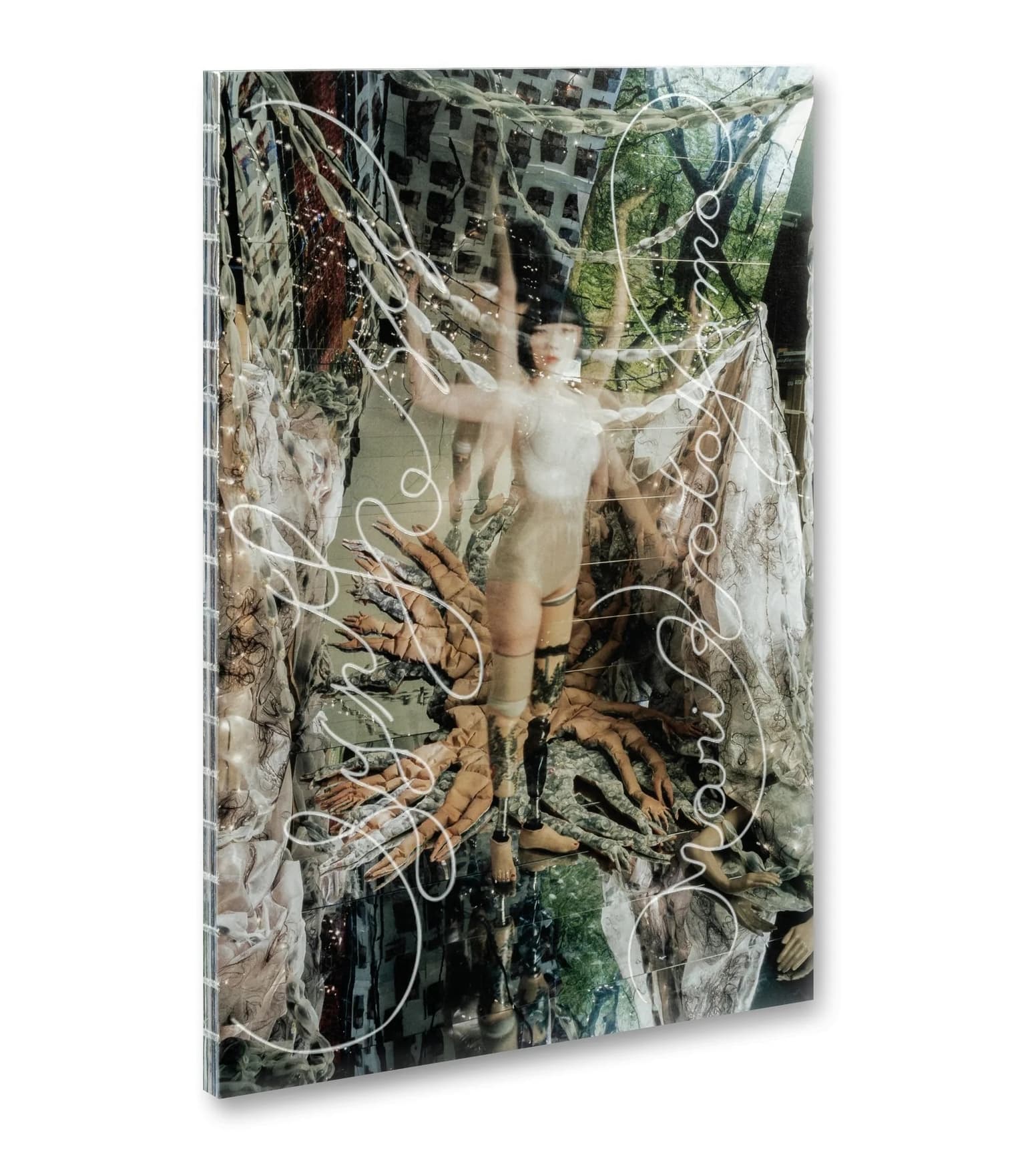
Synthesis, Mari Katayama’s newest book, brings together nine photographic series made between 2019 and 2025, a period marked by the birth of Katayama’s daughter and a return to Gunma, a prefecture on Japan’s Honshu Island, the province where she grew up. The book’s dimension is slender with an exposed spine. Katayama is centered on the front cover with arms raised, but in multiple poses at once, surrounded by a mass of sewn limbs that inch out behind her, blurring the boundary between her body and the objects she has made. This image is emblematic of the maximalist compositions she is known for. The title, Synthesis, is drawn out in a drippy, silver script, like twine unraveling across its front cover.
The nine series inside flow without breaks or title pages, and the images are printed full bleed, so they read as an evolution rather than a survey of discrete bodies of work. In her artist statement, Katayama describes, “the act of photographing [as] the dynamic of taking and being taken,” tracing the delicate membrane “between ‘you’ and ‘me.’” This formulation applies as much to the book as an object as it does to the images inside it.

Born with tibial hemimelia and faced with amputation at age nine, she first dedicated herself to the craft of making clothes that accommodated her body. The camera entered her practice as a tool for sharing those creations. But what she discovered was that it could do more than document: it could spawn a fanciful otherworld of augmented craft, a way to assert control of her image while opening onto a narrative potential that pushed the boundaries of material as a method of expanding selfhood.
It makes sense, then, that the book begins by documenting her studio. The opening pages show a room with a dizzying catalogue of objects: black filing cabinets strewn with textiles, ribbons, and lace in sensorial orchestration; a wall of delicately upholstered hearts; trays of shells; hosiery bulging with clumps of dark hair; a coffin-like box rimmed with bubble wrap, from which a plush octopus-like creature appears to be spilling out. The next photograph is identical to the last except for her presence, which arrives on all fours in long exposure, body translucent and in motion, straddling the splayed creature.
Featured in the middle of the book, the black-and-white “caryatid” series (2024) draws on the figures from ancient Greek and Roman architecture—sculpted women whose bodies support the weight of buildings—translating Katayama’s sense of bodily disconnection from the ground into images of herself standing on her prosthetics. Perpetually burdened and perpetually upright, ornamental and structural at once, the caryatid is an apt figure. She appears here draped in a blanket of limbs, somewhere between tentacles and arms, encrusted with shells and beads, holding up the weight of the unruly, inanimate body of her own construction.

The “tree of life” series (2024–25), new to this book and presented last, uses a mirrored stage that dissolves the boundary between ceiling and floor into a vertiginous reality where she is outstretched, expansive, almost floating or tumbling, generating new forms. It is the most formally ambitious work, arriving not as an ending, but as a prismatic beginning.
That sense of opening is not only formal. During the period covered by this book, Katayama received her first electronic prosthetic leg, one that uses sensors and microprocessors to adjust to her gait in real-time, making outdoor photography newly possible. She is matter-of-fact about this in her accounts, but its effect on the work is visible: there is more dynamism in these images, an immersion with the environment all around her.
Rather than addressing the camera head-on, as she once did, she balances nimbly on a chair, almost lost amid the landscape reflecting all around her in the mirror. Her body reaches out to meet its own reflection, the posture unmistakably reminiscent of Michelangelo’s The Creation of Adam: an arm extended, a finger pointing toward its double.
What the book’s six-year span registers is, perhaps, what motherhood changed. Katayama’s daughter was born in 2017, right before she began the series featured in Synthesis. There is a subtle shift from her previous work—such as her 2016 series “bystander,” in which her body is like a “shadow puppet”—to Synthesis, in which considering her body through the lens of her daughter might engender a different understanding of self as a life force for another. The work in Synthesis is not more personal for this; Katayama’s practice has always been personal, but it reads as less adversarial. Where her body once faced the camera squarely, it now festoons over a chair, nearly bending over backwards. The studio becomes a place not just of performativity and speculation, but a lived-in exhibitionism, because the world has in more ways than one opened up all around her.
Danielle Ezzo is an interdisciplinary artist-writer-researcher based in Brooklyn, NY. Bylines appear in Ocula, the British Journal of Photography, The New Inquiry, Magnum Photos, and Dear Dave Magazine, among others.