Kim Deitch’s How I Make Comics
This book is implicitly about the craft of making comics and explicitly about the practice of telling stories.
Word count: 751
Paragraphs: 8
Kim Deitch
Fantagraphics, 2026
Despite its title, How I Make Comics is no technical manual; it is the latest richly idiosyncratic graphic novel from veteran cartoonist Kim Deitch. A founding member of the underground comix generation, Deitch began his career at the East Village Other in the mid-1960s. In the fifty years since, he has produced a steady stream of comics and graphic novels, each book a gift to readers that gains complexity and delight by its links to all that came before. His yarn-spinning narrative voice guides readers through dense imaginative terrain, always buoyed by Deitch’s palpable enthusiasm for the material at hand. How I Make Comics is a book that is only implicitly about the craft of making comics, but is explicitly about the practice of telling stories.
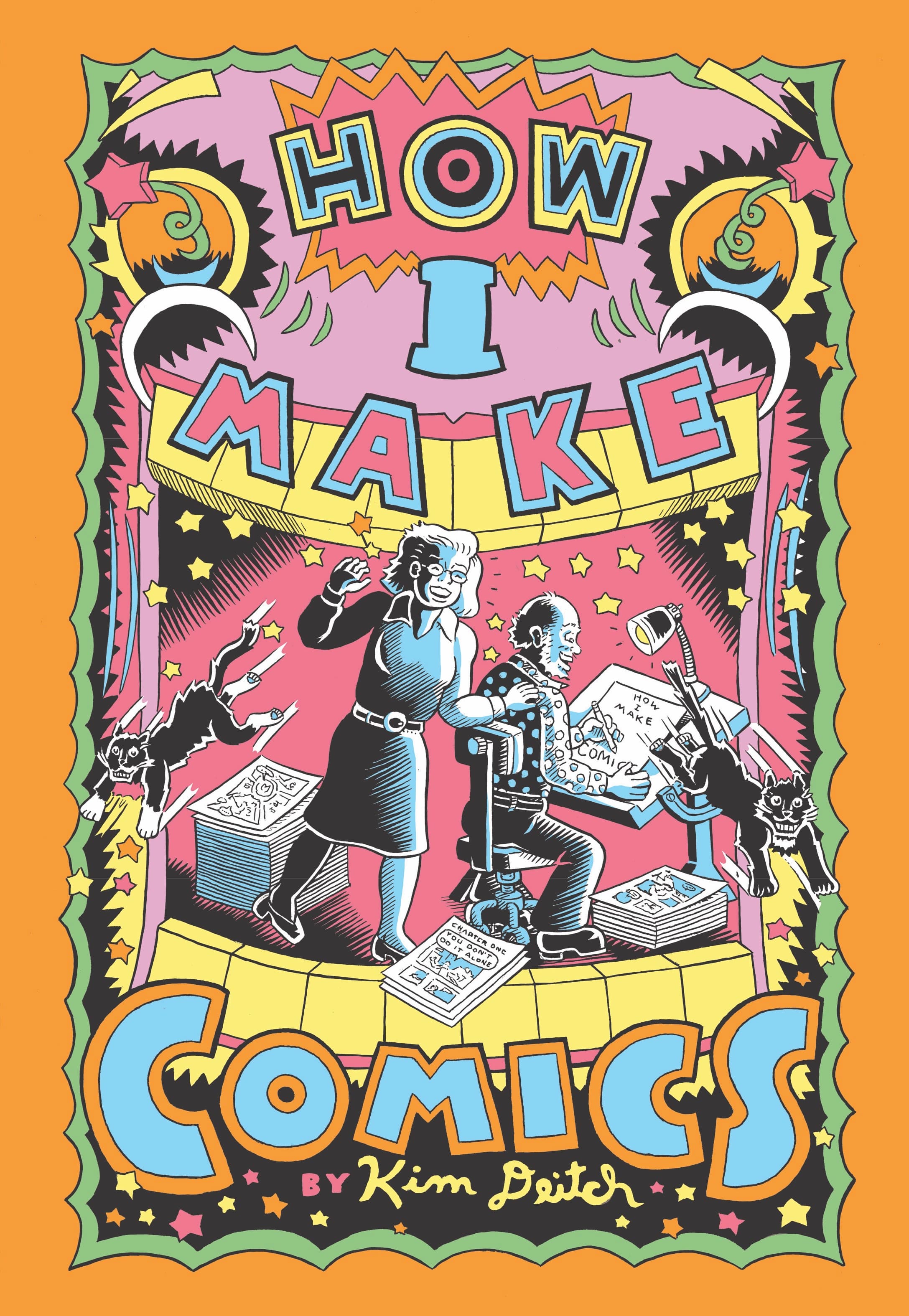
Like One Thousand and One Nights, The Decameron, and The Canterbury Tales, Deitch’s How I Make Comics is designed as a delivery system for stories. Here, he pitches one idea after another to his partner, Pam Butler, a regular presence in his autofictional work. Pacing an apartment stuffed with art, books, and cultural ephemera, Deitch pulls out story notes, character designs, layout pages, and other artifacts of his work process, slyly letting the reader in on his craft methods while giving each concept a hard sell to the partner whom he clearly adores. Each story idea, in its turn, comes to life as pages of comics bound into this volume and held between the reader’s hands.
Like his framing narrative, Deitch’s stories blend truth and fiction, covering personal and cultural history; he finds moments of particular narrative frisson when the two coincide. Deitch’s father, animator Gene Deitch, has made previous appearances in Deitch’s work (including in this book). How I Make Comics introduces Deitch’s mother, Marie. Drawing on her own voracious appetite for science fiction, Deitch dramatizes her casual friendship with seminal science fiction fan and Famous Monsters of Filmland editor Forrest J. Ackerman in a story that sees her rubbing elbows with author Ray Bradbury, illustrator Hannes Bok, and stop-motion pioneer Ray Harryhausen at Clifton’s Cafeteria in Los Angeles. Did this event happen? Only Deitch can say.

How I Make Comics sparkles with the author’s own sincere affection for authentic cultural artifacts, including Harold Gray’s Depression-era comic strip Little Orphan Annie and Golden Age superhero comic books of the 1930s and 1940s. Deitch’s comics are as dense as prose—he is one of the few artists who has truly taken the phrase “graphic novel” to heart. He never loses sight of the special fun of reading a good comic book, that inciting incident in the life of nearly every child reader who becomes a lifelong devotee, or a cartoonist themself.
For all the variety in the individual stories Deitch unfurls here, one persistent element is anthropomorphism. From the beginning of his career, he has drawn animal characters: in The Boulevard of Broken Dreams he relates how his signature character Waldo the Cat was inspired by the many Felix-like felines who populated early, black-and-white animated cartoons. How I Make Comics runs the entire anthropomorphic spectrum: people dressed as dogs, empathetic elephants, humans reincarnated as rats, hyper-evolved cats, a talking cartoon car, and variations on the man in the moon. Meanwhile, in the book’s framing sequences, the cartoonist’s pet cats careen through the apartment he and Butler share, its shelves heaving with antique stuffed animals.
Deitch’s lifelong love of animals—real and cartoon—runs through his work (he once drew a 3D comic book about the fate of a plucky circus pig). But the particular emphasis on anthropomorphism here seems appropriate to this book about storytelling. Stories extract strands from the overwhelming chaos of life. Life-threads are selected and arranged to construct and reveal patterns that have form: beginnings, ends, symmetries and asymmetries, repetition and variation, ironies, traumatic breaks and resolutions. In short, we reshape life to resemble the forms of our bodies, the rhythms of our consciousness, the shapes we give our lives. What makes a good story, Deitch’s book asks? A good story is one that feels solid and alive; something that resembles and reflects the human experience. The first anthropomorphic image in How I Make Comics is not an animal; it is the book’s own cover, an image of the exterior of Deitch’s own apartment bent to form a toothy, smiling face. At its heart is a window within which Kim is at his drawing table, happily drawing comics to Pam’s delight.
Bill Kartalopoulos is a multidisciplinary comics specialist whose primary research practice focuses on links between comics and various art and avant-garde movements. He teaches graduate courses about comics and graphic novels at Washington University in St. Louis, the School of Visual Arts in New York, and the Université de Picardie Jules Verne in Amiens, France. He recently co-curated Rewriting the World: Isidore Isou and the Lettrist Book at the Center for Book Arts. He is currently finishing a general history of North American comics, to be published by Princeton University Press, and is editing a second volume of Joe Brainard’s comics to be published by New York Review Books.