Michael Heizer: Negative Sculpture
Word count: 1415
Paragraphs: 9

Installation view: Michael Heizer: Negative Sculpture, Gagosian, New York, 2026. Courtesy Gagosian. Photo: Maris Hutchinson.
Gagosian
February 10–March 28, 2026
New York
Michael Heizer, now eighty-one and due to health issues residing in Manhattan, has lived much of his creative life in the public imagination as a cowboy artist, roaming and reshaping the open spaces of the American West. Yet the duality of rus/urbe—country/city—has been the presiding theme of his career. This show in Chelsea, his second since 2022 after not exhibiting in New York for seven years, feels like a return to roots. Its two parallel arabesques of trenches fill almost the entirety of the gallery. They are lined with weathering steel and inscribe themselves into an artificially constructed, roughly 16-inch-high concrete platform. Of recent design and titled Convoluted Line A and Convoluted Line B (both 2024), they directly reference the artist’s first significant earthwork: Nine Nevada Depressions (1968) in the Massacre Dry Lake and elsewhere, long ago withered by the elements. As a clear acknowledgment of that link, the small side gallery features 19 drawings for projects from 1966 to 1970—pleasantly inelegant designs with slanting print notations that presage the exquisite beauty and substantial power of the rendered concepts and sometimes address larger realities—one reads, “youth in Asia. 9/67 / euthanasia.” An intriguing early-stage sketch is of a small-scale scheme from 1967 that eventually would be expanded into the magnificent and monumental Collapse, executed in 2016 at Glenstone: a grand, rectangular, 16-foot-deep pit filled with fifteen massive and chaotically placed steel bars, like giant pickup sticks poking out of a shoebox. Vietnam War politics and American institutional breakdown are unexpectedly potent elements in these works. To realize Collapse in 2016 now seems eerily prescient.
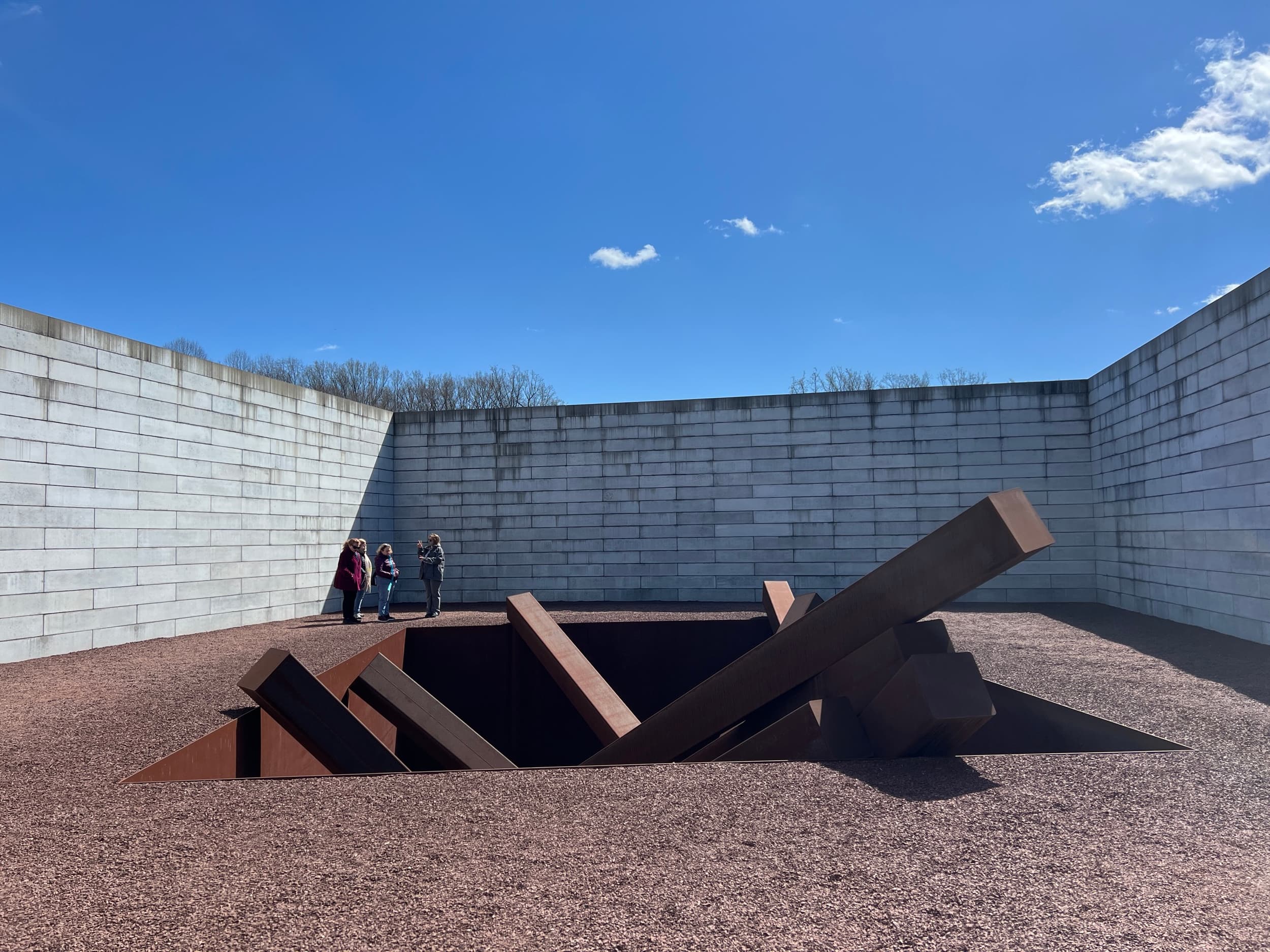
Michael Heizer, Collapse, 1967/2016. Photo courtesy Jason Rosenfeld.
At Gagosian, each “negative sculpture” trench is 15 inches wide and around 1,050 inches in lateral area (87 ½ feet). They are experienced by walking up ramps and around, but not across, their 14-inch-deep incisions in the raised gallery floor. Both ends of each Convoluted Line terminate just short of the gallery’s lateral walls; from above, the designs resemble lengths of rope with loops at one extremity and very loose knots in the middle. The channels are vacant but for a uniformly brown crushed granite lining their bottoms, the dark, pebbly texture visibly in contrast to the smooth light gray concrete of the raised floor. Unintended cracks have formed in the concrete between the gallery walls and the corner stress points of the steel trough, or where the ribboning gutters approach each other—but entropy was always part of the earthworks bargain. They are the latest version in a series of such looping steel trenches, such as Isolated Mass/Circumflex (#2) (1968/78), inset into the lush lawn at the Menil in Houston in 1987. On West 21st Street, the install took three weeks.

Installation view: Michael Heizer: Negative Sculpture, Gagosian, New York, 2026. Courtesy Gagosian. Photo: Maris Hutchinson.
This has always been the fascination of Heizer’s art: the planning, the process, the execution become sagas, as with Levitated Mass (2012) at the Los Angeles County Museum of Art and City (1970–2022) in the Nevada desert. After a 43-year gestation and fabrication period, Levitated Mass opened in 2012. You descend to a point under the suspended 340-ton granite rock via a 456-foot-long, V-shaped, 15-foot-wide staggered excavation that is also 15-feet deep at its nadir below. From the sidewalk, the rock magically seems to hover on a plain in front of the 6th Street side of the museum. The ground is covered with white crushed granite and encircled by a narrow strip of steel that forms an elongated, double u-shaped border about 20-feet wide at either long side and bisected by the cut’s entry points at either short end. It gently slopes down to the wide chevron of a ditch and from above the border resembles the Panathenaic Stadium in Athens or the Circus Maximus in Rome, with the cut as its spina. The boulder is similar in color to the textured ground around it, and at night it is unlit—a fin-shaped mass against Renzo Piano’s Resnick Pavilion, like Hart Crane‘s description of the Brooklyn Bridge: “Only in darkness is thy shadow clear.”

Michael Heizer, Levitated Mass, 1969/2012. Photo courtesy Jason Rosenfeld.
Levitated Mass is a chunk of Riverside County granite that took eleven days to be transported into the heart of LA’s Miracle Mile, a now legendary journey commensurate to Michelangelo moving his David from his studio near Florence’s Duomo to the Piazza della Signoria in 1504 (four days), or Cleopatra’s Needle being transported from the Hudson River to Central Park in 1880 (112 days). But while Levitated Mass is an example of rus in urbe, Heizer’s City in Nevada is the inverse: a meticulously planned urbe in rus that was conceived in 1970, executed consistently over half a century, and opened to the public in 2022. In a recent interview, the artist noted that it still was not finished—a few curbs and berms had yet to be completed or needed maintenance—but this was hardly evident on a visit there this past August. We city dwellers had to make our way into the natural wild via the artificial wild of Las Vegas, then drive just over a hundred miles north to Alamo, NV, and from there be driven over two hours along some sixty non-highway miles north to the site.

The title of the work, City, is as much a misnomer as Negative Sculpture, although the uninhabitable structures onsite are positively fabricated: additive as opposed to subtractive sculptures. A mile and a half long and half a mile wide at an elevation of 5,000 feet, City consists of gently undulating hills and dales all blanketed by a proprietary aggregate that blends many different colored rocks. From the air it looks like a vast, uniformly toned skate park, but on the ground the speckled material crunches satisfyingly underfoot, and as you round a bend you might find yourself on the edge of a depressed double u-shaped sunken stadium. Descending into one, you reach a point deeper than your height, where all that is visible is the vast sky; the distant mountains disappear and it becomes just you and the work. This unpopulated City—with its multiple angular, monumental, architectural forms that recall the sanctuary of Apollo at Delphi or mastabas or Mayan temples—is encircled and interconnected by a network of low concrete curbs that are essentially flowing drawings in the constructed landscape: every vista is picturesque, comprised of serpentine lines that entice you into another quadrant—an enterable, rococo folly. Heizer did not give the areas names because that would make them associative, but he gave them forms that elicit associations.

The intensely manicured nature of City and its three structures is in contradistinction to Double Negative of 1969–70, a 4-hour drive south-southwest from there in a high-clearance four-by-four along highways and up and across the rocky Mormon Mesa. Here, Heizer’s early penchant for DIY construction resulted in one of his most satisfying works, owned but little-maintained by the Museum of Contemporary Art, Los Angeles, although he recently said he would like them to restore it. The two excavated sections are 30 feet wide by 50 feet deep, and face each other across a cleft on the edge of the Virgin River Valley. You access the floor of the sculpture by scrambling down what were originally 45-degree ramps at either end, but that are now collapsed and unstable. Grand in scale and sublime in its attempt to evince a human creative presence on a seemingly impenetrable swathe of wuthered and water-formed earth, clambering down into its cavernous embrace—ruined walls and all—is a singularly thrilling experience.

Michael Heizer, Double Negative, 1969–70. Photo courtesy Jason Rosenfeld.
The newly wrought “negative sculptures” at Gagosian do what Heizer’s five Rock/Steel (2017– ) sculptures did in this same gallery four years ago, and what his Negative Megalith #5 (1998) at Dia Beacon continues to do: convey a sense of the ambition inherent in Land art, bringing the artist’s particular aesthetic blend of metallurgy and mineralogy into the concrete jungle. Convoluted Line A and Convoluted Line B take over the space and expand it in a manner that makes you curious for more. In a way, it is an inversion of the institutional critique that sent Heizer and Walter De Maria and Robert Smithson and Nancy Holt out West in the first place. But this octogenarian artist, backed by Gagosian funding and patrons, has somewhat managed to generously democratize the exclusivity of the remote Land art experience by bringing the outdoor sublime to a gallery near you. And we are the richer for it.
Jason Rosenfeld, Ph.D., is Distinguished Chair and Professor of Art History at Marymount Manhattan College. He was co-curator of the exhibitions John Everett Millais (Tate Britain, Van Gogh Museum), Pre-Raphaelites: Victorian Avant-Garde (Tate Britain and the National Gallery of Art, Washington, D.C.), and River Crossings (Olana and Cedar Grove, Hudson and Catskill, New York). He is a Senior Writer and Editor-at-Large for the Brooklyn Rail.