Abigail Lucien: Wrought
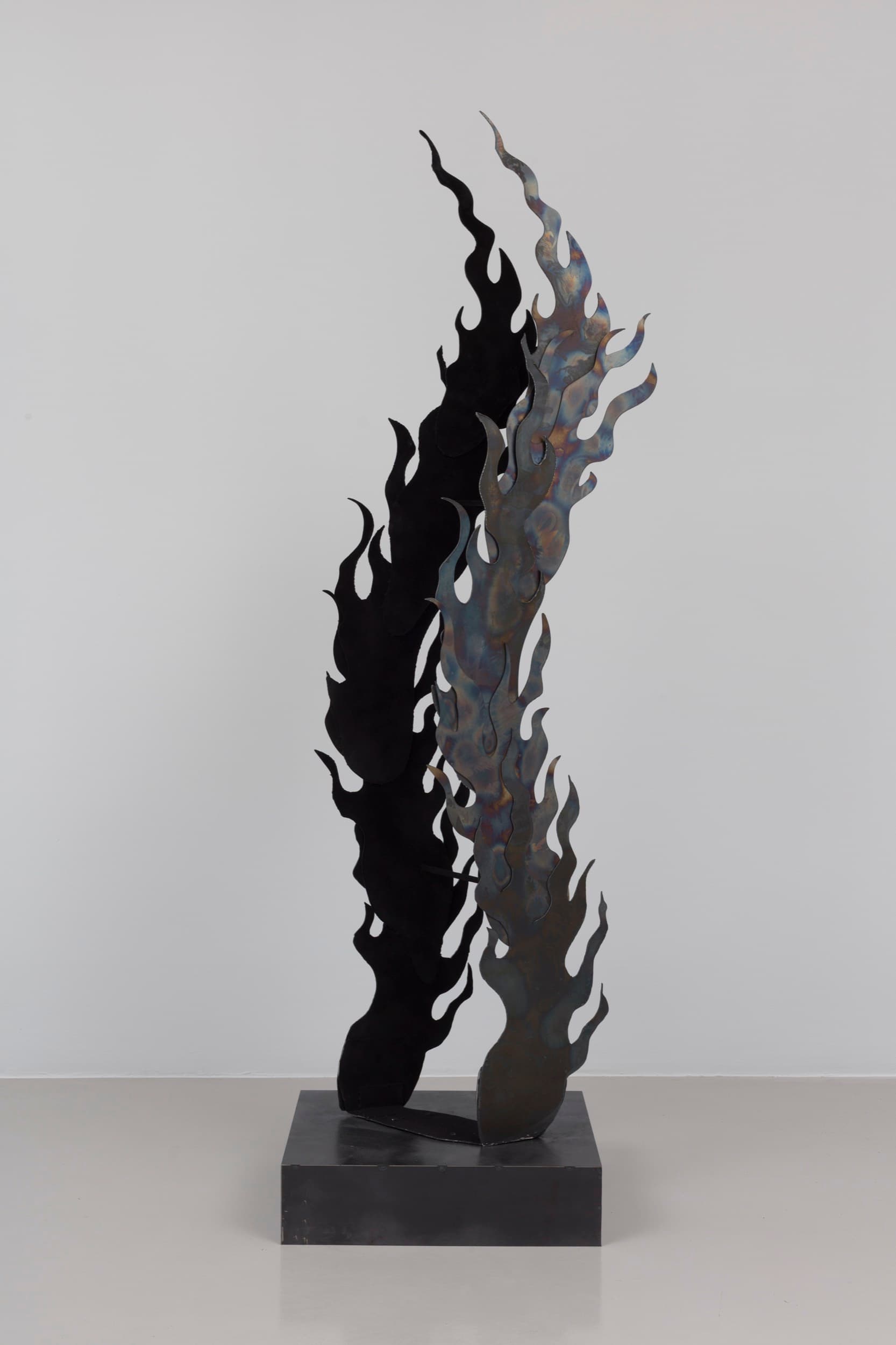
Abigail Lucien, Dèyè Dife, 2026. Rayon on steel, 86 1⁄2 × 24 × 2 inches. © Abigail Lucien. Courtesy the artist and Nicola Vassell Gallery. Photo: Lance Brewer.
Word count: 774
Paragraphs: 8
Nicola Vassell Gallery
March 12–April 18, 2026
New York
The sixteen sculptures on view in Wrought, Abigail Lucien’s first solo show at Nicola Vassell Gallery, depict cinder breezeblocks from a family home in the artist’s native Haiti, decorative iron window guards, woven bags of dried flower buds, and a ceiling-height birdcage containing a heart-stamped swing roughly scaled for a human body. These references speak to larger discourses on material as a keeper of memory (collective or individual), infrastructure and craftmaking lineages, trade routes and their attendant accumulations of labor, and the experience of belonging and difference. The themes that preoccupy Lucien are evident enough to be legible to most viewers, and a great reward of Wrought is the invitation for each of us to consider how they make meaning—come to matter—for us. What scents or shapes recall home? What would it look like to materialize memory or mythology, and could the process be reversed, in a kind of sublimation? How many hands worked to create your spoon, pencil, or phone? What transformations did all the things around us, including our bodies, pass through at a molecular level to reach their current states? Are these states of flux ever fully arrested?
Most of Lucien’s work is made of iron or its cousin steel—an alloy made up of iron and a small amount of carbon. Iron undergoes a long process of transformation to become usable: first it is mined, then smelted in a furnace, then refined, then cast or shaped, then given finishing surface treatments. The last two steps are part of Lucien’s artmaking process, though the work also evokes the material’s life across a longer temporal span. Although none of this prehistory is visible in the final work, the artist nevertheless finds strategies to make transformation and flux legible. In Dèyè Dife (2026), a towering floor work comprised of mirrored steel flames in contrapposto, Lucien dramatizes the theme by picturing—the first overarching strategy Lucien deploys in the exhibition—fire as an ever-morphing source of energy and agent of change.

Installation view: Abigail Lucien: Wrought, Nicola Vassell, New York, 2026. © Abigail Lucien. Courtesy the artist and Nicola Vassell Gallery. Photo: Lance Brewer.
We might next look to the wall sculpture To Unravel A Wrought (2026), which approximates those familiar box-shaped window grilles meant to offer protection to street-level apartment dwellers. Studded with steel flowers colored with red and blue enamel, To Unravel A Wrought suggests both growth and a state of undoing, since its steel strips unfurl from its frame. By staging this tension between the opposing yet dynamically related states of growth and undoing, the work gets closer to actually enacting mutability—which we might describe as Lucien’s second strategy. Even within this relatively focused exhibition, beginning to map Lucien’s approaches to moving between form and concept, or pictorial content and discourse, unifies seemingly distinct works on a single interpretive terrain. This may prove a useful hermeneutic as the artist prepares for a major solo exhibition at the Art Institute of Chicago this summer.
Lucien’s insistence on dynamic processes of material and belonging rejects static or fixed positions generally. The artist’s approach to sculpture, too, moves beyond the obdurate, physical thing itself, encompassing any kind of making, including associative chains or a viewer’s embodied response to the material. In a 2022 roundtable conversation with Gordon Hall, Lydia Ourahmane, and Michael Rakowitz, moderated by Mira Dayal for Art in America, Lucien posited “the idea of sculpture as an open method,” or as a kind of catalyst for allied activities that are not necessarily sculptural, like practices of care or rewriting history.

Installation view: Abigail Lucien: Wrought, Nicola Vassell, New York, 2026. © Abigail Lucien. Courtesy the artist and Nicola Vassell Gallery. Photo: Lance Brewer.
This expansive conception of sculpture feels especially powerful in the back gallery at Nicola Vassell, where Lucien’s three Makouti sculptures (all 2026) activate different aspects of the human sensorium. Each is a cast bag that appears to be made of the eponymous thatching material. The labor of weaving these dried strips of coconut palm leaves is replaced with casting; lightweight portability is replaced by iron’s unyielding weight. Lucien filled two of the three bags with dried hibiscus or lavender petals, offering us the possibility to tap into an olfactory archive that the body holds separate from memories tied to language. Provoking sensory response via different registers widens sculpture’s “open method” to encompass not just the act of making, but also the act of apprehension. Lucien’s approach is inclusive, resisting an ancient hierarchy of senses that prioritized vision’s cognitive value and assumed relation to truth.
Lucien’s work in Wrought is remarkable for how consistently and effectively it shuttles viewers between the realms of material and discourse, an experience that rewires how we relate to the past and how we position ourselves to act in the future.
Elizabeth Buhe is a critic and art historian based in New York.