Merrill Wagner: Marking Time
Word count: 845
Paragraphs: 9
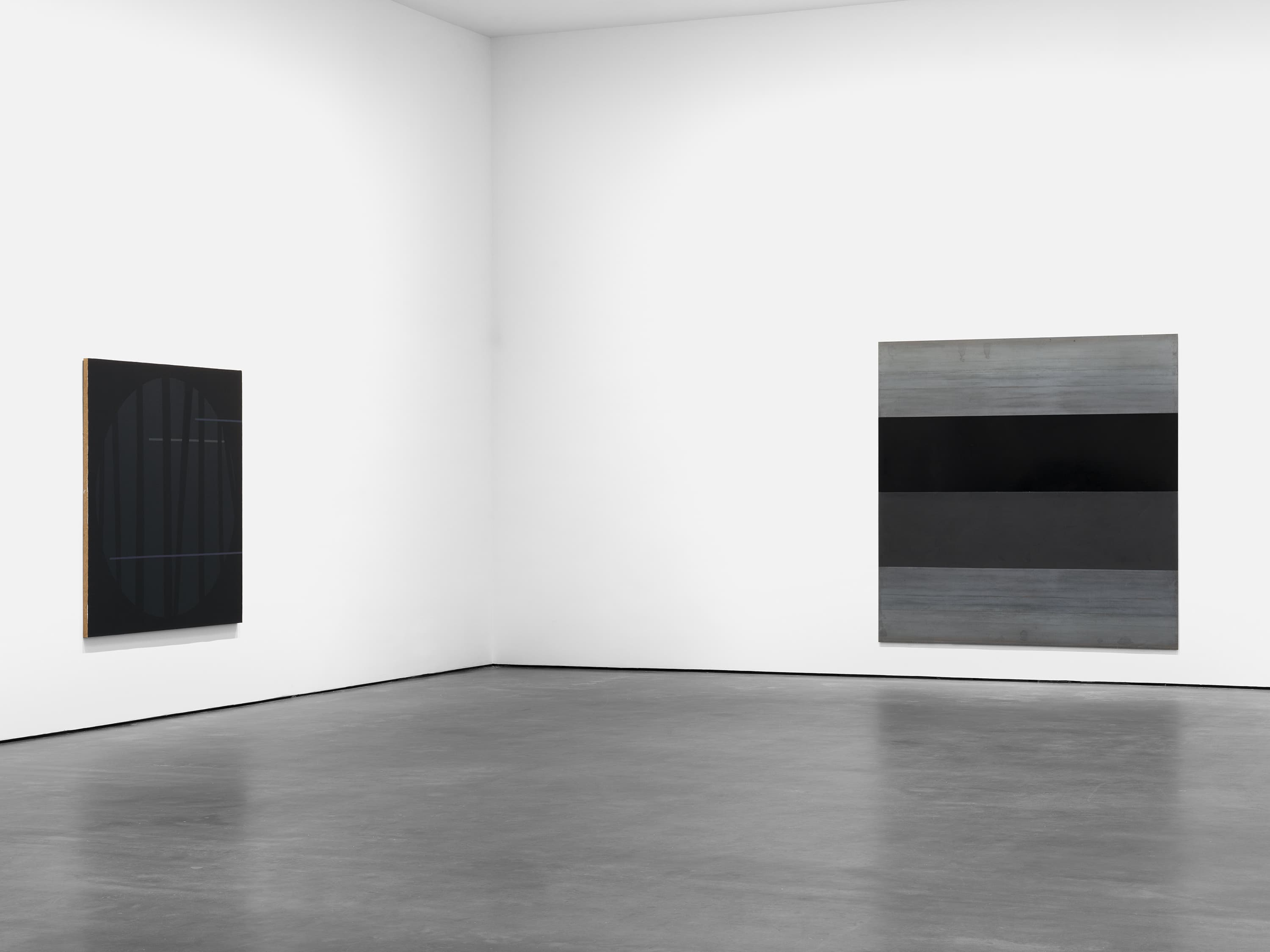
Installation view: Merrill Wagner: Marking Time, David Zwirner, New York, 2026. Courtesy David Zwirner.
David Zwirner
March 12–April 18, 2026
New York
When artists find their style, something like a religious conversion takes place. David Zwirner’s superb exhibition of Merrill Wagner’s work shows us the history of such a mystical marriage. Ranging from 1967 to 2017, the work on view here testifies to Wagner’s union with a style we could call found geometry: the geometry of fragmented stone or the planks in a fence. The interface between the artist and the world she inhabits takes the form of a combination of nature, banal artifacts, and a highly charged sensibility.
By 1967, Wagner’s artmaking had assumed a specific identity. She is a Minimalist, and like others of that school—Donald Judd, Agnes Martin, Anne Truitt, Carl Andre—her work hovers on the frontier between painting and sculpture. For Wagner, the very distinction between those two modalities has no validity. A look at the earliest piece in this large, twenty-one work show, brings us to her point of departure. Untitled (1967) is a large acrylic on linen, 72 inches square. An essentially monochrome painting, the surface is marked by barely visible vertical columns and three horizontal lines. It would be easy to overlook this self-effacing work, but it exemplifies several qualities that reappear throughout Wagner’s career. The surface is space, the vertical lines a fence or demarcation, the horizontal stripes a sealing-off of the pictorial plane. The painting is a Hortus Conclusus, an enclosed garden, but not in any religious sense: Wagner has created the private universe she inhabits.

Merrill Wagner, Untitled, 1975. © 2026 Merrill Wagner. Courtesy the artist and David Zwirner
The six works from the 1970s that are included here play with the idea of the ephemeral: strips of tape placed on a surface, either paper or plexiglass. Untitled (1975), 11 by 14 inches, consists of nine strips of masking tape stacked horizontally and embellished with pencil hashmarks. This piece plays with the idea of the work of art as a private utopia. The masking tape signals fragility, the pencil scribbling the presence of the artist herself. Untitled (1979) is a quadriptych, oil and cloth tape on four 40-inch squares of plexiglass. This large work hints at motion by moving us from bright yellow on the left to dark green on the right, but the sense of motion reads as temporal progression, reminding us that any work of art is subject to the ravages of time—fading paint, disintegrating tape, crumbling paper, fatiguing plexiglass.
During the 1980s, Wagner deployed more durable materials than those she used in the 1970s. But they still remind us of the impermanence of all works of art. Gorges (1986) is an assemblage composed of casein, oil, and acrylic on slate blackboard fragments. Someone destroyed those sheets of slate that children used to learn arithmetic, and Wagner transformed the remnants into a painted mountain range. This amazing and monumental piece, measuring 50 by 240 inches, is both painting and sculpture. Wagner does not imitate nature here but instead creates her own, composing it from broken geometric figures and subdued color that runs from blue on the left to black on the far right. The Hortus Conclusus has now become a world unto itself.

Installation view: Merrill Wagner: Marking Time, David Zwirner, New York, 2026. Courtesy David Zwirner.
Untitled (1987), a 15 by 39-inch oil on marble, is another notable work from the 1980s. Here Wagner, again, assembles fragments, pieces of white marble she fits together like a deliberately incomplete jigsaw puzzle. On the surface assembled from these shards the artist inscribes a black figure, either a scalene triangle or an abortive rhomboid. As she did with Gorges, Wagner takes remains, monuments to impermanence, and composes a totality some future cataclysm may yet smash to pieces.
Wagner’s challenge to time, echoed in the show’s title, expresses itself with full irony in her works on steel plates. Charleton Street (1988), measuring 48 by 48 inches, is a cruciform steel assemblage with a section covered by rust preventive paint. Here Wagner points out that the steel—armor plating deployed to protect painting from attack—itself needs a few microns of paint or it will rust away to nothing. The piece is a Minimalist archetype: planes superimposed on planes. Geometry itself is transformed into an ephemeral utopia. But all of Wagner’s complexity finds expression in the magnificent Cat’s Cradle (1989). Measuring 42 by 69 inches, this is a strange kind of collage composed of oil pastel, sewing thread, sewing hooks, steel, and slate. Wagner’s ars combinatoria (art of combination) takes the ruins of time, fragments harvested at random, and transforms them into something strange and new. The steel seems to hold the slate in place while the thread plays over the surface, suggesting an aeolian harp as well as the child’s game identified by the work’s title.
Wagner’s work of the current century takes a different emotional stance: nostalgia. Three small oils on linen, these works are nature studies picturing trees, bushes, a forest, all in a style reminiscent of Samuel Palmer. This is not nature as it is but nature as Wagner remakes it in her own image—a fitting capstone to this tremendous show.
Alfred Mac Adam is Professor of Latin American literature at Barnard College-Columbia University. He is a translator, most recently of Juan Villoro’s Horizontal Vertigo (2021), about Mexico City.