Emmet Gowin: Baldwin Street: Photographs 1966–1994
Word count: 876
Paragraphs: 8
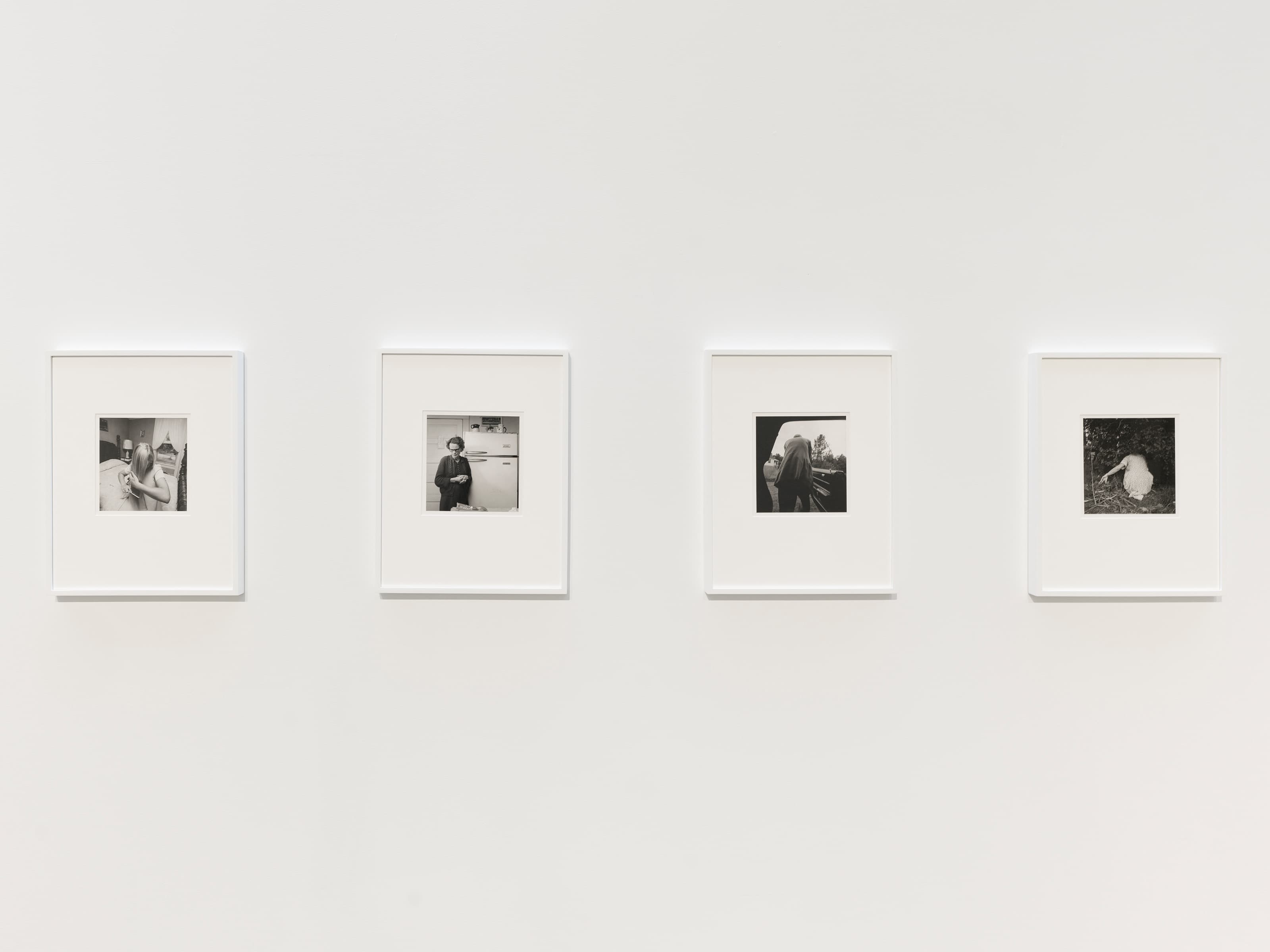
Installation view: Emmet Gowin: Baldwin Street: Photographs 1966–1994, Pace Gallery, 2026. New York. Courtesy Pace Gallery.
Pace Gallery
March 12–April 25, 2026
New York
I never saw my father clearly until he was dead. My mother woke me in the middle of the night, and I looked at him, just deceased, with a mixture of dispossession and utter clarity. Smaller now, he was divested of all the conversations, misunderstandings, and disappointments that had made our lives together a series of gaps. He was gone, and now it would be up to me to bring him back in a form more generous, forgiving, confident, and true. This negotiation with the dead became the task—perhaps the only task—of a lifetime.
Photographs work, over time, through just this kind of dispossession and utter clarity. What we thought we knew is no longer ours. But what is there in front of us reminds us of what we do or fail to do as stewards of memory. Dispossession and utter clarity are how the luminous photographs of Emmet Gowin solicit us. These terms are also how the images must have solicited him. Most of these photographs, shot in a square format on black-and-white film with a Rollei camera, appear now for the first time in public, as retrospect. Gowin went through pictures he made from the 1960s through the 90s and selected images that in the past were mute, passed over and never exhibited. But now they spoke to him. When you get older, you lose things and people, and you see with different eyes. Gowin is traveling among the shades here, and every one of the people in the photographs, even those still living (but, of course, older) poses the question: why have we been brought back? The answers are as numerous as the photographs themselves.
To some degree I feel I could have taken these photographs myself, because they populate a place that has become almost as familiar as William Faulkner’s Yoknapatawpha County. Gowin’s rural home territory in Danville, Virginia—Baldwin Street in particular—is populated by neighbors and family. He has been photographing them for decades. Most prominent are his wife Edith Morris and her family, who have come to occupy a kind of mythic status in photography. We know them. But we don’t, really, and these photographs present them again as if newly ensconced in their world. They have become occasions for light and shadow, gesture and stasis. Gowin may not have marveled when he shot these; possibly he forgot them almost instantly, but now they are cause for wonder at how what is so precious can hover at the edge of sight.

Emmet Gowin, Ruth in Her Mother’s Kitchen, Danville, Virginia, 1968. Gelatin silver print. 6 5/8 × 6 9/16 inches. © Emmet Gowin. Courtesy Pace Gallery.
There’s Reva Booher Morris weeding, her rounded form half disappearing into the darkness under a bush. Ruth with her hair in curlers looks as if she has been surprised by a question from the beyond. Meanwhile, Gowin’s father, referred to as Pastor Gowin, who was indeed a Methodist minister, is captured picking figs. Gaunt and dignified in white shirt, necktie, and suspenders, he might actually be looking up in search of fruit, but he seems rather to be in communication with something else, with himself or the deity. I can only imagine what thoughts of recognition and strangeness this photograph must have provoked in the photographer.
I noticed that fridges figure importantly in several of these photographs. In the rural south, quite apart from keeping things cool, they function as symbols of domestic solidity and economic modernity. Yet something else happens with Maggie in her kitchen. Her brow contracted in thought, hands intensely intertwined, she stands owl-eyed in front of her Frigidaire, the anxious guardian of a box of treasures. Margaret Ennis Booher Cooper (Reva is her sister) has her own backstory. Known affectionately by everyone in the Danville cul-de-sac as Aunt Maggie, she was the subject of a joint 2008 photographic essay by Gowin and his son Elijah, also a photographer, with a preface by Edith. The pictures by father and son are very different, but in the end feel like two sides of a coin, the magic of the real and magical realism.
A young girl combing her blond hair, a man getting out of a car, the view of a baby angled in such a way that we see nothing but toes—the ludicrous, the transcendent, and the inexplicable jostle each other as they tend to in life, often without our notice. They are as fleeting and imperishable as the figures on John Keats’s “Ode on a Grecian urn.” That these photographs can make such a claim on us comes in part from their format. The Rollei requires the photographer to look down through the camera, held below eye level, to frame the picture. So the photographs tend to have “the slows,” as Abraham Lincoln said of General George McClellan. No drive-by shooting. Instead, attentiveness. The square further imposes a sense of regularity and strengthens the analogy of photographs to windows. They almost require us to peer, to wait and anticipate revelation rather than glance and move on. That moment of peering is the time when the dead return, to awaken memory and association and to challenge our certainties, not to mention our presumption at still being alive. We are reminded that, regardless, it is a gift.
Lyle Rexer is the author of many books, including How to Look at Outsider Art (2005), The Edge of Vision: The Rise of Abstraction in Photography (2009) and The Critical Eye: 15 Pictures to Understand Photography (2019). The Book of Crow, his first work of fiction, parts of which first appeared in the Brooklyn Rail, has recently been published by Spuyten Duyvil Press.