Performing Chance: The Art of Alison Knowles In/Out of Fluxus
In this monograph, the compulsion to transmute the open-endedness of Knowles’s work into an explicit economy of care speaks to present-day insecurities about practices whose politics are subtle rather than overt.
Word count: 686
Paragraphs: 8
Nicole L. Woods
University of Chicago
2026
In 2000, Fluxus artist Alison Knowles completed Footnotes: Collage Journal 30 Years, a compendium of reproduced annotations, drawings, and found materials from travel diaries spanning several decades. When the project was complete, Knowles glued the original hardbound notebooks and their pages into a single object, a block of time. Already non-linear, now unreadable, the object underscores Knowles’s essential anachronism, resisting inscription within time’s driving, persistent logics. The pasted pages of Knowles’s diaries illuminate the fundamental difficulty of writing the history of her life and work.
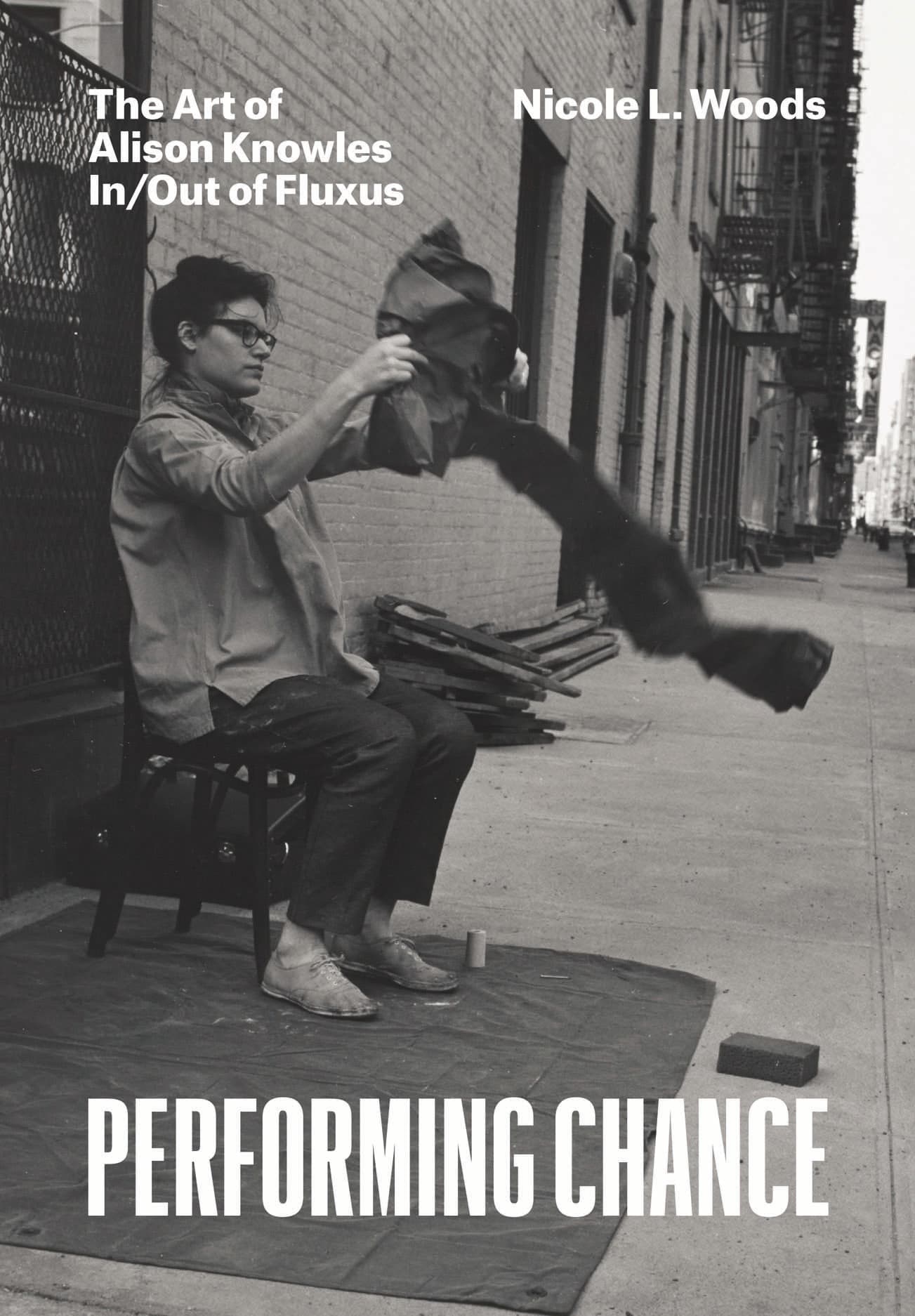
Nicole L. Woods’s recent publication Performing Chance: The Art of Alison Knowles In/Out of Fluxus undertakes precisely that provocation. Her tireless work in setting down the chronology and cross-referencing anecdote with evidence for this monograph on Knowles is invaluable. Yet I found myself hesitating over its arguments regarding intent, particularly those at odds with stances voiced by the artist herself.
As Woods acknowledges in the introductory pages of the book, Knowles characterized herself as an artist “who happened to be a woman.” At odds with the second-wave women artists who incorporated their politics into their practices, she understood herself to be a feminist, but did not read her own work through that lens. In an oral history for the Archives of American Art, she shrugged off any sense of having been “shouldered out” as a female artist in a male-dominated art world. Later in the same conversation, she stated tersely, “I’m not abused, ever, in what I do.”
In light of Knowles’s position, Woods’s book is necessarily revisionist; she presents the artist as a proto-feminist figure who radically inscribed gendered consciousness onto post-Cagean practice and arbitrated liberal sympathies, motherhood, and creative work. She marshals Knowles’s use of commonplace materials (“beans, shoes, paper, and other stuffs of the domestic sphere”) as a technique through which the artist eroded the divisions between public and private, platforming an otherwise invisible home-based and (it is implied) feminine world. But I found myself wondering whether shoes were, in fact, domestically coded—or beans, for that matter.
Woods’s attempt to claim a cult of dailiness, which is shared by many Fluxus practitioners, for her proto-feminist lens is surprising. She does not address the parallels between quotidian works by Knowles and those of her male contemporaries. Woods describes how Knowles’s Proposition #3: Nivea Cream Piece for Oscar Williams (1962)—in which a group of performers massaged squelching quantities of cream into their hands before a microphone—recontextualized a private act of personal hygiene in aural terms. In a comparable corporeal intimacy, Knowles and her then-husband Dick Higgins performed his Danger Music Number Two: Hat. Rags. Paper. Heave. Shave (1961) as a close shave of his head of hair, punctuated by other events like launching paper sheaves into the audience. Woods astutely observes that Higgins’s work reveals a tableau of domiciliary companionship—but doesn’t comment on how it stands in relation to her overarching argument for the political content of Knowles’s work. Assuming Woods’s position on the implicit radicality of interpolating public and private spheres, might we frame Fluxus more broadly as latent with feminist tendencies? Woods’s compulsion to transmute the open-endedness of Knowles’s work into an explicit economy of care speaks to present-day insecurities about practices whose politics are subtle rather than overt.
Knowles merits in-depth analysis; but I can’t help feeling that there is something intrinsic to the attitudes of monographic writing that runs counter to her work. She felt that soloist performance was “antithetical to Fluxus,” which to her represented a group practice entailing both collaborative exuberance and social friction. Her #10a Variation #1 on #10: String Piece (1964)—in which she tied up the audience and was tied up in turn—can be seen as a visualization of that mutually constituted milieu. Woods attempts to reconcile the monograph’s partisan perspective with Knowles’s collaborative spirit, emphasizing the artist’s anti-authorial approach and the porosity of the resulting work. Nonetheless, Woods never quite escapes a single-minded focus on Knowles that isolates the artist and obscures a sense of her work as part of an expansive dialogue.
Nicole Kaack is an independent curator and writer. Kaack's writing has been published by Whitehot Magazine, artcritical, Art Viewer, SFAQ / NYAQ / AQ, Artforum, the Brooklyn Rail, Sound American, and BOMB. Kaack has organized exhibitions and programs at Small Editions, the Re: Art Show, CRUSH CURATORIAL, NURTUREart, Assembly Room, The Kitchen, Hunter College, A.I.R. Gallery, and HESSE FLATOW. Kaack’s projects include prompt: and Not Nothing.