Alejandro Cartagena’s Ground Rules
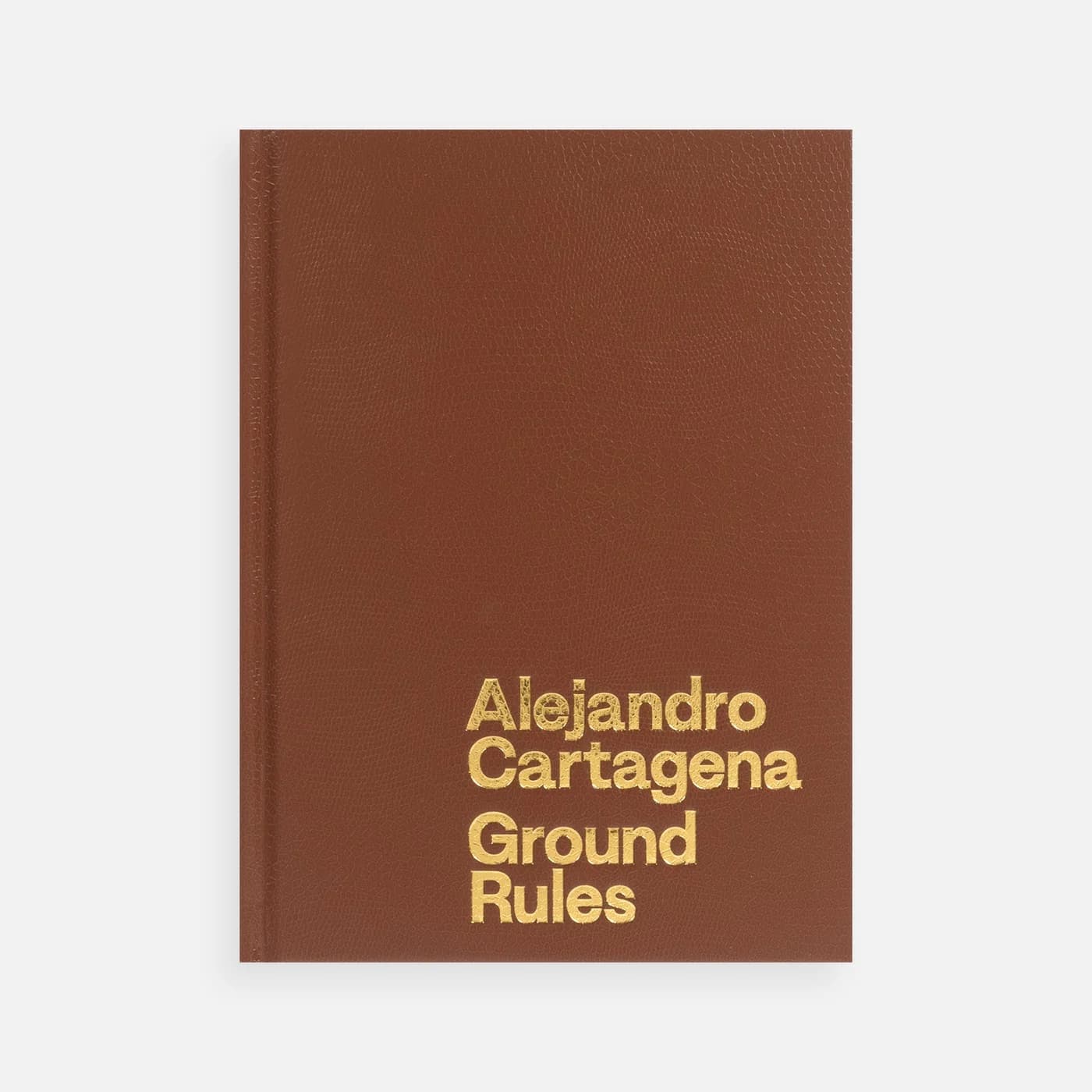
This monograph distills a multifaceted career spanning more than thirty photographic series, faces the challenge of presenting diverse bodies of work, including photobooks.
Word count: 796
Paragraphs: 7
Alejandro Cartagena
Aperture, 2025
Ground Rules, published on the occasion of Alejandro Cartagena’s retrospective at the San Francisco Museum of Modern Art (on view through April 19), distills a multifaceted career spanning more than twenty photographic series. As with any retrospective catalogue, this one faces the challenge of presenting diverse bodies of work in an engaging way, a matter further complicated by Cartagena’s voluminous photobook production—the pages of a book are not always suited to capture the experience of browsing through another book. Cartagena has predominantly worked in documentary photography, with the urban landscape his most explored topic. Many of his series focus on the Mexican city of Monterrey, where the Dominican-born artist moved as a young man and has resided since. Ground Rules opens with a career overview that doubles as a biographical sketch by the exhibition’s curator, Shana Lopes. The rest is divided into four image sections, including one devoted to photobooks. Each section is followed by a short critical essay, a structure devised to cover the most ground in the fewest possible pages.
Considerable space is dedicated to Suburbia Mexicana (2005–10), a powerful denunciation of how politics and corruption undermine affordable housing developments intended for the working classes. This was the first series to bring Cartagena widespread international acclaim. Many of these images depict near-dystopian sites, with rows of identical houses extending as far as the eye can see. The multi-layered work also captured the inhabitants of these dwellings. Their faces betray their hopes and dreams as much as their troubles in making these inadequate structures their homes. Another component of the series centers on the ecological impact of these housing developments on nearby waterways, a dangerous consequence of urbanization in a state that suffers from extreme droughts. About a decade later, Cartagena returned to the subject in A Small Guide to Homeownership (2020), a photobook in which he resampled material from Suburbia Mexicana and other series. The book imitates the recognizable format of the popular For Dummies guides to examine the economic and bureaucratic struggles of buying a house in Mexico. The photobook’s strong concept landed Cartagena on the shortlist for the Deutsche Börse, one of photography’s most respected awards.

Nevertheless, Cartagena is best known for his ingenious, if less intricate, series Carpoolers (2014), which depicts workers riding on the flatbeds of trucks to their jobs. Taken from a pedestrian bridge, the images’ top-down views highlight a social dynamic hidden in plain sight, an approach that encapsulates Cartagena’s ethos. In the book’s first section, the series is presented as grids of images, including a selection of Carpoolers, but also lesser-known works like Roma Parking (2012–13), which consists of close-ups of car bumpers, made in Italy’s capital, standing only a few inches apart. The second photography section in the book features a selection of the series enlarged to fill the page (one per spread if they are horizontal pictures, or one per page if they are in a vertical orientation).
Over time, the visually striking imagery of Carpoolers has come to eclipse Cartagena’s other works. It is perhaps this success that prompted him to try out more synthetic artistic strategies in subsequent projects. Cartagena’s AI-generated work in Ground Rules may further distance some readers from the values and expectations of documentary photography. For instance, in We Sell Homes (2025), Cartagena fed real estate advertisements to a self-built Generative Adversarial Network (GAN) to generate distorted variations of houses and apartments. The resulting images look like a cross between children’s illustrations and modernist abstractions. While these grids of AI-generated images occupy a marginal space in the book—the last chapter comprises just three works over seven pages—they don’t hold the same level of interest, authenticity, and charm as the earlier documentary work. Their presence, however, sets the stage for a necessary discussion of the testimonial power of photography and the ethical implications of these technologies.

Unfortunately, the critical essays don’t do much to expand our understanding of Cartagena’s work, mostly because they are unnecessarily short. The best of these accompanying texts is the interview between Cartagena and the art historian Charlotte Kent, in which the artist gets a chance to defend his unmitigated enthusiasm for AI works (“the origin of the cultural value of my work is digital,” he asserts). It will be exciting to see if Cartagena’s future direction brings him closer to the documentary spirit of his beginnings or if he continues to explore the complexities of the networked image. In this sense, Ground Rules can be seen as an example of the recurring conflict in photography between authenticity and technological advancements that reaches a boiling point every few decades (although what is at stake now with AI has implications beyond aesthetic attitudes).
Arturo Soto is a Mexican photographer, writer, and educator.