BooksMarch 2026In Conversation
SABA SAMS with Hannah Burns
Word count: 2740
Paragraphs: 41
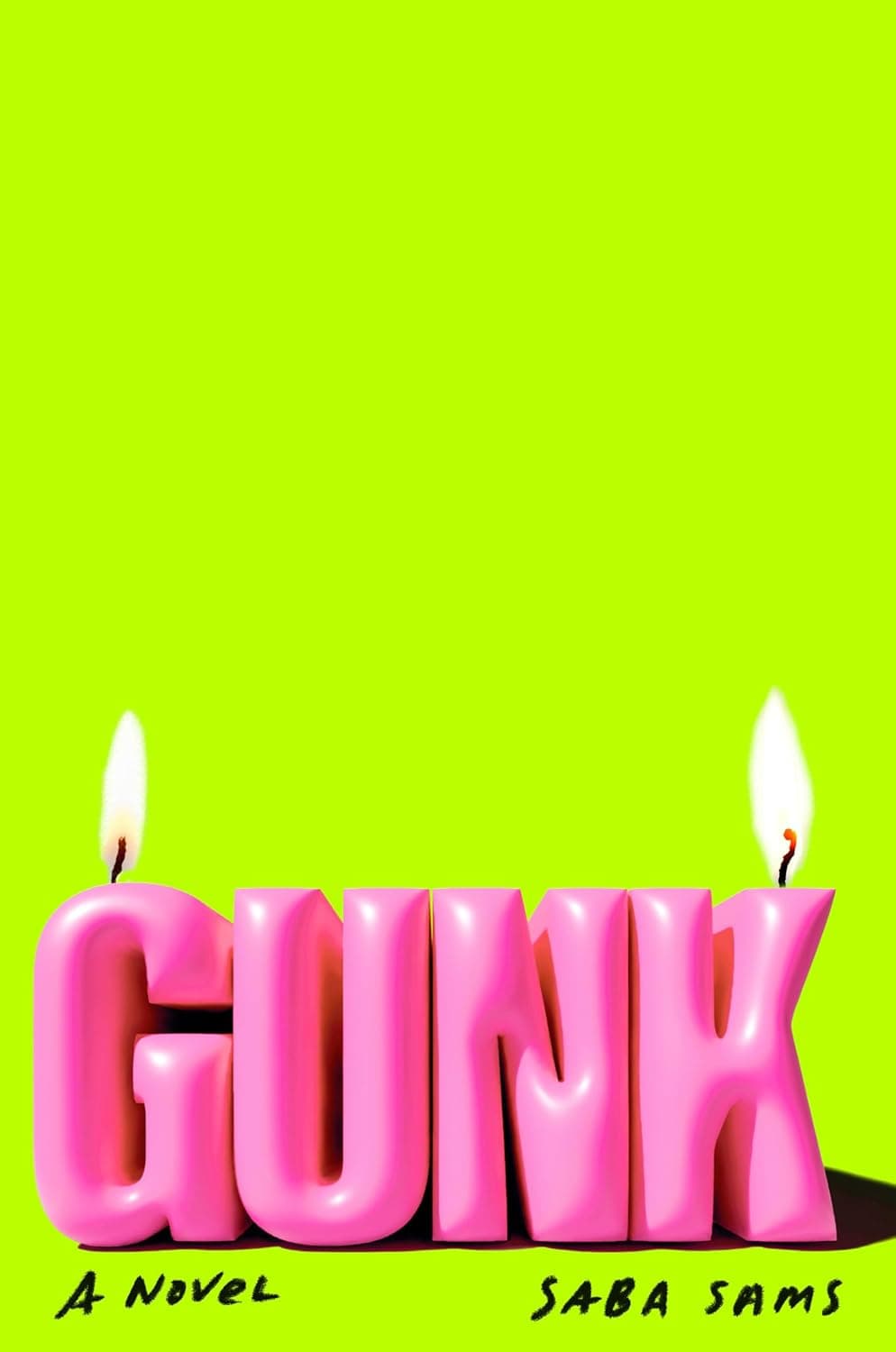
Gunk
Knopf, 2026
Nearly nine months after Gunk had its UK release, I had the chance to chat with Saba Sams over zoom. Gunk is as much a book about labor and the transactional nature of relationships under capitalism as it is a subtle exploration of what we ask from the people we love in the messiness (gunkiness) of life. Its nuance challenges the reader to look past what we want for the characters and to witness what is there. Gunk has a tender realism at the heart of it, which wins the reader with small moments of awe. I talked with Sams about the letting-go part of publishing, as her characters find new audiences.
Hannah Burns (Rail): How do you feel about people talking about books like they are children? Saying things like, “You’ve birthed this book into the world.”
Saba Sams: I actually don’t mind it. Motherhood is really divisive, right? I feel like women are kind of separated by whether or not they’re mothers, and Gunk was trying to write against that whole idea, and I genuinely feel against that whole idea. I think that birthing a book is the same kind of vein. Like, when people describe their pets as their babies, I’m into that. I think that’s cool.
Rail: That motherhood can be a whole range of things.
Sams: Yeah, we can make it bigger. I don’t find writing dissimilar to having a baby. You know, there’s the pregnancy where it’s kind of growing in your mind, and you just can’t stop thinking about it, but you don’t really know what it is. And then you have your first draft, and you meet this book. I feel like there’s nothing you can really do about it then, because it is its own thing. It’s just arrived, and you have to just work with it, you know?
Rail: And you’re trying to shape it, but it’s kind of telling you what it needs.
Sams: Yeah, exactly. You made it, but it’s completely not yours. And then the whole publishing thing, that is like okay, see you after school, you know?
Rail: And then eventually you’re an empty nester and the book visits you occasionally…
Sams: Expanding motherhood is the whole point of what I was trying to do with this book, so I like that question. There are a lot of books about motherhood. It’s obviously a topic that is well trodden in the sense of writing about the experience of traditionally how it is to be a mother. To be pregnant, to give birth, to raise children that are biologically yours. I was trying not to write that book, but then I also really wanted to write a birth scene. Because I could see it. It was actually the first scene that I wrote. I just sat down and wrote that scene, and I didn’t even know what it was, or why I’d written it, or whether it was a book. Then the whole plot fell out of that. I think I just was really interested in making the reader a witness to a birth.
Rail: Right. And it did have that urgency to it, that scene, that feels like it was written first.
Sams: Yeah, it was hardly edited, it just kind of came out.
Rail: And it’s so visceral, you have that line that’s like, “when would this get beautiful?” The moment of connection, of Jules witnessing Nim giving birth, because of her awe, there’s a lot of beauty there despite the question. And there’s so many moments of awe in the book.
Sams: Making the really small moments feel really big, that’s always where I’m trying to get to when I’m writing. That’s the energy, I think, that I’m looking for. I wanted to make the reader a witness because I had this idea that if you could witness a birth, you could also be a mother. Like, maybe you don’t have to do it as much as allow it into your mind and allow it into the room, rather than creating this kind of private club of women whose bodies have done a certain thing. Cause that’s the thing, really, I think that’s why mothers feel so protective of the word mother. Because it’s not only that your body’s doing this huge physical feat, it’s that you’re in a world where no one really cares. That’s the thing that you want to fight for, you know? But then you end up fighting for the wrong thing, which is this really reductive biological exclusivity. Which is not what it’s about at all. So yeah, somehow Gunk was just trying to marry those two ideas of can I do the birth scene, but can I also write about how you don’t have to give birth to become a mother?
Rail: And that was the key point of connection for Jules and Nim, that witnessing. I loved the relationship between Jules and Nim, really, I loved that it kind of defies categorization. But I wondered if you were maybe pushing the reader to question our assumptions of why we want them to have a romantic connection. Even with the age gap, I felt myself wanting them to be together romantically. And I liked that the story met me with resistance.
Sams: When I was writing, I felt exactly the same. And I was just waiting to write the kiss, you know? And I could feel myself being like, “Hmm, when’s the kiss coming?” And then I had to really check myself, because I was leaning into all of these traditional expectations of a relationship that I was actually trying to write against. Initially, I wanted them to fall into every single definition, because, you know, I was thinking about what motherhood was and the definition of a mother. Then I was like, “Oh, let’s make them feel like mother and daughter, but then the roles flip.” And making them housemates, and making them work together, all of the categories could be ticked. I think I was like, “Oh, let’s make them everything, and then let’s also make them romantic. Let’s make them a couple.” I’m not saying that I made them everything, so then I made them nothing, but it’s like, I don’t think they could ever slip into any kind of category, really, because then it would be over, you know? Once the hard definition is there, all of the amazing nuance and electricity of their relationship would die. So I think I realized that by trying to push for this kiss scene, I would just be killing the juicy part of the book.
Rail: The tension of what they are to each other really propels it forward.
Sams: Because we’re all waiting for the kiss, I guess. I’m interested in the ways that we categorize relationships, right? It’s so funny that we give them very careful slots. And then because of what we’re calling our relationships, I think we can also fall into patterns of how we treat each other, right? Like, there are certain things that you would not help a friend with that you would help your romantic partner with, like looking after them when they’re sick. And I think I was asking, how do we really mess that up and what might happen? Would it not work at all? Is there a real rationality to this? But in the end, I think they basically are able to love each other in a way that’s deeper and better, and they’re able to care for each other in a way that’s deeper and better, than if they had to define it.
Rail: And I think that while Jules might not have been totally aware of what she was doing by not agreeing to a category with Nim, I felt like she was protecting this person in her life and wanting there to be longevity in their relationship. And they had such incredible physical intimacy too, like the scene in the bathtub.
Sams: There are so many rules for these categories, the way that you can touch someone else’s body, or the way that you can feel for someone else. We talked about the age gap, and it could get quite uncomfortable a lot of the time writing it. And a lot of the Goodreads comments that I see are about the age gap. The people that hated it, it’s because of the age gap. I guess that’s the gunky thing: that I was trying to make everything a bit uncomfortable and lean into the mess.
Rail: Was there always an age gap when you started writing?
Sams: I wanted to write about the experience of a young pregnancy, because that had been my experience. And I thought there was something in that very sudden movement from being a young woman to being a mother. I wanted to explore that. But then I also knew that this young mother in my book would not be keeping the baby, and I needed someone who had wanted a baby for a long time.
Rail: That makes sense. It’s like the scene where Nim was so pregnant and losing herself dancing in the club, at Gunk. And it’s gunky, like you said, the kind of discomfort of seeing something unusual, and how people made space for her on the dance floor.
Sams: She pushes the rules away. And yeah, it’s kind of uncomfortable to read about a pregnant woman drinking beers, but it also just kind of had to be in there. I think my favorite characters are young women who feel very wise in their youth. I feel like the way Nim is in her body, and the way she throws herself into experience is… it’s kind of naive, but it’s also really wise. It’s kind of both things at once. And I see that a lot with young women like that.
Rail: Yeah, the way they move through the world is like they haven’t learned what they need to unlearn yet. Like Nim would never put up with Leon the way Jules did, but it’s different. There was love between them. I want to talk about the way that Leon was handled with such tenderness but there’s every reason to hate him. And there’s also every reason to want his redemption. The way Jules handles him and is taking on so much responsibility for him, you are protesting that as a reader, like it shouldn’t be this way, but at the same time… I felt like you didn’t hate any of the characters as the author. You were treating them all with such care.
Sams: He surprised me too, I think, because initially I hated him when I first created him. But that’s so easy to do. It’s so easy to write a bad man who everyone hates, you know? It didn’t feel like I was pushing myself in my mind or as a writer if I was gonna do that. Then he surprised me and I surprised myself by how much I came to care about him. And I think with the way that Jules looks after him and kind of mothers him in her way, that was also the sticky, gunkiness of… obviously it is uncomfortable that women are always forced into these roles. Even after they’re divorced, she’s still cleaning his flat and running his club and making sure he gets home okay, you know, and it’s uncomfortable that he gets away with it. I mean, he doesn’t have the easiest plot in the book. But he is continuously taken care of by her to the end. Even though he doesn’t deserve it. And I think there’s something undefinable there about love and how we can’t decide how we love or who we love or when that love might go away. Divorcing someone isn’t the end of caring about them most of the time, even if it should be. She can’t seem to cut him off. It’s that same thing of letting it be really messy. I don’t think there are any clean lines in the book for any of the characters. There’s never a point where she’s just like, hey, no more. And it seems like it happens all the time, with every relationship in my life, everyone’s constantly just trying to like break off
Rail: Yeah, everyone always wants to cut each other off. But I don’t think that’s our lived experience really. Even if you cut somebody off and block them on everything, they’re still part of your life in a lot of ways.
Sams: We have this very therapized, boundaried way of living now, and it’s very easy to say, “Oh, that’s bad for me.”
Rail: But when you care about a person, then sometimes you’re in positions that aren’t necessarily good for you.
Sams: I think I was thinking a lot about that with my first book, really. The experience of being a young woman to me was just being constantly faced with slogans like, no means no—the neat, Instagrammable feminism that I just could not get my head around in my lived experience.
Rail: Right, there’s such a removal of nuance from all these things that we’re telling each other are true.
Sams: And then you feel so guilty when you can’t see that, because the slogans seem so obvious and clear and everyone’s using them all the time. But I think we are really moving away from that now and embracing the complete chaos and nuance of it all, in some ways, at least.
Rail: I think this book did a lot to exist in gray areas too, even with the blurry lines of selfhood and parenthood. Like Jules’s parents, and the way that she talked about them having lost themselves completely in that role and then having resentment towards them. But then it also feels like it inspired this drive in her towards motherhood as well. That feels connected to me, that she was cared for so intensely, and she is compelled to care for others too.
Sams: Jules is not self-knowing in the way that Nim can be, even though she’s so much younger. It’s going back to that naivety-wisdom thing again. It’s almost like Jules can’t seem to see herself. I think she’s right that her parents lost some of their identities through parenting, but then I think that’s probably true for most parents. You know, it’s something that you give yourself to, and it will change you. I think it’s very naive of her to think that it’s so easy not to have to give yourself up, you know?
Rail: Right. I found it really interesting that Jules didn’t want to lose herself to it, but in all these other ways she is already mothering. That is her identity already.
Sams: I think because she also is so dedicated to her work at the club, and how she uses her body and doesn’t really sleep or eat. I guess I was thinking a lot about my characters in relation to capitalism. How she gives herself to her work so completely. And then she judges her parents for having given themselves to her as parents. Because they’re a different generation: her mum was at home with her, and her dad was out working.
Rail: And that labor is just valued differently.
Sams: The labor’s valued differently, exactly. Like, really, it’s the same thing. We’re all giving up our identities for something, but now we’re doing it for money.
Rail: There was a part where you talk about all the time that we give towards our work and our labor and our relationships. Everything becomes an exchange. Like, if people aren’t providing something for you, then there’s no space for a relationship that isn’t in some way useful.
Sams: Yeah, Nim wants to give Jules the baby, and Jules wants to kind of pay her for it. I think we conceive of parenthood differently now too, because of the way that capitalism has changed us. But then at the same time, there’s this constant free labor of being a parent and creating the next workforce for free. There’s not going to be a Gunk 2 but I do think about how Jules’s new identity as a parent will affect her, the way she thinks about her parents.
Hannah Burns, originally from Charleston, SC, received her MFA in Fiction from the New School. Her writing can be found in Atwood Magazine, The Crawfish, Public Seminar, Platform Review, Y’ALL! Zine, KGB Lit, and the Brooklyn Rail. She lives in Brooklyn and works for the Urbane Arts Club.