BooksMarch 2026In Conversation
KIM SAMEK with Anne-Marie Kinney
Word count: 2714
Paragraphs: 39
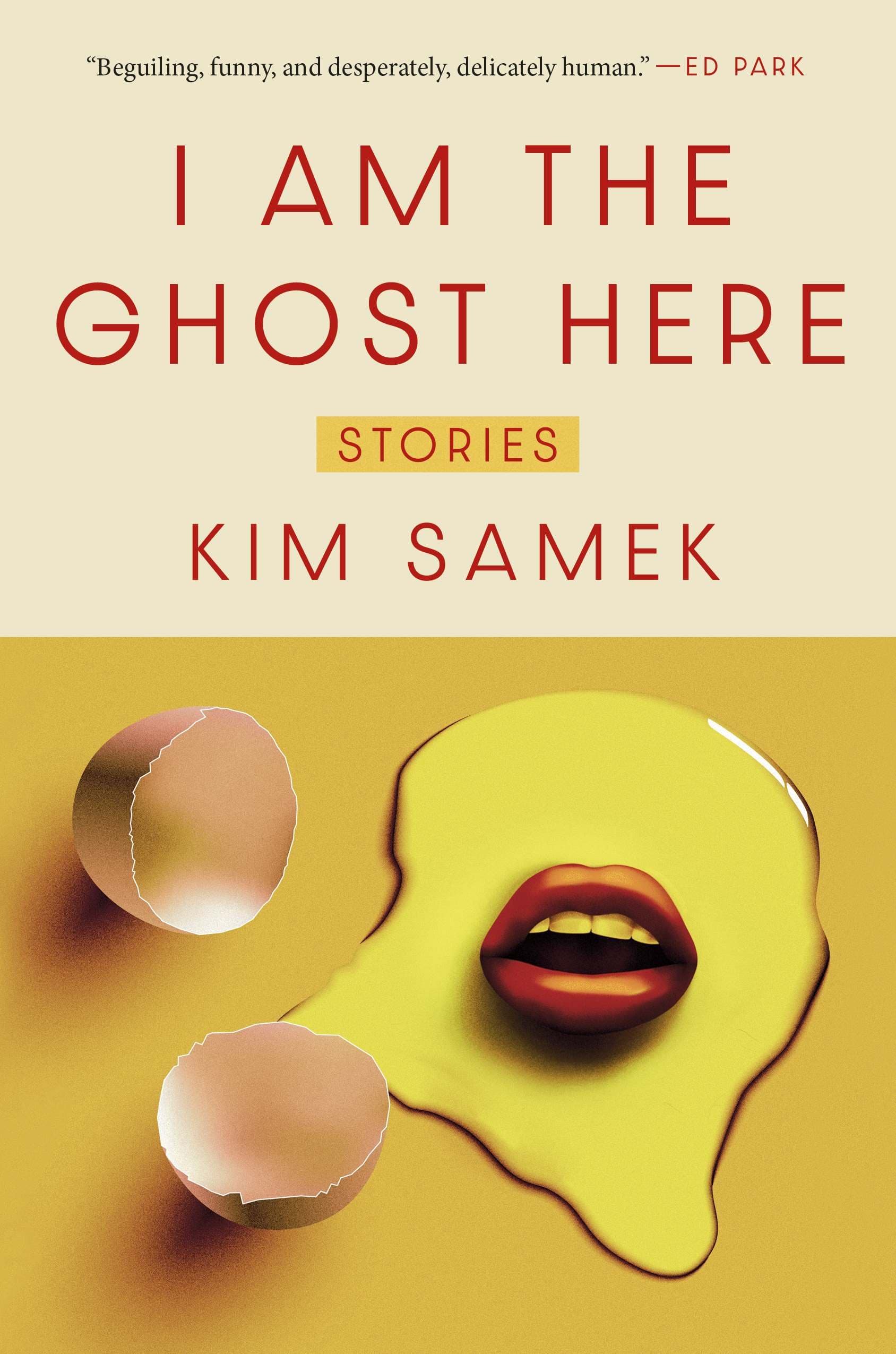
I Am the Ghost Here
The Dial Press, 2026
In Kim Samek’s debut short story collection, I Am the Ghost Here, characters navigate absurd modern predicaments ranging from limbs that go missing in “the cloud” to insatiable appetites for plastic. But at the heart of each of these stories remains a deeply human yearning for connection, wholeness, and purpose in worlds that put these aims just out of reach. I spoke with Samek in the lead-up to the book’s release about the short-story form and the unique opportunities it offers to explore capitalism, technology, and the everyday experiences that throw the strangeness of being alive into relief.
Anne-Marie Kinney (Rail): You’ve been writing fiction for many years, but you’ve said that you wrote these particular stories in a short period of time, at kind of a feverish clip. What did that look like?
Kim Samek: I wrote this book during a strange chapter of my life. I had been socially isolating during the pandemic. I was dealing with a serious illness, and I ended up isolating longer than most while I was recovering at home.
It was strange to experience the world primarily through the internet. While isolating, there was nothing to balance the hyperbolic, the hyperreal. On social media, blue checks were offered for sale and impersonators began to spring up. I was interested in fake news in a time of global crises and threats of authoritarianism. I felt powerless and could not understand how we had come to this political moment as a society.
Life was so bleak while I was ill that I was looking for ways to distract myself. I wanted to work on projects I could finish, so I tried writing a short story. After years of thinking of myself as a novelist and pouring my time into a project that had no end and no finished parts, I discovered that I loved the short form as a vehicle for idea-driven fiction and that the structure, as a spare writer, came naturally to me. I enjoyed the process so much that I wrote quite a few in a very short period. Many of the individual stories were written in a couple of days or a couple of weeks. It was like I could hear my thoughts with clarity for the first time because I wasn’t writing to publish a book. There was work involved in building out the stories, but I didn’t struggle with the concepts. Those landed whole. The long period of isolation and illness allowed me to have a different, freer relationship with writing. I wasn’t afraid to fail, and I was happy to experiment. These stories are the purest version of my voice.
Rail: When did you become aware that you were writing a cohesive collection?
Samek: I had probably written several stories by then. I sent these stories out to literary journals. The first stories were plucked out of the slush piles and published in Guernica, Ecotone, Catapult, Southern Humanities Review, the Threepenny Review. After my second story was published (in Guernica), I started to hear from literary agents, and I realized that I could assemble an interesting book.
Because I was engaging with one weird moment in time (a.k.a. the present), there was a natural cohesion in the work. I wouldn’t have to reverse engineer a device to frame the book. That can work well for some other books, but I wanted to write a collection in which the stories could paint a portrait yet stand on their own. I kept the characters unlinked and linked the ideas. My experience writing the stories was so powerful that it was important to me to celebrate what a story could do on its own without pretending to be a novel.
The stories are focused on the effects of technology and industry on our experiences of being human. These characters connect and find meaning in a world that is alienating them. I was concerned with labor, so I wove this thread through my stories by giving most of my characters jobs in the gig economy. Climate threads through similarly across the stories. These parallel threads explore what we lose when our governments don’t make decisions with the good of humanity in mind.
Rail: There’s something about the way technology operates in these stories that seems irrevocably linked to San Francisco—or San Francisco of the last twenty years—where you’ve spent a lot of time. How did this time spent in San Francisco and the way it’s changed inform the imagined technological advances within the stories?
Samek: I grew up in Seattle during a Microsoft boom, and I studied creative writing and literature at Stanford in a period when people went there to be innovators in technology; I’m certainly influenced by coming of age in those pivotal moments, and some of the smartest people I have met have been tech innovators. I think it is important to separate technology from capitalism. I’m interested in the way that capitalism has shaped us. I set a couple of stories in Thailand because it is a global concern. What have we gained? What have we lost? What can we do? What do we see and what is happening off screen? How can we lead meaningful lives when we were born into a system that is increasingly less interested in helping individuals lead good lives?
Rail: Another thing I found striking about all these stories is the spirit of “yes, and”—that improv philosophy in which you take every wild turn, no matter how absurd, and run with it.
Samek: My biggest influences were probably Franz Kafka, Albert Camus, Nikolai Gogol (“The Nose”), Fyodor Dostoyevsky. Film-wise, I liked the absurdism in Delicatessen and Brazil, but I consider improv comedy an influence as well, or at least I relate to the Upright Citizens Brigade style of absurdism. I like to thrust characters into situations they don’t understand. The work starts off-balance. It captures a feeling I’ve had many times recently: how did I/we get here? Many of my stories will take a point of view and push it to its most logical extreme. I love to give myself prompts and see what can unfold from there. Each story starts as a challenge to myself.
The first draft is a surprise. This keeps each story fun and fresh and allows me to experiment rather than trying to get between point A and point B. I never feel like I am writing a scene that does not need to exist. I’ve learned that if you put the correct elements into the setup of a story, it will complete itself. That’s not to say that the ending doesn’t take quite a bit of work, but it’s rare to get stuck and find that a story can’t be finished if it has a conflict and the characters have a desire. In each story, I take care to balance the political and the personal. Politics can’t be understood without the lens of the personal, and no individual story can be told without taking into account the forces that have shaped the moment.
Rail: How do you foster a sense of freedom in your writing?
Samek: I give myself full freedom at the beginning of a story. I could start anywhere. Normally I have an idea, a voice, a character, a POV, and usually a conflict too. That can arrive as a full package sometimes, though there are some exceptions. I set the world off-kilter a tiny bit for a purpose—to convey a genuine feeling. The voice, the take, is part of the premise and what allows me to feel like the story is writing itself, that I am following it. I’m guiding it too, but I’m also following it.
I think the freedom is the most important part—freeing oneself of writing to fit one particular mold. At the beginning of the story, there is leeway to try anything. You can’t get away with experimentation in the middle of a story, but readers are willing to get on board in the beginning, especially when they can relate to the emotional logic.
I love short fiction because the format gives me that freedom to write what I want. There’s no filler. You can start a story anywhere and finish it. An absurd premise can be sustained throughout the work without the sense that the bit has run its course and there’s still half of a book left. It’s important for a writer to write in a way that is genuinely exciting to them, to stick with the joy and not be afraid to fail. I think that often, people are so afraid to fail when they write. I know that I’ve felt that way before. This is why I tried a new format—I had always loved short stories and had studied them, but I hadn’t thought to write them.
I hope for the short story to come back as one of the premier forms of literature. There are many imaginative writers of short fiction and there is a hunger for this kind of work. The short story offers something that a novel can’t. They are equally good and deserve the same stature.
Rail: Who are some current writers who you see carrying the torch of the short story as the premier form of literature—the future giants of the form?
Samek: Just a few of many newer greats who write in a particular vein, with humor or absurdism: Kate Folk, Ling Ma, Kenan Orhan, Sayaka Murata, Vauhini Vara. I am leaving off dozens here.
Rail: A theme that recurs in a lot of these stories is the impulse to maintain normalcy while facing increasingly untenable situations—a new mother tries to manage her daily duties after she’d turned into scrambled eggs; a firefighter in Thailand continues putting out trash fires as the fumes from plastic offloaded by the west are slowly killing her and her whole town. Were you aware of that as a running theme as you were writing? Or is trying to maintain normalcy just what we’re all doing every day?
Samek: It started as a subconscious desire to reassert control or to explore why it felt like I as a person/we as a society had lost control. How did America arrive at this moment? I wanted to unpack that, often using body metaphors, fictional technology, or media as a device to explore this question.
I’m interested in exploring the tension between long-term crises and the daily experiences of human life. Even the most well-intentioned people usually don’t live with the larger political and ecological crises in mind every moment. Most people experience other highs and lows and are focused on immediate needs like paying the rent or mortgage, raising kids, or seeking connection.
The collection often captures disaster as a background concern and centers human searches for connection and meaning. Sometimes, when a crisis is foregrounded in one of my stories, the protagonists interact with the issues in unexpected ways. Nit, a firefighter, finds meaning in her work putting out trash heap fires in Thailand. Slow-moving, backgrounded crises are normalized, and that is not necessarily a criticism.
I’m interested in the idea of normalization, when incremental changes impact our lives across a decade or several decades. Social media is an interesting case. We’ve normalized handing over our data and conducting our lives in a way to enrich the parent company. This exchange happened before we understood the fine print. When I write, I aim to capture what we see and what we miss.
I’ve always been drawn to existentialism; those earlier works were a response to a feeling of alienation in the post-industrial world or a world at war. Now we are in a similar moment. This is an attempt to make sense of a world that feels indifferent and irrational. But in my stories, the characters still find ways to triumph despite not living in a rational world. The book is filled with hope.
Rail: This is one of the first works of fiction I’ve read that directly addresses COVID, not just as a specter in the background, but as a fundamental driver of the plot in two stories—both of which feature a main character facing an uncertain future while constrained by disability. Craft-wise, how does illness function as a constraint for those characters?
Samek: Though these stories are fictional, I drew emotionally from the experience of becoming ill very suddenly after experiencing a lifetime of health.
I’m interested in stories about illness, which is under-represented in fiction, but I’m also interested in illness on a metaphorical level because of the disconnect between body and self, or self and identity. Illness can feel alienating. If it comes on suddenly, you no longer recognize who you are. The rug is pulled out from under you. For me, it felt like turning into a cockroach or a scrambled egg. One moment, I was me, and the next moment, I’d been transformed into someone unrecognizable, set off from my own life.
Rail: You could say the same about becoming a parent, or more specifically, a mother—as several of the protagonists in these stories are. You’re a different person, no longer the main person in your own life. In the stories centered on new mothers, what did that aspect of the characters add to the realities they navigate?
Samek: Motherhood can be similar. You expect your body to work roughly like it did before, but often it doesn’t. Your relationship to your body changes. It can be as simple as ligaments becoming stretched out—losing the ability to do sports. You become an observer because there is a helpless human to observe. Motherhood transforms you. You’re suddenly a new thing. It’s like you’ve been swapped out. It can be jarring to experience. “Egg Mother” portrays that shift. I’m interested in those moments that call identity into question because they can be times people are especially attuned to the strangeness of being alive.
Circling back to illness—I want to talk more about writing the body on a metaphorical level—losing agency. I explored themes of illness and loss of control in parallel. For example, “Return” follows an ill person who wishes to return to a healthier time but ends up taking a time machine to the future after being misled by an app. “The Sharpest Knife” follows a woman who has to carry her heart around in a mason jar after she isn’t sure whether there is a real pandemic happening. I wrote this story soon after the blue checks were available to anyone on Twitter and people were impersonating scientists and celebrities. These stories are about illness as much as they are about the world we live in.
Rail: In “The Sharpest Knife,” the woman who has to carry her heart around in a glass jar for the rest of her life turns her plight into social media stardom. Other stories feature characters putting their lives on display on reality TV or being surveilled without their knowledge by their robot vacuums. Is there a parallel there with your position as a debut author—putting your strangest thoughts out in public and waiting for the public’s reaction?
Samek: I wouldn’t say I’m waiting for a reaction. Several of the stories have been published, so my experience might be different from that of a debut novelist.
I will say, sometimes my work is framed as an indictment of performance. I’m less interested in the performative aspect of reality TV as a theme. I mainly use it as a surreal device to explore identity, autonomy, and anxiety. I like the idea that there are hidden producers impacting a scene because it’s another way to establish the sense that there is something unfolding that is bigger than what we can control on an individual level—politically, ecologically. The title story similarly explores the relationship between a woman and her brother who has hired a puppeteer to control him. I like to write about the experience of feeling like someone else is puppeteering or producing, that life feels like a show.
The times we live in are not the result of democracy as we understand it, and I am often thinking about the hidden forces that shape our lives.
Anne-Marie Kinney is the author of two novels, Radio Iris (2012, Two Dollar Radio) and Coldwater Canyon (2018, Civil Coping Mechanisms). Her short fiction has appeared in Catapult, Joyland, Tin House online, Fanzine, The Rupture, the Adroit Journal, and elsewhere.