Anne Waldman’s Mesopotopia
Word count: 881
Paragraphs: 7
Mesopotopia
Penguin Books, 2025
A tycoon of poetry for more than fifty years, Anne Waldman has written a new book that searches out the value of the imagination amidst imminent global catastrophe and ultimately teaches readers to work, build something of human value, as our world collapses. Mesopotopia undertakes a poetics of immersive, overwhelming world-historical awareness, and what emerges is a grounding human vision for the work of poets and artists, work which turns out to be surprisingly indispensable. “My brave accomplices,” the poet seductively challenges, “weigh in.”
Mesopotopia is a 207-page book-length poem, built of seven “staves”—a word that can refer to a post or plank in a building or to a stanza of poetry. “The word conjures a place, an architecture,” Waldman told Poets & Writers Magazine, with the insight that the structure of poetry could be a place to stand, or live. Instead of any topic or concern, the unnamed staves center on a “tightening of skills & associations”—they are sharply measured swirls of impressions, intimacies, headlines, notes on ancient and living poets, and wild meditations. Waldman’s technique involves energetic and studious layering: “the taste of uprising” sits beside the Sumerian roots of eco-feminism, beside cluster munitions painted to look like drops of toys, beside the words of ancient prophets (“they shall be driven to darkness”), beside ruminations on her friends and their art, beside “TV episodes,” beside “people creating new histories.” Memories of all-night parties and meditations, rituals she witnessed, temples and art galleries, strikes and protests, listening to music and singing at dawn—a portrait of a radical takes shape, and her “investigative rage” sabotages our passive habits of media, experience, and intimacy consumption.
Each stave is built of discontinuous, rarely-enjambed lines, which crackle with a spontaneous, incantatory quality that makes one line follow another in a way that feels both outrageous and just right. Something like “have been studying the way social media is ripping us apart” might be preceded by a disarming line like “What is law? Not allowed to make a right on red in a car, et cetera.” Her unpredictable flow makes silliness, misconceptions, and clouds of unknowing apropos in a poem, as perhaps all poetry should. Divested from context and narrative, the lines become the subjects of endless reflection. The staves are structured to hold the explosive lines, and the balance radiates a strength and energy that only extraordinary poetry can release. Mesopotopia witnesses many pains of our looming dystopia but is far from a work of bleak despair—it is a contemporary prophecy, true to the moral force of that ancient calling, and with no proportionate loss to the play and humor that always make Waldman’s poetry formidably human.
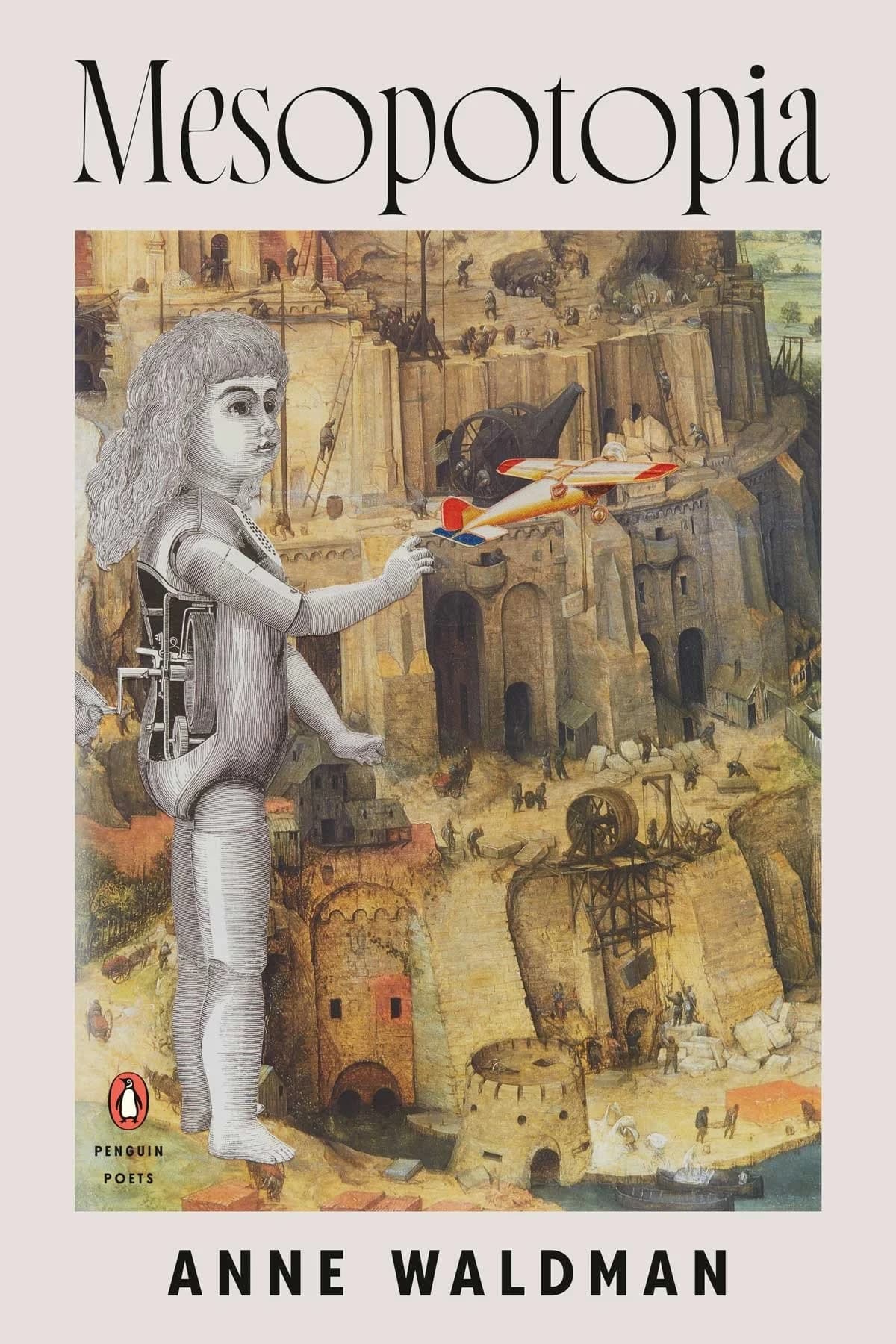
Waldman’s dear friend Bernadette Mayer says that “a utopia’s stamina must be addressed to or based on or written by or for someone you love,” and despite its global and ancient attentions, Mesopotopia stays close to the work of nearby poets and artists. “You shall not have loved (written) in vain,” Waldman says in a poem dedicated to the late Lyn Hejinian, and in an elegy for Mayer, she says, “Met you at the station / And see a way together.” Personal experience and memory pass into fable and myth in such lines. The cover of the book is collage by Waldman’s friend John Ashbery: a “wind up girl-child-toy-doll tossing a plane from the tower of Babel,” she describes it—“a witty depiction of how one feels in these raging times.” Much of Mesopotopia explores what it means to “see a way together”—“the prophet was always optimistic,” she believes—but this poet also suffers terrific episodes of despair about art and the pockets of resistant camaraderie that she has given her life to. “How can you even write?” she asks as she thinks of “the other side of the world.” “Never did enough. Never did enough.” The ways poets fail the world and each other bring home the failures and cruelties of our larger civilization. She grieves not just the deaths of her friends but how they “left one another / stranded,” and how they’ve died lonely, broke, and “punished.” Such crises of faith wash into Waldman’s more optimistic lines, but their rawness haunts the book and ultimately strengthens her effort “to not let these stories in poetry die / help guide us, alphabets of night.”
A transcendental faith in poetry may be a vice of this poet, but in the end that only compliments how Waldman’s work is one of the great achievements of contemporary writing. Her poetry is always bright, prismatically intelligent, tough as nails, and full of glee, questioning, rage, love, sorrow, and visions of how we and she could be truer than we are. She’s published over a sixty books large and small, and has led an iconic counter-academic writing program for half a century (the Jack Kerouac School of Disembodied Poetics); she’s ever on tour performing her poems and her band’s two recent albums, and this year she’s touring with a documentary about her life called Outrider; and she still makes time to befriend and mentor poets who cross her path. She is always building. Her structures may someday give out or need restoration; what will unshakably remain is a sense of someone’s having built.
Bradley King has two recently published books: If they are not to freeze us to death; i.e. How the small press destroyed my life (Spiral Editions) and a collection of poems called A few feelings before we leave (Copenhagen). His novella, Not caring about Louisa, is forthcoming with Keith LLC.