Joyce Pensato
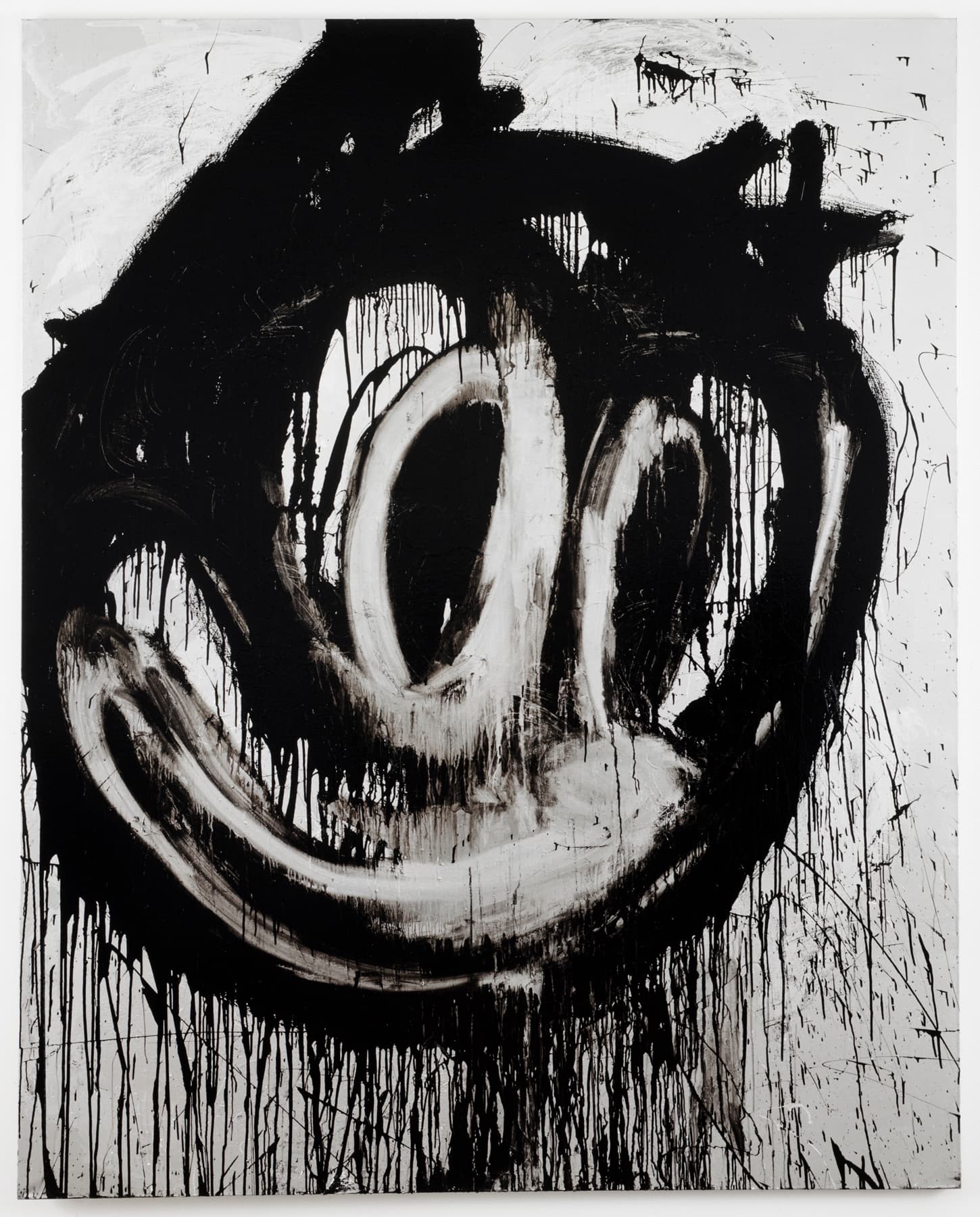
Joyce Pensato, I Must Be Dreamin', 2007. Enamel on linen, 90 × 72 inches. © Joyce Pensato Foundation. Courtesy Petzel, New York. Photo: Larry Lamay.
Word count: 896
Paragraphs: 5
December 2, 2025–March 15, 2026
Miami, FL
Mouse, mouse, mouse, duck, duck, duck, mouse, mouse, mouse, very big mouse, and so on. Calling out the beasts and characters populating Joyce Pensato’s drawings and paintings is one of the initial responses one has while walking through her most comprehensive museum exhibition to date at the Institute of Contemporary Art in Miami. She situated her paintings and drawing in a sticky and slippery world of slapstick cartoons and fairytales, and the show is cleverly organized around each of the genres of cartoonish beings Pensato painted and drew, displayed in a series of galleries spiraling in a counterclockwise layout. The largely monochromatic odyssey begins with her Mickey Mouse works, followed by the Simpsons, then Batman, South Park, Felix the Cat and Groucho Marx, and a brief respite with Donald Duck, before reaching the heart of the show, a selection of Pensato’s early Abstract Expressionist paintings. It seems like a curatorial first to lay out a show within these parameters and an opportunity too beautifully aligned with the artist’s impish sensibilities for curators Alex Gartenfeld, Gean Moreno, and Stephanie Seidel to pass up. Perhaps truest to Pensato’s spirit is the realization that within each of the spaces of the exhibition, the viewer finds themselves surrounded—by rambunctious mice, dripping lugubrious bat masks, grotesque distortions of an already caricatured American family (the Simpsons), and monumental googly eyes, a simultaneously delightful and thoroughly terrifying experience. Pensato cruelly unstitches our tenuous psychological connections between big smiles and laughing eyes, and the false sense of well-being and safety they typically confer.

Installation view: Joyce Pensato, the Institute of Contemporary Art, Miami, Florida, 2025–26. Photo: Oriol Tarridas.
I Must Be Dreamin’ (2007) is a shimmering, globular portrait of Felix the Cat. The feline’s absurdly spherical head is rendered in a downward-facing, three-quarter pose, the roundness heightened by massive wide eyes and a smile that stretches like an equator across the bottom of this orb. Felix’s happiness seems stretched to its limits though, and the delineations of mouth and eye have begun to dissolve, while the solid black of the fur around the features drips down in snaky trickles of glistening black enamel paint. It is ominous and terrifying glee, tortured hilarity, the grin of a skull. This gruesome joy is even more prominent in Untitled (Mickey) (1994) where Mickey Mouse’s face has devolved into an endless smile and capacious black eyeholes. Pensato’s brush transforms his ridiculously round ears (mouse and rat ears aren’t that cute in real life) and rotund body into three blunt, drippy, circular forms. The painter manipulates our comfort level by saturating our perception of non-threatening childhood references with horror. This dark side already exists in cartoons; that’s part of their attraction. We cling to them as a reassuring memento of childish naïveté while acknowledging that the surface happiness isn’t so straightforward. Pensato can fit all that in a single painting. And like the dichotomy of childhood and maturity, the artist is able to explore the infinite iterations: both Evil Stan (2007) and Not Groucho (2011) have enigmatic empty eyes, but those of the former are obliquely positioned along with a shallow downward grimace to seem as if straight out of Greek tragedy, while Groucho’s (or, Not Groucho’s) bushy eyebrows and moustache render his not-eyes more inquisitive than threatening.

Joyce Pensato, Take Me to Your Leader, 2018. Charcoal and pastel on paper, 108 × 500 inches. © Joyce Pensato Foundation. Courtesy Petzel, New York. Photo: Larry Lamay.
The exhibition opens with Pensato’s gargantuan, 40-foot-plus charcoal and pastel on paper frieze, Take Me To Your Leader, a parade of mice and ducks completed in 2018, a year before she died, and ends with two undated and untitled oil on linen abstractions. These hearken back to her early Abstract Expressionist painting practice, before Pensato united it with a drawing practice of primarily toys and cartoons. What the earlier abstract paintings have, which persists throughout the artist’s career, is a radically discomfiting surface, pre-dating Pensato’s darkly psychological reading of her figurative subject matter (there are several figurative drawings from the mid-seventies, but they seem tame and innocent by her later standards). Both of the largest abstract paintings, each about eight feet tall, feature a seething surface of mottled colors broken by scrapes and scratches; juxtapositions of the rough linen weave with the slick, thick paint. There is even the occasional perforation or cut through the linen itself. Pensato liked to tell the story of how her mentor Joan Mitchell once asked her, “do you still have that skin disease on your paintings?” which seems a particularly cruel but accurate way of characterizing the situation. But the sticky and scumbled high-gloss surface seems invitingly shiny and even erotic, especially when it gives issue to what we generally perceive to be texture-less cartoon entities. Now, they have skin and a life of their own in our world. The same is true of Pensato’s drawings, such as Lisa (2008) which is scuffed, ripped, torn, and pilled like an old woolen sweater—the Simpsons’ second child gazing down at us in a state of decrepitude reminiscent of a judgy saint or the Virgin Mary in a water-damaged fresco within an early medieval Italian chapel. The show offers many starting points from which to consider Pensato’s paintings: the psychology of childhood delights and nightmares, the phrenological study of cartoon emotion, and the dermatological and visceral approach to disgust and desire. In its varied approach, this rich retrospective is the first time that we can see the whole artist in one stroke.
William Corwin is a sculptor and writer based in New York. He has been writing for the Rail for fifteen years.