Imaging after Photography
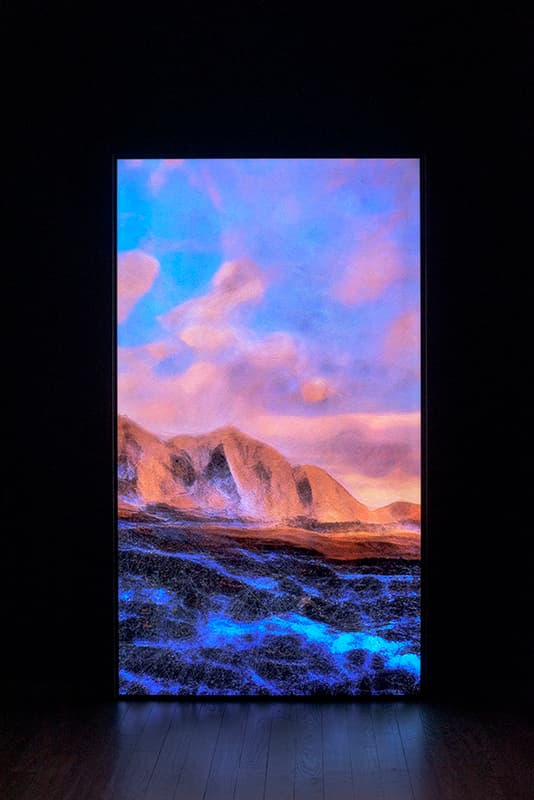
Refik Anadol, Quantum Memories Nature Studies, 2021. Video, 16 min. loop, dimensions variable. Courtesy the Carl & Marilynn Thoma Foundation and bitforms.
Word count: 972
Paragraphs: 12
Moody Center for the Arts, Rice University
January 23–May 9, 2026
Houston, TX
In the daily rampage of civic and cultural life, artificial intelligence looms stage right. By act three, catastrophe threatens and shreds ontological certainty. In visual culture, arguably, the effect has seemed somewhat more merciful, and AI seems a less disruptive endeavor, the post-fact present a benign superimposition of past and future.
Amidst this profound state of civic anxiety, Imaging After Photography surveys generative practices that dwell in a snug longing for the past, a postponing of a future reckoning that the scholar Svetlana Boym terms “restorative nostalgia,” which lingers in aesthetic givens. The show is an engaging palliative that emphasizes the natural world, research into the archive, and the fetishization of “data sets,” and, implicitly, the parsing of data to substitute for the act of photography itself. However future-forward its premise, it seems retroactive, recycling pictorial conventions and avoiding critical confrontation. Chopping wood with a laser cutter rather than an axe produces a pile of logs, still.
The exhibition, an admirable commitment spearheaded by curator Alison Weaver, is elaborately installed in a partitioned radial configuration, encouraging exchange between the individual bodies of work. It feels like a spectacle of pedagogy, a natural history museum with the dazzle of the game video arcade: the room is dimmed, and the pictures are backlit to evoke an entombed hypnosis of the screen. It is Plato’s cave, of course, and in the popular jargon of contemporary promotion, “immersive.”
The bravado of hyperbole seems to inevitably accompany the ambition of generative technologies. The exhibition catalogue notes that the work of Refik Anadol utilizes “the largest dataset of nature photography assembled for an artwork” and is not alone in asserting P. T. Barnum-esque swagger as promotion—the mantra of “scaling.” Meanwhile, Quantum Memories Nature Studies (2021) harvests a jillion landscape photographs for video projection: a techno pastoral and vague picturesque, its watercolor prettiness chaperoned by rolling techno music to amplify its theater. The integrity of the original individual landscapes—endlessly detailed and original and time-consuming—is neutralized and generic, the algorithm revoking experience for an idea of the landscape, estranged from its source. But most likely mine is a frayed sentimentality, a dungeon anachronism already molding.

Gregory Chatonsky, Completion, 2022. Photo: Gregory Chatonsky.
The apocalypse of information is, of course, a daily lament. In Completion 1.0 (2021), Gregory Chatonsky implements the archived images (fourteen million) publicly available on ImageNet. The individual photographs are seamlessly collaged with others they resemble, and the resulting picture is described audibly and with detached precision by an artificial voice. That these imaginary images are verbally articulated with clarity and confidence suggests they have become fact. This indeed poses an intriguing rupture of a prevailing photographic dialectic of fact and fiction.
So, too, What Darwin Missed (2024) is a grid of photographs taken from Charles Darwin’s 1830–40s studies of coral forms, intermixed—without identification—with Joan Fontcuberta’s images generated from his own underwater exploration. A shell game of marine biology, some factual and some generated, it unexpectedly reminded me of Donald Rumsfeld’s formulation of the “unknown unknown” (versus the “known unknown”), a spiral that diminishes our confidence in the human ability to gather and process the mysteries of the natural world. Happily, an actual and stunning species of black coral (1941) from the Houston Museum of Natural Science is included in the project, a moment of authenticity (or so it seems) and texture amidst the hardened surface of the screen, alleviating, momentarily, our cognitive insecurity.
In another botanical inquiry, Sofia Crespo borrows the nineteenth-century cyanotypes of the pioneering Anna Atkins to produce new images and a bridging of two representational technologies, nearly two hundred years apart. Resembling the biomorphism of Surrealism, the pictures recall a mid-century notion of the futuristic in the aspirational lexicon of science fiction. Crespo’s “Temporally Uncaptured” series (2023–24) suggests the horticultural practice of grafting as not only tissue-based but a visual and cognitive gesture. Lisa Oppenheim is alone in utilizing this technological prowess in a forensic excavation, fabricating that which is extinct. Mons Steichen visualizes a horticultural tribute to Edward Steichen from 1910, reconstructing irises as lavish dye-transfer prints, a hallucinatory proposal.

Lisa Oppenheim, Mlle Steichen, Version XXII, 2024. Dye transfer print, 18 ⅞ × 15 ⅜ inches. Courtesy the artist and Tanya Bonakdar Gallery, New York.
Trevor Paglen is much admired for his engagement with technology, revealing its hidden manipulations and the rhetoric of images. Here, an assortment of rosy floral photographs of various scales, Bloom (2020–22), is rendered from data sets and analysis of their characteristics of form, a kind of digital stereotype rendering of the simulated romanticism of artificial flowers. Of interest also is Paglen’s interactive video, Faces of ImageNet (2022), performing facial recognition on gallery visitors. As a kind of hashtag roulette, your correspondent was identified as hatmaker or Bedouin or tax assessor.
Photography’s hydra-headed role in the colonialist project has been much accounted for, and here allotted in the work of Nouf Aljowaysir. Again, through archives, Aljowaysir engineers a corrective to the frivolous biases of AI that originate in embedded misunderstanding and cultural generalizations. From this scrutiny the artist produces variations from historical studio portraits in which the figure has been erased, becoming a phantom and wavering reflective membrane bridging then and now. They recall a photographic history of supernatural summoning, of optic ghosts. The intention of Salaf (Ancestors) (2020–25) to both reclaim cultural identity and erase the individual seems not quite resolved, a contradiction for further inquiry.
The photograph—now the “image”—is a speculative endeavor, a useful fiction that has been crucial to an understanding of the world, coordinated with the senses, with thought, and with experience. Way back in the eighties, the writer and photographer Wright Morris wrote, “Only fiction will accommodate the facts of life.” Perhaps AI will finally, if painfully, resolve this loitering dilemma of the photographic discomfort with fiction, and free the photograph, decisively, from shouldering the burden of fact. More to come.
Stephen Frailey is a photographer and Chair Emeritus of SVA School of Visual Arts in New York. He founded the photography magazine Dear Dave in 2007 and remains Editor.