Nadia Gould: Because I am Young, Beautiful & Talented
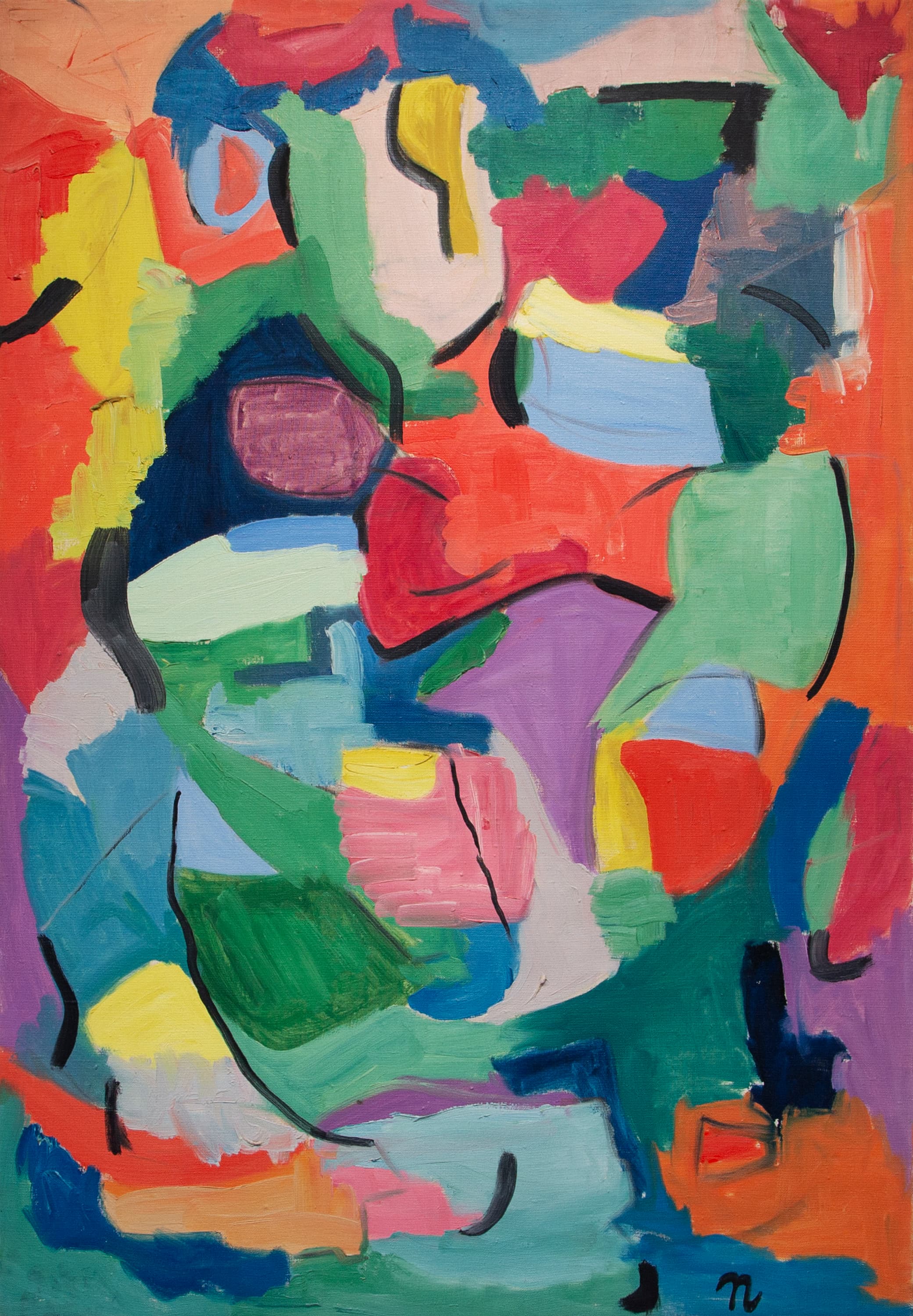
Nadia Gould, Gregory, 1954. Acrylic on canvas, 34 ½ × 24 inches. Courtesy dieFirma.
Word count: 1185
Paragraphs: 9
dieFirma
October 16, 2025–March 28, 2026
New York
DieFirma’s Nadia Gould: Because I am Young, Beautiful & Talented is a rather comprehensive review of this little-known artist’s oeuvre, which broadly consists of two periods: an early period of geometric abstraction followed by a later figurative one. The former spans the 1950s–60s and the latter, the 1980s. The connective tissue is their common chromatic palette. Although the geometric abstractions include pleasant patterns constituted by wavering shapes and shifting templates, the figurative works enjoy more art historical value and novelty.
Gould expatriated on a children’s transport ship during the Second World War, fleeing Vichy France by way of Spain and Portugal. She settled in the United States in 1943 and, after a brief period in Philadelphia, the fourteen-year-old and her family moved to an immigrant neighborhood in New York. Gould’s autobiography, Hitler Made Me a Jew, published in 2000 (seven years before her passing), reviews this interval. The early chapters contain scant references to the visual arts, with the exception of a section dedicated to the year 1936. Here, Gould recalls the time her family spent living in Châtenay-Malabry, where, “on the walls [of our new home] were colorful reproductions of paintings by artists I had never heard of before—Matisse and Picasso.” Gould writes that “Marcel,” an architect and interior decorator “inspired me to draw. He thought my drawings were ‘original’ and funny, and he gave me courage to draw what I pleased.” Evidently, Matisse’s influence was enduring.

Nadia Gould, Yellow Sky, 1960. Acrylic on canvas, 22 ¾ × 27 inches. Courtesy dieFirma.
Marcel’s advice and a second episode in 1945—where a junior summer camp counselor gave Gould her “first painting lesson,” exhorting her to paint triangles and “balance my shapes”—were the closest analogues to proper fine art instruction that the young Gould received—that is, until she studied with the Abstract Expressionist Fred Mitchell at the Southern Tip School of Art (Coenties Slip). Mitchell’s all-over mode left an unmistakable and lasting mark on Gould. One can particularly identify this in the earliest work on view, Gregory (1954), titled after her son. The acrylic-on-canvas work contains parcels of deflated aquamarine and salmon stroke-blots layered atop and beside one another. This early work, which neither veers toward the gesturalism of Jackson Pollock nor the delineated elements of Victor Vasarely, is a fairly typical and unassuming student experiment in abstraction. Gould’s abstractions improved over the subsequent decade, evinced by the progression from Yellow Sky (1960) through Chanson sans nom (1962) and Not Pop Not Op Just Top That’s Me (1965). As she resisted the temptation to fill each stretch of negative space, her edges grew tighter and her colorism more refined. The two-dimensional cadmium red, flaxen orange, and mauve-green triangles abutted against distended mulberry brown and bistre rectangles in [Steps with Triangles] (ca. 1960) demonstrates Gould’s increasing appreciation for the subtending unity of forms that distinguishes geometric abstraction from its gestural counterpart. Indeed, it was this “balance” which Gould’s intuitive camp counselor had presciently identified that Gould’s early abstraction lacked.
An editor’s note appended to the autobiography details that “Gould became a painter in 1950,” meaning after she returned to France, living in Montparnasse. She reflects that “Montparnasse is the neighborhood of painters and sculptors. Matisse, the painter I loved, lived a few doors away.” The influence of Matisse’s palette is evident throughout the canvas pieces on view, with works like Yellow Sky and Untitled (ca. 1964) yielding an array of stacked basic shapes so clearly limned that they resemble cut-outs. As her abstractions further progressed, Gould became something of a serialist of wavering silhouettes; the works from the mid-1960s find elemental triangles quartering ovals or circles figuring as flat apertures blazoned on varicolored parallelograms. Although the geometric compositions involve irregularly structured shapes, they are consistently quadrated within a gridded structure.

Installation view: Nadia Gould: Because I am Young, Beautiful & Talented, dieFirma, New York, 2025–26. Courtesy dieFirma. Photo: Jurate Veceraite.
Curiously, Gould was often associated with Op art during the mid-1960s, though she apparently rejected this label, underscoring that her work was more immediately concerned with the optical pleasure that geometry could evoke through repetition. Where Op artists properly engaged with spatial depth and illusion borne from gradations and color theory, Gould’s shapes were relatively flat. Their intrigue has less to do with the cultivation of form than the self-standing status of her colors. We see this in works like Homage to the Land of my Birth (ca. 1963), where her variegated rhomboids and chevrons are riven with stuttering edges. In an essay accompanying the exhibition, art historian Lisa Rotmil correctly observes that, “unlike Op Art, Gould’s work emphatically denies any direct attempt to manipulate the viewers’ visual perception, and she rejected mechanical techniques.”
Though she was well acquainted with her Coenties colleagues, such as Robert Indiana, Ellsworth Kelly, Agnes Martin, James Rosenquist, Lenore Tawney, and Jack Youngerman, Gould’s milieu also hewed to more underground annals. This is, in fact, the context in which I first discovered her, as her name reappeared in the “The Bridge Gallery, 1963–1964” archival folder of the Marion Greenstone papers. The Bridge Gallery, a short-lived project located on 61 West 56th Street in Manhattan, was run as an artists’ collective. Unlike the other artists spearheading the project, however, Gould not only exhibited at the space several times but, as evidenced by numerous administrative letters bearing her signature, also seemingly helped direct and program the space. A brief but telling 1963 press release for an exhibition showing her work that was presumably authored by Gould herself notes that her “small canvases evoke a delicate and whimsical fantasy through rhythmic variations and repetitions of form.”
This “whimsical fantasy” became pronounced after 1982, when Gould authored and illustrated a small children’s picture book as a gift for her first grandchild; its pages were scattered with scrawled zebras, mice, and cats. Hereafter, Gould’s imagery became humorous and naïve. It is also at this moment that Gould began appropriating art historical motifs. In the charcoal, pastel, graphite, and oil on paper Pink Odalisque (1986), for instance, Gould appropriates Edouard Manet’s Olympia (1863)—and, thereby, Titian’s Venus of Urbino (1534)—by positing a plump, roseate blonde woman before overgrown verdant shrubs with cloud-tufts in place of leaves. Her most unique works include [A Brief History] (ca. 1987), [River Crossing] (1987), and [The Peacock’s Pageant] (1987); each includes a Biblical cast teeming with humans and animals shoveled into a uniform plane crowned by citadels and church structures. Occasionally, the figures interact with one another, suggesting something of a narrative. This is what we find in the strongest work on view, [A Brief History], which, inviting comparison to Hieronymus Bosch’s illustrations, includes sapphire skeletons, vermilion tapis, and peach-pink dancing nude Epicureans. Unlike many contemporary artists, such as Joseph Geagan, who similarly traffic in characters puzzled into a scrapbook-collage semblance, Gould’s palettes resist dour tones. At times, the narratives are not particularly complete, and the motifs are often more suggestive than concrete; their elusive status, however, is obviated by Gould’s skill as a colorist. Her flashes of blocked-off and flattened oranges, celadon, and aquamarine resemble Niki de Saint Phalle’s simplified color. Thus, Gould’s earlier geometric abstractions augured her subsequent figural work, as this exhibition demonstrates.
Ekin Erkan is a writer, curator, and researcher whose writing has appeared in the Journal of Value Inquiry, the International Journal of Philosophical Studies, and Hyperallergic, among others.