Cannupa Hanska Luger: Dripping Earth
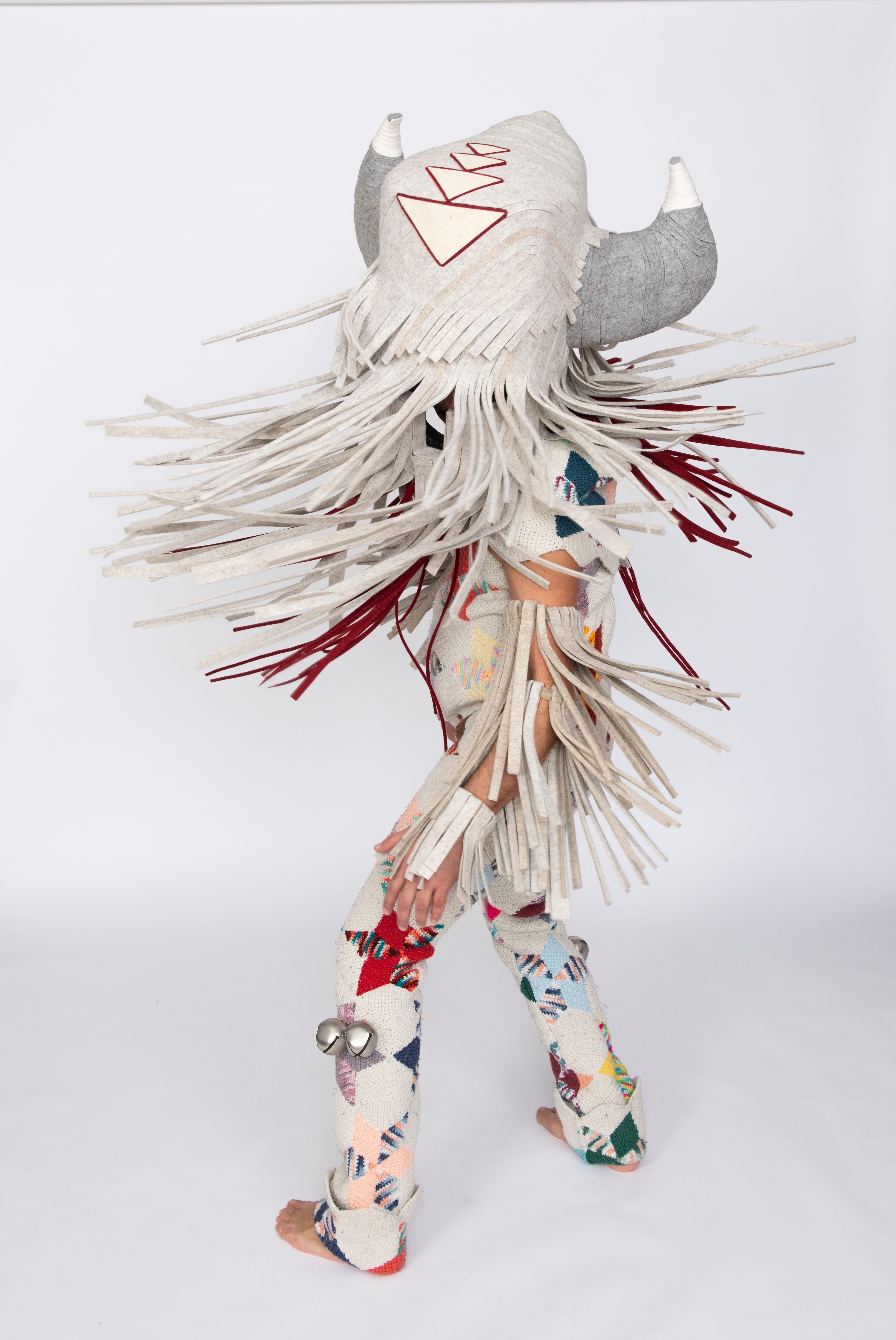
Cannupa Hanska Luger, Midéegaadi – Light, 2022. Mixed media bison regalia, installation dimensions variable. © Cannupa Hanska Luger. Courtesy the artist and Garth Greenan Gallery, New York. Photo: Brandon Soder.
Word count: 873
Paragraphs: 10
Joslyn Art Museum
November 15, 2025–March 8, 2026
Omaha, Nebraska
Cannupa Hanska Luger imagines a future that breaks the script. No cybernetic sheen, no techno-utopian glow—rather, clay, willow, blankets, and the cast-off materials of American life. Luger, of Mandan, Hidatsa, Arikara, and Lakota descent, builds a resolutely handmade futurism rooted in ancestral technologies, land-based knowledge, and communal labor. The decision to ground spectacle in the earth, rather than the distant fantasies of science fiction, is precisely where his work becomes most radical.
Much of contemporary futurist discourse emerges from a present hollowed by erasure—where marginalized histories, including Indigenous narratives, are absent. Luger confronts this directly, exposing how that absence has been constructed through colonial representation, archival omissions, and the slow violence of infrastructure. His ongoing “Future Ancestral Technologies” (2018– ) series, which anchors the exhibition, reanimates the now, insisting that futures are already embedded in land, kinship, and survival. Here, the future surfaces from what endures in the present.

Installation view: Cannupa Hanska Luger: Dripping Earth, Joslyn Art Museum, Omaha, Nebraska, 2025–26. Courtesy Joslyn Art Museum. Photo: Shayla Blatchford (Diné).
The current exhibition develops from Luger’s research into the Joslyn Art Museum’s collection of work by Karl Bodmer. Bodmer was a nineteenth-century Swiss artist who documented Plains communities during an expedition along the Missouri River in the 1830s, producing some of the few surviving visual records of Mandan and Hidatsa lifeways—traces made even more vital after the 1837 smallpox epidemic and, a century later, the land losses caused by the construction of the Garrison Dam. Luger reads Bodmer’s precision as partial: his figures’ hands and feet are often tucked into robes, concealed, or rendered as jointless shapes. Such omissions erase the everyday gestures through which culture is enacted and maintained, reinforcing a visual economy that renders Indigenous life static and taxonomic. Luger responds by populating the exhibition with living Native figures, animated through speculative world-building that reclaims agency, scale, and sovereignty.
The first gallery stages this reclamation in clay. Thirteen Irabágu (2025) vessels form a cross-like arrangement echoing the lunar calendar. Shaped as cupped hands, they hold both gesture and offering. Formed from ironstone clay, selected for its rich, dark surface that recalls the patina of vessels repeatedly exposed to fire, they invoke the material memory of ancestral cooking and care practices associated with Luger’s Awa xee (Dripping Dirt) clan, once responsible for repairing earth lodges. Above them, two willow bullboats (Máadiraxbi I and II [2025]) hover like ghosts of a submerged world, while afghan blankets cut into bison-hide silhouettes (Nahxíbi I and II [2025]) echo hides once stretched across such frames. The installation evokes the cataclysmic effects of the Garrison Dam, which drowned over a quarter of the Fort Berthold Reservation and severed communities from the river system upon which they depended. Luger’s underwater gallery lays bare the entanglement of hydrology, infrastructure, and historical violence.
Presiding over this drowned landscape is A Nation (2025), a sixteen-foot-tall seated giant. Luger reclaims the visual grammar of civic monumentality, inserting an Indigenous presence where the nation has long enthroned its own authority. The figure sits atop a broken column assembled from Americana detritus like barbed wire, industrial belts, a school chair, and medical respirator parts—objects tied to extraction, agriculture, and survival. The only figure in the exhibition granted a face, it looks toward a tipi-cover projection of archival images and interviews recorded by Luger’s grandfather, Carl Whitman Jr., documenting community responses to the dam project.

Installation view: Cannupa Hanska Luger: Dripping Earth, Joslyn Art Museum, Omaha, Nebraska, 2025–26. Courtesy Joslyn Art Museum. Photo: Shayla Blatchford (Diné).
The following gallery shifts from monumentality to choreography. Seven Midéegaadi (2021–22)—bison-dancer regalia made from repurposed afghan blankets, industrial felt, hockey pads, and shell casings—stand mid-motion, as if caught between moments in a ceremony. Luger treats regalia as a living language: an archive, a pedagogy, and a technology of relation passed from one generation to the next. The dancers encircle Census (2025– ), a community-built bead sculpture tracking the roughly twenty thousand wild bison currently managed by federal agencies. Each bead is hand-formed by workshop participants. The slowly accumulating buffalo becomes a collective record of touch, effort, and care, a reminder that ecological repair is inseparable from communal practice. For many Native nations across the Plains, the bison is an ancestral relative—central to ceremony and survival—so its appearance here speaks to relation as much as recovery. The Midéegaadi also reappear in Luger’s “Remarkable Landscape” lithographs (2025), which are superimposed on Karl Bodmer’s Missouri River watercolors. Brought into the foreground at heroic scale, Luger’s images disrupt the pastoral distance of Bodmer’s nineteenth-century gaze.
The exhibition’s final strength emerges through its dialogue with the museum’s own holdings. In adjacent galleries, historical Native works—buffalo robes, moccasins, tobacco bags—carry the attribution “Ancestor Artist” rather than the customary “Unknown Artist,” a subtle but pointed refusal of the colonial assumption that the unnamed is unauthored. The shift echoes Luger’s insistence that Indigenous art histories are relational and continuous, demonstrating how a single exhibition can nudge institutional practice and the narratives museums build toward a more accountable future.
Dripping Earth reclaims Futurism as a form of living art, rooted in the land’s teachings, intergenerational responsibility, survival, and more-than-human kinship. Luger activates futurity through clay, community, and materials that carry both grief and possibility. In doing so, he reminds viewers that the future is not elsewhere but already embedded in the “dripping earth,” taking shape beneath our feet.
Eana Kim is an art historian and curator based in New York. She holds a Ph.D. from the Institute of Fine Arts, New York University, and teaches modern art history at NYU.