James Walsh: Relief in Sight
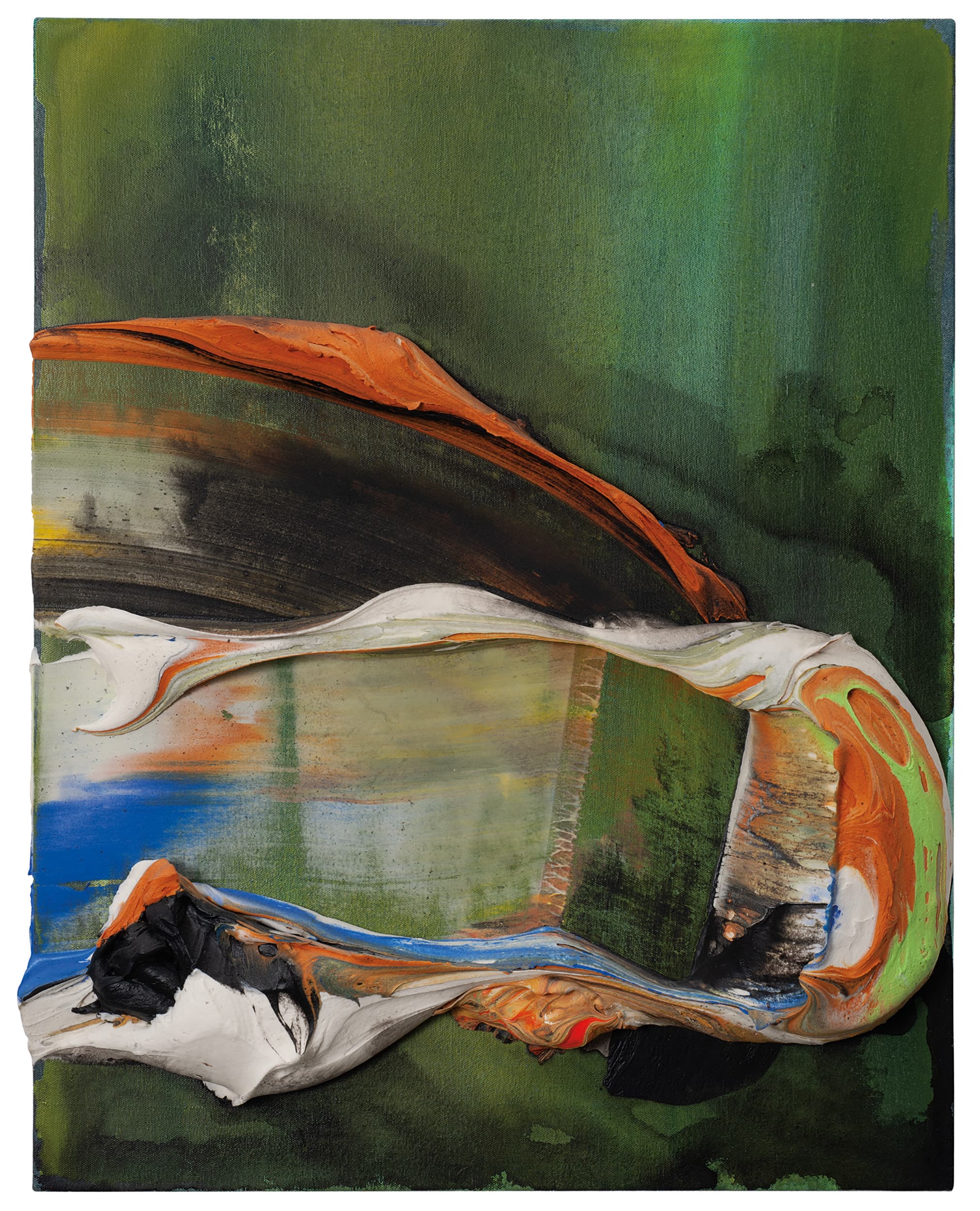
James Walsh, Drawn, 2006. Acrylic on canvas, 28 × 22 inches. Courtesy the artist and the Sam and Adele Golden Gallery.
Word count: 732
Paragraphs: 7
The Sam and Adele Golden Gallery
September 27, 2025–Febuary 20, 2026
New Berlin, NY
Over the past several months in New York City, I’ve encountered paintings containing neon lights and umbrella spokes, paintings with horns and chains, paintings made from pool tables, paintings agape with Surrealist silicone orifices, and paintings made from HVAC elements—the latter eluding my understanding but analyzed by my brother, a gas plant operator, with remarkable operational clarity. But the paintings that surprised me most, the paintings I found most challenging to square with my assumptions about what a painting is or could be were those in James Walsh’s Relief in Sight, currently on view at the Sam and Adele Golden Gallery in New Berlin, New York. A characteristic Walsh painting comprises masses of bold and brashly colored paint thickened so densely with acrylic gels, pastes, and mediums that it casts shadows on the surface. Walsh begins by preparing the canvas with a thin stain or wash before adding mounds and dollops of paint that project assertively from the surface. Though sometimes, as in Thanks (2005), Walsh’s brushwork smoothes the transition between surface and texture.

Installation view: James Walsh: Relief in Sight, the Sam and Adele Golden Gallery, New Berlin, New York, 2025–26. Courtesy the Sam and Adele Golden Gallery.
Relief in Sight celebrates two related occasions: the forty-fifth anniversary of Golden Artist Colors and Walsh’s professional and artistic relationship with the company and its founders, which has unfolded in parallel over the same period. In his reflective catalogue essay, Mark Golden, the exhibition’s curator, highlights the artist’s formative experiences at the Syracuse Clay Institute and the Triangle Artists’ Workshop, where Walsh met artists Kenneth Noland, Anthony Caro, and the critic Clement Greenberg, a context that would inform the subsequent trajectory of his painting practice. Golden also stresses the importance of Walsh’s early work with clay and ceramics, the physicality of which, he observes, has continued to inform Walsh’s painting.
Among the many surprises these paintings afford is how differently the materiality of these paintings registers, in visual and tactile terms, from one to the next. Walsh amplifies sensations of pressure, mass, and movement by scraping heaps of paint in pictures such as Drawn (2006) and Brownie (2009). In the former, a mound of color hurtles across the surface, its motion abruptly arrested as it grazes the right edge, while the downward grinding motion in Brownie is impeded by an immense embankment. By comparison, the windswept textures in Lavender Haze (2022) feel weightless, and the folds and ridges of paint in Trio: Bluest (2001) seem to defy gravity. This last picture is one of six similarly sized works hung close to one another in two rows. The textured reliefs throughout these paintings, suspended on the surface and recoiling from its edges, evoked to me the appearance and traditions of still-life painting.

James Walsh, Lavender Haze, 2022. Acrylic on canvas, 30 × 22 inches. Courtesy the artist and the Sam and Adele Golden Gallery.
In addition to the paintings hanging on the walls are several dozen smaller works, set up on tables and shelves taken directly from Walsh’s studio and installed in the gallery space. Situated among paint encrusted spatulas and buckets, these paintings demonstrate the restless, experimental nature of his practice.
An earlier stage of Walsh’s career is represented by a number of works from the late 1980s and early 1990s. Though they share the emphatic physicality of his paintings from the last couple decades—experimentation with emergent paint materials and technologies is a constant throughout Walsh’s body of work—the pictures from these years are more conventional. The looping gestures of Nevados (1990), for example, pushing against the canvas boundaries and turning in on themselves, echo the contemporaneous “Mitt” paintings of Jules Olitski (one of the many artists, incidentally, about whom Walsh has written perceptively and incisively). While there are occasional flashes of bold color, particularly in Black Tears and Cacimbo (both 1990), the overall palette of this period is more subdued, centered around black and white, with muted and grayed colors. The most successful pictures from this moment, Celeste and especially Grey Alight (both 1988), are lighter in tone and texture, airy, almost lyrical, calling to mind naturalistic phenomena like sea foam coursing through river rapids. The tumultuous, Gustave Courbet-like Scalar (1988) is even more striking in this regard, with a dark, central eddy encircled by craggy slabs of pigment. Ultimately, Relief in Sight not only celebrates Walsh’s longstanding relationship with Golden Artist Colors, but also demonstrates how, through constant material experimentation, he has continued to open up and expand new possibilities for picture making.
Alex Grimley is an independent art historian specializing in postwar and contemporary art, particularly Color Field painting. His writing addresses intersections of visual art, criticism, and experimental music.