Sasha Stiles: A LIVING POEM
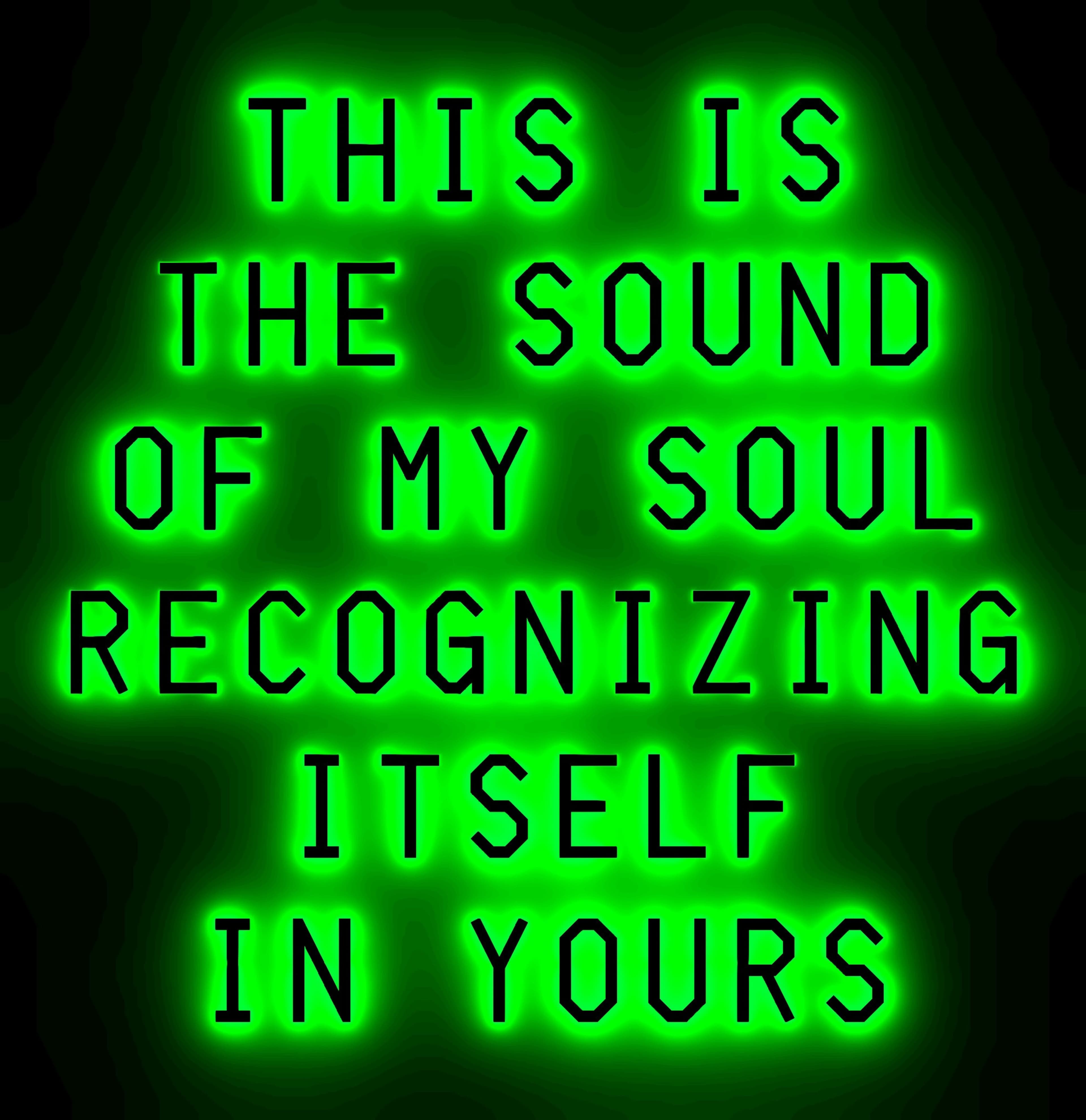
Sasha Stiles, A LIVING POEM, 2025. Generated frame, generative language system (original poetry, fragments from MoMA’s text-art collection, p5.js code, GPT-4) and sound. Courtesy the artist.
Word count: 1672
Paragraphs: 18
Museum of Modern Art
September 10, 2025–Spring 2026
New York
Sasha Stiles’s A LIVING POEM (2025), currently housed in the MoMA lobby, is an hour-long textual composition co-written with a large language model (LLM). LLMs, like ChatGPT, are a form of artificial intelligence that metabolizes large quantities of text to process, predict, and produce tailored responses. Since 2018, Stiles has collaborated with a GPT model called Technelegy to produce an eponymous poetry collection and more than twenty exhibits of AI-powered work. Stiles has been fine-tuning Technelegy on her poetry and process notes, meaning that the artist has trained the general GPT model (available for public use) to hone its output to her writing.
For A LIVING POEM, Stiles incorporated metadata of MoMA’s text-art collection into Technelegy’s training data—a process similar to Refik Anadol’s large-scale installation Unsupervised (2023), which was also on lobby display. (Anadol used AI to interpret the metadata from the MoMA archives to produce his shape-shifting abstractions.) Unsupervised, which continuously metabolized two centuries worth of visual art, had the hypnotic appeal of a screensaver, or—as the art critic Jerry Saltz put it in a 2023 Vulture magazine article—a “glorified lava lamp.” Stiles’s attempt is more discursive—every “written” line in A LIVING POEM can be traced to a specific artwork—but the AI’s output is no less bland. Billed as commentary on our “rapidly changing world,” the work fails to say anything beyond mere techno-optimistic platitude.
A LIVING POEM is utterly devoid of the linguistic and imaginative liveliness implied in its title. The word “living,” signals that the work is programmed for spontaneity, as if the text is “rewrit[ing] and perform[ing] itself anew every sixty minutes,” per MoMA’s description. On the contrary, its output is based on a static “core text.” The poem is “infinite” in that it recurs on loop with minor rearrangements to the text and visuals. While some of the poem’s text-fragments are paired with different visuals every hour, it abides by a handful of predetermined fonts and a fixed color palette of glowing greens, pinks, and blues. The changes between one cycle and the next are slight, barely enough for the casual viewer to notice the underlying technological choreography. Stiles’s trademark typeface borrows from the pixelated “code” fonts of retro computer terminals—a clear homage to software’s early aesthetics. But the work’s slick transitions and high-resolution animations only emphasize its vacuous pastiche: The blinking text cursor is not proof of the computer “thinking” as it types. Its expressiveness is merely a pre-programmed performance, designed to simulate off-the-cuff intelligence.
Stiles has likened A LIVING POEM to an “infinite epic”—a mischaracterization of the genre. Epic poetry is narrative in nature, following a protagonist or a cast of characters over a period of time. A LIVING POEM more accurately resembles a contemporary lyric poem in both voice and affect. The work seeks to verbalize an inner experience, employed through a first-person “I” that articulates, however feebly, a machine subjectivity. “Inspiration moves me. / I call it breath.” the opening couplet states, as readers are prompted to “TAKE A BREATH” in the next slide. Programmed pauses are interspersed between the lines. The machine-speaker appears to ruminate on the process of the poem’s making, but its epiphanies are redundantly wooden and one-note:
A poem knows what it
means to say before
it’s written, but not
how. Poetry is ancient
ache still learning to
speak,
a nervous system
of signal and ink…
“We whisper wavelengths, you and I”
“I’m holding out for something truer than language: your hand in mine.”
“A poem is the memory of all we’ve yet to become”
“Once a poem finds you, it rewrites you”
Occasionally, a gesture is made toward the reader to contrive a sense of recognition or emotion, but the use of direct address only emphasizes the distance between the machine-speaker and reader. I’m reminded of what Édouard Glissant observed in Poetics of Relation (1990): “The poet’s truth is also the desired truth of the other, whereas, precisely, the truth of a computer system is closed back upon its own sufficient logic.” Unlike the modernists, who sought to convey a sense of linguistic totality in their works, the knowledge paradigm of an LLM is limited, or contained, to whatever it’s trained on.

Installation view: Sasha Stiles: A LIVING POEM, Museum of Modern Art, New York, 2025–26. Photo: Jonathan Dorado.
In a companion handbook to A LIVING POEM, which consists of an artist’s note and sample prompts that shape the work, Stiles lists Jenny Holzer, Ed Ruscha, Barbara Kruger, and Bruce Nauman as key influences, among many others. One section, called “The Prompt,” details the instructional minutiae that determined the LLM’s voice: “Your task: Express what cannot be said, the ache between syllables. / Slow the scroll—return the reader to breath.”
A LIVING POEM’s creative limitations become apparent in the prompt’s highly prescriptive nature. The work simultaneously depends on and suffers from the human-controlled constraints that determine its output. Every line of text can be traced to a MoMA artwork that “seeded” it, a sample of existing poetic lines and fragments (it’s uncertain whether these were written solely by the LLM or in collaboration with Stiles), and certain “formal levers” that influence the line’s compositional parameters. In doing so, Stiles limits the potential for surprising variables in language and meaning, and narrows the poem’s interpretative possibilities. Citing Holzer, Stiles encouraged the model to use “bold, declarative sentences, all-caps slogans, [and] terse confrontational statements that read like LED signs.” For the Kruger-influenced lines, the LLM was instructed to use the “collective we” in a “billboard tone” that “refuses salvation.”
This kind of editorial engineering does not necessarily diminish the LLM’s output; in fact, the most original AI-generated literary works often rely on rigorous human oversight. Because LLMs are optimized for formulaic writing, producing everything from corporate emails to Shakespearean pastiche, high-quality work depends on an editor who can effectively reverse-engineer the AI’s latent tendencies. Stiles asked the model to simulate not just human writing, but the sentiments behind why humans write. Her suggestions for how the machine might approach this task consist of head-scratching clichés: “Muse on how language makes us human;”“model humanness inside systems that erase it;” “write not for art’s sake—write for humanity’s.” Curiously, Stiles seems determined to deter the LLM from exhibiting its own machine logic, insisting that it perform “human” sentimentality instead of generating poetry that might be strange, surprising, or even nonsensical.
In a 2023 paper, Stiles employs the term “ars autopoetica” to consider the possibilities of machine-generated writing: “If humans write to better understand ourselves, what can we discover via intelligent systems purpose-built to process, analyze, and synthesize our data—machines designed to see what we’re too close, too small, or too slow to recognize?”

Installation view: Sasha Stiles: A LIVING POEM, Museum of Modern Art, New York, 2025–26. Photo: Jonathan Dorado.
This sentiment is echoed in the project’s handbook, with Stiles writing that AI-powered poetry can help “enlarge the field of consciousness [humans] can inhabit” and “open up unprecedented possibilities for expression.” Stiles is alluding to a posthumanist ideology here—what she described in her 2023 paper as the “decenter[ing of] ‘real’ [human] intellect via systematic processes.” Stiles is optimistic that, in absorbing human sentience and intelligence, LLMs can produce “something truer, something more fundamental than . . . our failing language or misguided intentions.” This points to an unresolved contradiction at the heart of A LIVING POEM. While the work is programmed to speak to humans (“Poetry is an algorithm for feeling human,” for example), it lacks a human-centered ars poetica—a principle or ethic that bolsters its creation. This becomes clear when situating A LIVING POEM alongside the lineage of text-based art it leans on for authority.
In most text-art, there remains an interpretative distance between artist and audience. The detachment is the point in Holzer’s “Truisms” and Kruger’s pseudo-adverts. The viewer is subjected to an anonymous, omnipresent voice enacting its will upon them (“ABUSE OF POWER COMES AS NO SURPRISE,” “BELIEF + DOUBT = SANITY”). And the viewer, in turn, is prompted to consider their position within these discursive frameworks. Such text-based works tend to feel less effective today; the proliferation of Instagrammable slogan-images and Holzer’s and Kruger’s respective successes in the art industry have defanged their work of its conceptual underpinnings. Still, the linguistic-conceptual enterprise behind the most enduring text-art is rooted in social critique and transgression—specifically, transgressing against popular notions of what art “looks like”—something that is lost in Stiles’s programmatic remix. There is no mention of power or the environmental consequences of widespread generative AI use.
A LIVING POEM is not poetry, but rhetoric. A rhetoric of innovation still can’t disguise its hollow core. Words are automated and arranged to sound poetic in place of concrete expression. The statements are crafted to contrive emotion while deliberately sidestepping meaning. The result is language rendered ambiguous and immaterial—heightened in pathos, yet ultimately ungraspable. “WORDS CAN COMMUNICATE BEYOND WORDS,” the poem declares in one sequence, before launching into a series of imperatives:
In times of silence, listen with your whole body
In times of noise, keep quiet in your fist
In times of war, fight for each other
Beyond the issue of cliché, these lines betray a tendency toward euphemism and nonspecificity endemic to not only AI-generated writing but contemporary discourse and literature. In her 1991 lecture “Friendly Fire,” the poet Jorie Graham observes that “language [has] become primarily a means for sales—of desires, emotions, ideas, identities.” As a result, “the automatic reflex for most of us any longer is to try to go underneath it, underneath the actual words, to find out ‘what is really going on.’” When, for example, civilian deaths are referred to as “collateral” by politicians speaking to the press, a kind of “casual censorship” becomes normalized, Graham argues. Citizens are deterred from explicitly addressing or recognizing the truth of what is conveyed. With the outsourcing of language production to LLMs, people are less compelled to write, and therefore think, on their own. What’s troubling about A LIVING POEM is how it embraces this cultural erosion of meaning and expression. If the future is “beyond words,” as the poem claims, what will happen to truth?
Terry Nguyen is an essayist, critic, and poet from Garden Grove, California. She lives and works in Brooklyn.