ArtFebruary 2026In Conversation
PAUL PAGK with Phong H. Bui
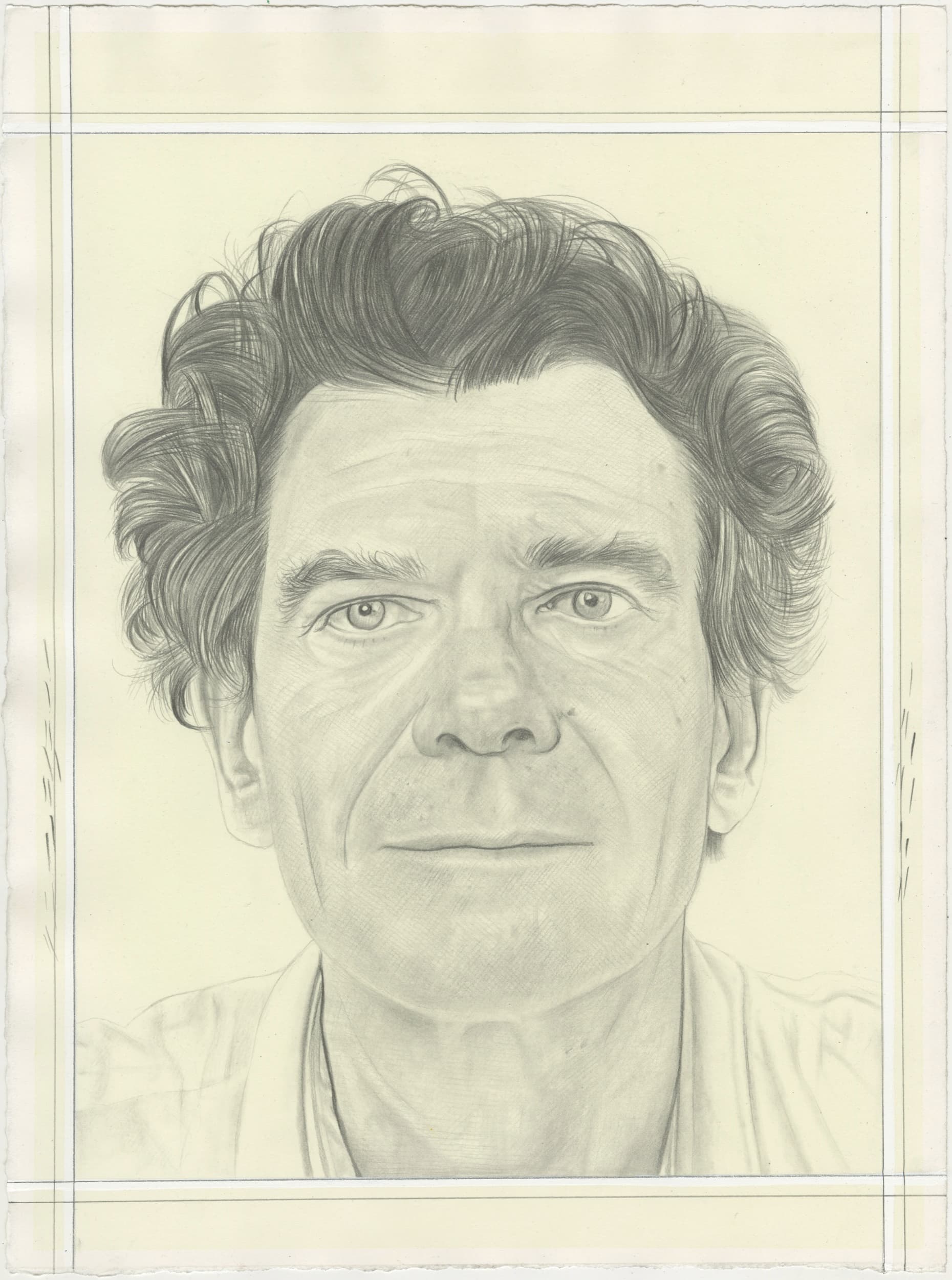
Portrait of Paul Pagk, pencil on paper by Phong H. Bui.
Word count: 4777
Paragraphs: 59
Miguel Abreu Gallery
January 16–February 28, 2026
New York
I first met the painter Paul Pagk in the fall of 1990 through two mutual friends Bénédicte Burrus (then a painting student at the New York Studio School, now the director of Thaddaeus Ropac Gallery in Paris) and her then-partner Jonathan Nossiter, the filmmaker, and soon was introduced to his work in the following year at Thread Waxing Space in 1991. Ever since then, I’ve followed his work as frequently as I could in different contexts—from seeing Paul’s paintings in various one-person or group exhibitions, to making occasional studio visits and even once having a conversation before a live audience at the site of his last exhibit at Miguel Abreu in 2023—I’d never had a lengthy conversation in the studio with Paul until recently, just the day before this new body of work was brought to the gallery to be installed for Paul’s current exhibit Inscriptions in a Shade of Color (January 16–February 28, 2026), dedicated to the memory of Franz Dahlem (1938–2025). I’ve always thought of Paul’s work in regards to his deep interest in abstraction as a pictorial synthesis of linear geometry, color and light, all of which can be revealed in varying degrees of his personal sense of tactility. As I’ve been thinking more about Paul’s greater emphasis on how his line within its seemingly simple, yet complex geometric structure relates to its painted surface, I was reminded by this Carl Jung remark, “Often the hands will solve a mystery that the intellect has struggled with in vain.” The following is the edited version of our longer conversation for your reading pleasure.

Installation view: Paul Pagk: Inscriptions in a Shade of Color, Miguel Abreu Gallery, New York, 2026. Courtesy Miguel Abreu Gallery.
Phong H. Bui (Rail): I remember reading Donald Kuspit’s review of your second show at Thread Waxing Space in Artforum’s 1993 summer issue, and at some point he cited the psychologist/writer Thomas Ogden’s phrase “autistic-contiguous mode,” which instead of using the limited framework of the psychological condition of the “autistic”, it describes the most rudimentary, primordial mediation of how we experience the world through our raw sensory data and sense of touch.
Paul Pagk: Yes, Kuspit appreciated my work as it resisted any gestalt reading. I had the feeling he may have seen my first show there two years earlier in 1991, which included a group of paintings that dealt with the idea of giving the same physical weight to painted surface and built form. The physical application was thickly painted in many layers. I was using lots of earth color palettes, including variations of Van Dyke brown, yellow ochre, earth green, but between 1991 and 1993 I began bringing in pure reds, yellows, and blues; the whole color palette was beginning to shift.
Rail: Was the network of lines during this period similar in their thickness, or at the least of the same character?
Pagk: No, the lines became much thinner and more varied in their characters. I was retracting paint with a small palette knife, and then I would put down the ground, redo the drawing, and repeat this process between line and ground, going back and forth.
Rail: I’d imagine the same is applied with the relationship between color and surface as you just mentioned.
Pagk: Definitely.
Rail: It’s called hard-won unity. [Laughs] As Adrian Dannatt pointed out in his essay in your
recent Skira monograph, you took ballet classes when you were thirteen after seeing Rudolf Nureyev perform at the Palais Garnier in Paris, and continued to do so until you were eighteen. That’s five years seriously dedicated to ballet. Do you think the choreography of ballet, however simple or complex, slow or fast in its movement, which only takes place within the constraint of the stage proscenium, may or may not relate to the choreography of painting?
Pagk: Thinking back now, both are related in some ways. The painting is like a stage, contained in its given boundaries. After seeing Nureyev do a pirouette, I wanted to take up ballet lessons with a teacher named Sylvie Pigeon, who was once a star of Les Ballet de Monte-Carlo. Due to a car accident, she had to abandon her dancing career and teach dance. My family lived in Pontoise, and I would take ballet lessons in Saint-Ouen-l’Aumône where she taught. It wasn’t that I intended to become a professional dancer, since my clear ambition was to be a painter as early as the age of seven.
Rail: I was also thinking about how ballet requires a certain degree of athleticism, precision, and fluidity. The same can be said of how the linear geometry in your painting generates its own formation in a variety of ways, as the lines change their speed, slow or fast, thick or thin, below or above the painted ground, and so on. Still, insofar as to how the use of material, paint application, surface/support relate to the painted image, I feel the treatment of line and geometry in each of your paintings is both fragile and declarative at the same time. As it has been described in having pictorial affinities with minimalist work, especially those by Dan Flavin, James Turrell, and Fred Sandback, all of whom undertake direct perception, industrial repetition, among other known restraints, I wonder how they again correlate with your attraction to classical Chinese painting, which embraces all things having equal worth as one unified worldview?
Pagk: Must I go back to the beginning? [Laughs]
Rail: Tree has roots, sure!
Pagk: I was making figurative paintings, like most art students, at the Beaux-Arts, specially under the tutelage of a well-respected figurative painter named Pierre Carron, a good friend of Balthus. My interest in the figure at the time had a similar rebellious spirit to that of Eric Fischl’s paintings; while referring to Édouard Manet’s painterly language, they were charged with psychology revealed in their images. It was only after art school, when I took over an abandoned factory with a friend of mine in east of Paris and we were all so poor, that I came to realize I didn’t want to make nineteenth-century French paintings, and I began painting on doors, car bonnets, bus seats, bathtubs, and cardboard that I had found in the street. It was a kind of liberation really. I should mention one of my earliest supporters was Jean Fournier, who included my work in group shows at his gallery, bought some works, then gave me my first show at his gallery in 1987 when I was barely twenty-five. It was during this time that I became less interested in telling stories; I was thinking about ways of making paintings that have sustainability, that I can continue making when I am ninety. I was aware of Fournier being a bridge between the French and American art scenes in the 1950s. He showed artists like Sam Francis, Shirley Jaffe, Joan Mitchell, and also Simon Hantaï, Claude Viallat, and Pierre Buraglio at the same time. This was when I began to abandon the figure and investigate line and surface.
Rail: So, the shift to abstraction took place when you were showing at the gallery.
Pagk: Yes, I knew even then that I didn’t want to reinvent abstraction. Although I did and still love Pablo Picasso, Henri Matisse, Willem de Kooning, Jackson Pollock, and others, I didn’t want to paint like them. I spent lots of time talking to Hantaï about painting and art history in Fournier’s gallery; I discovered James Bishop’s paintings, his subtle ways of handling paint surfaces and his reductive approach behind his monochrome paintings. I also always loved Paul Klee for his poetry of intimacy and especially his distinct use of line.
Rail: Which he famously described as “a dot that went for a walk.”
Pagk: Exactly. I’m trying to explore my line with similar dynamism but spontaneity where natural growth and cosmic energy can evoke feeling and a sense of rhythm.
Rail: It’s what Kuspit once again referred to as “the rhythm of sensation” that engenders the viewer’s “sensory contiguity.” He meant that your insistence of how the skin of the painted surfaces, that are succinctly and rhythmically infused with the network of abstract lines, form endless dissimilar variations of your highly idiosyncratic geometry. Paul, can we return to what you would add to your attraction to minimalism and Chinese classical paintings again?
Pagk: Well, in the mid-eighties, I started to look at Chinese painting and pottery, and read François Cheng’s Empty and Full; I also became very close friends with the Korean painter Hyun-Soo Choi, who had started to work in our abandoned factory and had an immense influence on my understanding of Eastern philosophy and painting. Then, when I came to New York in March 1988, seeing the light and the energy of the city, I said to myself this is where I had to live and work. One of the first shows I saw was Joseph Beuys, Imi Knoebel, and Blinky Palermo which was Dia’s inaugural show in Chelsea. I was blown away by their works. I loved Beuys’s nervous and delicate lines of mysterious traces of things, animals, diagrams; Knoebel’s layered construction of painting and sculpture as a hybrid. But it was Palermo’s abstract painting that I was moved by the most, partly because he subverted the spiritual or utopian claims of Piet Mondrian or Kazimir Malevich by painting on banal and found objects, upholstery materials for example, also treating the color itself as the canvas, moving beyond applied pigment to color as structure, all of which somehow blurs what lies between painting, object, and the surrounding architecture.
Rail: And a sense of humor, poking fun as being a German painter, yet at the same time deadly serious about his subversive action.
Pagk: I agree. And it wasn’t that I was committed to either the spiritual, utopian, or subversive aspects of painting, but I was inspired, and still am, to follow one idea at a time as an imposed search for something. For example, I spent most of my time on the painting 4 Triangles (2019) working the mixture of cobalt blue with an ultramarine until I got it to the luminosity and depth I needed without adding any white. It was just too obvious. I needed to put a color there that would turn a painting into color. So, intuitively, I would just mix two colors together and put it down. At some point I realized I shouldn’t go back into it, because if I went back into it, I would kill the energy of the color. What I’d learned was that each painting kind of builds itself with me. In other words, the image and the structure are not the same in each painting. I began slowly trusting what each painting tells me what I needed to do. And sometimes the painting is right, sometimes it’s amiss, but I must grapple with choices and roads I need to take with each painting.
Rail: Which brings me to the next question: in their insightful reading of your work, the essays by Raphael Rubinstein, Molly Warnock, and Mériam Korichi in your recent Skira monograph each explored the condition of your application of color. On one hand, Raphael expressed that each painting takes on its own mood, capable of creating its own climate or atmospheric mise en scène, and on the other hand, in Mériam’s words, your sense of color is at once “voluptuous, carefree, and sensual.” Molly posited that each color is unnamable as it becomes an archive of the time the painting takes. What are your thoughts?

Paul Pagk, Tete-à-Tete, 2023–25. Oil on linen, 76 x 74 inches. Courtesy the artist and Miguel Abreu Gallery.
Pagk: I was never interested in monochrome painting that adheres to absolute flatness. I am interested in how the form appears in the painting, how the whole surface of color gets built up, depending on the degrees of opacity or transparency it generates. For example, in one of the new paintings in the show, the pink Tete-à-Tete (2023–25), which is a French expression of two people intimately talking one-to-one, I really wanted to imply a slight sense of air by bringing a bit of white paint butting the outer edges of the red lines in the upper part and the left of the image.
Rail: On a thickly painted surface otherwise.
Pagk: True. And not all the pink colors are the same in that painting, which in subtle ways gives an illusion of tonality that creates a friction against complete flatness.
Rail: Not to mention how in each painted area in-between, the lines throughout the whole painting are so visible in their different brushworks hence drawing us, the viewer, to look at them ever so slowly. Also, the two similar nipple-like forms kissing the left line near the left edge of the painting, along with the two dissimilar teardrop shapes drooping down off the center axis, are very alluring to our tactile sense. Is it tickling, sexy, or at the least with the predominant soft baby pink like color, about nurturing? In my immediate reading I can’t decide. What about An Ode to Canal Street (2024)—a painting I saw you working on while you had a studio on Canal Street in the summer of 2024?
Pagk: This painting has a similar treatment as Tete-à-Tete in the use of the white, but the ground is more thickly painted, and they are very different in their moods. I was interested in the fragility of the line being declarative but at the same time being nothing else except itself. Even though the linear geometry is a bit more complex, as the two identical configurations are right on top of each other while facing up and down, I wanted the pink lines to be simultaneously as fluid as they are discontinuous. The same is true of the white lines.

Paul Pagk, An Ode to Canal Street, 2024. Oil on linen, 65 x 74 inches. Courtesy the artist and Miguel Abreu Gallery.
Rail: I really love the circle below that looks like a cord knob, which once pulled down, the whole network of lines or yarns will unravel. Otherwise, the lines are acrobatic yet at the same time I see them as occasional glimpses of anxiety, despite the fact that they’re squeezed between the raised surfaces from either side.
Pagk: That’s nice. As I said earlier, each painting demands its own linear geometry and mood. In Scape (2023–25), for example, we see the geometry is mirrored, similar to An Ode to Canal Street but frontally rather than overlapping. Its lines are more muscular, and varied in color, from cadmium orange/yellow to lead-tin yellow being painted in an unexpected way.
Rail: The temperature changes from one passage to the next.
Pagk: It’s a landscape after all. This painting started off as an earth green, and at the beginning the main structure had a spinning effect so I had to stabilize it with the lead-tin yellow lines, the overall image is pretty contained within the boundaries of the painting.
Rail: Whereas Ur (2025) is one of your most reductive and minimal paintings I’ve ever seen.

Paul Pagk, Ur, 2025. Oil on linen, 64 x 65 inches. Courtesy the artist and Miguel Abreu Gallery.
Pagk: Ur is short for Uruk, an ancient Mesopotamian city, which was the birthplace of writing and the home of Gilgamesh. I called it Ur because I thought it looked like a city from afar as you were coming toward it in the desert.
Rail: Even with the incomplete horizontal line, and how small the image recedes in the middle as well as the lines being even, the architectonic weight is felt even more, as opposed to this painting Origami (2025), which has many folding planes while the overall image holds the painting frontally.
Pagk: Exactly. That’s why I call it Origami, because I felt it looked like a folded piece of paper, especially the upper half painted in a pinkish white. And then there are two reds: alizarin crimson and cadmium red. As you had referenced my work in the context of minimalist artists like Flavin, Turrell, and Sandback earlier, this painting De-Doublement (2025) is a good instance of a double image, slightly altered off the center axis, hovering over one another, and the lines are painted with different lengths of colors, from light cadmium green to light cobalt blue, moving to lead-tin yellow to orange, pink, yellow, and so on.

Paul Pagk, Origami, 2025. Oil on linen, 65 x 64 inches. Courtesy the artist and Miguel Abreu Gallery.

Paul Pagk, Dé-Doublement, 2025. Oil on linen, 61 x 80 inches. Courtesy the artist and Miguel Abreu Gallery.
Rail: You’re right, they’re your neon lights flickering very gently. In any case, looking back now, your admiration of Alhambra’s intricate geometric tiles, ornamental vaultings, and carved stuccoes, with elements of arabesque and calligraphy, is in a way at odds with your appeal to simplicity of form—well, they’re not that simple—and minimal use of color, how would those juxtaposed interests reveal issues of time, space, and emotionality in your painting?
Pagk: I went down to southern Spain and saw the Alhambra in the early nineties, right after my father had died. As he was of Jewish descent, I started getting interested in cosmology in different religions, particularly in Judaism and Islam. The figure wasn’t the center of things, and I became more aware of the concept of infinite space. And gradually I came to see that there exists this infinite space in Mondrian’s work as well.
Rail: Especially with his “Pier and Ocean” series starting in 1914.
Pagk: Exactly and also in his later work. That’s when I got rid of the letter-like forms in my paintings. I felt that they were totemic structures, like figures held within, because that’s where I was coming from: figure within painting, figure floating in painting, standing in paint, contained. So, I decided to remove the painting’s boundaries, and I made a painting called Egyptian Blue (1993), in homage to my father. The title hinted to the Israelites leaving Egypt. And this painting treated space as being infinite, going beyond the painting’s boundaries, opening it to the outside world.
Rail: Yes, and the more Mondrian tried to contain, the greater the form of the painting expanded. His network of verticals and horizontals are ready to extend themselves beyond the edges of the painting and onto the surrounding environment.
Pagk: And Barnett Newman brought it even further with his zips, scale, and color field. Anyway, between 1993 and 1999, I was really trying to deal with those issues. Then by the end of 1999 to 2000, I decided to reintroduce the ideas of perspective and image within the painting. That’s when I started moving away from the non-illusionistic picture plane that I was holding on to, because I found the modernist approach had failures in it, and though they were interesting failures, I didn’t have to abide by them necessarily. I also started to reintroduce the arabesque.
Rail: Well, Matisse explored the arabesque in the mid-1920s onward to welcome intricate, flowing patterns from Islamic art, Byzantine mosaics, and textiles into his compositions to emphasize rhythm, decorative beauty, harmony rather than strict naturalism.
Pagk: Matisse has been a big influence on my painting just as much as Klee. And I also love Rembrandt for both his exuberance and painterly eloquence. Yet at the same time, there’s a weight of emotionality. I was also interested in painters like Robert Ryman, and in how Maurice Merleau-Ponty explored the issues of memory and the perception through the body and eye. All is in the eye of the beholder: you come with your own memory of art before seeing a painting or work of art, and this memory is the start of what you see in it.
Rail: I wonder whether the structure and geometry of Richard Diebenkorn’s landmark “Ocean Park” series—which is abstractly visible as landscape divisions, windows, architectural elements, and above all the light of Santa Monica when he moved there in 1967—ever came across your thinking with similar concerns?
Pagk: As much as I love Diebenkorn’s “Ocean Park” series, especially as we share an interest in Matisse, my line and structure come more out of Matisse’s than his. Partly I think Diebenkorn is abstracting reality, whereas I play with the illusion of reality to break through the surface and ultimately come back to the surface to create pictorial depth and an ambiguous space where the viewer may imagine seeing something but always comes back to the painting as an object.
Rail: That’s true. In any case, when did you begin grinding your own color pigment? What prompted you to undertake such a laborious process? And how would you describe its sustaining effects on your painting surface as well as your specific color composition as you often describe it as such?
Pagk: When I left art school in 1982 and had no money, it was cheaper to buy pigments than expensive paints. That was when I started to use pigments. I first used them in a vinyl medium for two years after which I decided to go back to oils and started to grind them with oil. At that time, it was for financial reasons. From there I began to understand that each color also had a pigment quality, not only a color quality—but some were also smooth, some had tooth with pigment particles, some absorbed more oil and so on…and a color became a decision as it was a commitment to grind it. I began to invest in searching for colors in different pigment stores. For example, there would be a bigger choice of cadmium yellows, or ultramarine blues, cobalt, the choice of different colors became vast. I learnt how a color changed in the oil and I learnt about its innate consistency. Each pigment has its own surface when applied. I found colors that one could not necessarily find in commercial oil paint brands. When grinding pigments, I limit myself to grind one or two batches at a time, one for the large areas and one for the lines (sometimes I will use more than one color in the lines). Both of those colors change during the painting process by grinding different colors into them. Thus, infinite hues can be found.

Paul Pagk, 8 Squares, 2023. Oil on linen, 61 x 80 inches. Courtesy the artist and Miguel Abreu Gallery.
Rail: That makes perfect sense for how the surface appears the way it does, I mean each has its own surface condition. For example, in 8 Squares (2023) how the uneven patches of dried (matte) and wet (glossy) interact with each other on a thickly painted surface otherwise. Can you share with us how such surface appearance came about?
Pagk: The painting started with the eight squares interlinked with lines. I realized I needed to introduce a second structure in the painting like two bodies coming together, like tango dancers, to subvert the viewer from the first eight form structure, giving ambiguity and complexity. At the same time, I worked on the cobalt violet light surface. Cobalt violet light doesn’t have much covering power, because it is extremely translucent and the color changes significantly each time a new layer is added. The surface developed a physical presence; it became more than a color. I spent a couple of months building up the surface, reapplying the same color. At one point, I even added a little red to subvert the blue in the violet. The uneven patches of matte and glossy surface is an ongoing process: it will become more matte over time, and it is apparent only under certain light. I like its living surface and imperfection against the refined lines.
Rail: At any rate, can floating forms, or say suspended geometry, be capable of evoking both movement and stillness at the same time?
Pagk: For me, everything in the canvas has the same importance. Nothing should be left unthought of, even the memory of the past of the painting must be addressed. And that’s where the whole is an absolute. I don’t want to use the word absolute, because that’s not the word, but it’s a unity of things I aspire to see. There are two types of painters: one who already knows how the painting is going to look when it’s finished, and one who doesn’t. I’m one who doesn’t. [Laughs] Every time I bring in a new color, I always feel it can be a total failure, a pictorial failure. The biggest challenge is to create a desirable color composition on which the eye may travel with ease and engagement. To answer your question: like most painters, I aspire to create a dynamic pictorial equilibrium in my painting, where every issue regarding form, matter, color, and composition is equally considered to generate both movement and stillness. This is the most difficult because ultimately it is about trusting oneself on the decisions one makes, but then each painting has its own life, which you have to accept.
Rail: Which again relates to the most essential issue of speed of execution, how fast or slow the artist’s hand gesture can be in coordination or harmony with their natural body movement. This is the very reason why we can detect any form of forgery, be it a painting or a signature once it’s closely examined by those who have sensitive yet discriminating eyes. I suppose such an idea of what was called connoisseurship (explored by Dr. Giovanni Morelli in the late nineteenth century, who introduced systematic visual analysis, and popularized by Bernard Berenson at the turn of the twentieth century) no longer has its similar relevance today. Since we’re talking about speed of execution, I may as well ask you to share with us the relationship between your drawing and your painting?
Pagk: For me, drawing is about the directness and spontaneity of how an image is given birth to, although sometimes I revisit my drawings. My drawings are not studies for my paintings but a parallel expression with my painting. My painting may reverberate into my drawing, and my drawing may echo into my painting. One drawing breeds the other, and over time they may slip an element into a painting. For me, paper is a transparent infinite space, and it only becomes a drawing when the paper is drawn on, while a painting, due to its object nature, is a painting even before it is painted on.

Paul Pagk, March 25, 2024, 2024. Pencil, gouache and dry pastel on paper, 15 x 11 inches. Courtesy the artist and Miguel Abreu Gallery.
Rail: Drawing is like taking notes of a thought, which requires no specific coherence, whereas painting is like the writing that needs some form of legibility.
Pagk: I agree. But I also want the feeling in the drawing to be monumental and painting to be intimate.
Rail: I thought another interesting thing that Adrian pointed out in his essay was how you took the initials of your birth name, Paul Alexander Godfrey Klein, to invent your last name: Pagk. I thought it was very perceptive of Adrian to suggest that in creating a new identity, a new birth, the four letters P, A, G, K correspond to the four corners or the four edges of the painting. Again, it recalls the four corners of the stage’s proscenium when you were dancing in your youth. Am I over psychoanalyzing this reference to your spatial sense of scale?
Pagk: Yes, for me, the four letters in my surname and in my name are like the four edges and four corners of a painting. I’ve always felt that creating a scaffolding on the painting through the process of drawing is like a skeleton from which the flesh and skin can be built onto. It can take a long time or a short time, depending how the overall image sits in the picture plane. I think scale is not about size. It can’t be measured by mathematical equations; rather it’s an inner or lived condition, as Merleau-Ponty explored — our perception, emotion, memory, and bodies are what lead to each of our personal, sensory experiences. Similarly, color is essential to eliciting this lived experience. I have read Ludwig Wittgenstein’s primary work on color Remarks on Colour—which had a big impact on my way of thinking about color—often think of Goethe’s Theory of Colors, and I was really interested in Isaac Newton’s color experimentations. And of course, Albers’s Interaction of Color confirmed that when you put one color next to another one, say an orange to a red, it will be affected by one another; it’s as if a new unnamable color would emerge. I came to understand color through the color pigments I use to make my oil paint.. Color, for me, is an essential element that can only be expressed through material experimentation; a hands-on experience. I do not use tape, my lines are hand drawn, my paint is hand made. Painting is the ultimate analog art form to be experienced in person, body and mind. I’ve always embraced the idea of imperfection in art: the concept of imperfection as the step after perfection, in a line or a gesture, a surface, revealing my sensibility, my vulnerability, ultimately humanity.
Phong H. Bui is the Publisher and Artistic Director of the Brooklyn Rail.