ArtFebruary 2026In Conversation
MANDY EL-SAYEGH with Chloe Stagaman
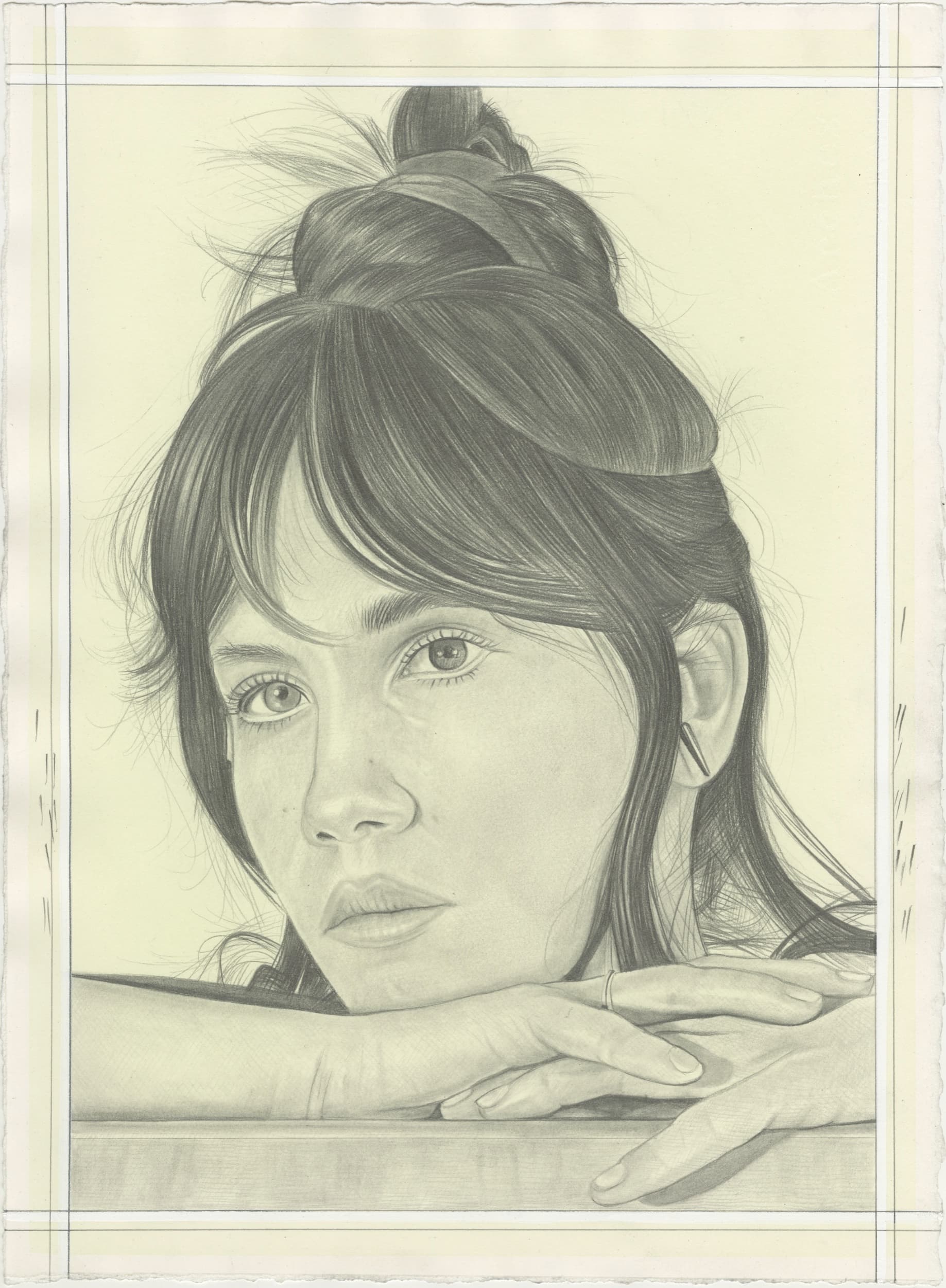
Portrait of Mandy El-Sayegh, pencil on paper by Phong H. Bui.
Word count: 3864
Paragraphs: 49
The Depot of Museum Boijmans Van Beuningen
November 1, 2025–March 8, 2026
Rotterdam, Netherlands
Mandy El-Sayegh uses collage to examine political and social power structures. The shelves of her South London library brim with newspaper spreads, maps, psychoanalytic texts, textiles, and family calligraphy, among many other fragments to be incorporated into her work. El-Sayegh grew up speaking English between her Malaysian Chinese mother’s Malay, Cantonese, and Mandarin, and her Palestinian father’s Arabic. Her elaborate compositions reflect this experience and resist privileging any one manner of communication over another. Across her body of work, images, words, and painted gestures speak in every direction and await identification and close looking. Often they are layered beneath the framework of a gossamer grid, a structure that extends to any site where her work is displayed. Every exhibition includes a floor to ceiling installation, frequently of newspaper spreads gridded and held in place by latex, a material with a history of colonialism and extraction. Among an accrued architecture of print media, El-Sayegh re-presents the news, apparatus and all, as something to be held, scrutinized, and—crucially—felt.
This winter, curator Amira Gad commissioned El-Sayegh to make her first solo exhibition in the Netherlands, a site-specific survey at Rotterdam’s The Depot titled Figure, Field, Grid that layers years of the artist’s projects across the institution’s third-floor gallery. An apt context for El-Sayegh’s work, The Depot is a mirrored, publicly-accessible storage building that houses the over 154,000 objects in the collection of the neighboring municipal Museum Boijmans van Beuningen, publicly viewable by appointment. If you forget to make a reservation, stacked glass and metal vitrines display a selection of the institution’s famous paintings and objects around its central staircase. Amid this environment of smooth, suspended time, El-Sayegh’s exhibition feels like entering the wound of our violent present. Images of atrocity, war, mass death, and torture are layered with headlines of political upheaval and paintings and drawings from the museum’s collection.
On a cold London day in December, I spoke with Mandy in her studio as we walked among in-progress artworks, sat in her library, and looked at newsprint together. What follows is a version of our conversation that has been edited for length and clarity.

Installation View: Mandy El-Sayegh: Figure, Field, Grid, Depot of Museum Boijmans Van Beuningen, Rotterdam, the Netherlands, 2025. Courtesy the artist and Museum Boijmans Van Beuningen, Rotterdam. Photo: Damian Griffiths.
Chloe Stagaman (Rail): Mandy, the artworks on view in Figure, Field, Grid incorporate and examine contemporary images of violence disseminated in the media. Often, you include the full newsprint context of the images, implicating the systems of how they’re received. In a central diptych at the front of your new exhibition, for example, titled Burning Square (Double page spread #3) (2024), you layer gold Chinese joss paper over an October 9, 2023 issue of the Financial Times that announced Israel’s siege and bombings in Gaza opposite a full-page Tiffany & Co. advertisement. What has guided your studio practice as you’ve worked with these images and juxtapositions?
Mandy El-Sayegh: In the work, the concreteness and the horror of these images is allowed a different space and time. They exist in another way through aesthetics. The paintings hold each image, but also allow them to be. I want to do the work of looking. This is where the zone of ethics versus affect comes in. I don’t want to make a pornography of violence. But if I can elevate an image, and hold it—that does something. That’s the space of aesthetics, and it’s for the viewer to judge. It’s hard and it’s something that’s still being worked out, which means it’s an active space of negotiation. I also feel an ethical imperative to disseminate these images, which perhaps is quite distinct at this time and under the current conditions of repression. It becomes more respectful not to hide anything. The only resistance available to Palestinians on the ground is to show the world what is going on.
I think that my work can sometimes make people feel that I’m offloading something onto them, and it’s not my intention to exacerbate the pain. But these images intersect with my thinking and my being. Nothing about them is managing to get to our bodies. We’ve become a dissociative culture, and sometimes the thing that disrupts is a feeling, a weight that pulls your gullet down.
Rail: You frequently refer to each work of yours, or collections of works across time, as a body. Can you say a bit more about how you think about embodiment in your practice?
El-Sayegh: Collage is like surgery to me. That’s why I use the word “suturing,” because with collage you think of paper, but with suturing you think of flesh. I’m going back to Maurice Merleau-Ponty’s idea of vision going through our bodies. Conceptualism is about distance, and I want extreme proximity.
I like to feel a body-empathy when I go into a show: an affective intensity that comes through the senses. It’s something that you wouldn’t necessarily associate with a gallery or with paintings, and it can come from sound, touch, texture, or a certain type of fleshliness. It bypasses the intellect—you might expect this excess in an artist’s studio, but it transgresses the expectations of a gallery. It doesn’t ask for permission, the same way the source images in the work don’t ask for permission. They bypass a certain level of understanding and cut straight to the affective domain. There is something violent to that shortcutting, but nothing else seems to be working. Empathy doesn’t have to mean something soft or compassionate. It can be, but it can also be a jolt. It can be painful.

Installation View: Mandy El-Sayegh: Figure, Field, Grid, Depot of Museum Boijmans Van Beuningen, Rotterdam, the Netherlands, 2025. Courtesy the artist and Museum Boijmans Van Beuningen, Rotterdam. Photo: Damian Griffiths.
Rail: Can you tell me how you got into the habit of collecting the media that goes into your work?
El-Sayegh: I think it was about finding what I thought was precious, because we moved so much when I was growing up. It started with stamp collecting and then expanded to my dad’s Arabic calligraphy, which was written on newspapers and thrown away. I thought, how precious these are. So I’d collect the bits that I could manage to scrabble out of the bin. He hated me taking them out, because calligraphy is an action. You weren’t meant to keep this thing, but you weren’t exactly meant to throw it in the bin either. It was this preciousness that he thought didn’t have validity or legitimacy.
And then it was wanting to keep it together in a family, what we call a composition. I put importance on objects and treat them as families and groupings. The vitrines that are exhibited at The Depot come from my library arrangements. I begin with a single item or fragment which becomes the “seed” for a composition, in the same way that I make a painting. I draw objects and ephemera from my collected material in a process that resembles free-association and lay them out. At a certain point I stop the spread, take down the dimensions, and a table is fabricated accordingly to display the work. I remember, when I had a show at Chisenhale Gallery in 2019, saying that the collecting comes out of this place, as a maker, of not feeling good enough, and that these bits can form a whole. I’m always trying to make myself whole and to make a legitimate picture and subject for viewing.
Rail: Looking at works of collage by other artists in recent months has highlighted for me how much you hold in place.
El-Sayegh: I like that idea, holding in place. It’s true. It’s all laid out on the canvas, along with everything that led up to it. I think temporality is so important, as well as making transparent the process of how I fed the work. I’ve even incorporated several screen printing frames into the current show.
Every time I tried to combine fragments into a whole when I was in school, which started just with collage, it was patchy. So painting became the perfect language for cohesion, because when you’re on one plane, at least you can hold that one plane to the canvas as something legitimate. I needed to find a device that could hold the preciousness of a failing subject.

Installation View: Mandy El-Sayegh: Figure, Field, Grid, Depot of Museum Boijmans Van Beuningen, Rotterdam, the Netherlands, 2025. Courtesy the artist and Museum Boijmans Van Beuningen, Rotterdam. Photo: Damian Griffiths.
Rail: Your work makes me think about what it would feel like to print every photo that I’d seen in a day and adhere them together onto a singular surface. What would the day’s accumulated portrait look like? What would come to the foreground? What would it reveal? You have this interest in how, and with whom, any one person identifies.
El-Sayegh: Identification is huge. When you’re looking at images, you feel a removal or a closeness to certain people. Subjective allegiances happen with images and aesthetics. How we classify things—with terms like “classical” or “punk”—helps us determine legitimacy as well. I’m interested in the power of identification, and the way that we dehumanize and turn people into an abstract field. At the same time, I’m drawn to the potential for abstraction to confer renewed dignity, or allow transcendence, to subjects. Abstraction gives way to the sublime’s terrifying void. There is an obliteration, an extreme abjection, but with that comes sublimity, and painting can hold these two things in balance. Abstraction also holds this esteemed position in art history, meaning it has the potential to elevate something base. I am also thinking of censorship—when it is impossible to speak literally, abstraction is the only route available, and it becomes more weighted because of that. Abstraction can be survivalist. I have a book on African mapping systems that shows how to prevent the colonizer from getting resources. The maps are made with pins on wood. They are really beautiful.
Rail: The title of your exhibition, Figure, Field, Grid is a nod to the art historian Rosalind Krauss, and gets to your explorations of abstraction as well.
El-Sayegh: If you want it to be, the base of any meaning can be a binary: between the printed word and the white of the paper, for example. A painting is about an arrangement, and when you introduce a third, you get something more abstract. Rosalind Krauss was a point of departure. Her text was always there, because I couldn’t find a historical context for my work when I was in art school. I was given that big book, Art in Theory. If I didn’t have a grid in that space, the free-association of words would go on forever. I think of a breakdown of thought and syntax as a breakdown of self and subject. So “figure” feels like a good way to start building meaning. And it’s an entry into painting. I’m really interested in psychoanalysis, specifically Lacanian psychoanalysis. I like the idea of the matter doing something beyond your consciousness, and that the forces of the unconscious will always thwart whatever you try to do consciously. I want to see what happens in the matter. That’s the proof for me.

Installation View: Mandy El-Sayegh: Figure, Field, Grid, Depot of Museum Boijmans Van Beuningen, Rotterdam, the Netherlands, 2025. Courtesy the artist and Museum Boijmans Van Beuningen, Rotterdam. Photo: Damian Griffiths.
Rail: Figure, Field, Grid features several “Net-Grid” paintings, which you’ve made for years. In these works, a multicolored hand-painted or printed grid simultaneously acts as a structuring device for the composition, an overlay, and a net that holds the work’s fragments together. Each “Net-Grid” painting is slightly off a square, giving the works the sensation, even in the specificities of their scale, that they might spill over their edges.
El-Sayegh: I am interested in the grid as a holding device, but one that is fragile and always failing.
The exhibition uses the format of a grid in multiple ways to look at several fields of organization that use a gridded structure—among them a cage or enclosure, a painting’s pictorial field, a method of organizing a figure, a way to arrange media within a newspaper, or the stacked, psychical reality of social media. The grid has a flattening effect, not foregrounding any one thing over another, so that you can stay in a state of equilibrium. So, I am looking at how that structure is used, laying it bare as a visceral entity in and of itself, and exploring how it can get under our skin.
There’s a metal grille that hangs from the ceiling of the exhibition space in Rotterdam that we’ve laid artworks on. It gets to ideas of capture. I’m thinking about people stuck at the US-Mexico border. I’m referencing a metal grille as much as I am skin grafting, where surgeons use a fishnet-type mesh to weave the body back towards cohesion. “Holding” can mean care work and it can mean violent holding devices and archives within the state. These different grids interest me. They’re literal and also abstract.
Rail: You work on multiple paintings at a time, and often repeat images, words. This repetition happens across the show’s “Net-Grid” paintings and in the “Piece Paintings” on view, in which the screenprinted and painted elements are left exposed and gridless. There’s this continual insistence that the viewer look again at the same subject, rendered slightly different each time by the silkscreen.
El-Sayegh: It’s a resistance as well. A resistance within a resistance. How do you create a language which allows movement to get outside of the structure? This insistence on the image, and the persistence of forgotten subjects or fragments, combined with an endeavor to be with and sit with is important. Repetition makes a demand against forgetting.
Images are also changing their relationship and form as they move through time, and repetition allows for a plasticity. Images are altered through being repeated, and through the forms of painting and screenprinting that I am using, in the same way that they degrade as they are forwarded digitally. I am interested in the abstraction that emerges through the breakdown of the image, and the idea that abstraction can occur in a field of excess as opposed to a vacuum.

Installation View: Mandy El-Sayegh: Figure, Field, Grid, Depot of Museum Boijmans Van Beuningen, Rotterdam, the Netherlands, 2025. Courtesy the artist and Museum Boijmans Van Beuningen, Rotterdam. Photo: Damian Griffiths.
Rail: What differentiates your “quasi archive”—the materials you collect in your library and then layer within the work—from a more traditional archive such as the one at Boijmans’s Depot?
El-Sayegh: Like the fragments within my art and collages, “quasi archive” isn’t my phrase. The curator Sohrab Mohebbi called my archive process that. It’s about legitimacy and legibility. Every archive is quasi. Every map is too. Quasi because there’s no official truth. It’s an attempt at something, because the endeavor is important, but it’s always failing. Even the latex that I use in my installations is quasi-conserving, because it’s maintaining the newspapers beneath its surface, but it’s also decaying in plain sight while it does so.
Rail: How do you avoid some of the power structures of the archives that your work is critiquing?
El-Sayegh: I don’t. I have to let a lot of it be unconscious. I have to let it just be the contingency of who I am, and the things that I’m attracted to. I don’t apply a critical lens to it, because criticality will come from myself or from the curator afterwards. I can only see myself once I’ve made the work. The work is something to be witnessed, and I want someone to witness it. I think if you’re working in aesthetics, it’s a given that there is a layer of absurdity.
What’s not a given is the work being received and held, and the promise of meaning. Because I’ve been invited by The Depot for this show, the work will actually become part of their collection. And that’s incredible, because it helps the work resist erasure.

Installation View: Mandy El-Sayegh: Figure, Field, Grid, Depot of Museum Boijmans Van Beuningen, Rotterdam, the Netherlands, 2025. Courtesy the artist and Museum Boijmans Van Beuningen, Rotterdam. Photo: Damian Griffiths.
Rail: Figured Ground (2025), the Depot’s site-specific floor and wall installation, coats the gallery floors and walls in spreads from the Financial Times, How to Spend It, Asharq Al-Awsat, the Volkskrant, Het Financieele Dagblad, and The Sun. Can you talk about assembling this show?
El-Sayegh: The assembling of The Depot show was my most complex, because it’s old bodies of work with new bodies of work. I needed to consider how to juxtapose the layers so that you could see the strata and how it’s constructed. My approach is to give over everything. If I give you everything, you can’t mess with me. I give myself up. In her invitation, the curator, Amira Gad, wanted all my excess. I started my career hearing lots of “you don’t need to do that”, or, “you’re doing too much.” But I can’t hold back, because the ground that I’m given, the white cube, I don’t believe in. I think it’s a political position, actually, to not be happy with this constructed “neutral,” given to you as the accepted thing.
Rail: This “too-muchness” reads in the work. The show feels unafraid.
El-Sayegh: It’s nice that you get that. If I do hold back, that’s when I feel pain. If I can put it in the artwork, it still plays on my mind, but it’s not wreaking havoc in my body. And if I’m conscious that I’m having to hide something, it will become more of a force in me. So the work is a processing system. Someone once called it a metabolizing of events, information, and pain.
Rail: Walking into Figure, Field, Grid feels like entering the beating organs of a machine. There’s a deep humanity to your colors and to the materials that you use, among them the latex with its qualities of decay, its colonial history, and its smell. The walls feel alive.

Installation View: Mandy El-Sayegh: Figure, Field, Grid, Depot of Museum Boijmans Van Beuningen, Rotterdam, the Netherlands, 2025. Courtesy the artist and Museum Boijmans Van Beuningen, Rotterdam. Photo: Damian Griffiths.
El-Sayegh: That’s a huge compliment, thank you. The exhibition at The Depot was so hard to document. We tried to get a videographer in, but you have to experience it. It’s really hard to photograph it.
Rail: I believe it, because all of the senses are engaged, especially within The Depot’s reflective and glass architecture. There’s also the sound that accompanies the show, which feels like a heartbeat, and which stems from the video, Superimposition (2023), on display in the exhibition’s back room.
El-Sayegh: The sound goes back to basic human things. I had an experience of losing myself in a psychotic episode, and I stopped being able to speak properly. I stopped eating, and couldn’t make paintings because I didn’t understand what I was doing. But I still had deadlines, and one of them was for a performance. My dad told me that I needed to find my pulse at the base of my head to ground myself. I asked my collaborator Lily Oakes, a composer, to make me a beat. I had these sounds that I’d collected, which I’d called “pot rain.” I put my phone under this pot that was outside, because I couldn’t stop pacing or moving and I needed the structure. So the sounds became a kind of grid. After asking about timing and things, she made the perfect soundscape for me to reintegrate with my body. And I was received. Performance curators came to that performance, and they accepted it. Psychosis kicked me out of my old body, and when I had nothing, none of my faculties, I started again with sound. It’s an orienting force.
There’s a lot installed at The Depot, but you can follow the ding. If you notice, in the show, it’s offbeat. Lily has treated it so it sounds ethereal, and leads you to its end, which is a distorted instrumental from Screamin’ Jay Hawkins’s “Portrait of a Man.” If you had listened to the actual lyrics, it would have been so cheesy, because it’s literally the show. It talks about painting a portrait of a man, painted in blue, all shades of blue.
Rail: Receiving this commission from The Depot also meant having the chance to delve into the Boijmans collection and use some of the artworks in their archive as material. One of the works that recurs in the show is Andy Warhol’s The Kiss (Bela Lugosi) (1963). Can you talk about working with this painting?
El-Sayegh: It’s such an iconic image. Warhol really knew about desire, branding, sex, and memory. I picked that work because it’s the bridge to his “Death and Disaster” series. I like it because it is painterly ecstasy. It resonates with a crisis moment of rapture, right before his electric chairs. The Depot’s been showing it a few floors above my exhibition.
I knew I had to use that image and I knew that he was going to float to the surface of the work and be recognized, because of its power. I’m interested in that robustness that speaks massively, which is what Warhol was doing with The Kiss. I’m thinking about how I can use what is called, in shamanistic language, temple power, and associate other fragments and images with that which is already venerated. I also use Abu Ghraib images in this show, and I can imagine Warhol using them. For a period, he used his visual language to look at catastrophe. It’s hard now, when you search on Google, the images from Abu Ghraib that are so present in our generation’s mind are harder to find. You can only find really impoverished versions. But to me they’re still so present, as present as Marilyn Monroe. In fifty years, I fear they’ll be gone.

Installation View: Mandy El-Sayegh: Figure, Field, Grid, Depot of Museum Boijmans Van Beuningen, Rotterdam, the Netherlands, 2025. Courtesy the artist and Museum Boijmans Van Beuningen, Rotterdam. Photo: Damian Griffiths.
Rail: Your interest in temple power feels just as present in another work you’ve incorporated from the Boijmans’s collection, Andrea Lilio’s Study of a Male Nude for a Pietà (ca. 1596). In this sketch drawn in black chalk, a seated male body tilts backward, his head and arms lifeless and heavy. An overlaid, squared grid aided Lilio in transferring the sketch to its eventual canvas, where it would become Jesus held in the arms of Mary.
El-Sayegh: This stood out to me because Christ feels like the last memory of how we dealt with pain collectively in the West. Christ is a singular image which speaks to a universal, and its singularity is how it gains its power. I’m interested in instances when the image of one suffering body (almost always depicted as a white body) has more symbolic power than a slew of images of masses of bodies. I think of the many images coming out of Palestine right now. I can’t even get back to any one of them on social media, to have a record, because there is such a flood of imagery. Palestinians remain a mass that we’re unable to identify with.
Rail: In the video that accompanies Figure, Field, Grid, you talk about speaking and feeling through abstraction and poetry at a time when your words could be used against you. What does inviting audiences to see this expansive survey of your work mean to you?
El-Sayegh: I ran into my undergraduate teacher recently, and he didn’t know that I was Palestinian. I told him that I thought, back then, that my classmates wouldn’t understand my experience. And then he brought up “compassion fatigue” and other world events in Iran, Sudan, Ukraine, and how suffering is everywhere, and how there’s so much—too much—pain. And I thought: I’m not asking you to go out and be an activist. I’m asking you to just be with, to be with me and look at the images in the work and see what that does. Why do I paint? To keep looking.