BooksDecember/January 2025–26In Conversation
SAM HEAPS with Jorja Rae Willis
Word count: 3044
Paragraphs: 42
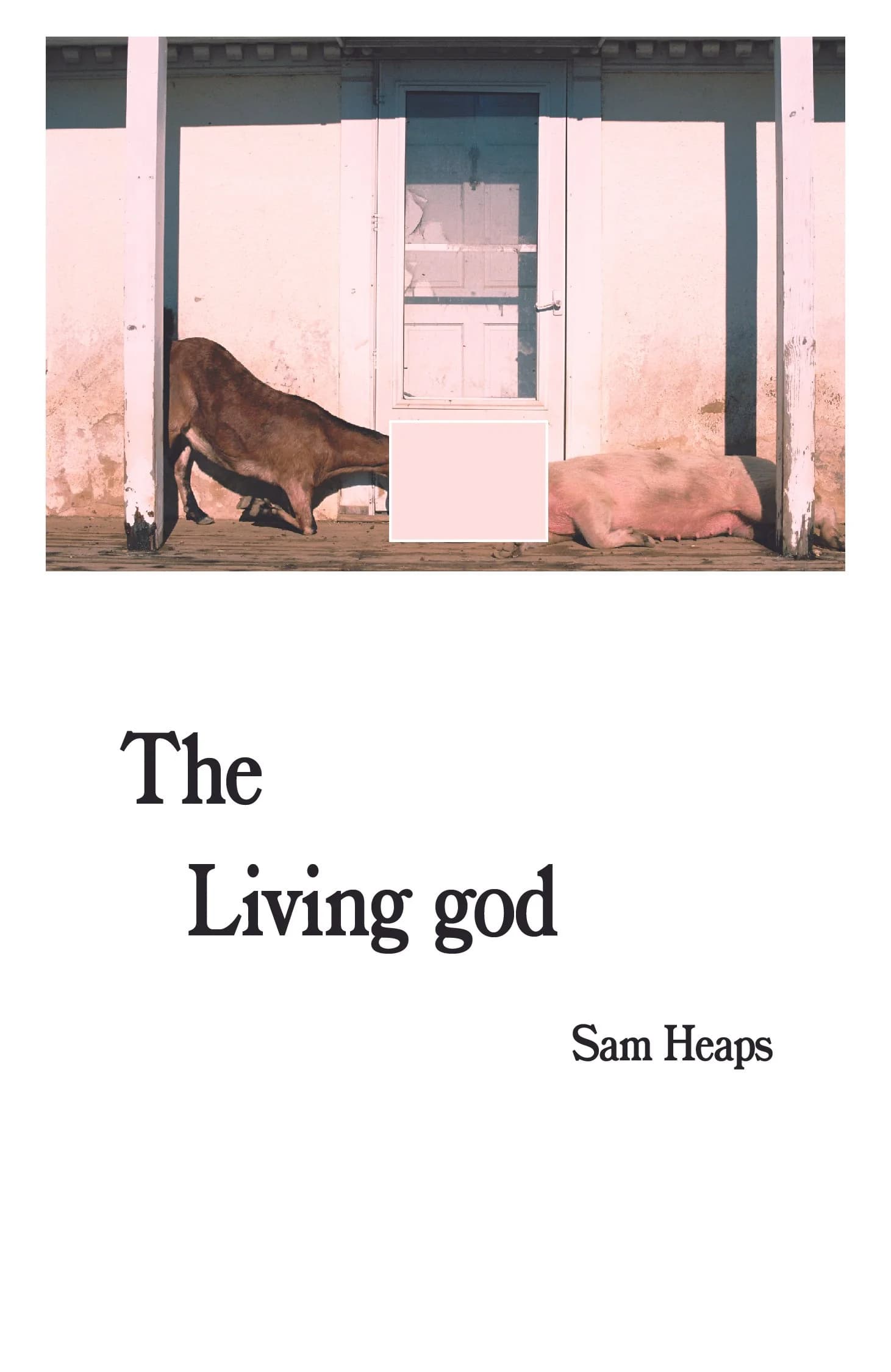
The Living god
SARKA, 2025
Sam Heaps’s debut novel The Living god is as haunting in subject as it is in style. The story offers an unfiltered look into the life of “baby” over the course of twenty-four hours, following her departure from the religious community run by Elaina—her lover, prophet, and mother to their god, Immanuel. Waking up in a Montana motel with Jesse, a fellow former devotee and Immanuel’s father, baby is forced to bear the weight of their shared past while struggling to carve out a future. The prose is delicately balanced: simultaneously tender and unsettling, sensual and sharp, each word luring you in as you watch baby through her darkest moments.
Following The Living god’s publication by SARKA, Sam and I met to discuss their Mormon upbringing, cult leaders, and child messiahs.
Jorja Rae Willis (Rail): Your first book was a memoir, so I imagine writing The Living god must have been a very different process. What was it like for you making this novel and what research went into it?
Sam Heaps: Writing The Living god was a really different process than writing Proximity, my first essay collection, which came out all at once in a three-month fever. The Living god I intended to be a much larger volume. I started by doing a lot of research, both into famous cults, and into my own ancestry. I was raised Mormon, so I have access to diaries from some relatives in Mormon handcart companies. These pioneers show up in Jesse’s dreams often in the current iteration, but those plot arcs were initially much fuller. It felt good though, in the end, to cull god into what it is now.
Rail: How did you decide to whittle it down from being a generational tale to this incredibly immediate story of one person?
Heaps: I was spending a lot of time on this really extended timeline in which the women from Jesse’s dream—Patience and Lily—are lovers who have a long, harrowing voyage, and a parallel child loss. But their world ended up feeling like a distraction from what was important to me in writing The Living god, which was the desire to express an individual forced into extreme pain by personal and historical circumstance, and the pathetically limited options to address suffering in our current system. As much fun as it was to write these other storylines, they ended up feeling like distractions, or opening up something different. This book looks at but does not really interact with the violence of westward expansion and genocide. Baby and Elaina, and Patience and Lily, feel they are paying for sins, I think. But this book did not feel like the place to pry the origination of these sins open. They ended up feeling like some sick kind of play, or a thought experiment. After making the cuts, I think the book turned into the perfect little volume.
Rail: It is a great length! In thinking about the main character, power and autonomy—and the lack thereof—are really central to the work. I often found myself frustrated with baby, but then also sympathetic toward her. She had an abusive childhood, she had this partner that had the upper hand in the relationship—she was basically patient zero in a cult. Then we see her struggling with mental health crises and with addiction, and she’s left with a much older man who’s not stable himself. She made a lot of bad choices, but then a lot of bad choices were made for her—she’s a flawed character, but someone we’re still rooting for all the way up until the end. What was it like to write a character like that?
Heaps: I feel kind of disappointed in myself, because I think I’m of the zeitgeist in the fact that baby is one of these extremely passive female characters we see a lot now. It isn’t new, but also I feel like it is having a resurgence, as this kind of response to “alpha girlboss” types, and the insurmountable defeatedness of existing, or trying to, now. It’s not disconnected to the rise in traditional gender roles—not disconnected at all. But I hope it is a visible captivity here, and not a condonance.
Rail: Why baby—why her as a character? How did you hope she existed? She’s a very complicated character. I wouldn’t describe her necessarily as passive; a lot happens to her, but—especially towards the end—we see her really resisting.
Heaps: I think she’s definitely trying to resist; I don’t know if she necessarily has the tools to do that. None of her dialogue is actually in quotations; it’s not actually voiced. You can never be sure if she’s really speaking out loud, or if she’s even being fully perceived by others. Why baby is hard. Baby I do think is interchangeable—a vessel. And there’s a despair in that, which is present?
Rail: Yeah, it is.
Heaps: [Laughs] Great. I’m glad it is felt. But—not to be repetitive—there are no systemic supports for her; there’s very little internal or external resources. I really wanted that state to be represented in her: someone who has plenty of privileges and might appear to be kind of “okay”, but who is just totally at sea. And also as a contrast to these larger-than-life characters, particularly Elaina.
Rail: The book takes place over twenty-hour hours, which is one of the things that makes it really compelling. Baby spends much of that time reflecting on the past, and also moves through the present and the past really fluidly. Sometimes it even feels like these two realities are overlapping or converging. What drew you to that form, and what made you want to tell her story this way?
Heaps: I was thinking about trauma a lot while I was writing this for a variety of reasons, and the way that trauma impacts your ability to process time. In particular, I was thinking about the experience of flashbacks or the experience of triggers, and the way the past is very present in your reality. A lot of going to therapy for these kinds of things is learning to be in the present again through untangling narrative and sensation. That’s started to really feel like a lie to me—another way of saying, “You’re crazy,” to someone who has seen horrific shit. I think our perceptions and sensations matter, and I was trying to represent that state of being, and again—in another fallacy of a container—the day.
I would love to write another twenty-four hour book. I think it’s the best.
Rail: Religion obviously plays a major role in the trauma that’s happening in this story. There’s a lot of contradictions: Elaina embraces the fact that this is an ancient religion, it predates any of the Abrahamic faiths, but then she also co-opts some Christian ideologies. Throughout the book, for baby, her experiences with faith are not really positive. Even at the end, where there’s this hint of, “Okay, this is a new chapter,” she’s still shoved in the direction of religion. But, in a way, each experience is a new opportunity. Things change for her as she embraces these different faiths. You grew up Mormon—I was wondering if you could talk about the role religion plays throughout the book, and what it represents to baby and also to Jesse?
Heaps: Elaina is certainly drawing from Akhenaten and the first monotheists, in part because it makes her feel special, and of course powerful. But she’s also really doing whatever she wants. I envisioned her as having a fetishistic relationship with certain Eastern religions. And of course, part of me thinking of her this way is coming from Mormonism, which is a very cobbled-together religion. For Jesse, I think religion represents atonement: punishment and release. I think baby would like that as well, but is also longing for home, purpose, order.
Rail: Elaina is one of the most interesting characters I’ve come across in fiction. I’ve been describing her as kind of a perfect villain. Cult leaders—especially those who involve a sexual component—are typically men. More recently I feel like we’ve heard more about some women cult leaders, but it’s still more of a novel idea. Elaina fluctuates: she’s nurturing, but then she’s cold and cruel, and then sometimes she’s both simultaneously. She has this voracious sexual appetite, and she uses intimacy and affection as weapons, just as she does different elements of faith. She keeps herself powerful through all these different means. What was it was like to write a character who represents a lot of what’s wrong with religion—some objective bads within the world—but also someone our protagonist has a really hard time moving away from, because she still loves Elaina, and Elaina still has this power over her?
Heaps: For Elaina in particular, I was doing research into Jim Jones, expecting some larger-than-life character that would look strange even to me. But really Elaina is a domestic abuser with an enlarged ego. She’s complex. She’s also traumatized. She’s sexual and charismatic and alluring. But relationally she’s limited. She can only dominate.
I can imagine falling in love with a cult leader—Elaina, someone like her. I have loved people like her. I also enjoyed writing her weaponization of intimacy and sexual dependence. I think also cultivating desire is this really ephemeral power women have, which Elaina was able to somehow never let go of. I think it’s interesting. I think she would utilize that. Male cult leaders use sex all the time. Elaina uses it too, even in a cult of one.
Rail: That’s interesting, because when I think of men who are using cult status to manipulate people, I always think of it more of a brute force thing, in a way. I would say Elaina has a lot of qualities that could be seen as typically masculine, even though she’s this ethereal, very feminine character. And I think baby acknowledges that too, that Elaina is everything.
Heaps: I think it depends on the cult, but a lot of these men were sexy, you know? They were charismatic, a more feminine power. Not just brute force and extreme manipulation. Pair that with the power that comes with some grandiose theory, some knowledge of your being you’re not allowed to be privy to, and then this charming charisma. A nice hybrid of feminine and masculine? Someone worth sexually revering as deity? I think.
Rail: Yeah, if you know how to leverage it, you can take it far. Now I want to talk about the concept of “the living god.” I actually learned that there was a living prophet in Mormonism through this book. I know almost nothing about the faith—I was raised Catholic, which is its own weird thing.
Heaps: That’s a mess, too.
Rail: Yeah, it is. [Laughs] The idea of the living god comes up in Catholicism and Christianity though. Some Hindus and Buddhists believe in the Kumari, who is always a prepubescent girl. I actually had a friend who was in a cult that believed that god was a living Korean woman, and she referred to South Korea as Zion.
Heaps: Mormons have a Zion. It’s one of those Middle American states. I haven’t been practicing for a while, but I think it’s in Missouri.
Rail: [Laughs] In this book the living god is a child. What attracted you to the idea of creating a living god, and why Immanuel? Why a child?
Heaps: I think I’m drawing from a lot of mythology, from the Christ reborn to my own background with the living prophet, because Mormons do believe that there’s always someone on Earth speaking directly to god. So I think that’s partly where this is coming from for sure—a very literal critique of or response to various organized religions.
Immanuel as this figure of reverence is very much a relational one and an interpersonal one. This book also came out of my grief after the loss of my relationship with my stepson, so I was thinking about how with Immanuel—or children in particular—there’s a very specific caretaking relationship that you’re very lucky to be a part of, and you’re very conscious of that gift as you’re in it. So I was thinking of Immanuel as just any child that one might love in this godlike way.
Rail: That really comes through in the way that baby and Jesse take on this parenting role with Immanuel throughout the book, and also how Immanuel is the person who managed to humble Elaina: he made her weak, and he wasn’t afraid of her. There’s something really powerful about him beyond cult worship—in just bringing a child into this dynamic.
Heaps: And baby biologically does not have that power in her relationship with Elaina. It’s a huge part of Jesse’s draw.
Rail: On that note, much of the book is incredibly direct—it’s even graphic at times. You don’t shy away from much. But there is this mystery at the center of the story: we know Jesse and baby are on this path to living independently, and by the end we get a pretty clear idea of why, but we’re never told directly what happens. I was curious about your decision to leave that part of the story more open-ended. In a way, the past is as important as what was happening to baby in the present, and what I would imagine would be the climax of that plotline almost goes unsaid. What was it like writing around that, and what informed that decision?
Heaps: When I write anything, but especially when I was writing Proximity, when I was writing this, there are certain scenes that I don’t want to write because they make me just so sad. So I think the climactic moment with Immanuel and Elaina I was also writing around because I didn’t want to do it. I didn’t want to look at it. But now, also, I don’t think for baby, there is anything after that event. She’s struggling to even care about her own miscarriage. She’s struggling to care about her own child, her own body, her own current circumstances. She’s all but gone after the loss. I think everything leading up to that moment is what matters to her—every memory of their time together. I wanted to make that present as well.
Rail: She wakes up in a motel room and the in-between is missing, but she’s trying to push forward while struggling with all this grief. Similarly, we’re introduced to the spirits early on and really directly. In the beginning they were described as a gift, though the more we see them, the more we know that’s not necessarily true. They’re mean, and they’re always laughing at baby. I think it’s easy to perceive them as a symptom of mental illness, but they’re real to her, and I chose to take them at face value—this was something that was totally happening. How did you arrive at the idea of the spirits and making baby literally a haunted character?
Heaps: I think that’s interesting that they feel really real to you. I hope that they feel as real, if not more, than baby herself, because I think she’s very much one of them for much of the book in a lot of ways. But I also was thinking of them as some sort of Greek chorus situation—some kind of audience or careful observer. I crave some kind of understanding or observation of pain sometimes when I’m suffering. I think that’s also something that was maybe being projected by baby. I think of the spirits as pretty real; I think of them as a pretty important part of her and Elaina’s life. They also just kept popping up. The more and more I thought about these environments that baby would find herself in, the more I was thinking of the other people who were in those environments in other states of pain, and the more they kept coming up in my consciousness while I was writing, so I at least wanted them to assert themselves briefly, especially in the motel room. They serve a few functions, and certainly one of them is to represent a character who is very mentally ill. But, again, I guess I question our basic assumptions about what someone is experiencing who’s experiencing mental illness, and the reality around the reality of those things. That’s there too.
Rail: I’m going to read the last two paragraphs of the book, because it’s a really good ending:
I feel the spirits grow into huge grotesque clots, like jellyfish, corporeal as they flutter upwards, as if my faith had been the cage. I am now just bones and flesh. Jesse is standing in the door and the shadow he casts is a road and the room behind him an incandescent orange orb. But it emits no heat.
Elaina’s revolution is past now. The latter days are upon us.
It’s sinister, but there’s the potential for a happy ending there. We talked about how baby’s not autonomous: she doesn’t have the tools to be making decisions for herself. But, in this moment, she does seem open to moving on. It was kind of a mixed bag for me, where I was thinking, “Well maybe this is better?”
Heaps: The ending is increasingly complicated for me. When I first thought of the ending, I was like, “Oh, what an absolute tragedy if she joins the church.” My absolute worst nightmare: let’s have her do that. I think it is partly tragic because of the embedded misogyny, because of the lack of options and the lack of autonomy, as mentioned. But then I do agree with you that there is a bittersweetness, there is a forward momentum, there are people who—in whatever way they are capable of—will care for her in a way that perhaps she has not ever received care. I think it also keeps her alive and I think—I hope—that matters. But, yes. Ultimately, I think of it as a tragic ending, but I do think there is something more complicated going on than just despair, nihilism, sadness. There’s a future for her, for sure.