BooksDecember/January 2025–26In Conversation
JOE SACCO with Tadhg Hoey
Word count: 3828
Paragraphs: 49
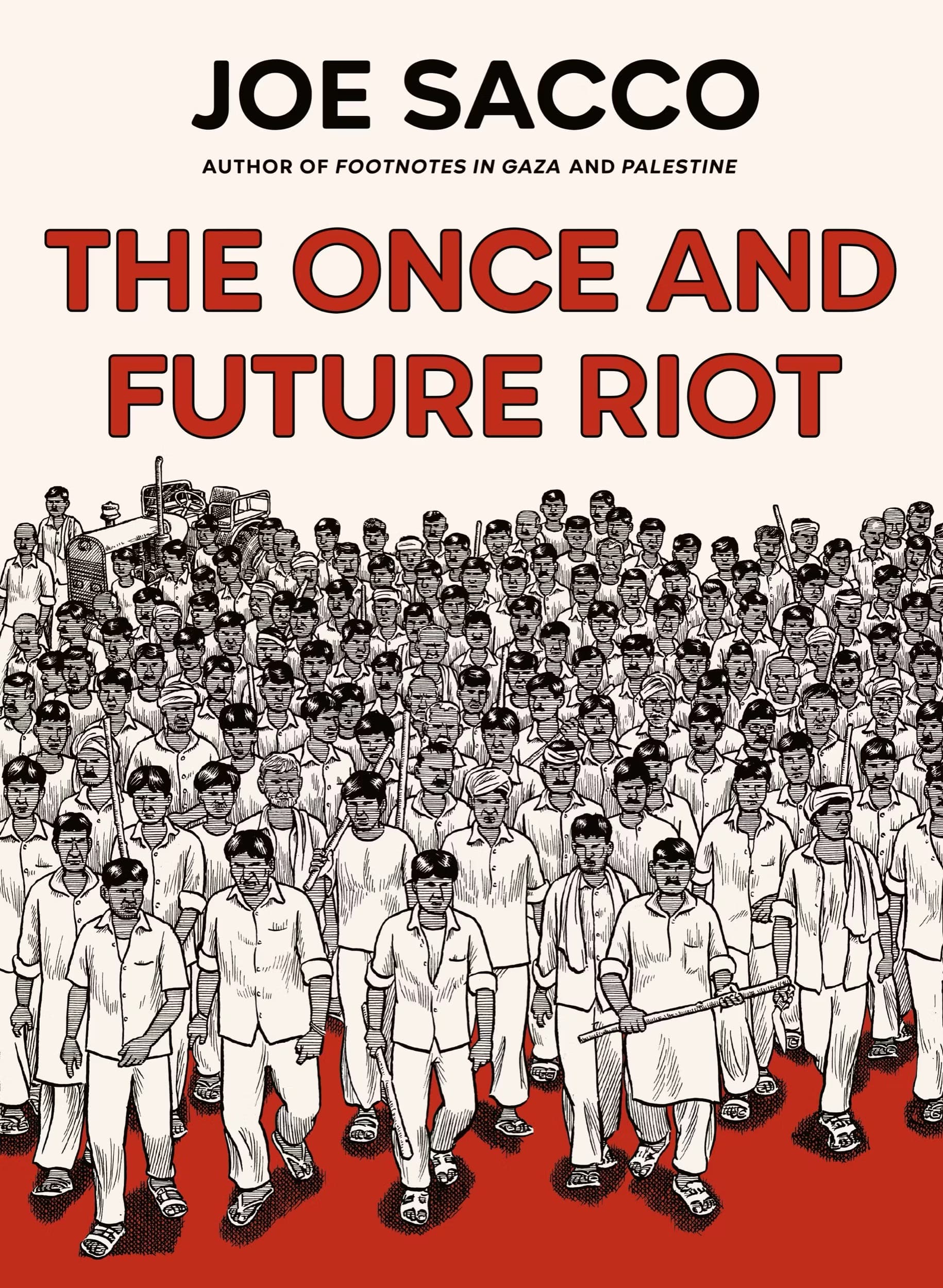
The Once and Future Riot
Metropolitan Books, 2025
2013 marked some of the worst sectarian violence seen in recent history in the Indian province of Uttar Pradesh. The weeks of violence, which later became known as the Muzaffarnagar Riots, saw alleged lynching, arson attacks, rape, mass displacements, as well as the military dispatched to de-escalate tensions between Hindu Jats and Muslims. Though the cause of the unrest remains disputed, Muslims were disproportionately impacted by the violence and displacements, with many forced to flee to refugee camps and unable to return to their villages. The riot fits into a larger pattern of anti-Muslim sentiment and violent rhetoric increasingly promoted by the Bharatiya Janata Party (BJP), the Hindu Nationalist party led by India’s Prime Minister, Narendra Modi.
Joe Sacco, the award-winning author of Palestine, Footnotes in Gaza, and Days of Destruction, Days of Revolt (co-authored with Chris Hedges), travelled to Uttar Pradesh in the years following the riots in an attempt to better understand how the Hindu and Muslim communities have since come to understand the events. Sacco is no stranger to reporting on conflicts—he has covered Russia’s invasion of Chechnya, the Bosnian genocide, and has now spent decades covering not only conflicts but daily life in Gaza and the Occupied West Bank.
I spoke with Joe recently from his home in Portland about his thoughts on what lessons can be drawn from the situation in Uttar Pradesh, and, more broadly, about the ways politicians exploit differences and division for their own ends.
Tadhg Hoey (Rail): You wrote about Uttar Pradesh some years ago, when you went to spend time with the Dalit class and you reported on poverty and food insecurity. What took you back there?
Joe Sacco: I guess I’d been just looking for another excuse to go to India. It’s a fascinating place and you could say, geopolitically, it should be a major player. There’s over a billion people, making it the world’s largest democracy. So, I am curious about a country like that. When I lived in New York, half my friends were Indian, so India’s always sort of coursing around my head. But a colleague of mine in Uttar Pradesh wrote and said I might be interested in this riot that happened, and I began to read about it. They’re called the Muzaffarnagar Riots, and I thought it would be interesting to do a book.
Most of my books, unfortunately, have been about violence, but I wanted to go a little deeper and not just do the who what where when typical journalism story. I wanted to probe a little deeper. I thought it would be interesting to find out what people say about what they did in an incident of violence like that, sometime afterwards. I wasn’t there for the riot itself, so I thought, well, let’s see what happens after about a year. That was the main idea: what are the narratives people come up with in a situation like that?
And, of course, when you get there—when you get to any place like this—other things start to open up. You begin to look at things like, oh, this is connected to electoral politics. This is also about politicians manipulating certain situations. It broadens out. But that was the main impetus.
Rail: One of the things I found fascinating with this book were the claims that attacks, murders or massacres that happened were constantly being called into dispute by both parties. You go to look at one building you were assured was burned down in an attempt to run those people from their home. You get there and it’s clear the place has not been burned down. Most people, it seems, are exaggerating to cast themselves and their community as victims. Later, someone says, “The truth is that nobody was killed in this village, but they went somewhere and maybe they died.” Then some Jats told you that Muslims burned down their own houses in order to get government compensation—but, in reality, very few Muslims received any compensation at all, contrary to the government’s claims. What was your approach to dealing with these competing narratives?
Sacco: My approach was to hear people out—let’s hear what they say, let’s hear how they paint themselves, how they paint the antagonists, and then do the journalistic thing and try to find out the facts. It wasn’t just a question of hearing people and recording what they say—it’s like getting to the truth. So, if I was in a Muslim village, and I was told one thing, well, you can find Jats who were victims going through these Muslim villages, and you can talk to them and see what they say happened, which seemed more accurate—and vice versa.
The main example I used was a Jat village called Lisarh, where it seemed clear that about thirteen people were missing and probably dead. But I was told in the village that no one was harmed there, and the stories they were coming up with about why no Muslims were even in the village at the time were just ludicrous—they really seem made up. So you listen, you record, and then, okay, if you say no Muslims were harmed here, let me see if I can find Muslims who were harmed here. It takes time, but, to me, this was kind of a book of pure journalism—that’s how I thought about it. I wanted to not just listen to what people said, but find out how close to the facts what they were saying was.
Rail: That reminds me that early on in the book, you met this Jat journalist, and he said to you: “You find lots of liberal people … Jats and Muslims—in the middle with the extremes on each end. But if something happens, you will find no one left in the middle.” With very few exceptions, this prediction rings true throughout the book. Having been doing this for as long as you have, are you still surprised by how quickly the middle ground disappears?
Sacco: I suppose I shouldn’t be surprised, but it still startles me. It always startles me when societal fabric begins to fray. And you’re right, I’ve seen a lot of experiences of it. In Bosnia, I heard a lot of accounts of neighbors persecuting or attacking neighbors, people who were friends ending up on opposite sides. What’s interesting to me is that, very quickly, you just have to decide where you’re going to be the safest. It’s sort of easy to say, well, we should all try to coexist, whatever—but certain incidents have a resonance. When there are violent incidents, you would normally, I think—almost animalistically—go to your own kind. I mean, it’s a matter of human nature to feel you’re going to feel safest where you look more like the people you’re with, or have the same beliefs or whatever it is. If you are a Muslim where there’s violence between Muslims and Jats, you’re not going to go to Jats to find protection—though every now and then that happens.
That’s the other thing I always find interesting, too. There are always people willing to put themselves on the line. There’s an example in the book of a Muslim who took me to his Hindu friend, an older gentleman. He and his wife protected the parents of the Muslim—basically had them come into the house and just stay there while the Jat crowd roamed around looking for victims. And in one of the hamlets close to Lisarh, a couple of Jats—landowners—took in a lot of people, at least for a while, to protect them.
So, as much as you find people behaving as you might expect them to behave, other people will surprise you. That’s the other surprise—people who are willing to put themselves on the line to protect people who aren’t of their own kind, so to speak.
Rail: And often in those politically-charged, volatile situations, people who help often pay a pretty high price from their own communities for doing something like that. Ostracization might be the least of their worries.
Sacco: That’s exactly true. I would imagine if you protected a bunch of Muslims, you might not be harmed, but other Jats are going to be looking at you like, we can’t count on this person. It’s like the police. You ride around with your partner and your partner does something wrong. If you report the partner, you’re going to be ostracised by the rest of the department, probably. That’s realistically how those things play out.
Rail: You mentioned earlier how some politicians exploit this. You quote someone in the book who says, “Communal violence, planned or not, can confer some electoral advantage, and bloodshed, properly framed, is nothing if not a political building block.” This reminded me of some lines from Philip Gourevitch’s book about the 1994 Rwandan genocide, We Wish to Inform You That Tomorrow We Will Be Killed With Our Families. “Genocide, after all,” he writes, “is an exercise in community building.” He also points out that genocide is the logical conclusion of one people telling themselves they can only be safe if the perceived threat posed to them by another group is eliminated.
I’m not saying that what you’re covering here is by any means genocide, though these things exist on a spectrum. It’s a hackneyed playbook that political leaders exploit to bring about communal violence to their ends again and again—are you ever surprised by how often it works?
Sacco: No longer, really. I have a very low opinion of most politicians. People who aspire to power, just almost naturally, seem a little demented and probably should be disqualified. You see it in the United States—you see it in other places, too. The famous Nazi jurist and philosopher Carl Schmitt said, politics needs an enemy. I think there’s just less work to be done to get people on your side if you can provide an enemy, to look at whatever is troubling a community and the souls of each individual. A politician provides an outlet for that by pointing the finger at someone, some thing, or some group.
That’s true in India, where it was built on a secular foundation. If you look at the Indian Constitution, it’s a really good constitution, really self-consciously written to provide as much equality as possible, blah, blah, blah. But, the reality is, over time, someone like Modi or the BJP were able to make a lot of ground based on finding an internal and external enemy. In India’s case, Pakistan is the external, Muslim enemy, and there are at least a couple hundred million Muslims in India that can be cast as an internal enemy. People respond to fear and they respond to their own sense of insecurity, physical and otherwise. So, in some ways, it shouldn’t be a surprise that politicians are ready to disrupt the fabric of their societies by causing division and by emphasising the otherness of some imagined enemy.
We’re seeing this in the United States. It’s the same playbook. You’ve seen it for a long time. Muslims are the enemy. Now, immigrants are the enemy. One of Donald Trump’s main building blocks was pointing the finger at immigrants and painting them as rapists and murderers—creating this narrative about what immigrants are. And people, they’re afraid. They respond to that, for some reason. Also, they’re looking for someone to blame for the loss of jobs, for the way there’s been basically a societal collapse in the United States. I look around me and I see homelessness and drug use and all that, and instead of talking about the economic reasons for this or the policies that have been instituted that have made this manifest, instead of looking at those things, it’s like, well, this group’s to blame, and the drugs are coming from here, and let’s do this and let’s do that.
I think people respond to easy solutions, especially if it’s about very gut, lizard-brain kind of stuff.
Rail: Exactly. Scapegoating. This reminds me of an earlier standalone piece of yours. In it, you visited Malta, which at the time was experiencing an unprecedented influx of African refugees. A lot of the Maltese people, and some politicians, blamed various social problems on these incredibly poor, often traumatised refugees, who lived in awful conditions. Today in Ireland, where I’m from, many blame refugees and immigrants for these same problems, and blame them for a housing crisis that’s a result of systemic government inaction stretching back decades. Just recently, on October 21, there were large riots in Dublin over the sexual assault of a ten-year-old girl by an immigrant. Immediately, without waiting for details, an anti-immigration protest formed, and that quickly turned into men and teenagers rioting and attacking a hotel where refugees were being housed, attacking police, setting cars on fire. Then this one awful incident becomes symptomatic of larger issues.
You see versions of this dynamic all throughout Europe now, and the United States. Societies that have seen much of their welfare states and public housing stock hollowed out through privatization have a sense of frustration and hopelessness that is being misdirected at the most vulnerable people—migrants, in many cases—as opposed to making the government accountable for their plans, or lack of. Have you come across any positive stories where societies, or groups, are able to overcome their perceived differences, to bridge that perceived gap?
Sacco: Well, it’s not a fair question, because look where I’ve gone! I’m searching out those places where things are falling apart.
Rail: True. [Laughter]
Sacco: I did give you some examples of individuals who do behave in ways that I think are exemplary. I think when I was in Canada among the Dene people, there was a lot to learn there. I think that experience probably had as big an impact as anything has had on me, because I saw people whose culture has been under assault for generation after generation. It’s really damaged the society of the indigenous, First Nations people. But then, you meet people who are really trying to reconstruct and reject the way they’re perceived, and almost ignore it, and just try to inhabit who they are. It doesn’t mean the society itself isn’t troubled, because it is, but there are always people working against that grain. They’re working against the damage.
I think a lot about human nature and, at this point—it might be different in a month from now, just so you know—I think of it as an embrace of what Jean-Jacques Rousseau said. I think people are generally good. What I find difficult is with leadership, with people who are leaders, because I think to get to certain positions—especially in really large societies—you have to have a certain pathology, almost like a sociopathology, to throw people under the bus. If you can imagine someone saying, “Oh yeah, I can send people to war,” and that’s why we’re going to vote for them, because this guy’s got the balls to do something like this—it’s just odd. It’s weird. When I look at someone like Trump, or Modi—and I won’t exclude the Democrats, for example, I won’t exclude almost any politician from this sort of thing—they’re looking for wedge issues, and they’re looking to keep power and retain their privileges. I think that’s who they are. But, I tend to assume people are good. I’ve had too many people helping me out in situations.
Even when I was in Bosnia. It’s not reflected in my work, but I spent a lot of time on the Bosnian Serb side. I could see how they were manipulated, and I could also see how they were manipulating themselves, that they were buying into something and they were justifying things. In other words, I could easily have pointed all these things out to them and they would become very defensive about it. But, putting all that aside, they would’ve given me the shirt off their backs. I mean, they weren’t bad people so much as I felt they were manipulated. Sometimes, things develop in a certain way where you’re all in and you’ve got blood on your hands now. I mean, that’s probably true in Rwanda. Often, what you want to do is get everyone in your community to join in on the violence. Why aren’t you coming over here with your machete, or whatever? Why aren’t you coming over here with your iron rod? Get over here and hit this person. You could be ostracised by not joining in.
Rail: It’s interesting to hear you say that spending time with Bosnian Serbs complicated whatever assumptions you brought with you to the conflict. That reminds me of another quote that’s been on my mind recently, and I’ve been searching to find the exact quote. I’d love to attribute it to James Connolly, a very important socialist, and one of the leaders of Ireland’s revolutionary Easter Rising of 1916, but I can’t confirm it. It was something to the effect of—you can hate the idea of an entire nation without hating a single person from it. This was obviously said in relation to England, but the sentiment, that an individual isn’t always representative of the state, has something to it—something that many people aren’t willing to grant at the minute.
Sacco: No, they’re not. Even what you’re talking about, about what happened in Ireland recently. You mentioned a ten-year-old girl was assaulted by an immigrant, right?
Rail: That’s the allegation and what prompted the riot.
Sacco: So, I understand it’s hard for people to do. I really do. But, if you want to talk about trying to be rational, you say, well, that individual then should be punished. There has to be justice, but that shouldn’t make you leap to painting the whole community that way. But, it’s quite difficult to start talking about the complexities of these social problems and say, well, if we provided them avenues of this and this, there’d be less of these sorts of problems. Convincing people on that level doesn’t fly when you can just say, they’re all like this. It responds, like I said, to the lizard brain—the one that’s fearful and wants vengeance. We haven’t really evolved that much. Ten thousand years ago, we were in little family groups roaming around. Now we’re nations of millions, and even billions, of people at this point. I don’t think we’ve really evolved properly to look at these things, at the problems we have. Our brains just aren’t there yet. I’m not sure they’ll ever be.
Rail: Is there a lesson in here for Americans about the kind of increasingly fractured society they live in, not just from the perspective of obscene material differences in wealth, but also the fact that many Americans now seem to live in different versions of reality from one another?
Sacco: I think we’re reaching an authoritarian moment here. I would hope that people can look at examples on the outside, let’s say what’s going on in India, and see how it parallels what’s going on here. I think people have to be as aware as possible about how manipulation works, and they have to check themselves a little about buying in. For example, Charlie Kirk’s assassination immediately, very quickly turned into, “the far left is the problem.” Stephen Miller even called the Democrats—and I don’t think of the Democrats as the far left, or even the left—a terrorist organisation. This rhetoric is just so out of hand.
I start to look at what some right-wing conservatives are saying, and it’s really troubling. The people want to pile on and really get engaged in it and let themselves be carried away. What can I say? Honestly, I think the lesson is: be careful. Don’t get carried away by even troubling incidents. You have to sort of take a step back and say, what happened here? What could have been done to have solved this?
Even in the story I did, it was an incident between Jats and Muslims, a fatal incident, where two Jats and one Muslim were killed. If a police investigation had been allowed to go forward—Muslims were telling me this—probably there wouldn’t have been any problem. But it wasn’t. I think we need to be on our toes about the manipulation from above. We have to be on our toes. We can easily end up at each other’s throats. And why, exactly?
Rail: One hundred percent. I sometimes feel like we’re in a doom loop. Something happens—or, more often than not, someone decides to fan the flames—then everyone jumps in, wittingly or unwittingly taking sides, and it turns into a race to the bottom where the risk of tit-for-tat violence increases and becomes more normalized. Not quite everyone loses, but most people do, while politicians and the capitalist class cashes out on it.
Sacco: And I think the other part is, in a society where people are generally satisfied with where they are—they have some level of, let’s say, comfort, and they’re not so worried about the future, that things are orderly enough—these things are less likely to happen. But, I think we live in societies now—particularly you can talk about the United States—where there’s been an unwinding of what the society is. We don’t feel a sense of security. We’re worried about our status, and how we are doing in relation to other people. We feel our status is being eroded.
My generation thought we would do better than my parents’ generation, and some of us did, but most of my friends probably didn’t do as well as their middle-class parents. Rents are going up, healthcare costs are enormous. There is incredible student debt. All this stuff is troubling, and I almost feel like something is missing in people, too. Beyond all that stuff, there’s something spiritually lacking in people. Maybe it’s Freudian in a way, but there’s an inner loathing, and politicians are telling you who to turn it outward against. Like I say, I have almost no respect for politicians. There are very few I would give the time of day to.
Rail: I can sense that! I share your antipathy towards them. [Laughter]
Sacco: I guess I have an anarchist streak, not that I think that’s really a way to run any place.
Rail: I’ve heard you say that this might be your last book-length work of journalism. Is that right?
Sacco: I wanted it to be, but then the genocide in Gaza escalated, so I’m working on a book about Gaza with Chris Hedges.
Rail: Big fan of Chris Hedges’s work. I love his podcast.
Sacco: He’s great. So we’re working on a book together. We went to Egypt and we interviewed Palestinians who got out of Gaza during the genocide.
I would rather be drawing other things, but Gaza calls.
Tadhg Hoey is a writer. Hoey's work has appeared in The Stinging Fly, Dublin Review of Books, BOMB, The Millions, Los Angeles Review of Books, and elsewhere.