BooksDecember/January 2025–26In Conversation
JORDAN CASTRO with Tadhg Hoey
Word count: 3338
Paragraphs: 54
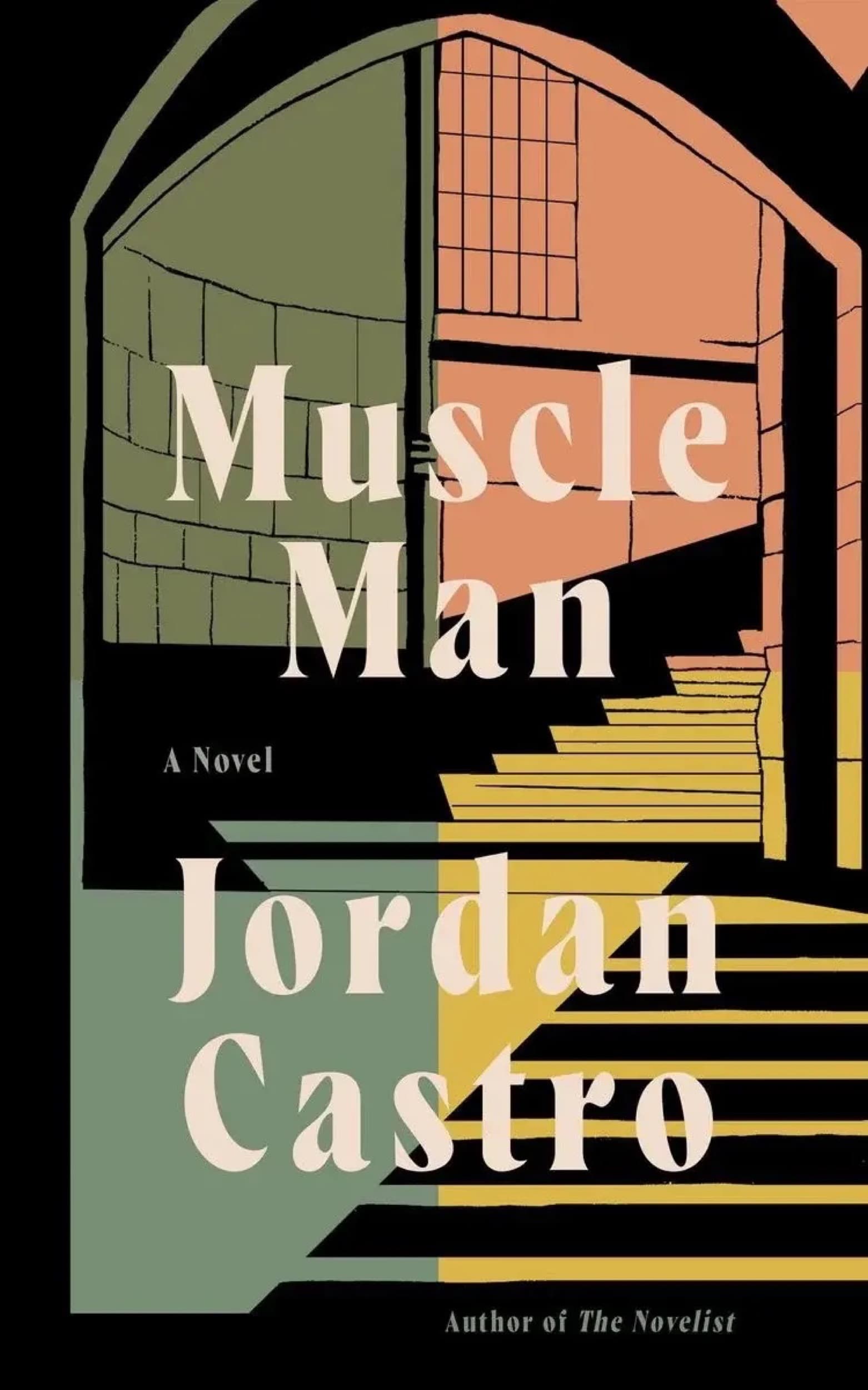
Muscle Man
Catapult, 2025
In Muscle Man, Jordan Castro’s hilarious new novel, there are many things that its disgruntled protagonist Harold—the author of an acclaimed, if perhaps misunderstood, novel about a warrior born into a society that won’t allow him to embrace his exceptional vitality—despises. There are, for example, the normie English department colleagues at the small liberal arts college at which he teaches. Then there’s the “zombified” students, and the suffocating ideology he feels the English department is forcing on everyone. Don’t even get Harold started on the weakness—the spiritual and physical weakness—he sees all around him. And while there is certainly a case to be made that what Harold actually hates most is himself, I couldn’t help but conclude that the way we have begun to perform our identities and our politics is a close second. The list of things he loves is much shorter. Undoubtedly, weightlifting sits at the top.
I spoke with Castro recently over Zoom from his home outside of Washington, DC, where he lives with his wife, the writer Nicolette Polek, and their dog. Castro, a relatively recent convert to Christianity, teaches at the Catholic University and is the editor of the Cluny Journal, the publishing offshoot of the Cluny Institute—an organization seeking to rejoin spirituality to our contemporary world. During our chat, I told him I found Muscle Man’s politics to be slippery, that its many ironies made it resist straightforward or simple readings. Castro himself was almost as elusive; he would rather readers, he told me, come to their own conclusions about the book and its politics. He seemed to want to get beyond the current frameworks and the incessant binaries we insist upon when talking about politics and, increasingly, art.
Tadhg Hoey (Rail): In an interview with BOMB, you said you saw The Novelist as a novel about “trying to emerge from nihilism.” Maybe the protagonist of The Novelist wasn’t what Friedrich Nietzsche had in mind when he wrote of the Übermensch; nonetheless, your protagonist takes a leap of fate and actually does something. Nietzsche was on my mind a lot reading Muscle Man, for different reasons. Harold very much epitomizes the Nietzschean idea of ressentiment—a condition characterized by rancor, bitterness, and inaction. Here’s this person who despises his colleagues, and the world he lives in, but doesn’t really seem capable of living a better life.
Jordan Castro: Nietzsche wrote brilliantly about ressentiment—but he also embodied it. One of my favorite stories about Nietzsche is that, after Cosima—the woman he loved and worshipped—chose Richard Wagner and not him, he continued to show up and hang around their house, showering both of them with gifts. Nietzsche even wrote piano compositions for them, which neither found impressive. One of the compositions was apparently so bad that Wagner was literally laughing and rolling around on the floor…. A brutal situation.
But like Nietzsche, I’m disturbed by the flattening of culture—the sort of listless fog that people find themselves in now, where values have been leveled and everything seems the same as everything else. In The Novelist, the narrator flees the leveling and goes to the woods and has some sort of proto-spiritual experience. But another answer people gravitate toward is the delusion that ultimate meaning can be found in being strong and vital, in opposition to the herd: I'm fundamentally an exception. The people around me are the problem. It’s the world; it’s society. Crush your enemies. And so on.
I wanted to explore that kind of response.
Rail: Harold exists in a long line of anti-heroes—people who perceive themselves as having been maybe born in the wrong time, and whose aspirations they feel are thwarted by the kind of spiritual malaise they see around them. Which is why they find themselves embracing nihilism, which he never really manages to get beyond. You satirize a lot in this book, but I think you might reserve the sharpest satire for Harold who, despite all of his self-seriousness, isn’t much better than anyone else. A university, with all of its cultural politics and power dynamics, is kind of the perfect place to set a story like this. What led you to set it there?
Castro: My experience of being in school was one of horrifying claustrophobia. I couldn’t think or speak. I felt like I was being taught how not to learn. When I was at home or with friends, I could read, write, think, talk…. But then I’d go to school and, unless I was totally numbing myself with drugs, I couldn’t handle it. This bred a kind of contempt toward school, one that took the form of this tortured, reactionary mode…
But the universities are also just a place where impotent resentment abounds, and there is all sorts of creepy, psychotic behavior, an almost-impossible-to-satire level of derangement all around.
I appreciate you noting that Harold is satirized. There was a creepy review that came out in The Baffler that seemed to totally miss that component of the book.
Rail: The centerpoint of Muscle Man is a mandated DEI-type class that Harold and his colleagues attend, and I felt a spectre hanging over the book—not necessarily an enforced ideology, or a forced democracy of values, but more so the performative politics and morality behind them. There’s a throwaway line in here when Harold recalls speaking to a colleague about a certain presumably questionable—or perhaps a recently-cancelled—book, and wonders afterwards whether he had been “sufficiently disapproving” of it during the encounter.
So much of the book’s humor comes out of Harold’s attempts to navigate—and evident dislike and mistrust of—what I will lazily call “woke” politics. I’ve heard you speak in another interview about how this kind of politics can be bad for art and I’d like to hear your thoughts, because you’re addressing it pretty directly here.
Castro: The New York Times recently published an article that said eighty-eight percent of undergraduate students reported pretending to be more progressive so that they could succeed academically or socially. Eighty percent said that they’d lied in their schoolwork because of pressure they felt from professors.
I saw the quote on X (formerly Twitter), then clicked through to the article, and—to my horror—saw that the piece was called “The Rise of Right Wing Nihilism.” Imagine a world in which eighty-eight percent of people were lying about being right wing because there was that much social pressure. It’s basically impossible to imagine. That’s how much power the progressive left has. And they’ve only been able to prop it up with immense pressure campaigns and emotional blackmail.
This is bad for art and literature and learning because in order to do any of that well, you have to be able to be honest. You have to be able to describe the world as it is. And this is a threat to any ideologue. That being said, I do think that the temptation to react with the kind of violent belligerence—
Rail: What do you mean by violent belligerence?
Castro: Maybe something like Harold—this sort of seething muted rage where you respond to the pressure cooker of wokeness with hatred, or delusions of grandeur, or something like that. That kind of thing is happening, obviously. It’s an understandable response. But it is also bad for art, learning, etc. And it’s not good. I don’t have any interest in “crushing my enemies.” I want to love my enemies and write novels. But when eighty-eight percent of people are lying about what they believe, this is a difficult situation.
Rail: That segues into something I wanted to talk about: performativity, which is central to the book. Harold despises his colleagues for what he sees as their performativity—whether it’s performing their basic identity or their cultural or political identities. He engages in very neurotic, often very funny monologues where he imagines debating them or appearing on an imaginary podcast, defending his views and sharpening his hot takes. One that comes to mind is Dolly, who misinterprets some inane comment Harold makes about the weather in the South, and he begins obsessing over what he calls her performed southernness. In a way, though, these imaginary conversations, debates, and podcast appearances are just Harold’s performances, where he sculpts his public persona, privately.
Castro: Often, when we accuse others of being “performative” it’s just total self-justification and coping. One area where you can see this really clearly is in rap music, where they’re always accusing each other of being fake or copycats for the sake of the performance—but in reality, they’re all copying each other and the whole thing is literally a performance.
Rail: Every accusation is an admission.
Castro: But I also think that there’s this sense in which we’re probably more performative now, even to ourselves. In university environments, and in general online, people are constantly thinking about how they’re being perceived, because of this panopticon scenario where there’s immense social pressure—people are always aware of how they may or may not seem and aware of even how their thoughts may or may not seem to others.
So, it creates this effect: for Harold, everything is filtered through this imaginary Other who’s seeing and judging his behaviour, almost like some sort of perverse god. But, in reality, it’s just other people.
Rail: Other people’s voices in your head.
Castro: Right, exactly. That’s why I wanted to use the form of the Gothic. When you think about what’s really going on—when there’s this kind of amorphous voice of something like X, the news, your professors, and other students, and all this kind of stuff—it’s almost like a phantom spirit that possesses you… There is a leakiness between heads.
I talked to a Yale professor the other day who was very sheepish about admitting that she liked Michel Houellebecq. You could see this thing in her brain where she was negotiating like: “Should I say that I like Houellebecq? Should I not say it? Am I going to get in trouble for saying it?” For a lot of us who broke free of that zone many years ago, we forget that this is still totally dominant, if slightly dormant for the moment. People just walk around and they live like that.
Rail: That reminds me of a funny moment in the novel where Harold is called on to provide a character reference for a colleague who’s under review by the department. Harold tells them that he once heard him say he loved Knut Hamsun and that European novels were the best. [Laughter]
Related to this is the fact that Harold’s deeply paranoid and neurotic. He thinks people are out to entrap him. That comment I mentioned earlier that he made to Dolly—he’s intensely worried that she misunderstood him and that single interaction will frame the rest of their relationship. Do you think that’s a result of the culture making us self-police? And beyond that, is it fair to say that it comes from the university, or that that aspect of culture flows downstream into—not from—the university?
Castro: I think it’s possible for fear to be based in reality, but then for the way you respond to that fear to be corrupting and perverse.
The university is a sort of mimetic cauldron where basically everybody wants the same thing, and there just isn’t that much of it—whether it’s jobs, intelligence, basic competence, and so on. I think a lot of the ideological stuff is covered for structural dynamics. In 2022, about 10,000 people got Master’s degrees in English; about 3,000 people got advanced degrees in creative writing; about 1,500 people got a Ph.D. in literature. That’s like, 15,000 people in one year.
Rail: And there’s like, a hundred jobs.
Castro: Exactly. So you end up in this totally insane scenario. Like a pyramid scheme. To me, a lot of the ideological fighting—cutting people down, and getting rid of competition—is really just trying to position yourself in the job market.
Rail: I think the pendulum has started to swing the other way now, and I don’t think it’s clear just how much of a correction we’re heading towards, but it feels to me like that era is now over. Was there any of it that you think was good? Or, for you, was it just a case of there being too much policing or over-policing?
Castro: It’s a hard question, and I’m not sure. I have a friend who tells me that wokeness was a civilizing force. He says the way that men in positions of authority used to talk to women who they were supervising was totally horrific. That’s probably true in a lot of cases, so maybe in some ways it was a civilising force; but, in other ways, it went too far. And it’s hard not to feel like there is a sort of rot at the core of the ideology.
Rail: Yeah, I think it was for sure a civilising force. I also think that it created this competitive dynamic that factionalized progressive movements and encouraged advocates of a specific group or cause to unintentionally try to one up each other. To the point where it almost consumed itself and exhausted or alienated a lot of its supporters.
Castro: One of the things I was thinking about in the novel was—I’ll use the language of sin—the way that sin is interconnected and multi-generational and really spans back to the very beginning of humanity
For me, it’s always hard to say my sin starts here and yours starts there; that yours is totally separate from mine. In a weird way, intersectionality discourse kind of gets at this. There’s this way in which people are always trying to demarcate lines between evil, mistakes, harm, historical injustices. And it doesn’t totally work.
There’s a kind of leakiness to sin—whatever you want to call it—where, on the one hand, it would be easy for people on the right to be like, “look at what they did for the past decade.” And the progressive: “well, look what they did before that.” And so on. It’s this kind of spiral throughout history where people are reacting in imitation to the people who wronged them just prior. To me, the Gothic novel was a good form to explore this because all of these questions—did wokeness go too far? What about the reaction? What about this kind of censorship? There’s really just a kind of interconnectedness that makes it hard to speak about truthfully. It's easy to scapegoat people.
Rail: You’re saying there’s more nuance to it than people on either side are willing to admit and meaningfully discuss?
Castro: I’m so sick of the discourse.
Rail: In the frameworks that people talk about these things?
Castro: I feel like giving my thoughts could potentially ruin some of the subtleties or the more dynamic and interesting parts of the novel.
Rail: Totally. That’s what made it hard for me to come down on the politics of the book, not that that’s necessarily the most important part of reading a novel, but thinking about them was one of the most interesting parts of reading this novel.
There’s a few really good meta jokes in here. One of them is when David, a colleague of Harold’s who appears in Harold’s office while Harold is reading an anthology of underground writers, and who later describes this story of a man who longs to dig a hole so big that he can live underneath the ground—though he occasionally still feels he is both above and below everyone. Another phrase I loved comes from one of Harold’s imagined debates and that’s “earnest satire”—which by the end of the book was ringing in my mind for reasons I couldn’t quite pinpoint.
All this to say: there’s a lot going on here, and these moments complicated my reading of the book.
Castro: I hadn't read the novel in a long time after finishing it, and I reread it the other day. In some ways, I feel like that passage where David is telling the story about the man who digs a hole is the key to the whole novel.
Because, on the one hand, it deals with all these political themes, but it really is more of an existential novel. I’m sort of a political atheist. That’s not really where I put my faith or my hope.
Novels are often “earnest satires”—Mikhail Bakhtin saw satire as the precursor to the novel, in its mix of lofty and low styles, ironic relationship with other genres, etc. The first novel, Don Quixote, is a kind of satire on the heroic. And—this is one aspect of the novel that others missed, and you seem to get—there is a self-undermining quality to Muscle Man, too.
Rail: I think I had a mostly unconscious ban for many years on any media or commentary that I saw as right-wing or conservative-leaning, essentially because I have mostly fairly left-wing politics. That being said, this past year or so I’ve found myself paying attention to more right-wing and conservative media, mostly as a way to get a better understanding on what’s happening in America, and how and why things have shifted so dramatically, particularly in these past few months. Some of the the things I hear come up again in that media landscape, beyond the obvious things like “woke,” are things like “left-wing conformism,” decrying leftists as zombies, decrying what they describe as a spiritual malaise in American society, which they like to link to the idea that there’s a lack of “vitality.” I think there’s a tendency to blame all of this on progressives and as a direct result of “woke” policies as opposed to, say, the much more plausible answer that billionaires and corporations have ruptured and hollowed out American society. These are ideas that I think might float around Harold’s mind a little, and I’m wondering how you think about all of this.
Castro: I went to a thing with Francis Fukuyama a couple months ago, and he gave this really short talk about an essay that Leo Strauss wrote in 1941, called “German Nihilism,” which is sort of about how when liberalism flattens things, it removes something for people to struggle toward. There’s a certain kind of person who will always want to struggle upwards. Liberalism can maybe satisfy your material needs, but there’s a certain kind of spiritual need for self-actualization and struggle, and paradoxically that satisfaction in the material realm eliminates this need for struggle in the spiritual realm. Fukuyama kept saying, we need to take this critique very seriously, because it’s happening again.
You have these people, like you were saying, talking about vitalism and rejecting all of this peace and prosperity, relatively speaking, in historical terms. We have access to medicine and so on, but the thing is people don’t care about that. I mean, they care about it, but it’s like, we are the most ungrateful…. I don’t know, do other species experience ingratitude? It always blows my mind… I sometimes think a human being can be defined as: he who is ungrateful.
So, we have all this peace and prosperity, but at the same time there’s been a flattening of values. This is a problem that I legitimately struggle with: if liberalism says that all desires are equal, that what you want is as good as what I want, it’s all just preference and so on. It eliminates a certain kind of value order that enables legitimately meaningful action. This flattening of values is totally intolerable to people’s spirits. It’s also incoherent. But to your point, it’s not purely left wing—the market is a leveller too.
The last thing I’ll say is that I’m a Christian, so, as a result, I think it’s way too easy to point at different political groups and say everything is their fault, and I’m not like them. I think that’s wrong. I think I have just as much capacity for evil in me as everyone else.
Tadhg Hoey is a writer. Hoey's work has appeared in The Stinging Fly, Dublin Review of Books, BOMB, The Millions, Los Angeles Review of Books, and elsewhere.