Peter Cornell’s The Ways of Paradise
Word count: 2704
Paragraphs: 16
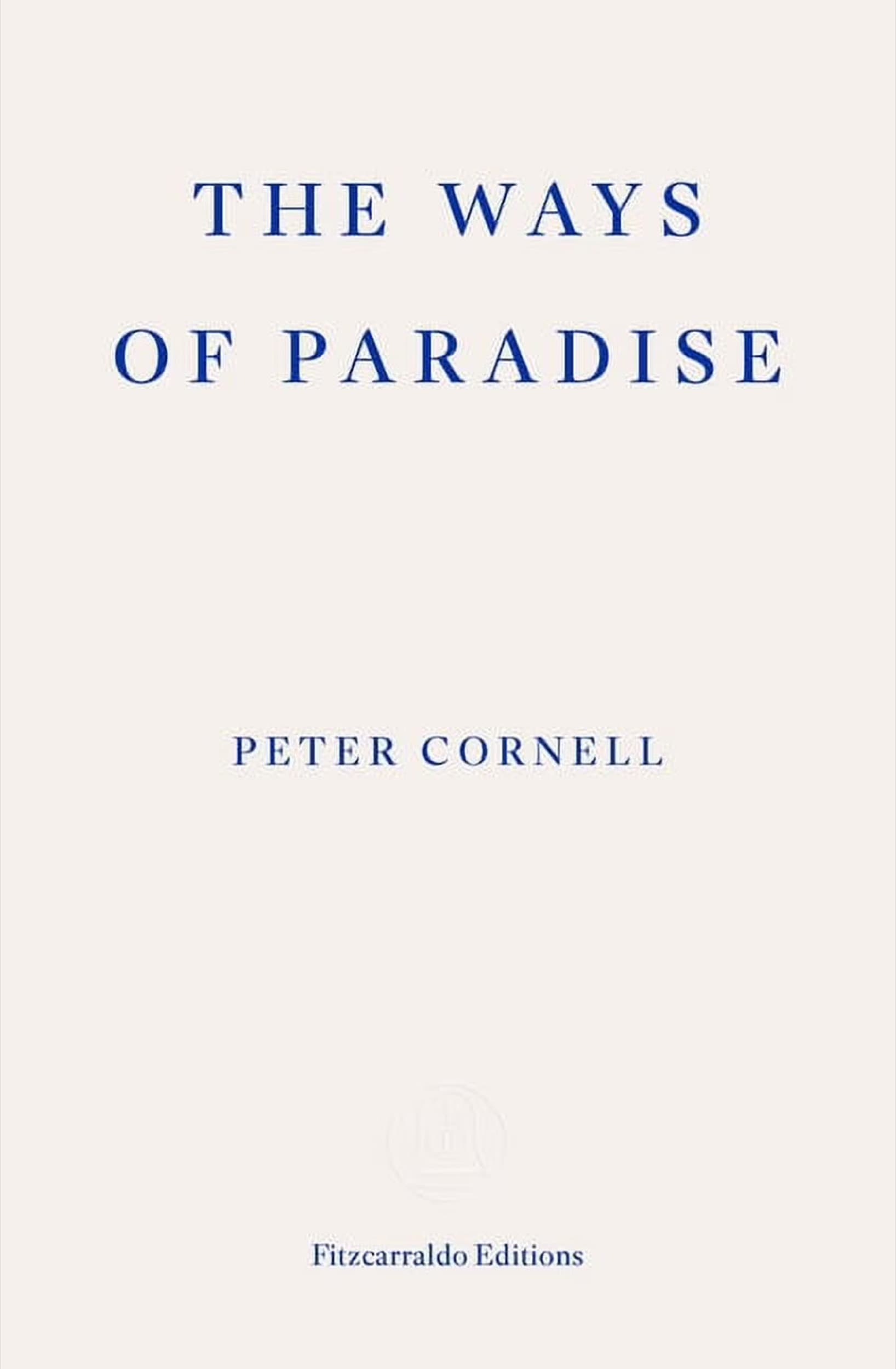
The Ways of Paradise
Translated from the Swedish by Saskia Vogel
Fitzcarraldo Editions, 2024
“Each landscape, no matter how calm and lovely, conceals a substrata of disaster … The hells of geology remain to be discovered. If art history is a nightmare, then what is natural history?”
—Robert Smithson, “Art Through the Camera’s Eye,” ca. 1971“The Lord proceeded to show him the ways of paradise and said to him, ‘These are the ways that men have lost by not walking in them.’”
—Pseudo-Philo, Liber Antiquitatum Biblicarum, ca. 100 CE
The difference between a mystery and an enigma is important to draw at the outset. A mystery can be clarified, unraveled, solved, but an enigma grows only more opaque the more one investigates it: shedding light upon it only makes a true enigma that much darker. Peter Cornell’s novel-in-notes The Ways of Paradise is itself an enigma, even as it pursues a whole complex of enigmatic and esoteric phenomena spanning millennia, languages, cultures, and discourses, from art history to literature to politics, all pointing to something invisible—and terrible—at the center.
Published in 1987 but arriving in an English translation by Saskia Vogel just in time for our paranoid psychosphere of 2025, The Ways of Paradise oscillates between deduction and seduction in inspiring a kind of conspiratorial reason in the reader. This recent volume from London’s Fitzcarraldo Editions—despite the white cover reserved for that press's nonfiction titles, I'll call this a novel—was written by a distinguished Swedish art historian and critic who drew on his vast erudition to present the work of another (fictional) scholar, an unnamed writer whose fragmentary editorial text the novel purports to be. As the foreword by a certain “Peter Cornell” relates, this anonymous scholar worked quietly for over thirty years on a comprehensive masterpiece, but left behind only a passel of endnotes at his death, the main manuscript having seemingly disappeared. Even more strangely, the numbered notes left behind sometimes seem to be commenting on yet another text, presumably by a third, even more ghostly writer about whom we know nothing. Some lives are shadowed by an absent center, a looming dark tower that brooks no approach, but only emits its obscure radiance in shards that play upon the surfaces of the visible—such seems to be that of the unnamed writer-scholar and many of the figures that fall under his melancholy, searching gaze: Gérard de Nerval, the doomed prince of French Romanticism; Hélène Smith, the disturbed young medium who invented languages in her trances; the surrealist lightning rod André Breton; and the brilliant and tragic land artist Robert Smithson—just to name a few. Smithson’s monumental land-art sculpture Spiral Jetty (1970) is not just an object of study in The Ways of Paradise but a formal model, since the book is written in the form of a spiral. Smithson’s earthwork, a giant sacred spiral made of rocks seeming to emerge from out of the earth at the barren edges of the Great Salt Lake, becomes something like the secret skeleton key of the book, which is preoccupied with winding circles and spirals in the deserts of the world. As Smithson knew well, the location he chose for Spiral Jetty was thought to be the promised land by Mormon settlers in the nineteenth century, who baptized their earthly paradise of Utah with a new name: Zion.
As Fernando Pessoa wrote in his own shadowy gathering of fragments, The Book of Disquiet: “Everything that man pronounces or expresses is a marginal note in a text that has been totally erased. From the meaning of the note, we can more or less work out the meaning of that vanished text, but there is always a doubt, and many possible meanings.” We can only glimpse the contours of the absent work at the center of The Ways of Paradise through clues in the scholarly notes that comprise the entirety of the book, notes which range all over but retain certain recurring themes, patterns, and names. Our lucubrating scholar has embarked on an arcane quest that mobilizes huge swaths of knowledge and a consuming preoccupation with sacred geography (and geometry); the search for paradise in art, politics, and religion; the Crusades; cities (especially Jerusalem and Paris); pilgrimage and travel; labyrinths; occultism; sacrifice; colonialism; and dreams, madness, and conspiracy. In one sense, The Ways of Paradise is a book about interpretation and its curses: historical curses. It is worth remembering that “hermeneutics” and “hermetic” both derive from Hermes, the name shared by the fleet-footed Greek trickster god and the legendary Egyptian mage Hermes Trismegistus. An important clue to the novel’s intellectual and political center is left in a brief quotation of Thomas Aquinas on interpreting “corporeal metaphors for spiritual things”—while the quotation is unremarked upon, the book seems to offer a series of warnings about confounding the spiritual and the earthly, even as it cannot help indulging in such a transgression.
A review can only give a sense of the mood of the book. As a treatise of iterology (a word it plucks from Michel Butor, meaning “the science of journeys”) and an exercise in historical osteomancy faintly tethered to a narrative frame, it is a work of doom, dread, and intoxicating strangeness. To attempt an exegesis of the missing enigma it pursues would only drag one deeper into the vortex, but for some atmospheric coordinates in the form of names, think W. G. Sebald, Chris Marker’s La Jetée, Nathaniel Mackey, Maria Gabriela Llansol, Marcel Schwob, True Detective season one, Benjamin Labatut, David Lynch, Adania Shibli, Antoine Volodine, Italo Calvino. But The Ways of Paradise is distinguished from all of these precisely by its lack of distinguishable style—it is written in an impersonal and relatively reserved (if never boring), explicatory academic register just barely askew, achieving its effect only cumulatively through an almost ritualistic recurrence of themes and rhythm of exegesis and through flickers of tension feeding into a slowly permeating sense of dread.
The subjects and names broached are too various to catalog, but one of its most frequently recurring topoi is surrealism. From Breton’s walks around Paris searching for corners charged with elusive magnetic energy (I couldn’t help but think too of the mystical energy fields around Bucharest in Mircea Cărtărescu’s Solenoid), to painter André Masson’s haunted places, the sur in surrealism here is less an “above” than an eddy, a force torquing the real into a spiral. For one central figure in the book, a key precursor to the surrealists and a writer very dear to me, let’s take Nerval, suicided in 1855. If you’ve walked around Rue Nicolas Flamel (so named for the French manuscript-seller posthumously associated with alchemy) leading to the Saint-Jacques Tower in Paris, you’ve likely felt the sense of eeriness that emanates from that environs. It is a place the book returns to again and again. The scholar in The Ways of Paradise describes and seems to share Breton’s obsession with this area, which the latter found “frightening.” The Tour Saint-Jacques, all that remains of an immense church destroyed in the anti-clerical rage of the French Revolution, cannot but recall the mysterious “abolished tower” [tour abolie] in the first stanza of Nerval’s most famous poem “El Desdichado.” The former tower, whose church once served as a waystation for medieval pilgrims traveling to Spain on the Way of St. James, emits a gravitational pull throughout the book, just as it persistently reappeared like a mythic template in Breton’s consciousness. In the spring of 2024, I wandered around Rue Nicolas Flamel, drifting into a dusty used bookshop that sold me volumes two and three of the Bibliothèque de la Pléiade set of Nerval’s Œuvres complètes (the first volume was missing) and then found myself entering the square of the enigmatic tower. What The Ways of Paradise (purposefully) leaves out in all of its discussions of Nerval and of this place, but what the flaneur around the Tour Saint-Jacques will discover, is a small Nerval memorial in the enclosed park that houses the tower: a cylindrical column dedicated to Gérard Labrunie (penname: Nerval), next to a rock slab jutting out of the earth. On the jagged gray stone are engraved the opening two stanzas of “El Desdichado,” which despite being Nerval’s most iconic work, also goes unmentioned in The Ways of Paradise, a book replete with pregnant absences. Here is the first stanza, translated by Nolan Dannels:
I am the dark—the Widower—the inconsolable,
the prince of Aquitaine in the abolished tower:
my only star is dead, and my starry lyre
bears the black sun of Melancholy.

Courtesy the author.
In the book, the Tour Saint-Jacques is both a clue and obstacle—it points (but to what?) while also saying: no more. The gate to paradise is closed, and “the gatekeeper’s lodge of the kingdom of heaven”—a phrase from the book’s description of painter Ernst Josephson’s madness—is vacant. The abolished church which once surrounded this tower, rhyming with the vanished temple in Jerusalem, seems to house the lost secret of some forgotten rite.
Nerval appears in The Ways of Paradise among other physical and psychic itinerants owing to his own wayward wanderings through the Middle East, documented in Voyage en Orient. Though in contradistinction to most similar Orientalist travel narratives of this (or any) period, as the scholar points out, he “merely brushes against Palestine” and skips Jerusalem rather than making it the goal of his journey. In one crucial note, the scholar summarizes a legend that Nerval claims to have picked up in a café in Constantinople. This haunting nested narrative concerns Adoniram, the architect of Solomon’s great temple in Jerusalem, and his knowledge of a secret password that resulted in his murder. After this crime, “The grave is eventually found by nine masters. They dig up the corpse and, faced with the rotted body, cry ‘Makbenash,’ which means: ‘The flesh leaves the bones.’ This word becomes the masters’ new password.” This fable from Nerval is an allegory for The Ways of Paradise itself: scattered bones, clues, and interpretations all pointing to a missing word that, if spoken, might break open history. But the original word remains lost and instead there is only a substitute, a cry exclaiming bodily decay: the flesh becoming not spirit, but nothing. The unavoidable suggestion behind this story of the killing of the temple’s architect is that to rebuild it would only be building on top of murder—that this vain attempt to make a metaphor real would seek to build a living corporeal thing out of imagination, power, and air, ending up with only corpses and bones.
Nerval’s twice-told tale about Adoniram is so integral to The Ways of Paradise because it concerns the building of the temple in Jerusalem, the site that would hold stable the roving presence of God that had been housed in the constantly itinerant tabernacle and that would function as a site of ritual sacrifice. Sacred architecture, sacred geometry, and sacred geography constitute the red thread woven through all the others in The Ways of Paradise; whether discussing the medieval Templars (named for their relation to Solomon’s Temple), Jacques Derrida’s commentaries on the Egyptian-Jewish poet Edmond Jabès, the canvasses of Kazimir Malevich and Jackson Pollock, Surrealist novels, secret societies like the early-modern Rosicrucians, or Freud’s exegesis of Leonardo da Vinci’s hidden encodings, it’s always a question of the numinous power that emanates from certain places (cosmic navels, sacred mountains, mythic lakes, energy fields) and the baleful desire to take and possess this power. Despite the vast chasm of historical and cultural difference between one fragment and the next, this fairly slim book is held together by an almost mystic tautness, a dark gravity of barely invisible coherence that pulls the reader irrevocably toward its missing center. We leap from the measurements of the temple in Jerusalem to the measurements of Stéphane Mallarmé’s all-encompassing The Book in a single page, all surrounded by learned divagations into art history. Sometimes an elliptical note will continue for several pages, while others tersely appear and dissolve in a single line, like: “77. A continuation was promised, but never materialized.” Is it really a novel? Sure.
Reading The Ways of Paradise is like unfolding an interpretation of a dream—or nightmare—we did not ourselves have or no longer remember. As the fragments accrete in spiral form, with names, figures, themes, and shapes recurring, some patchwork sense flits tantalizingly into and out of view. An extraordinary violence haunts the book: political violence, both in its spectacular and its more hidden, conspiratorial aspects. The menace of a secret, masked violence runs under all the fragments at a low rumble, ever on the edge of threatening to become a roar swallowing everything. The notes contain strange, hazy allusions to Cold War conspiracies (communist spies; networks of sexual abuse among the rich and powerful) and darker ruminations that the missing manuscript seems to have been investigating, though the sinews connecting, say, the Crusades to the Surrealists to Emanuel Swedenborg to Gladio-esque parapolitical operations in the twentieth century remain mostly hidden in the shadows. But this mood is not unfamiliar. In the schizo-noir structure of feeling of our Jeffrey Epstein present, conspiracy, some say, is just another name for ruling-class organizing.
Curiously for a canonical poem written in French, Nerval’s “El Desdichado” bears a title in Spanish, inspired by a novel by a Scottish writer about a medieval Saxon knight—there is a whole journey implied in the sonnet’s very title. “El Desdichado” is the hidden identity assumed by the title character in Sir Walter Scott’s novel Ivanhoe, and in that context, translates to something like “the dispossessed.” Ivanhoe masks himself as the mysterious black knight “El Desdichado” upon returning from Palestine, where he fought for the Crusaders at the famous Siege of Acre. There is a wretched proximity between dispossession and paradise. Not for nothing did the Palestinian national poet Mahmoud Darwish—born on the outskirts of Acre in 1941—title one of his books Unfortunately, It Was Paradise. A note near the end of The Ways of Paradise registers how the brutality of the American settlers and frontiersmen was fueled by visions of paradise, as the search for white Eden in the New World cut through flora, fauna, and human flesh at a rate unseen in the history of the world. Recalling Smithson’s spiral in the wastes of American Zion, the book’s two gloomy docents, Smithson and Nerval, return in the final pages. The anonymous scholar quotes Edward Said’s critique of Nerval’s journey in Orientalism, where the great Palestinian critic expresses his befuddlement that so perceptive a writer as Nerval could not actually see what was in front of him, going in circles and circles in the desert and alighting only on absence. In a letter about his travels, Nerval claims to have lost kingdoms of fantasy to the clutches of reality upon seeing the actual places he had so often dreamed about—the spiritual kingdoms in the heavens of metaphor had been displaced by the earthly reality.
The Ways of Paradise, published in the year of the First Intifada (1987), thus obliquely comes to pose its central question: what has the spiritual Jerusalem to do with the earthly one? The two cities, real and unreal, meet at the intersection named dispossession—and genocide. The book’s final note is composed of a long quotation from a Swedish novella from 1835 (Baron Julius K* by C. J. L. Almqvist), whose closing words, and thus the closing words of The Ways of Paradise, read: “‘A journey to Palestine, to the Promised Land, in our time, in the nineteenth century, how unusual,’ I remarked.” The reader in the year of the book’s English translation trembles in transposing, across the labyrinthine spirals of history, the literal, actual, corporeal place Palestine in the twenty-first century. If we follow the void at the center of the spiral, the empty space accompanying the curved line and pushing it outwards, another overwhelming question cannot be avoided: What if all of those desires to rebuild the temple, those blind, desperate travels to paradise, those attempts to retrace our steps back to the first garden, what if these ways themselves made something else? What if what the ways made is not paradise but the other place?
Joseph Albernaz reads and writes about poetry in Brooklyn. He is the author of Common Measures: Romanticism and the Groundlessness of Community (2024).