ArtSeenDecember/January 2025–26
Robert Storr: Fits and Starts
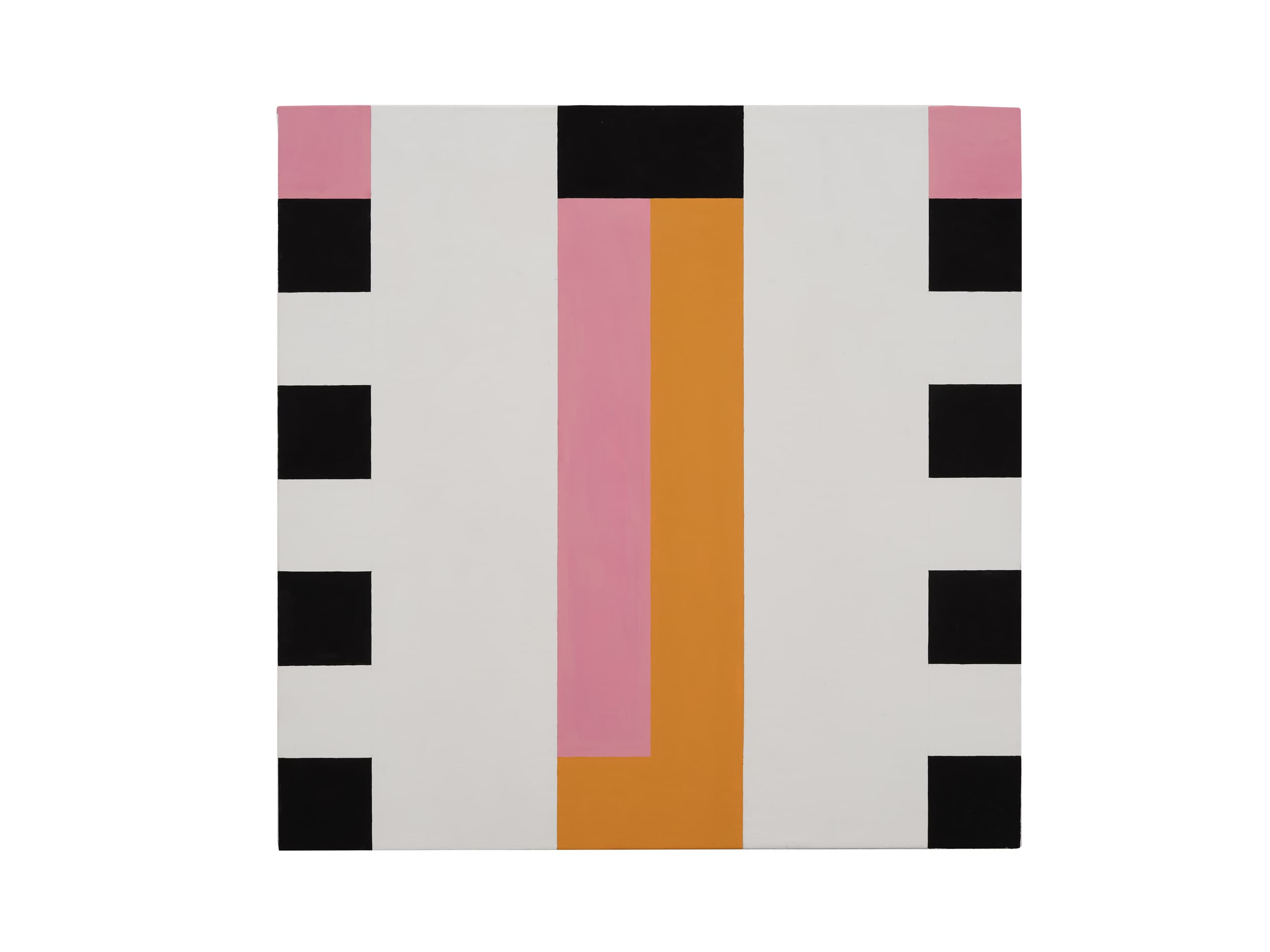
Robert Storr, Untitled, 2025. Flashe on linen on board, 24 × 24 inches. © Robert Storr. Courtesy the artist and Vito Schnabel Gallery. Photo: Argenis Apolinario.
Word count: 1317
Paragraphs: 10
Vito Schnabel
October 29, 2025–January 17, 2026
New York
Geometric abstraction today carries a layered visual memory. Its force no longer depends on novelty and instead rests in the persistence of its compositional possibilities and the ways line, color, and ratio continue to condition the viewer’s perception. In Fits and Starts, Robert Storr works squarely within this terrain. Rather than offering a singular resolution, the exhibition is structured as a confrontation between the clarity of a geometric vocabulary and the materiality of paint. Some paintings adhere to a strict linear discipline, their structure direct and unyielding. Others allow painterly modulation to occur within sharply defined boundaries, letting color and brushwork loosen without dissolving the line. Still others operate as painterly studies, their gestural brushstrokes held within edges that retain a persistent tautness.

Installation view: Robert Storr, Untitled, 2025. Flashe on linen on board, 12 × 108 inches. © Robert Storr. Courtesy the artist and Vito Schnabel Gallery. Photo: Argenis Apolinario.
The widest work in the exhibition, an untitled painting (all works 2025) measuring one-foot high and nine-feet wide and visible through the gallery’s glass-fronted entryway, serves as a rhythmic overture that brings the show’s dialectic of measure and impulse into sharp focus. Composed of light grays, light taupe, and pale blue rectangular forms arranged across a deep taupe ground, the painting establishes measured relations that sustain an unresolved tension, focusing the eye on the internal logic of its proportions. Black horizontal line segments connect and interrupt these vertical and horizontal blocks, producing a structure that entertains the reality of the surface alongside pictorial depth. The painting registers differently with distance: the firm geometry perceived from afar reveals, at closer range, the movement of the brush within the forms and across the ground, where the Flashe vinyl emulsion manifests translucent strokes and tonal variations. In this sense, the painting functions as a compressed statement of the exhibition’s governing logic—holding control and release in the handling of line and color.

Installation view: Robert Storr: Fits and Starts, Vito Schnabel Gallery, New York, NY, 2025. Artworks © Robert Storr. Courtesy the artist and Vito Schnabel Gallery. Photo: Argenis Apolinario.
A group of six horizontal paintings brings Storr’s linear language in Flashe paint into well-defined rectangular constructions of solid coloration through a palette of red and black set against a light gray ground. Across this suite, blocks and bands are arranged with an elegance that comes from dispensing with conventional symmetry: at times two red forms differ only slightly in tone, while elsewhere a yellow element enters as a considered inflection. What unifies these works is their unwavering commitment to sharp, linear edges, which holds chromatic variation firmly within a disciplined structure. As such, the paintings stand in dialogue with early twentieth-century abstraction—Kazimir Malevich, Theo van Doesburg, and El Lissitzky—not as quotations, but through shared formal languages that remain actively in play.

Robert Storr, Untitled, 2025. Flashe on linen on board, 12 × 48 inches. © Robert Storr. Courtesy the artist and Vito Schnabel Gallery. Photo: Argenis Apolinario.
As the exhibition unfolds, its structure begins to read less as a sequence of isolated works than as a carefully calibrated ensemble. The formats recur with an almost musical insistence: a series of one-foot-high paintings stretching horizontally in extended measures; four two-foot-square works functioning as compact counterpoints; and two vertical paintings, one foot wide, that punctuate the lateral flow. These proportions are not incidental. Placed in multiples of twelve inches, they establish a shared metric throughout the arrangement. Against this underlying order, a group of eight smaller paintings—each twenty by twenty-four inches—introduces a pronounced shift in the handling of paint. Dark gray frames and light gray grounds are often articulated by yellow bands and stripes. Visible strokes reveal the surface beneath, yielding an optical lucency that emerges from the dry, powdery layers of Flashe paint. Here a painterly task unfolds within a regimented geometry. Gesture does not oppose structure; it operates within it, testing how far painterly force can be extended without undoing compositional control.

Installation view: Robert Storr: Fits and Starts, Vito Schnabel Gallery, New York, NY, 2025. Artworks © Robert Storr. Courtesy the artist and Vito Schnabel Gallery. Photo: Argenis Apolinario.
One painting on the north wall makes this structural commitment impossible to miss. Beneath its layers of color, a rhythmic sequence of vertical lines is partly visible. Once these vertical lines are met by the horizontal edges of the painted blocks, a latent grid coalesces, offering a glimpse of the objective framework that underlies the work as a whole. The grid carries a familiar claim: measurement, geometry, regularity—the impersonal order that has long anchored modernist abstraction. Hence a given coordinate system provides objective evidence of the painting’s infrastructure. Yet this objectivity is unsettled by what happens within an assumed ground. Shapes are arranged in ways that resist predictability, their proportions and color relationships refusing to settle into foreseeable balance or symmetry. The grid proposes order, but the spatial arrangements push against it, introducing a modernist subjectivity akin to the tenets of the Bauhaus and De Stijl. For a moment, the presentation as a whole entertains a classical dialectic: the armored clarity of Apollonian geometry countered by the fluid play of Dionysian coloration, gesturality, and luminosity. The works collectively hold geometry’s planar structure and paint’s recessive space as defining conditions.

Robert Storr, Untitled, 2025. Flashe on linen on board, 12 × 72 inches. © Robert Storr. Courtesy the artist and Vito Schnabel Gallery. Photo: Argenis Apolinario.
This defining condition is communicated through scale, measurement, and the obdurate conviction that abstraction remains an arena of visual rigor. The show does not dramatize the old dialectics of modernism so much as put them back to work. Here the planar and the recessive, along with the objective and the subjective, are held together by the material behavior of a vinyl medium calibrated through a range of densities. Geometry thus shifts from the architectonic to the atmospheric, presenting the density of the paint and the openness of the gesture as distinct formal embodiments. Yet, strangely, the press release invites us to find a compositional parallel in Francisco Goya’s Plate 21 from “La Tauromaquia” (1816)—an etching and burnished aquatint depicting the brutal fatality of the mayor of Torrejón—citing its radical asymmetry as a blueprint for Storr’s abstract configurations.

Robert Storr, Untitled, 2025. Flashe on linen on board, 12 × 72 inches. © Robert Storr. Courtesy the artist and Vito Schnabel Gallery. Photo: Argenis Apolinario.
While a literal compositional link between Goya’s gored mayor and Storr’s geometric blocks feels like a conceptual stretch, the citation functions as a permission slip for a drama that has been evacuated from representation and renewed in the work’s abstract visual field. In this light, the Goya parallel is not a mere formalist blueprint but a dialectic of the exhibition’s own polarity of disegno and colorito, a tension that reaches back to the debate between the institutionalized rigor of Charles Le Brun and the painterly advocacy of Roger de Piles. The exhibition operates through clashing temperaments: the group of highly linear abstractions carries the weight of reason and objectivism, countered by the painterly works defined by unruly subjectivism and sensory affect. Storr is not painting the bullfight; he is staging an arena where the categorical imperatives of monochromatic logic are gored by the more errant impulses of the hand. The true iconoclasm here is found in the epistemological rupture between these series—an imbalance of method where the bull is absent, but the arena remains. What Storr stages is a spectacle of decision: where to place, how to measure, and how to keep the eye working across a spectrum that modulates from the architectural weight of the vinyl to the thin translucence of a wash.
To insist on this arena now is almost willfully unfashionable—and that is part of its force. This is not the world of Nicole Eisenman, where figures carry social temperature, narrative friction, and the pulse of lived contradiction. Storr’s paintings refuse that route. They operate as if painting does not need to translate itself into story in order to matter. And yet they are not naïve about systems either: at moments, the work can appear to brush against the cool, infrastructural language of Peter Halley—hard edges, units, containment, a syntax that looks like it might be about culture’s architecture. The difference is that Robert Storr does not turn geometry into metaphor. He does not allegorize geometry. He uses it. He tests it. He lets it hold—and lets it fail to hold—so that the viewer becomes the site where order is proposed, undone, re-proposed. The exhibition wins by staying stubbornly inside painting’s means and making those means feel sufficient again. Geometry takes on a temporal thickness through extended looking.