ArtSeenDecember/January 2025–26
Fall Show
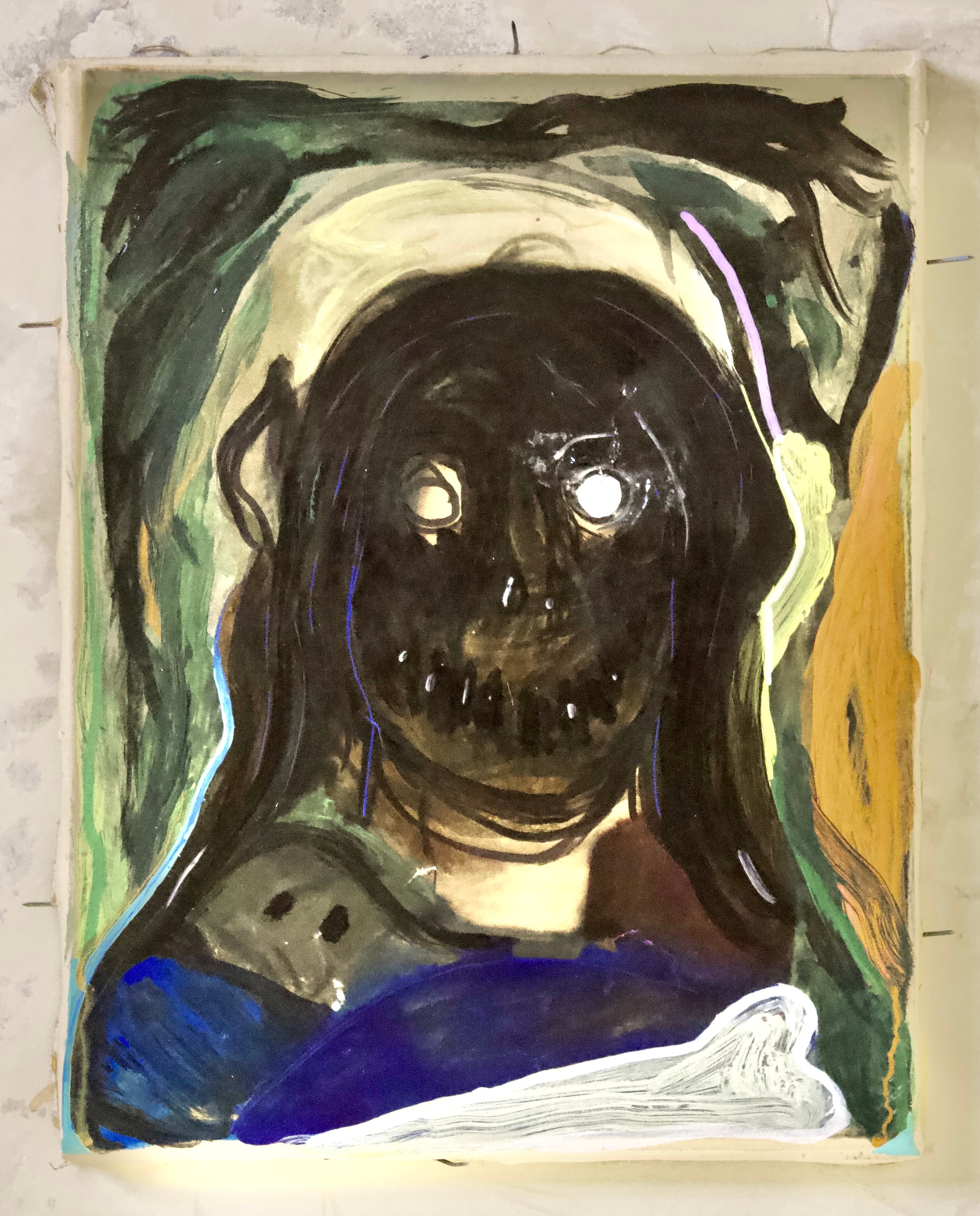
Christian T. Norum, Self-portrait as a Roman Swordsman in the 11th Century, 2025. 19 ⅚ × 15 inches. Oil over off-set lithograph. Courtesy the artist and Norse Institute Central Europe.
Word count: 1059
Paragraphs: 13
Norse Institute Central Europe
October 17, 2025–January 31, 2026
Vienna, Austria
In a text accompanying Christian T. Norum’s curatorial installation at No Institute, Edvard Munch tells his interlocutor he must “learn to fall.” It’s a fictional exchange, and the phrase serves as the title of the current exhibition at No Institute, a collective installation curated by the Norwegian artist. The imaginative dialogue reflects Norum’s long-standing obsession with Munch, highlighting parallels between the Expressionist painter’s tumultuous life and his own.
Norum shares the installation with other young Scandinavian painters and historical figures, cramming it with paintings, posters, ephemera, sketchbooks, prints, reproductions, graffiti, and documents (some signed), creating a chaotic display across the raw, textured walls and ceiling of No Institute’s rooms. The concept of dérive or drifting through urban environments—a central theme for the Situationists—permeates Fall Show, allowing viewers to navigate the pieces as if wandering a city street, creating a sense of emerging and receding in selective parallax.
Two of Norum’s works stand out, both depicting gnome-like creatures rendered in black. The first, Self-portrait as a Roman Swordsman in the 11th Century (2025), looks like a smiley shrunken head or voodoo fetish. Painted in thick black impasto, each spotted eye is a different color, while the small painting’s tar-like surface nearly obliterates what might have been a reproduction of the Mona Lisa. The tortured cartoon expression serves as a slapstick representation of a contra-Duchenne smile, and with the addition of a skeleton arm, it alludes to Munch’s partial X-ray Self-Portrait with Skeleton Arm (1895).
The second piece is also a “Situationist détournement,” a term associated with Asger Jorn’s series of overpaintings from the 1960s. Descriptively titled Modification (2025), Norum has altered a reproduction of a 1972 Asger Jorn woodcut known as A Boar that thinks itself a Sphinx, a creature silhouetted in black with four anxious eyes suggesting incestuous coupling. Squiggles in orange and purple evoke Munch’s Madonna (1895–1902), with its border motif of a sperm and embryo reframing Freud’s Oedipal interpretation to the point of absurdity. Norum’s egalitarian craftsmanship also refers to the folk art that Jorn and CoBrA championed to preserve Norwegian culture, along with its anti-elitist, bawdy humor.

Installation view: Fall Show, Norse Institute Central Europe, Vienna, Austria, 2025–26. Courtesy Norse Institute Central Europe.
On a nearby wall, folk humor may have provided the impetus for including a drawing by artist and writer Matias Faldbakken—known for his unyielding bound locker sculptures—represented by Monstrus (2021), an intimate, well-drafted image of a pig.
Alfred Brekke paints hybrid abstractions that teases one’s perception through anamorphisms and other optical twists, a further twist is his reclaiming Troll-core to its animistic roots. In contrast, if there is a foundation to Fall Show, it can be found in Brekke’s formal portrait of No Institute’s founders, Kjeld Undseth and Elida Høvik. Elida and Kjeld in front of CTN Painting (2024) has been recycled from Brekke’s portrait series shown in June, capturing the Nordic-Austrian social construct of the gallery. Within the composition, the chic yet stiffly seated pose of the gallerists is accompanied by a depiction of Norum’s Dadaistic work hanging in No Institute. The portrait functions in a multidimensional manner by employing a Droste effect, fusing the creations of three artists within a single image.
The recursive aspect and frenetic pulse resonate within the short history of No Institute (since 2023), also known as N.I.C.E. (Norse Institute Central Europe). Founded by Undseth and Høvik, a Norwegian artist couple now based in Vienna, who have opened their first district home as a gallery. Undseth’s ironic choice of the Instagram handle @norwegianembassyvienna exemplifies their fresh energy in a city known as a refuge for the end of the world—and which is, in many ways, considered at least 50 years behind.

Installation view: Fall Show, Norse Institute Central Europe, Vienna, Austria, 2025–26. Courtesy Norse Institute Central Europe.
Their presence scratches at the Austrian art world, with exhibitions both on-site and off, as well as revolving residencies that have attracted a collective of foreign young talent. Aside from Munch, their patron saint is Ivor Caprino, the pioneering Norwegian filmmaker and master puppeteer known for his whimsical yet profound animated works. Caprino’s award-winning stop-motion feature film, The Pinchcliffe Grand Prix, is based on a book by Kjell Aukrust. The inclusion of Aukrust’s 1958 illustration of four funky characters on a joyride captures the Nomadic prevailing good humour & spirit the exhibition. In contrast the Aukrust drawing hangs closely above a beautiful yet haunting canvas by Kjeld Undseth, of a woman, glazed over in absinthe green, seemingly a mysterious casualty of Bohemian Christiana.
Elida Høvik’s work features a lyrical depiction of two nudes, reminiscent of Déjeuner sur l’herbe—minus the clothed men. This scene celebrates uninhibited sensuality, subverting the transactional voyeurism typically associated with art historical tropes, transforming it into a liberated, bucolic scene. Other notable inclusions feature Swedish artist Louis Evensen Herreira, whose painted window blinds, when closed, eliminate the need to check the weather. Their camouflaged green and grey clouds create a mood disorder for daily adjustments. Unexpectedly, there are twin autographed glamour photos of Pamela Anderson displayed above a facsimile of a letter from essayist and poet Dagny Juel to Edvard Munch. Juel was a feminist protagonist in the avant-garde circles of Christiania, who’s letter complains to Munch that her image is widespread (especially the famous Madonna), while he has yet to fulfil his promise to gift her any artworks in exchange for modelling—reflecting the mythological magic of being in the public eye, a disappointment that both Juel and Anderson might share.
True to the gravitational promise of its title, the opening night of Fall Show concluded with a distinctly Viennese after-party in the building’s catacombs. Guests moved from the upper floor gallery down the fin-de-siècle spiralling staircase, passing the first-floor doorway where Sigmund Freud once worked. We then descended another 30 metres below street level into cavernous rooms pulsating with techno music and a well-stocked bar lit in a hellish red.
Vienna, like many historical cities, has its mirror underground—a labyrinth of tunnelling catacombs and the crypts of St. Stephen’s Cathedral, only 300 meters away from the party, filled with bones and forgotten stories of the city’s past. Likewise, Norum’s resilience and his art-filled suitcases—freshly arrived from Oslo and stuffed everything from a photograph of Walter Benjamin to a drawing by graffiti artist Blade—made me think of Marcel Duchamp creating a portable collection of his works and ideas during the impending onslaught of the 1930s.