ArtSeenDecember/January 2025–26
Archie Rand: Sons
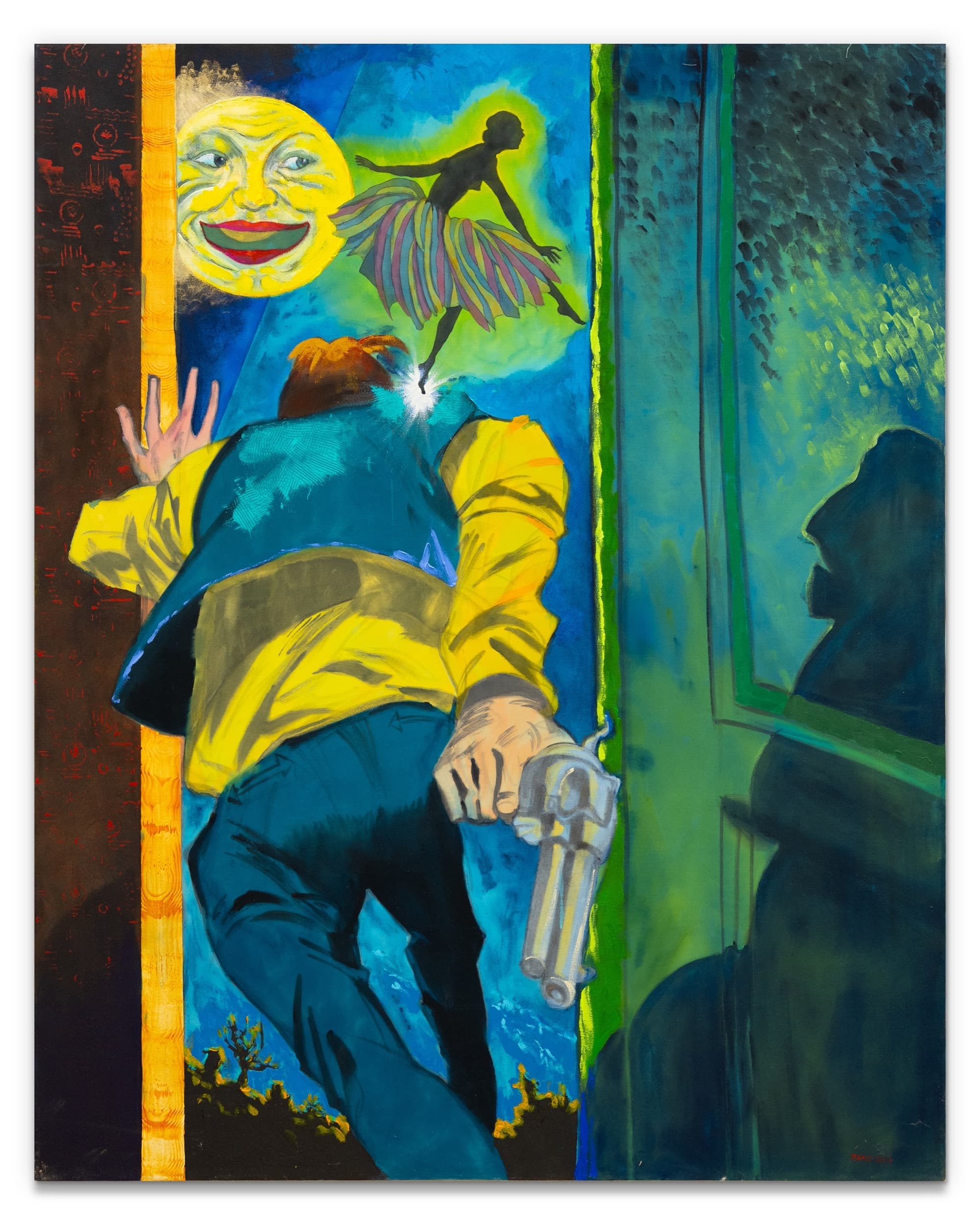
Archie Rand, Levi, 2019. Acrylic on fabric, 59 ⅞ × 47 ⅝ inches. Courtesy Contemporary Fine Arts and the artist.
Word count: 1032
Paragraphs: 7
Contemporary Fine Arts
November 15–December 20, 2025
Berlin
Archie Rand’s Sons, now on view at Contemporary Fine Arts (CFA) in Berlin, continues the anthology painting the artist has become known for. Rand’s oeuvre is characterized by dense sets or series that begin with themes derived from literature, Jewish history, or the art canon, but are then translated using the imagery of adventure comic books and pulp magazines. They transfigure the monumental mythologies and histories of the world—and all of their aesthetic codes of reverence and memorialization—but Rand only allows himself to tell their tales in the lurid colors and angular forms of detective novels and dime-store comics. These formal devices allow Rand to experiment with texture and solidity. He does so compulsively, right down to the support of his paintings, which are often cheap, store-bought canvases. The works are direct in this way. Rand has to get each set of images out of his hands and onto the canvas as soon as he can. The sheer volume supersedes individual gestures. This speed allows the artist to come through without inhibition, and really, the whole endeavor is contrived so he can focus on how far to take each form in its rendering. That is both enough and the engine that drives the work.

Archie Rand, Untitled #15, 2024. Acrylic on canvas, 13 ½ × 25 ½ inches. Courtesy Contemporary Fine Arts and the artist.
Like most of his anthologies, the current exhibition works with subject matter that itself flirts with ambivalence. While the Biblical twelve sons of Jacob that Rand takes as his starting point have historical significance for Jewish identity, Rand is more interested in retelling such stories through new forms of invented myth, bringing the inaccessible veneration of tradition into a more approachable and exciting semblance. This is irony delivered through the window of representational abstraction. Like the work of Mike Kelley or Jim Shaw, everything is legible, but is suspended together in a complex surface of mutual relations that leaves motifs difficult or impossible to decode. Rand distends images past their semiotic associations, both lifting and dissembling their appearances. In Issachar (2019), Rand shows that no two cowboys are alike. One of the figures pictured here is crude, modelled in a sharp and unfinished manner that Ernst Ludwig Kirchner might appreciate. Meanwhile, the other is an apparition, an icon of stained glass, or the giclée cell of an animated strip. Each cowboy can only be understood through a different universe of handling, in a recognition of what can occur when mimesis is strained through the specifics of application. These works evoke the caricatures of Henri de Toulouse-Lautrec and Honoré Daumier just a short drive away at Berlin’s Alte Nationalgalerie, which is currently exhibiting the Scharf Collection. Caricature breaks down the concept of the agreeable in mimesis. It finds the edge of representation so as to profane it, and in so doing releases both a deeper truth and our fear of its acknowledgment.
Rand is really a symbolist in these formal exercises, a Stéphane Mallarmé of pulp that reshapes the vivid archetypes of the comic book page until the dot matrix of the page breaks and becomes moiré. The heated image-swarm congests into a complex set of dialectical relationships, where representable images become unrepresentable abstractions. The question then is, to what end? Rand’s image mélanges are unlike that of Larry Rivers, whose deconstructed history paintings question the end of history or meaning itself in the age of mass communication. What makes Rand distinctive is his paintings’ relationship to the sacred. For Rand, the sacred is cast in the gorgeous shadow of bewilderment, barely transfixed within the everyday and the ordinary. Each miracle has to be dredged from the dross of fast culture, where affinities and coincidence become the language of spiritual transcendence. Like every miracle, however, such holy apparitions can only be witnessed alone and can barely be believed. Rand’s sacred lies in disturbing the purity of images by sloughing off all of their associations and meanings, finding instead what is irreducible about his subject. It is little different than the Dadaists combing through second-hand stores or searching the curbs to find truth within a garbage heap. This is painting as retrieval from the ten cent pages.

Installation view: Archie Rand: Sons, Contemporary Fine Arts, Berlin, 2025. Courtesy Contemporary Fine Arts and the artist. Photo: Nick Ash.
So why now? Unlike some postmodern painters, who depicted the feeling that we’ve lost all signal and inherited only noise, Rand is earnestly seeking out what signal might be left. Rand is, in some ways, a progenitor of scrolling and posting, of sharing an image or a meme faster than it can be comprehended in the hopes that it instead conveys something sensuous. For Rand, there is a stunning beauty in coincidence, the point where all belief systems are held in synecdoche with each other, and he seems to suggest that our only way of arriving at this miraculous moment is to pay close attention to what we rarely notice, to the glow of commercials and advertisements, and the pulp pages of comic books. That’s where the infinite scroll of images might accidentally create something more than montage, and instead leave us an oracular message in the pulp. God is there, somewhere, within the material, within the images, within the aleatory and the wondrous juxtapositions of dissimilar histories.
To enter into this economy of images means stepping into more base materialisms. For Rand, the sacred is found, above all, in the images of adventure. In his work we feel the heartbreaking intimation of a world of excitement that is always happening somewhere else, always richer and more vibrant than our own reality. Somewhere else, there are smoke-filled rooms where the power of the world is configured. Somewhere a hero rides on horseback, or soldiers load a canon that saves the trench. What Rand seems to suggest is that despite their vivid shock, these images are still unknowable and unreachable to us. As he layers on the iconography of adventure to sublimate the histories and narratives that have shaped his life, we can feel the desire, the longing for these vivid experiences, always deferred and elsewhere. But he uses them to make himself visible and appreciated and loved for the things that have made him, and because of that, we might find our love for them too.
Andrew Paul Woolbright is an artist, gallerist, and Editor-at-Large at the Brooklyn Rail, living and working in Brooklyn, NY. Woolbright is an MFA graduate from the Rhode Island School of Design in painting and is the director of the Lower East Side gallery Below Grand. He currently teaches at Pratt and School of Visual Arts in New York.