ArtSeenDecember/January 2025–26
Ming Fay: Midnite Porridge
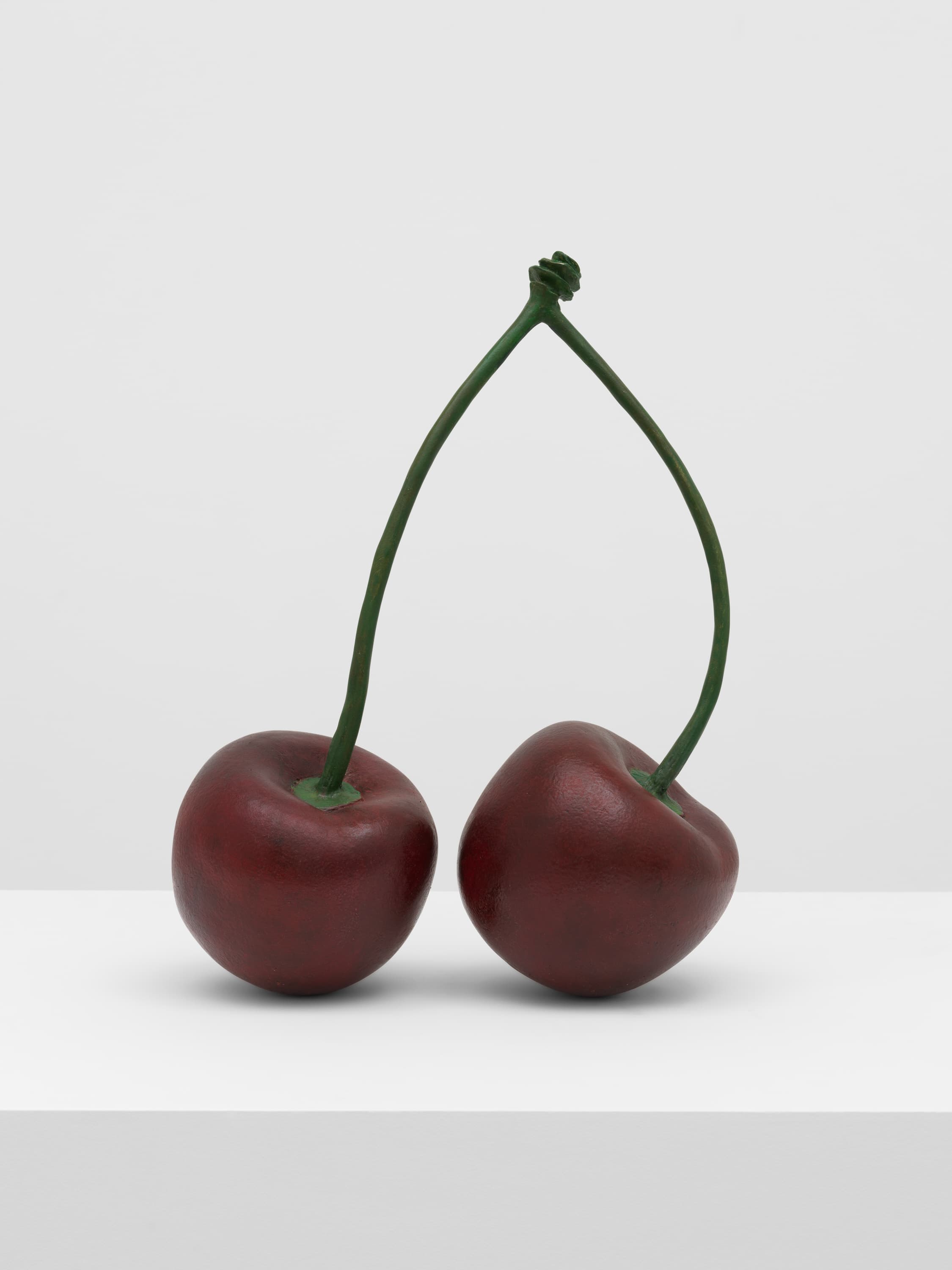
Ming Fay, Wishbone Cherries. Bronze, 26 × 16 × 9 inches. Edition of 10 plus 2 artist's proofs (#2/10). Courtesy the artist and Kurimanzutto.
Word count: 599
Paragraphs: 11
Kurimanzutto
November 6–December 13, 2025
New York
Compared to the public stream of one-thought memes, two-bit stunts, and emotionally manipulative commentaries polluting the ocean of our communal intelligence, making a larger-than-life-sized object as a plea for attention seems almost quaint. Yet, this maneuver (and its cousin, the smaller-than-life-sized object) was fresh and effective in the latter half of twentieth-century Western art, from the Pop monuments of Claes Oldenburg to the looming yet vulnerable figures of Ron Mueck.
Among those artists was the curious case of Ming Fay (1943–2025), a Chinese expatriate who lived in New York City, working largely outside the commercial art world from the mid-1970s until his death earlier this year.

Installation view: Ming Fay: Midnite Porridge, Kurimanzutto, New York, 2025. Courtesy Kurimanzutto.
Born in Shanghai to artist parents, Fay left China at the age of eighteen to attend a handful of highly-regarded American art schools. After settling in New York City, he discovered the subject that would inspire his artistic output for the rest of his life: the natural world. Of course, countless artists have been inspired by “the natural world” over millennia, yet Fay’s focus—creating oversized versions of the plants and seeds he found in city parks and the fruits and shells he discovered in Chinatown markets—offers a unique approach that continues to resonate, often in unexpected ways.
Walking into Midnite Porridge, a mini-survey of the artist’s sculptures, drawings, and ephemera at Kurimanzutto, the viewer is initially greeted by a large, frieze-like arrangement of oversized fruits, nuts, and seed pods—the effect creates a more powerful experience than you’d think. Perhaps because, across decades of biomimicry within Western design, art, and film, we’ve been repeatedly taught to “appreciate” art by recognizing these subjects within abstract forms. Fay, on the other hand, asks us to do the opposite.
It might surprise viewers to learn that Fay was quite familiar with abstraction and was, in fact, initially working as an abstract artist before turning to natural imagery. It is this tension between Western abstraction and Eastern symbolism that generates friction within Fay’s supranormal objects.

Installation view: Ming Fay: Midnite Porridge, Kurimanzutto, New York, 2025. Courtesy Kurimanzutto.
Made with materials like epoxy, paint, paper pulp, gauze, foam, and rice paper, artworks like Coconut (1984) are a testament to Fay’s talent for capturing uncanny resemblances while simultaneously emitting an “expressionistic” surface. Nearby, Seashell (1984), with its multiplicity of folds, perforations, jagged edges, and swirling peach, pink, and grey hues, pulls off an even more impressive trifecta by resembling pure abstraction, the shell itself, and discreet female anatomy all at once.
In his own words, Fay sought to reveal “the wonder of even the humblest natural forms, lending the viewer a new appreciation of the ordinary,” and he undoubtedly succeeded. Less obvious, at least to Western audiences, is the symbolic meaning behind many of Fay’s subjects within Chinese culture, where a pear represents prosperity and a lychee symbolizes love.
Initially overshadowed, the drawings, which date back to the seventies and reveal another side of this artist’s approach, further encourage comparisons to Oldenburg. Yet, unlike the Pop artist’s fast and jagged punchlines, Fay’s softly modeled renderings of lone shells, fruits, and seeds mine the gentle pathos of Edward Hopper-era sketches.
In his later years, Fay saw his garden of sculptures “as a symbol of abundance, paradise, and the location for the ultimate desirable state of being.” Depending on how you view the trajectory of our planet, this might add a tinge of melancholy to Fay’s career. Should Fay be regarded as an earthbound student of nature or an escapist creating idealized worlds in his studio? The beauty of the work is that both feel true.
Ryan Steadman is a contributor to the Brooklyn Rail.