Art BooksDecember/January 2025–26
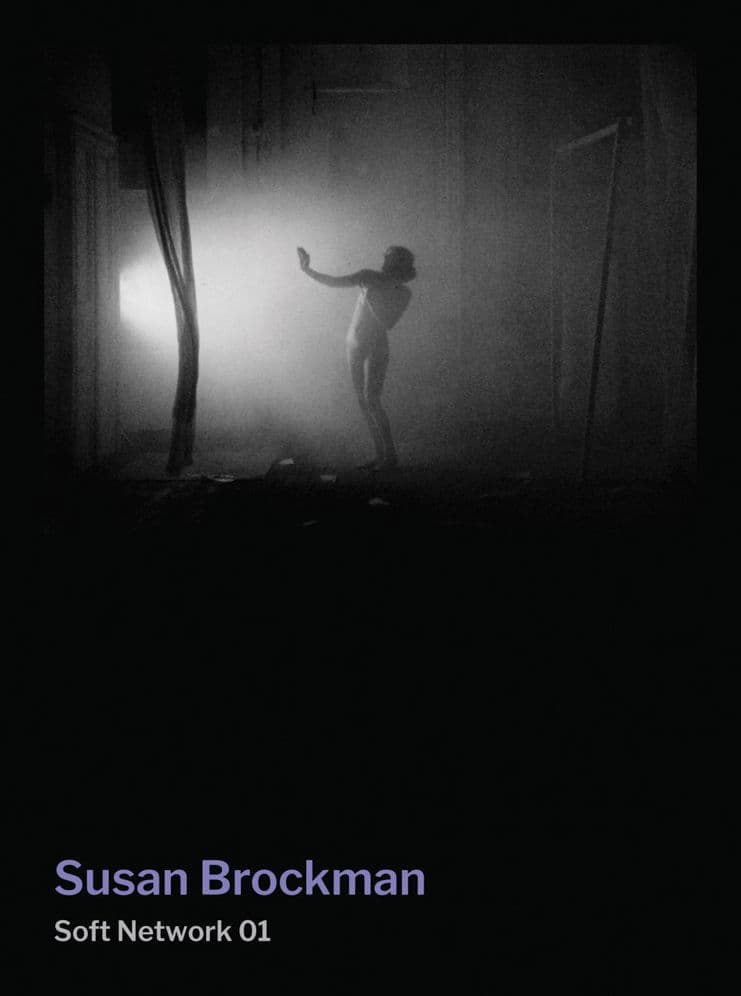
Susan Brockman: Soft Network 01
This book charts the life of an archive and the long awaited afterlife of an artist.
Word count: 866
Paragraphs: 8
Edited by Marie Warsh
Soberscove Press / Soft Network, 2025
Much of my own research and writing requires me to spend many days and hours in archives, sitting in oddly lit rooms without water as I sift through the ephemera of an artist’s life and work, trying to find a way to tell a story about them. For those not familiar with this process, archives can seem synonymous with death—a storage facility for the detritus of a life. But those whose lives live on in archives, and the researchers who keep them alive, know otherwise. This resonates with the mission of the recently founded Soft Network, an organization in New York dedicated to activating and using the archives of artists who worked with ephemeral media such as time-based or performance art. Established in 2021 by curator Chelsea Spengemann and artist Sara VanDerBeek, joined soon after by art historian Marie Warsh and artist Max Warsh, Soft Network, among other activities, hosts an archive-in-residence program, whose second resident was the archive of filmmaker and photographer Susan Brockman (1937–2001).
In the opening line to their first publication, which serves as both documentation of the Brockman archive and exhibition, as well as an introduction to Soft Network, Warsh writes, “Books are a valuable tool and resource for those involved and interested in artists’ legacies; they are often the sole access point to an underrecognized, historical artist, offering the only substantial documentation of their artwork.” With this in mind, Susan Brockman: Soft Network 01 is as much about the life of an archive (or the afterlife of an artist) as it is about Brockman’s work. The slim, 112-page softcover has a workbook feel to it. It brings together a selection of Brockman’s photographs, stills from her films, ephemera from her performances and editorial work, some of her own writing about her work, and invited contributions from scholars, family members, and her fellow artists. Together, these begin to achieve the goal set forth by Soft Network and the promise of the opening lines of the book: offering a much needed access point to Brockman and her work.
In the book’s afterword, Mirra Bank, Brockman’s sister-in-law and one of the keepers of her estate, paints a picture of an artist whose “visual acuity and wit flew under the art world’s critical radar. In part, she’d fostered her own obscurity, through a deep-seated mistrust of attention.” Perhaps this is why her work remained lesser known for so long despite her close relations to other artists of note, including William de Kooning, Peter Hujar, Robert Frank, and the group Women/Artist/Filmmakers that included Maria Lassnig, Martha Edelheit, Carolee Schneemann, and others.
Fittingly, much of Brockman’s work was also about recovering lost things. Her archive is full of color photographs from visits to flea markets. “Brockman’s archive was full of scraps of these images, perhaps artifacts that she was saving for future collages or for adding to existing ones,” notes Warsh. For Soft Network, the act of digging through her materials in a way mirrored Brockman’s own process of art making. As Warsh writes, “The restless energy of her archive made it difficult to discern what was process and what was finished work, and this made it challenging for us to figure out how to present it.” Ultimately Soft Network opted to use the duplicate printouts of flea market photographs found in the archive as working material in the exhibition. “We decided to pile these duplicates into stacks, and allow visitors to sift through and even purchase them,” explains Warsh, “evoking the experience of the flea market while also trying to give these prints new life and reflect on the artist’s own practice of reuse.”
Documentation of this part of the exhibition is included in the book, showing photos of porcelain figurines, glassware, and knicknacks. In a text by Brockman reproduced in the book, she writes in a list of thoughts about her work, “The subject matter of the work is generally made-up of cultural artifacts either created at the height of an artistic flowering, as with porcelains from Sevres” and later “By combining and juxtaposing photographic images, I am making cultural comparisons, spatial comparisons, sculptural comparisons.” Cultural juxtaposition is also part of Soft Network’s approach to the archive. Part of the “archive-in-residence” program activates artist’s papers and working materials, creating “cultural comparisons” that bring the artist and their work into a present in which they did not have the chance to participate. “We wondered if, within an exhibition so focused on her process, there could be a way to activate the archive in the present,” writes Warsh. In Brockman’s case, the first exhibition at Soft Network also included a series of photos by Allen Frame, also inspired by his own flea market find.
More broadly, it seems that Brockman has been a fitting choice for this first residency, perhaps in more ways than anyone involved could have predicted. “This process has taught me that legacies aren’t about looking back,” concludes Brockman’s sister-in-law Bank, “legacies create new beginnings.” There are more new beginnings ahead with Soft Network as they continue this approach to artists’ legacies, archives, and the afterlife.
Megan N. Liberty is the Art Books Editor at the Brooklyn Rail. Her interests include text and image, artists’ books and ephemera, and archive curatorial practices.