Art BooksDecember/January 2025–26
Double: Carol Newhouse & Carmen Winant
These photographs reveal the close relationship and feminist inheritances exchanged between the artists.
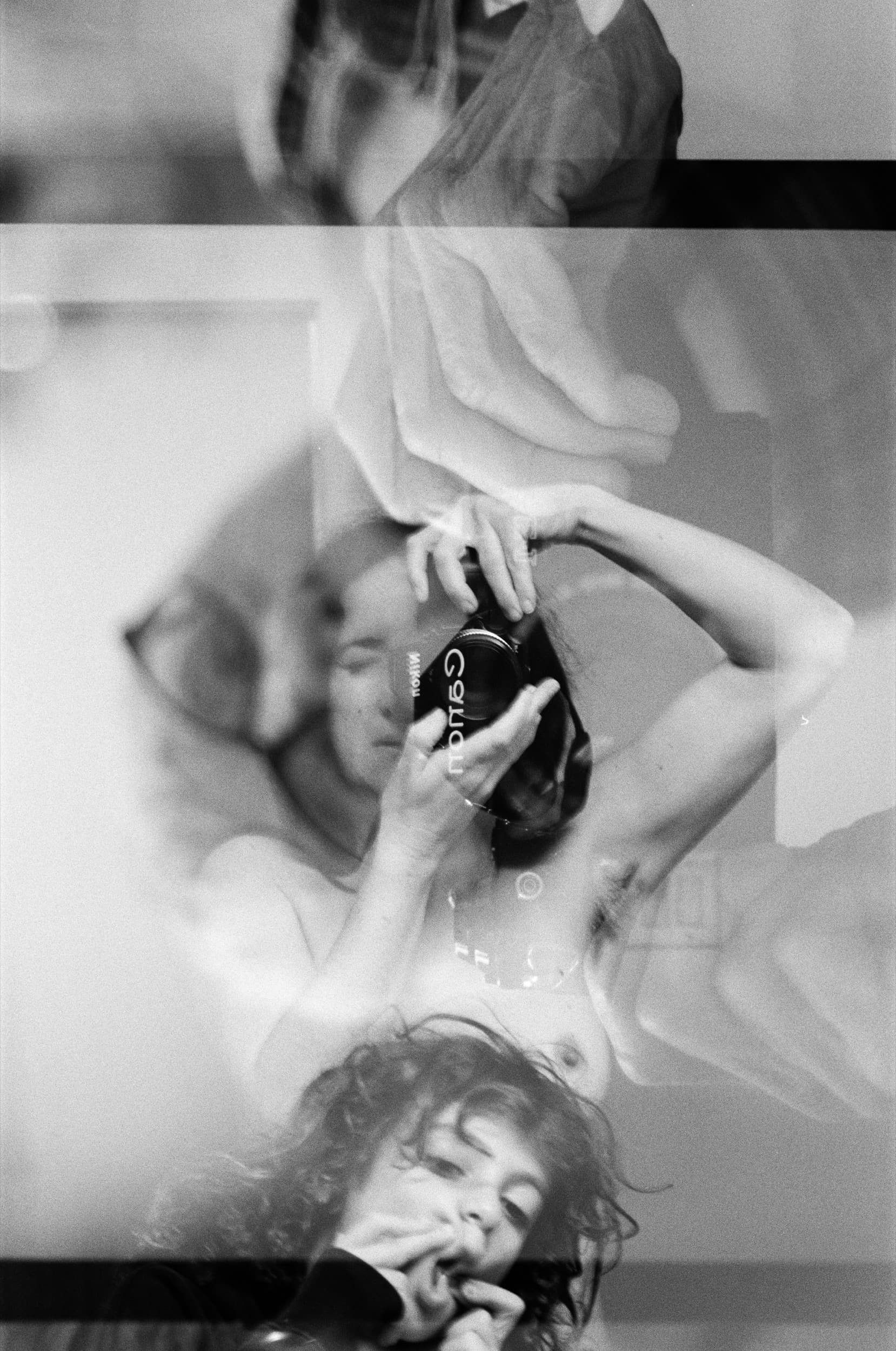
Carol Newhouse and Carmen Winant, Double exposure, 2024. Courtesy the artists.
Word count: 766
Paragraphs: 10
Edited by Nina Strand
Objektiv Press, 2025
Visual artist Carmen Winant (b. 1983) and photographer Carol Newhouse (b. 1943) embarked on a years-long friendship and creative partnership in 2019, leading to their latest project: Double. For this new body of photographic work, Winant would shoot a roll of film, rewind it, then send it across the country for Newhouse to reshoot. The rolls of film were labeled with agreed upon categories: self-portraits, hands, and nature. Together, they created a series of ethereal, sensual, and charged double exposures.
Double, both an exhibition and publication, builds on Winant’s previous project, Notes on Fundamental Joy; seeking the elimination of oppression through the social and political transformation of the patriarchy that otherwise threatens to bury us (2019). Notes on Fundamental Joy explores the history of WomanShare, a collective (of which Newhouse was a founding member) inspired by lesbian separatist communities in the Western United States in the 1970s and ’80s and their experiments with photography as a tool for self-representation in workshops known as the Ovulars.
Double consists of seascapes, close-ups of hands and flowers, as well as intimate self-portraits of Winant and Newhouse. All of these subjects collapse together under the genre of experimental self-portraiture. During the project, Winant had the idea to assemble some double exposures into four-part collages. In one collage of color double exposures, Winant and Newhouse are overlaid, as if fading in and out of one another. Vibrant pinks, yellows, purples, and blues from Newhouse’s watercolor paintings in the background of her exposures bleed across the collage like aura photographs, which are meant to capture the distinctive energy or atmosphere of the individual. In this collage, the fictional auras of Winant and Newhouse flicker and blur together, like two flames of a fire merging into one.
In the first double exposure the two artists made for the project, Winant photographed herself standing behind her son, facing a mirror; Newhouse captured a close-up of her own hand gripping her camera. Atop one another, Newhouse’s hands loosely cradle Winant and her ghostly head drapes over Winant’s nude body, as if offering a blessing or a gesture of care—three generations situated in one frame. The invocation of the mirror is not only a potent reference to the work by artists from the Ovulars, who often incorporated mirrors into their photographs as a symbol of empowerment, but also a reminder of self-reflection and of the implications of gaze.
The collaborative photographs in Double subvert a male gaze, which can be bound up with threats of harassment and violence. Instead they imagine what Newhouse terms a “female gaze” because of the close relationship and feminist inheritances exchanged between the artists. Newhouse and Winant’s photographs convey a perspective built on trust between women, on safety, and on a profound respect for one another.
The book also includes an account of Winant and Newhouse’s friendship by Nina Strand, who curated a presentation of the artists’ work at the Rencontres d'Arles. Strand documents their creative pursuits and the ways they navigated political and personal tumult. Recalling the 2024 US Presidential Election and the #MeToo movement taking root in France, Strand writes—not unlike Winant in Notes on Fundamental Joy, and in the spirit of WomanShare before her—that “the need for a space outside of society feels stronger than ever. While times have changed, the fight for freedom persists.”
Her essay in Double reads as both a personal reflection and a narrative bibliography. She teases out references buried within the photographs while recounting a history of the artists’ work. She surfaces The Blatant Image: A Magazine of Feminist Photography, which emerged from the Ovulars and was published annually from 1981–83, as well as Raechel Herron Root’s article, “Foremothers of Photography” (2020), among others. Strand’s curatorial voice guides the reader through the photographs, but only as a wanderer through the alchemy of Winant and Newhouse’s collaboration.
These photographs and their process also espouse a belief in chance encounters. Inherent to chance is optimism. “Is there an aesthetic to hope, expectancy? In what ways does it become dislodged between generations and in between lives?” Winant asks in Notes on Fundamental Joy. In Double, these artists propose friendship and intergenerational learning as a call to action. It suggests to a population overstimulated by an internet culture steeped in pessimism, polarization, and dejection that it is possible to live in a world stoked by the warmth of connection, because it has been done before. It can still be made with your own image, perhaps starting with a camera.
Victoria Horrocks is a Brooklyn-based curator, writer, and art historian. She is the Curatorial Fellow, Photography at the Solomon R. Guggenheim Museum.