ArtNovember 2025In Conversation
PAUL SIETSEMA with Suzanne Hudson
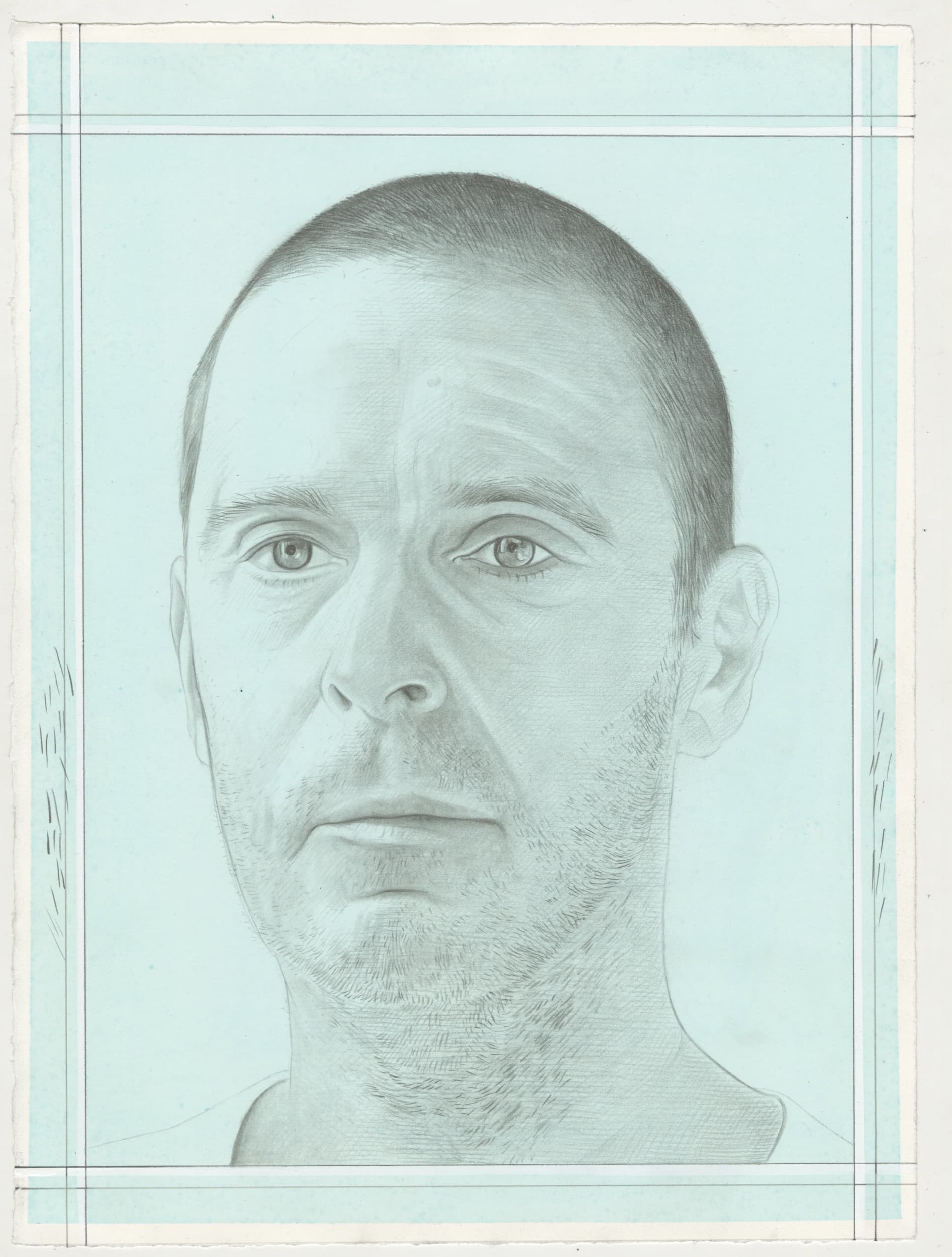
Portrait of Paul Sietsema, pencil on paper by Phong H. Bui.
Word count: 5843
Paragraphs: 92
Marian Goodman Gallery
October 18–December 20, 2025
Paris
Throughout his career, Paul Sietsema has engaged with the conditions of image-making as historical and contemporary practice. He often uses wildly labor-intensive techniques—I mean, he once made a pair of New Balance running shoes by hand, casting rubber and braiding the laces!—constructing intricate visual worlds. Sietsema is a collector. He finds and chooses things; then comes research, overflowing bookshelves and stockpiles of back-catalogue stuff to make sense of them. He regularly translates objects, which, in the course of such mediation, and beyond digital infrastructural activity, might be reconstructed, photographed, drawn, painted, or filmed. Subjects vary, but all seem to reflect on how meaning erodes but also accrues through reproduction.
I would describe the process as a necessarily embodied reconstructive method. But through this procedural mimicry, Sietsema less seeks the compensation of return than critical engagement with how tools have been, and might continue to be, epistemological partners in generating patterns of information together with structures of accessing them. He has made 16 mm films—Empire (2002) and Figure 3 (2008)—that explore how histories of modernism and artistic labor are reconstituted through the mechanism of aesthetic reconstruction and obsolescent technologies. His more recent paintings and drawings have depicted paper money and coins, LPs and CDs, exhibition ephemera, tools, and studio debris.
Some flaunt paint stains picturing what Sietsema used to make them; they might sit on “newsprint” that is really a drawing (the infinite regress comprises the content of the paper and the signs of its wear and tear). He has aggregated other images of disassembled framed photos in the series “Painter’s Mussel”—an allusion to the muscle of the brain over the arm/brush, and also a reference to the freshwater mussel found throughout Europe that long held painter’s paint. (These look like photograms but are actually made with liquid rubber that resists an airbrush spray of ink; when removed, it reveals the blank paper as if it were the photo negative.)
As before, then, with his new paintings made for his second solo show at Marian Goodman Gallery Paris, the point is analytic. He seems to ask, in so many ways, how representation is managed and how value circulates, and what the artist has to do with this passage of material into currency. We talked about this in his Los Angeles studio amidst the works, set to ship out the next day but not crated just yet.

Installation view: Paul Sietsema, Galerie Marian Goodman, Paris, 2025. © Paul Sietsema. Courtesy the artist and Marian Goodman Gallery. Photo: Rebecca Fanuele.
Suzanne Hudson (Rail): Okay, so should we start by talking about what’s going to be in the show?
Paul Sietsema: Sure. There are seven new pieces that I’ve made that are going upstairs. The gallery in Paris is a small, nice, clean space with windows running along one wall, so you can see the work from the courtyard outside, too. It makes it a little bit like a vitrine, which I like. It’s going to be a hang of the seven works you see on the wall across the room here. Then downstairs I’m showing some earlier work. Some of those have imagery of the work’s creation—actions that I felt emanated enough on their own to turn them into something. There is also a painting [Blue Picasso (2020)] that is a sort of canceled exhibition poster from the Peggy Guggenheim Collection.
Rail: A Picasso.
Sietsema: Yes. It’s very weird, surreal. You can’t see much of it because it’s covered, but if you know On the Beach (1937), it looks sort of like science fiction, with cubistic figures on a beach. It has a very blue sky, light tan yellow sand—very Mediterranean. It’s funny being in California and looking at a Cubist beach scene.
Rail: Maybe it’s appropriately wistful for fall in Paris, even grayed over.
Sietsema: Exactly. And then there are these two carved stone pieces from building cornerstones. When I was living in Europe around a decade ago, I traveled through Paris a lot, and I would photograph these dates whenever I came across them. I started making the paintings with a broken airbrush that I was into because it sort of splattered and did things that were less technical than the other pieces I was working on at the same time. I would render the stone with the dates, but I changed the dates to earlier moments in my life.
Rail: Do you still do those at all?
Sietsema: I haven’t in a while, but lately I’ve been wanting to, and now it is kind of a funny thing, because I have started to look back at work that I’ve made even twenty years ago, and it’s a different feeling than I had when I made them. As I change and move in other directions, the older work sometimes seems to hold even more potential.
Rail: But you never go back into work. I mean, once it’s done, you wouldn’t re-work a piece? You would make something new in that idiom.
Sietsema: Yes, other iterations. I do have a bunch of the date panels that I started but never finished; it’s been over ten years since I touched them. For some reason with those, I’m never in a hurry to finish. I think they rely less on entering the world at an exact moment. A lot of my work does have to do with things that happened before it, and it’s maybe ambiguous when it was made, or what my stance is in relation to the preceding histories or authorship in general. I think I’ve been waiting for this moment since I was much younger, to be able to ripple back through my own history and use it as a kind of echo chamber, or maybe amplifier, to address these things more deeply.
Rail: That’s why I like that this is part of the show with the new work. I don’t think I fully got it until seeing this mockup. I mean, so many shows pair earlier work and more recent work, with whatever mechanism of connection between them. But there’s something about this subterranean chamber, with the earlier work undergirding what is above it. You are spatializing a psychic model.
Sietsema: Yeah, I was into that. In gallery press releases, they usually call it “exhibition space level two,” or something like that. But in reality, everybody just calls it “the basement.” I was very interested in the idea, because “basement” relates to “bedrock,” geologically. It’s not just a room under a building; it’s also the geological formations under the surface of the earth. As I was coming to those ideas, I came across this Marcel Broodthaers concrete poem, one of his vacuum-formed reliefs in plastic, called E Sous-Sol from 1969, which portrays both bedrock and clouds with the same abstracted jagged shapes on either side of a line that stands in for the surface of the earth.
Rail: It is an image of the thing that can’t move, that determines or gives literal shape to what comes on top of it.
Sietsema: Yeah, yeah, it’s exactly that. It can’t change now. I do feel like I’ve just been forging ahead for decades without looking back. And maybe it has something to do with age, but also everything that has happened this year, that led to me taking stock.
Rail: What are you calling the show? I didn’t even ask.
Sietsema: I was just going to use my name, which is what I usually do. Titles can overpower things.
Rail: But there’s not going to be a date range, or a sense of chronology?
Sietsema: No. The only organizing feature will be the above ground versus the below. As for titles, I mean, I guess I really try to get what I want into the work, and then a title feels like a cataloguing element, unless there’s something that I want to remember about it specifically. I might tag certain things about a piece in the title, so that when I come across it again, it’ll remind me of something I thought I might want to think about in the future.
Rail: So it’s like a placeholder for you, always already proleptic. You don’t want the framing to be interpretive.
Sietsema: I am extremely interested in language, but I also think that fundamentally, language, like music, has an immense amount of power behind it, and I feel like the work is maybe a little bit quiet, so that power is sort of—
Rail: Well you can’t undo it. I always feel like you can’t unread something that you’ve read, or from the other side, you can’t really take it back once you put it out there.
Sietsema: Yeah. Whereas with artworks, I think your conception can change a lot over time, which of course is something I’m fundamentally interested in.
Rail: In itself and also because of the relation of what you put beside it. The deck can always be shuffled. For this show, you have muted the colors, in the new and older works.

Paul Sietsema, Arrangement, 2025. Enamel on linen, 48 × 48 inches. © Paul Sietsema. Courtesy Matthew Marks Gallery and Marian Goodman Gallery.
Sietsema: When the market went crazy, I realize I started associating color with that other kind of saturation. In my last show in LA at Matthew Marks Gallery, in 2024, I made one of my phone paintings that have always had color based on the original phones. I was thinking about what a hot color might look like. I was thinking about lures, like the ones for fly fishing. I mixed this weird and specific reddish-orangeish pink. I don’t really know exactly how it got there, but it felt right. And then when I was parking to install the show in West Hollywood, there was a brand-new Jeep parked next to me, still with temporary plates, and it was the exact same color as my phone painting. It made me a little queasy that I’d come to this color, and the car company had come to it as well, maybe on a similar timeline, and then our colors came out at the same time. It just got very confusing for me. So I decided that I wanted to explore material itself, and of course, it’s maybe more complicated than that, because it’s always very representational material—almost always representations of material—but I was interested in processing something closer to raw materials, and not using color or other elements that might juice the work beyond its fundamental existence.
Rail: I remember seeing the brightly lacquered phones in your studio and in the LA show, but the pink one for me had a kind of tacky, hardened quality of nail polish or auto body paint that I took to be very deliberate. I didn’t get the squeamish association you’re describing, but thought it to be about product lines and how you can cloak something in different colors, and the colors anyhow can’t escape topical reference.
Sietsema: Because that’s how the phones initially were marketed. The changing colors were a very important part of them selling more of the phones, as interior design trends changed.
Rail: Right. The obsolescence built-in.
Sietsema: In my last New York show at Matthew Marks, in 2023, I had a yellow phone, a more standard red phone, a sort of turquoise phone, and a dark green phone, based on the colors they originally came in. So I would find the phones, and then I would mix and match the color and pour the paint over them before capturing them digitally. Also sometimes they’re enhanced through the photography, the default proprietary color builds off the digital file, and then I might nudge them around a little to get them to sit right. But basically, it’s all found color.
Rail: But now seeing it in grisaille, it almost looks like it’s naked, waiting for some surface application. Or like this is the under-painting, even though I know materially that’s not how the others work.
Sietsema: Yeah, that’s interesting. I mean, the other paintings are smaller, and they are meant to have a very hard, shiny surface. They have some Finish Fetish in the way they are painted. But I think that I’ve always also been interested in phones as bodies, so at a slightly larger scale, they are more like machines and bodies at the same time. That physiological quality in machines is disappearing of course. We could become obsolete now, you know—earlier the machines became obsolete, but now that could flip in the new system.
Rail: Like in the service of communication or networking, or—
Sietsema: Exactly. So I don’t know, I sort of think of this as, like, a figurative painting, although it sounds like such a dirty word to me right now. [Laughter]

Paul Sietsema, Object painting, 2025, Enamel on linen, 44 ½ × 43 ½ inches. © Paul Sietsema. Courtesy Matthew Marks Gallery and Marian Goodman Gallery.
Rail: Maybe it’s a kind of pareidolia, but the typewriter in Object painting (2025) reads as not so much bodily, but facial. Or it is provoking that reading of patterning in an inanimate object in such a deliberate way.
Sietsema: I do see a face in it sometimes, which I do like, but that is just a byproduct of its early-machine physicality. As new technology alienates itself from us, older technology starts to seem almost human. What I was really interested in though was the relationship of the apparatus to your body, your fingers—the idea of hitting keys, which of course are really just simple levers, and pushing the carriage back to advance the sheet of paper and start a new sentence. I think of it in relation to making the painting. I think it’s similar, you know: the manufacture of the object and the manipulation of the object, the interaction with the body and the way the painting is made. They both involve physical labor that produces language. I wanted a subject that had these attributes—a machine that would fill the frame completely and sort of overtake it.
Rail: This is making me think about the way that so many of your works have implied a body or indexed movement. This could be in paint being really evidently slid across the surface or something, but also in what is pictured. They are like quasi-narratives of things arrested in positions that redouble the process of their making to imply a prior action. But now these are like the phone being unplugged, or handset being taken off the cradle. There is also a sonic dimension of these choices, like the clicking of the rotary dial after being returned. Back to your point about the interaction with the body, the feeling of this is so specific: the tension of the turning, the give of the coiled cord. You can sense it. But I guess all I’m trying to say is you can also hear it. Strangely, as images, they are very loud.
Sietsema: It is funny because I was thinking about this very thing just ten minutes ago. [Laughter] But before that, I don’t know if I did that much. You know, for these paintings I take the phones apart, to pour paint on them and photograph them. I have to gut them first so they won’t be so heavy they fall out of the paint. I think I have phones from the 1940s through the eighties, which I’ve gotten for their different colors. If you hang the ringing bells taken out of the phones from the forties on a nail and tap them with a screwdriver, they will reverberate for minutes, making a beautiful, high-pitched sound, and it just goes on and on and on and on. And the eighties versions go silent in less than thirty seconds. Manufacturing got worse and worse. But in the beginning, it was like a musical instrument. I think of the typewriters in a similar way.
Rail: They’re feats of engineering.
Sietsema: Completely. If you open them up, they’re incredibly simple objects. Once, the night before the opening of a large international group show, the 16 mm projector I was showing a film on stopped working. It was late and there were no techs around. I found some tools and took the casing off the projector and was able to fix it by tracing the mechanisms to find what was missing, without ever having seen the inside of a projector before. If you’re making an artwork—well, this kind of artwork—it’s that same situation: a mechanical process, a brain-hand feedback loop in which nothing is taken out of your hands. So for me, there is a resonance, because I think I would almost prefer just to make monochromes. But I just don’t believe that painting has that particular power anymore, or maybe it’s that I don’t want to hand that power back over to painting. I think reading the paintings can include a similar hand-brain feedback loop. In my dreams, this brings about a more phenomenological experience for someone standing in front of them. So I’m trying to find ways to get back to an activated simplicity of some kind, or a directness.
Rail: Yeah, these are maybe more about directness than simplicity. The typewriter, Object painting, is such a complicated painting, despite its centering something tilted up to the picture plane, and, as you say, aligned so utterly with it. But the longer I look at it, the less sense it makes. It dissolves up close, too, which is the best feeling—when you think you can understand something, and then it starts taking itself apart as you apprehend it. Then I’m thrown back on trying to figure: Where does space happen? Where is something going in or out? And it is so dumbly flat, which is perfect, because it makes me realize it is a literal ground for my projections, for my trying to keep the illusion and see how you produced it at the same time.
Sietsema: That’s something I’m very interested in across the board: ambiguity. But spatially, especially with this one, there was a lot of tuning to get it to sit right, you know, and to not either just explain itself or disappear into one particular type of space.
Rail: The space is consistently inconsistent. That’s kind of the ultimate game, right? To give the image and simultaneously complicate a path through it. And now that you are returning to these typologies that you developed—in some cases decades ago—you are re-entering those spaces, but also redefining their thresholds and rules.

Paul Sietsema, Arrangement, 2025. Enamel on linen in artist’s frame, 42 ½ × 36 ⅝ inches. © Paul Sietsema. Courtesy Matthew Marks Gallery and Marian Goodman Gallery.
Sietsema: Yes, I think so. Arrangement (2025) is a painting that I’ve done one iteration of in the past: a broken record in silver. The last one didn’t have a frame, which is kind of a small detail, but when I do use frames, it’s very much about keying it off as an object of trade, a kind of domesticated cultural object. When I do use them, I often paint imagery over the frames to pull them into the mess. [Laughter] So it’s not an entirely polite situation.
Rail: You mean you make this as an overall structure, or you paint the frame separately, and then put them together?
Sietsema: It does have to be painted separately to get to all of it, because the image goes down the side and across the gutter. I usually do paint the backs too, which the galleries are not crazy about. They get stuck to the wall and sometimes paint chips off. The question is inevitably whether the back is part of the painting or not.
Rail: Which is it?
Sietsema: It’s all the painting. Yeah, it’s all the painting. It’s partially that I do believe this object needs to have its own sort of existence, and us looking at it is one part of it, but it is also a totality on it’s own.
Rail: Without us.
Sietsema: Yes. So the painting on the back has meaning to me, because I don’t only care about the surface of the painting your eyes are currently moving over. With the backs specifically, it’s also that I spend a lot of time with installation crews, and it just makes that much more enjoyable if you’re experiencing a side of the work that other people don’t get to experience. For me, that’s a very nice moment, this feeling that you’re sharing something.
Rail: There’s an intimacy.
Sietsema: Which then, for me, calibrates the work differently, because work just sitting on a wall in a gallery is a pretty dead proposition.
Rail: Maybe we can talk about how the works relate to each other. It’s an odd segue, but I guess it is another way of thinking about sociability or vitality in a manufactured situation.
Sietsema: Well, these paintings were definitely conceived together, and there has been a lot of editing over the last year and a half. I’m usually more of a planner, and this time, for whatever reason, I decided I would just follow my intuition. I work on tables, so the work is in different parts of the room and different states of being finished—not really visible as a group. When I was getting close to being finished, I put all of them on the wall, and sort of freaked out, because I felt like something was happening that was out of my control.
Rail: They do play off each other so actively. I’m not sure how to put it exactly, but they each have spots where the images interrupt themselves. And I am realizing that you have made a catalogue of gestures with different sets of moves within the same organizing logics.
Sietsema: I do think that. And I think what I like about this group is that each painting is processing some similar ideas about art or commerce in very different ways. Usually, I feel I need a series to do this. But this time, I felt like I was able to get it in there in singles. I see them more as integers, or variables in an equation.
Rail: They can each stand alone, so you don’t need more than one of anything.

Paul Sietsema, Action painting (black line), 2025. Oil and enamel on canvas, 35 ⅞ × 23 ⅞ inches. © Paul Sietsema. Courtesy Matthew Marks Gallery and Marian Goodman Gallery.
Sietsema: Yeah. I did make two on the backs of matched used paintings though. I sometimes find old paintings and turn them around to use the reverse. Action painting (black line) and Action painting (white on white) (both 2025) are knockoff Jackson Pollock paintings from an auction house in Florida. I think they were like 150 dollars each or something, but sold as Jackson Pollock originals, which is kind of amazing. I don’t know if the laws are different in Florida or what—
Rail: They seem to be, about most things.
Sietsema: Yeah, maybe all things. These feel like high school art class abstraction. They’re nice though. I mean, I chose them because I believe in them as paintings.
Rail: They made it harder for you to undo them. But they are still readymades, now assisted.
Sietsema: I think about Abstract Expressionism in terms of chance instead of emotion or expression, or male bravado. The paint is going to do what it wants, so that is really making the image. And there’s something I like about using a coin rather than a brush as the paint applicator.
Rail: Chance within certain parameters that aren’t governed by temperament or psychology. It’s either going to be heads or tails.
Sietsema: Yeah. The idea that a gesture like this could be right or wrong is sort of fascinating to me, because if it feels right, does that make it wrong? What are the rules? A painting like this with a simple gesture makes me uncomfortable, because although it’s playing with this, it does also believe in it somewhat—plays a bit by the rules. There’s this odd feeling of the gesture as a sales pitch. Is a Willem de Kooning stroke also a symbol of monetization? I’ve been fascinated by this since I started looking at art. I mean, if you take a step back, it’s kind of silly and bizarre that one person’s gesture should be loaded with so much importance and value, when, in fact, it should really be every gesture that everybody makes having equal value.
Rail: Right, so the question becomes, “How do you think about these older gestures as the externalization of something?”
Sietsema: I mean, it’s weird: one of the strictest, deepest, most personal boundaries for me in terms of making work is that I can’t make a gestural mark and believe it is important just because I’ve done it, or it looks a certain way. And I guess I see the sort of more direct, Abstract Expressionist-type painting out there now as a response to certain types of technology—digital technology and phones and screens—and the idea that gesture carries better on social media because of the dissonance. It’s as if it’s this incredible thing to make a mark that AI hasn’t made. It has reactionary power of course, but I think gives too much deference to the technology itself in the end. Sometimes it feels like AI is training us to make more regressive expressionistic work because it can’t.
Rail: It’s interesting because I’ve been coming to this recently from writing about art therapy and the use of the gesture in this moment of historical Ab Ex, which was coincident with its development from occupational therapy. Margaret Naumburg was one of the earliest and most important practitioners in the US. She and her sister, Florence Cane, were progressive educators. They used this scribble drawing game on kids and then Naumburg took it into her clinical practice, encouraging people to effectively make and analyze their own Rorschach test. They are all un-choreographed bodily gestures that supposedly open onto something that language could not, except in their company. But it’s never pure communication. Even the gesture isn’t enough. It needed to be interpreted. It was a precondition to other forms of meaning-making, whether they’re visual, verbal, or some combination. Even in this psychodynamic context, there was not a transparency to meaning. And then how does this translate for work that is intended to leave the studio? That we assume that the gesture can ever just communicate, or that anyone wants it to, feels like such a folly. But what does that mean that it’s our desire that it does, or could?
Sietsema: It is just taking our perceptual system that’s honed over, you know, generations, that takes in visual information and sounds and all these things, and processes them into something that our brain can make sense of—languages, right? So with the gestural or abstract, you have this either super-limited or, I guess, irrational information you’re taking in, and it allows your brain to breathe and relax, and allow other ideas in—which I think can be a very pleasurable experience. But interpretation is a very different situation. And utilization another still. And I guess for me, one of the complicated questions in terms of how this abstraction functions now is that, spiritually or metaphysically, it encompasses as much as you want it too. And in art, the economic often expands in the same spaces the spiritual does. So in the end, it has this extreme potential for value enhancement.
Rail: That gets to Isabelle Graw’s ideas on “liveliness”—with the painting as an index of the agency of the maker, which keys to the market so directly.
Sietsema: Yeah, exactly. But, I mean, it is funny, because I’m often just trying to vacuum myself out of the work. Maybe I’m fighting harder to remove myself, and somehow I’m getting more stuck in the tar of the situation.
Rail: I guess that’s kind of what I was trying to say: that I was starting to feel this is such a tight grouping because it’s all the same. These are all just different versions of the same painting, even though nothing about them is actually…
Sietsema: Yeah…
Rail: Or different propositions within the same concept of what a painting could be.
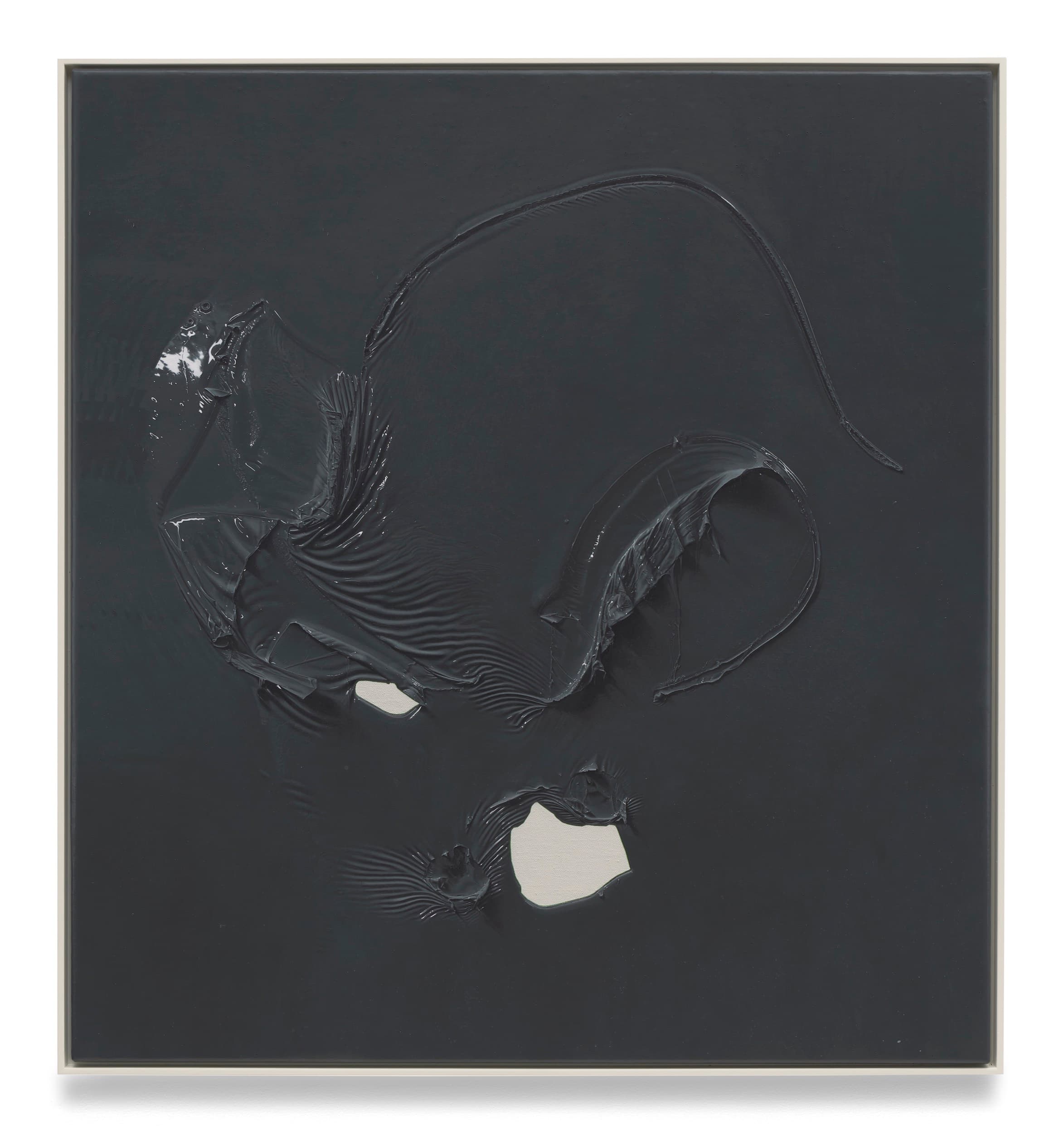
Paul Sietsema, Gray painting, 2025, Enamel on linen in artist’s frame, 51 ⅜ × 47 ¾ inches. © Paul Sietsema. Courtesy Matthew Marks Gallery and Marian Goodman Gallery.
Sietsema: And each work is its own problem completely, and none of them are easy to solve in the end. Even with Gray painting (2025): I’ve used this image several times before, although it’s been at least ten or fifteen years. This type of painting was originally meant to look at Concrete abstraction, Alberto Burri and Lucio Fontana, etc. But of course, the paint slagging and making its own form happened in my studio, and I just felt like it rhymed with that earlier era enough. In terms of the painting that’s in front of us now, I did want a ripple back to the work that I’d done previously, which is floating around on Instagram and other places—books, magazines, etc. When I started working on this, the highlights felt off, so I found a book that one of the earlier versions was in and scanned the page and laid the image over this one. And then I realized this was a different photograph taken at the same time as the ones I made the earlier paintings from. When I started this painting, I picked the wrong image. This one took place a few seconds before or after the other, and was taken from a slightly different angle. But this potentially inconsequential shift makes this a totally different thing to me, especially in terms of painting the image, because every single part of it is different. I like that it’s not just a replication, but this weird parallel moment disguised as replication.
Rail: And the phone is interesting in this, too—the versions and the different histories they encode.
Sietsema: The smaller phone paintings really are about being opaque, and I’ve been into opening them up this way: making them quite a bit larger and staying thinner with the paint. The painting is more—I’m not going to say performative, but at the very least a physical workout. There is something there for me about the mess of the dust that’s settled on the original object before I photographed it, and then in the painting stage, the sort of paint debris that comes from working quickly and using looser techniques. These are natural byproducts of the different stages the work goes through, and I like the lack of intentionality or design in that. And if I take a step back, I do think, as people have less and less experience in working with certain materials themselves, it’s nicer to have more access to my engagement with it, so that you can still fall into it as a painting.
Rail: They still are inscrutable images though, which is, I think, what one realizes after the initial confusion over material process. Even trying to figure out where the light source is, or from what vantage the thing is being shown. You are playing with the orientation in these, especially in the fake Pollocks with the horizontal getting set upright on the wall, which registers in the experience of looking at them.
Sietsema: That’s funny. I never really thought about these that way, consciously at least. But now I can see it, because a lot of them have references to gravity in different ways that might undermine the normal non-space of an image, and also have specific relationships with flatness, in terms of the forms of the objects, but also the low relief I build up with the paint, which I think creates a kind of accentuated in-betweenness. Yeah, that’s something I’m going to be thinking about for a while now.

Paul Sietsema, Figure ground study (white on white), 2025. Oil and enamel on canvas, 36 × 24 inches. © Paul Sietsema. Courtesy Matthew Marks Gallery and Marian Goodman Gallery.
Rail: How about in Figure ground study (white on white) (2025)? The parts seem like they are sliding past each other.
Sietsema: When CDs break, they break in very different ways than a vinyl record does. The break describes the material; it delivers a specific edge, which in a painting becomes a specific line. I always think about composition. In the era that I was educated in, composition was an absolutely evil thing. Composition is design; design is bad. And I really liked that the records and CDs, to a lesser extent, drifted around in the paint I poured over them as they were drying, finding their own positions, and sort of self-composing. Plus the jagged pieces point to the full circle of the whole, so there’s a sort of subconscious projective reassembly that takes place when looking at them that I think relates to composition, or non-composition, in a satisfying way.

Paul Sietsem, Action painting (white on black), 2025. Enamel on canvas, 48 ¼ × 41 ½ inches. © Paul Sietsema. Courtesy Matthew Marks Gallery and Marian Goodman Gallery.
Rail: And what about the paintbrush in Action Painting (white on black) (2025)? I’m trying to imagine what would have been different if it had been the first instead of the last thing we talked about. It would have totally changed something. It’s not just inverting the order; it’s like a key on a map or some kind of decoder-ring scenario. I also love the black monochrome, because so many of the other grounds have more residual incident. This is really like a presentational space.
Sietsema: Totally, a presentational space. I’ve always liked this image and have wanted to make it as a painting for the last fifteen years or so, and just haven’t found the right spot for it. But it is also uncomfortable, because it reminds me of the worst Roy Lichtensteins I’ve ever seen—the free floating brush strokes on Plexiglas. But that is also what I like about it, that it has an undeniably bristly aspect to it in certain ways.
Rail: These are all rigorous, hard paintings. I don’t think they’re hard to access, but then to figure out what to do with them is something else. And maybe that’s your point? But so then there’s a question of, “Well, what is it about?” This is the most didactic. It is straightforward, like, “Here’s the device; here is the tool that made the mark that I hung on the wall.” How we value it is another issue, but not unrelated, obviously, as we were also just talking about. Beneath that are questions as to how we orient that mark, and when we leave it as a mark. I feel like this kind of unfolds the whole story of what these other things are doing in a way that’s probably much more straightforward. Like, I’ve undergone an experience, and now I have this thing that explains to me more efficiently what produced it, if not exactly what it was.
Sietsema: Yeah, I thought it was too jokey or something. And it kept wavering between being in and out of the show. But then I realized I do kind of want that. And maybe in a way, it’s the most critical that way, too, because to me it’s also like the logo that you would find on a pre-stretched canvas in an art store.
Rail: You’ve been interested for so long in the history of art materials and the way that tools migrate into other technologies, like the digital paintbrush icon for in-program design.
Sietsema: You know, everything you’re looking at was made with a brush. [Laughter]
Rail: It’s a stoner in the parking lot kind of thing—a dumb joke that is deadly serious at the same time.
Sietsema: I mean, you just summed up how I feel about the paintings. So that’s pretty cool.
Suzanne Hudson is an art historian and critic. She is Professor of Art History and Fine Arts at the University of Southern California in Los Angeles.