EL ANATSUI with Zoé Whitley

El Anatsui, pencil on paper by Phong H. Bui.
Word count: 3707
Paragraphs: 64
Goodman Gallery
October 11–November 19, 2025
October Gallery
October 9–November 29, 2025
London
Tate Modern
October 8, 2025–May 10, 2026
London
Ghanaian sculptor El Anatsui (b. 1944) is internationally celebrated for creating work that transforms humble materials into grand installations, often of monumental proportion. Coming of age in a post-colonial society, Anatsui moved to Nigeria as a young man to teach at the University of Nigeria in Nsukka. There he found kindred spirits in his colleagues, the writer Chinua Achebe and the artist Uche Okeke. Anatsui describes the moment as “a meeting of souls.” On the occasion of his dual exhibitions in London at Goodman Gallery and October Gallery, and his inclusion in the Tate Modern’s Nigerian Modernism exhibition curated by Osei Bonsu, the artist spoke with art historian and curator Zoé Whitley. Their conversation touches upon Anatsui’s long held interest in material versatility, how culture influences his process, and the importance of play for art and for the world.

El Anatsui, Fractured World Order, 2025. Burnt and incised tropical hardwood, tempera, 55 1/10 x 165 ⅖ inches. Courtesy the artist, Goodman Gallery, and Jackson Pearce White.
Zoé Whitley (Rail): The authoritative study of your art, co-authored by Chika Okeke-Agulu and Okwui Enwezor, is titled El Anatsui: The Reinvention of Sculpture. The tome examines in detail the contexts that nurtured your revolution of form. From your earliest explorations in wood reliefs, across your less well-known terracottas, and to the worldwide acclaim of your metal cloths, you have taken the noun “sculpture” and made it a verb. Indeed, most of your oeuvre is polymorphous and cannot be displayed in precisely the same manner twice: the metal will contort at different angles, pool at new circumferences, the wood achieves balance in subtly different choreographies each time. Did you set out to change the meaning of sculpture?
El Anatsui: I would not say that I consciously set out to “change the meaning of sculpture” but rather to question and extend its possibilities. Each material I work with—be it metal, wood, or any other—carries its own memory and energy. And when they are reconfigured or installed in different contexts, they begin to converse with their surroundings and, in that process new meanings emerge.
For me, sculpture is not a fixed object; it is a living form that can shift in response to light, space, and the people who encounter it. I am interested in that fluidity, in allowing the work to breathe and transform rather than remain confined to a single interpretation. In this sense, the act of installing also becomes part of the sculpture’s life, a moment when its meanings are renegotiated rather than predetermined.

El Anatsui, Ink Splash II, 2012. Aluminium and copper, 112 ⅕ x 146 ⅘ inches. Courtesy El Anatsui Studio. Photo: Darren Pih. © El Anatsui, Courtesy El Anatsui Studio
Rail: A work such as Conjugation (2024) is a perfect example. You present new possibilities in visual and spatial syntax with its multiple wooden elements that can be reordered into many different configurations. I can recall the exacting conservators at Tate Modern aiming to faithfully recreate every wrinkle, ripple, and undulation of Ink Splash II (2012) when it was displayed in the museum, as captured on a reference image. Yet your instructions expressly encouraged dynamism beyond mere replication. You make it possible to explore a material’s capacity for folding, oscillation and flow—even those we might assume to be rigid or stagnant. By incorporating mutability into your art forms, viewers are confronted with materials doing what was not previously possible. Conceptually, did you know you’d need more than wood alone to challenge the notion of sculptural obduracy with what you call “the unfixed form”?
Anatsui: The materials that I’ve used so far lend themselves to flexibility and freedom. The round wooden market trays that I worked with straight after finishing art school were a fixed form. But, in working with them, I began displaying them in clusters. Once you have a cluster, then you are bound to play with form. They could be arranged horizontally, or in the round, and I could keep changing the arrangement. So, you can see that I started with this idea of the unfixed form right from the beginning.

El Anatsui, No Child Is Born With All His Teeth, 1973. Wood. Courtesy the artist.
Rail: So then, let’s go back to the beginning. What was your early art education like?
Anatsui: We followed a Western curriculum, which included life modelling and plaster casting. At the time, I did not find them useful. Artwork should replicate life, not life caught at a certain moment and just kept there.
Rail: No one can accuse your art of stasis! Did art pedagogy feel like it was stuck in the past?
Anatsui: I do enjoy looking at traditional forms of art, but I thought from the very beginning that art should do something else—or something more. Because life is not a static thing, it’s constantly in flux. Initially, my work taught me that a situation is not fixed, and transition is inherent.
Rail: You found freedom in the form. In many ways, your work gives shape to Stuart Hall’s assertion that “identity is not a set of fixed attributes, the unchanging essence of the inner self, but a constantly shifting process of positioning.” Can you say more about how important it is in your work to be able to reposition things?
Anatsui: Repositioning is at the core of how I think and work. I have always felt that materials, like people, histories or ideas, carry multiple possibilities within them. When you shift their context or relationship to one another, something new emerges. So, this act of repositioning is a way of freeing both the material, and myself, from fixed meanings.
I am drawn to forms that allow for change, for movement, for reconfiguration, because they reflect the fluid nature of identity itself. Each installation becomes an opportunity to reconsider how things might relate differently, to find new resonances between parts that were once separate. In that sense, the work is never final; it remains open, available to transformation, just as our understanding of who we are continues to evolve over time.
Rail: How did this approach manifest?
Anatsui: The breaking of a pot, for instance: in my culture, this doesn’t mean the pot’s use has ended; rather now it’s open to more uses. If it was a water pot, it was only for water; if it was a grain pot, it was only for grains. But once it breaks, it can be used for so many other things. It’s a kind of freedom that is given to the medium in the broken form. And again, this idea ties in with art being life. I even think that the idea of breaking or dilapidation is a prerequisite for growth or change. In pottery or ceramics, when a fired pot—clay taken to, say, 1200 or 1400 degrees celsius—breaks, there’s a practice of pulverizing it and mixing it with fresh clay, like mixing different generations together. That the clay has been through the firing process gives it more resilience and more strength. It withstands subsequent firing better than it would have before and better than clay fresh from the ground.

El Anatsui, We Dey Patch Am, 1979. Clay, manganese, 15 ⅗ x 15 ⅗ x 15 ⅗ inches. © El Anatsui. Courtesy El Anatsui Studio.
Rail: Your “Broken Pots” series (1977–81) is a testament to this. We Dey Patch Am (1979) draws on traditions of Nok clay firing. I love your use of Pidgin English in that title, referring also to the saying “We dey patch am e dey leak,” which translates to “It leaks even as we try to mend.” Far from the futility of patching, you demonstrate that from the destruction of one function, a new purpose can be born. The ceramic sculpture Chambers of Memory (1977), which is supported by an intricate internal scaffolding, appears to commemorate a rebirth as much as anything.
Anatsui: That period was also very much about finding meaning in fracture. About things that had lived, had broken, and yet could still speak. The title We Dey Patch Am implies both irony and resilience; it acknowledges the impossibility of returning something to its original state, yet affirms the human impulse to keep repairing, to keep making do. In that gesture, I saw a metaphor for history itself: how cultures and identities continue to build from what has been damaged or dispersed.
With Chambers of Memory, I wanted to take that idea further, to construct something that carried the memory of breaking within it yet stood with its own new strength. The internal scaffolding was a way of showing that what holds us up is often invisible—a network of connections, of repairs, or past experiences that continue to support the present form. So yes, both works were about transformation, but not to erase the wound but to reconfigure it into another kind of wholeness.
I was also inspired by the Japanese tradition of kintsugi, which gives primacy to mending and patching. And the line from Kofi Awoonor’s 1964 poem “Rediscovery” about “the chambers of memory” has stayed with me from the first time I read it decades ago.
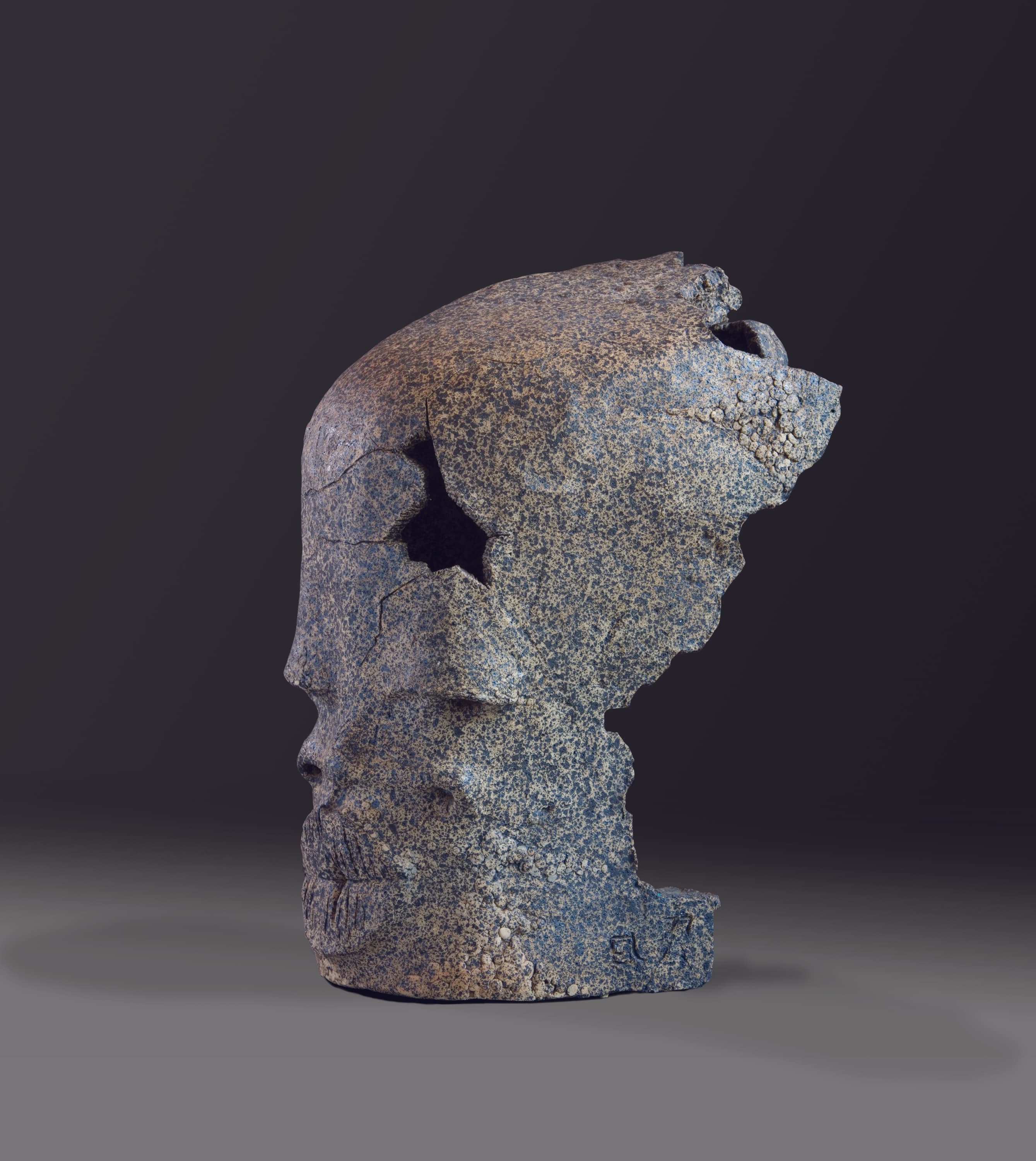
El Anatsui, Chambers of Memory, 1977. Clay, 15 ⅗ x 11 ⅘ x 10 ⅗ inches. © El Anatsui. Courtesy El Anatsui Studio.
Rail: So, how did this approach translate into your work with wood?
Anatsui: After working with clay, I turned back to wood again, this time using strips so that I could line up many of them into one work. The idea was that each element could retain its individuality and change, just like in life, where you find yourself close to somebody one day and at another time, closer to someone else. This idea of relation, of things that are always in a state of flux, is very important to my work.
Rail: This ethic of relation also seems to retain something fundamentally playful. I’m reminded of Ghanaian playwright and poet Efua Sutherland (1924–96), whose book Playtime in Africa contained evocative visualizations of sails in the wind, of kites fighting then finding the breeze to soar. I thought of these poems when observing how your recent works conjoin different properties into a new whole. In One Teaspoon Daily (2022), wood and metal coexist in more than fifty panels, some dangling, others overlapping. When was the turning point in your work where your two defining materials could start to intertwine?
Anatsui: After working with materials in series, I thought about marrying them, having them in the same composition, where each says, or does, what it wants to do. We call it “mixed media.” I think about mixed media as a situation whereby you bring in a medium that does what you want done better than others. When I was teaching, I would give to students the example of a building as being “mixed media” where the properties of each material endow it to perform specific functions within a greater whole. I got my students to interrogate why each material was present. A roofing sheet is light and waterproof. A window must be something that lets in light and air. They can apply the same thinking to their work as I do to mine. When I’m making my work and I need an area that is light, then I think about a material that is endowed to do that.

El Anatsui, Luvi, 2025. Burnt and incised tropical hardwood, tempera, 48 ⅘ x 144 ½ inches. Courtesy the artist, Goodman Gallery, and Jackson Pearce White.
Rail: Let’s go back to your early days in Nigeria, at the start of your career. You spent time with musicians, wood carvers, and textile artists at the National Cultural Centre of Ghana in Kumasi. Then, in 1975 you were appointed to teach at the University of Nigeria in Nsukka. Your colleagues included the writer Chinua Achebe and the artist Uche Okeke. Nigerian modernism came alive at that time with a defining philosophy of “natural synthesis” that advocated for merging Indigenous Nigerian art forms, traditions, and ideas with modern Western techniques to create a new, distinctly Nigerian artistic identity. Did those ideas resonate with you? Beyond art theory, were there various other campus movements that led you to change how you were making art?
Anatsui: At that time, Nigerian artists tried to return to their Indigenous locations or cultures to rediscover what the colonial experience had tried to destroy, and institute something else in its place. Nigeria was very different from Ghana, but I immediately found kindred spirits there in Achebe and Okeke. Their experience was the same as mine, and therefore we were all looking at how to recover whatever was left of the culture and try to understand what had happened. It was a meeting of souls with the same need but using different artistic and literary expressions.
Rail: The connections that you found in Nsukka helped make space for both multiplicity and specificity to coexist in your sculptures.
Anatsui: Yes, both Ghana and Nigeria became independent at about the same time. So, the post-colonial experiences and impulses were similar. At that time, we were trying to go back and pick what felt important from the past to create new futures. In Ghana we have a word for this, sankofa, which was translated for the title my London exhibition into “Go Back and Pick.”
Rail: Your metal cloths are admired in the West as quintessentially “African”—a catch-all label so broadly applied and simultaneously reductive as to be essentially meaningless—yet they are the products of your truly international outlook. At root, your cloths speak to the transatlantic trade in goods and in people (of enslavement fueled by capitalism), distilled in the metonym of the bottlecap. You are not necessarily associated with international artistic movements like Process art, though I’ve always considered you to be kin to, say, Louise Nevelson and others. Can you speak about your own global artistic influences?
Anatsui: It’s good you bring up Louise Nevelson! I saw her work in New York and liked how she handled wood and colors and form and shapes. Her compositional sensibility has stayed with me since that time. But, generally speaking, my influences are from all over the world.
Rail: Which other artistic movements figure in your development, along with the aesthetic philosophies among kindred spirits?
Anatsui: Internationally, I think the most important influences would be Marcel Duchamp and Robert Rauschenberg.
Rail: Why?
Anatsui: They revolutionized modern art. They originated the idea that a readymade can be an artwork. In so many societies, especially African, the readymade or found objects have been used but not formalized as art. Rauschenberg brought about that revolution, which has transformed art completely.

El Anatsui, Conference of Knives, 2025. Burnt and incised tropical hardwood, 90 ⅕ x 138 ⅗ inches. Courtesy the artist, Goodman Gallery, and Jackson Pearce White.
Rail: And closer to home?
Anatsui: In Ghana and most societies in Africa, the idea of reusing, repairing, manipulating is very much part of life. So as an artist, I take something from that. That’s why, for instance, bottle caps come in handy; wood comes in handy. If I were in a culture where such things are immediately discarded after use, they might not come in handy. So, the culture, the local Indigenous culture, has contributed to my decision-making. But, most of the time, for artists inspiration comes from society and its anonymous acts.
Rail: Such as?
Anatsui: Acts and objects that pass into public domain without authorship. Like Adinkra symbols and Akua’ba dolls.
Rail: What you absorb, you then put back out in the world. That leads me to another essential aspect of your practice, your mentorship of others.
Anatsui: I taught for over fifty years. You can learn from the students or the people you are mentoring. They’re not empty when they come in. So, it’s great if you have inquisitive students, because when they’re working well, they may inadvertently teach you one or two things. It’s a give-and-take situation. But what I did as a teacher was to make sure that when I set tasks to my students, they were challenged.
Rail: How so?
Anatsui: I’ve seen so many teachers give tasks to students which don’t have any challenge, which don’t move them or get them thinking or looking for anything. If you give a task to students and they immediately pick up paper and start drawing, it means they’re not challenged.
Rail: So were your challenges to young artists open-ended, creating possibilities so the students would be inspired to try many different things?
Anatsui: You impress upon them that there are so many possibilities; they should not just pick up pencil and paper and start doing the thing that they are used to. Instead, they should stop and think before doing. At times you set challenges, and you are not even looking for a finished work. You’re looking for people who are searching, and if students can search and come up with something, that gives great joy. Being able to open young people up to new ideas is very rewarding.
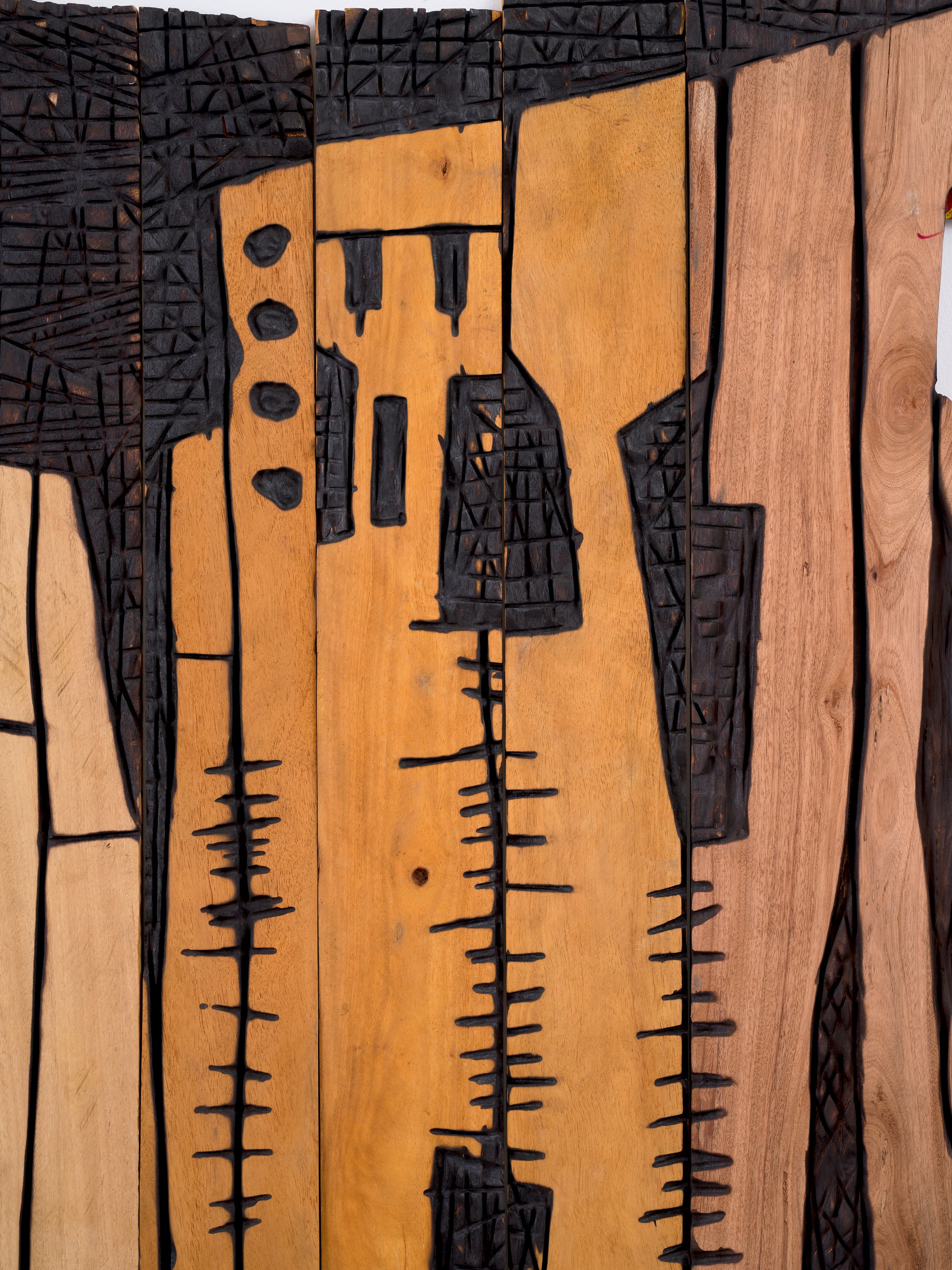
El Anatsui, Conference of Knives (detail), 2025. Burnt and incised tropical hardwood, 90 ⅕ x 138 ⅗ inches. Courtesy the artist, Goodman Gallery, and Jackson Pearce White.
Rail: Now this takes a different form because you have emerging artists in your nascent residency program in Ghana, and you are still engaging with them and their ideas on a regular basis.
Anatsui: Yes, it’s a continuing story. One year, when students put up their end of year exhibition, I went around and saw all the work. I felt they were working on very fresh ideas, and so I was compelled to become a curator [laughter] because I wanted those new ideas to be seen in the larger society. So, I organized an exhibition, New Energies, and took the students to Lagos. There were students working with things that are close to society, like Nnenna Okore, who explored the idea of air in the tropics. She took a long plastic sheet and put an electric fan at one end. When the fan was turned on, the air current raised the plastic, like a river flowing. Another artist recorded sound from one of the popular motor parks. So, these were things that people in Nigeria had not known previously as art or as forms of expression. They are what I selected and showed in Lagos. The artworks in the exhibitions became the subject of hot debate for almost a year.
Rail: Where did this debate take place?
Anatsui: Mostly in and around the galleries that hosted the exhibition, Nimbus and Mydrim. I liked that the debate went on for a long time, because the art that is taught in schools tends to limit students, which then estranges them from society as artists. Society doesn’t always perceive what artists are doing conceptually. But if students get working with things that are close to society, after several years the same people who were questioning whether they were artworks will now understand them. This is what makes teaching and mentoring people interesting. So, after I quit teaching, I started setting up a studio.
Rail: How does the studio differ from art school?
Anatsui: I do not want a situation where people who have been to art school come and continue what they learned in art school. I want to invite people who come to become artists but have not gone to art school. Like the lawyer-turned-chef and the architect who ended up discussing food security.
Rail: All of this relates back to not keeping art separate from society or life. Society informs the art, and then the art produced gives something back to society. I think of your work not only as a body of impressive objects but truly as social sculpture. You empower all of those around you to see themselves as artists with the potential to change society for the better. Can you describe a day in the Tema studio?
Anatsui: Each day I review what has been done with the artists who work with me. I’ve previously discussed with them what needs to be done. If there are fresh ideas that I want to introduce to them, I do so, or I have a way of doing it where I demonstrate it for them, so I lead them to come up with their own ideas. By working this way, I have developed several different syntaxes.
Just like some artists stay with oil paint and canvas throughout their career, I’m trying to see if the materials I work with—metal, wood, clay—are enough. I think the materials are so versatile that they can be my oil paint on canvas for life. But that’s not to say that I’m not still searching.
Rail: The materials are only as versatile as the ideas imposed upon them.
Anatsui: And I am continually discovering the versatility in them.

El Anatsui, Theta, 2025. Burnt and incised tropical hardwood, tempera, bottle caps, 53 1/10 x 78 7/10 inches. Courtesy the artist, Goodman Gallery, and Jackson Pearce White.
Rail: For me, two works speak to each other across the exhibitions at October gallery and Goodman Gallery—Passage of Time (2023), where the wood contains the sculptural form, and Theta (2025). Both are transfixing mises en abyme of concentric rectangles, drawing us ever deeper down the rabbit hole. They appear to be in a call-and-response with one another, simultaneously self-referential and portal-like. They represent two equal and opposite ways of thinking about time as infinite and hurtling us ever closer to an endpoint out of view. What do you see when you look at these works and contemplate the passage of time?
Anatsui: Well, the lessons I’ve learned are more about humans being given freedom. If we are conditioned to do things in particular ways, then that’s it. It remains so. I want to give the same challenge that I give my students to people who encounter, or own, acquire, or exhibit my work. I want them to discover new things in the work, but it’s challenging when they are conditioned to just follow instruction. So, in my exhibition, it meant asking the galleries to use my original configurations for each work, but in addition, that they should play around with the arrangement of each work. There are so many ways of playing around with them. You can just mix them up, and see what happens—for example, you do not necessarily have to keep all the elements at the same height.
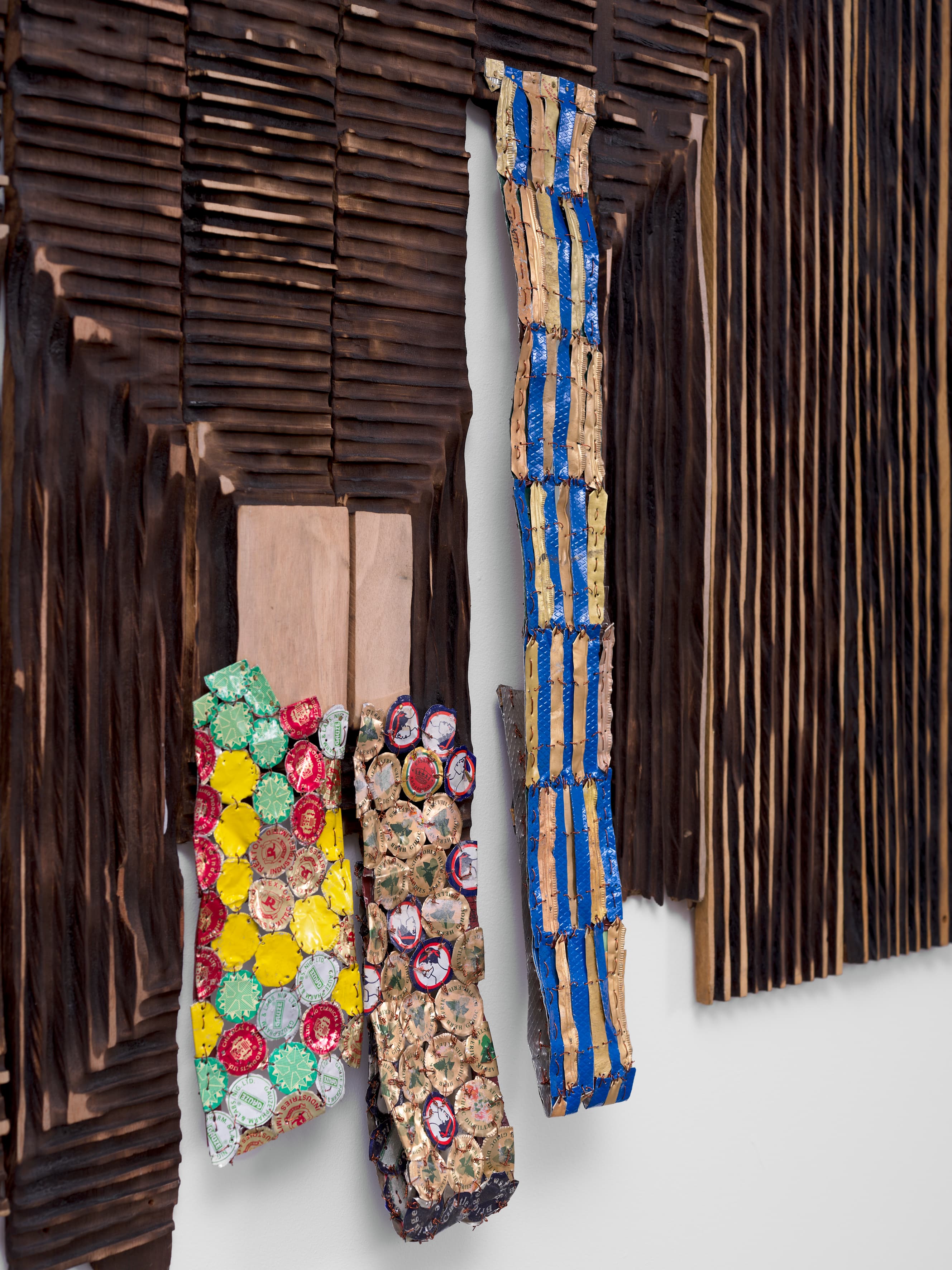
El Anatsui, Theta (detail), 2025. Burnt and incised tropical hardwood, tempera, bottle caps, 53 1/10 x 78 7/10 inches. Courtesy the artist, Goodman Gallery, and Jackson Pearce White.
Rail: You mean maintaining the same horizon line?
Anatsui: You can have some elements above and some below. You can play with the intervals. There are so many ways that you can play around with these works. My practice has taught me that we as humans tend to not want to change anything and to accept the things as they are brought to us. So, I work against that.
Rail: So, you are challenging that conservative desire?
Anatsui: It’s an opportunity given to you to play. Children play in the sand. Play remains very crucial; it moves art and moves the world. Because if you are at play, you’re at your most honest. To play is its own reward.
Zoé Whitley
Zoé Whitley is a curator and art historian. She was awarded an honorary OBE for Services to Art in 2025. Her PhD was supervised by celebrated artist Lubaina Himid CBE. Whitley currently serves on the boards of Teiger Foundation, New York and Sir John Soane’s Museum, London. She is a Fine Arts faculty member for the British School at Rome and Art Outreach Summit Singapore.
Whitley led the vanguard arts space Chisenhale Gallery for five years, resulting in artist commissions acquired by the Whitney Museum of American Art, Henie OnstadKunstsenter, Norway and Mudam Museum of Modern Art Luxembourg. Whitley’s award-winning projects span exhibitions and publications at the Victoria and Albert Museum, Studio Museum in Harlem, Tate Britain, Tate Modern (notably for co-curating Soul of a Nation: Art in the Age of Black Power) and the Hayward Gallery, as well as curating the 2019 British Pavilion at the Venice Biennale.
She was one of the London Mayor’s Commissioners for Diversity in the Public Realm and was selected for the inaugural cohort of Center for Curatorial Leadership.