ArtJuly/August 2025In Conversation
MARCEL DZAMA with Jason Rosenfeld
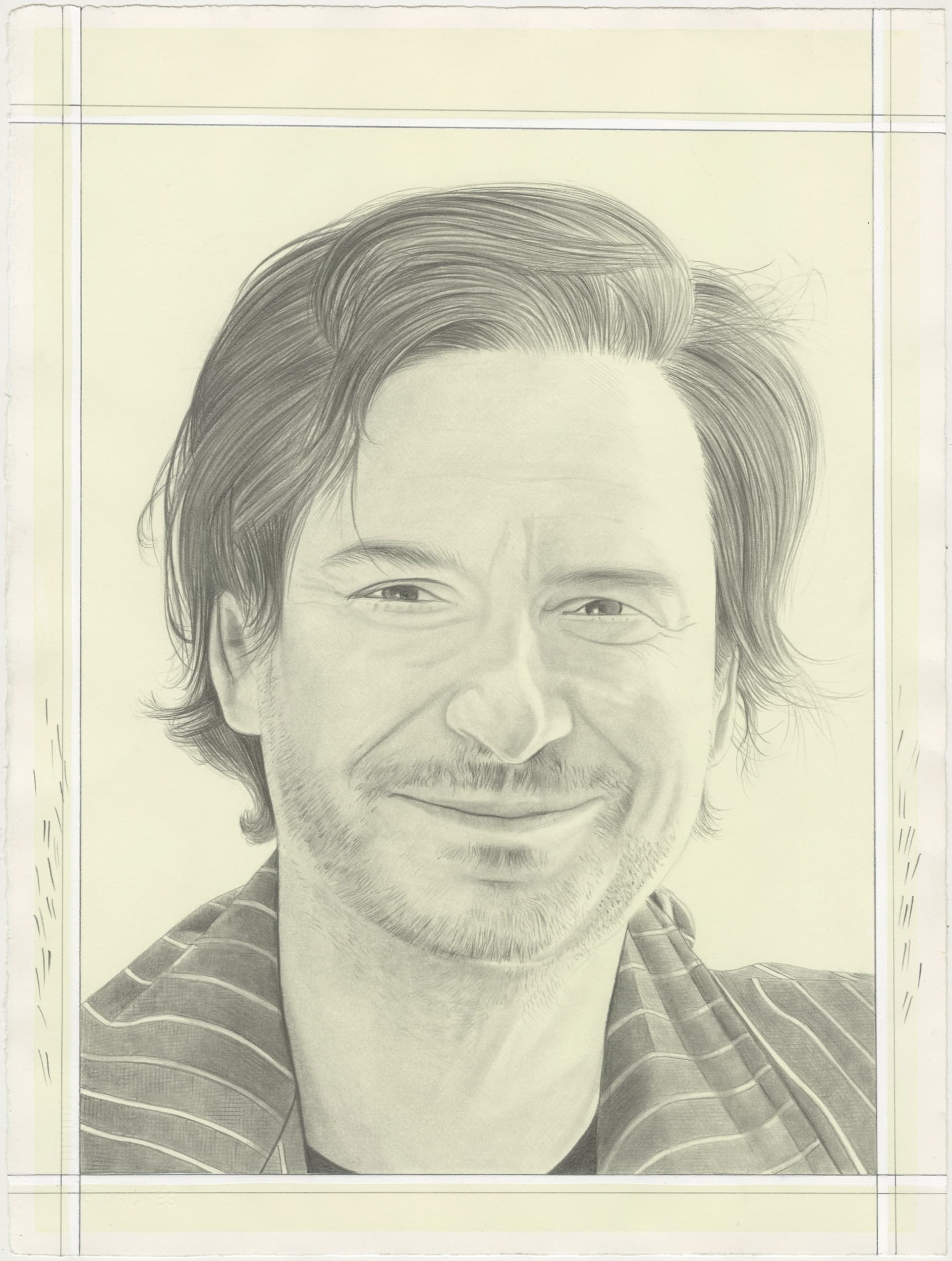
Portrait of Marcel Dzama, pencil on paper by Phong H. Bui.
Word count: 5991
Paragraphs: 163
David Zwirner
June 28–August 8, 2025
Los Angeles
Marcel Dzama’s new show, Empress of Night, opened at David Zwirner in Los Angeles on June 28 and runs through August 8, 2025. It includes one film, twenty-four small medium works, and eleven large works on paper. I spoke to Mr. Dzama in his Brooklyn studio about working with David Zwirner and his gallery over nearly his whole career, his recent subject matter, his stunning mosaic installations for the Metropolitan Transportation Authority, and the resonance of the opulent and large new paintings with respect to the state of America and Los Angeles.
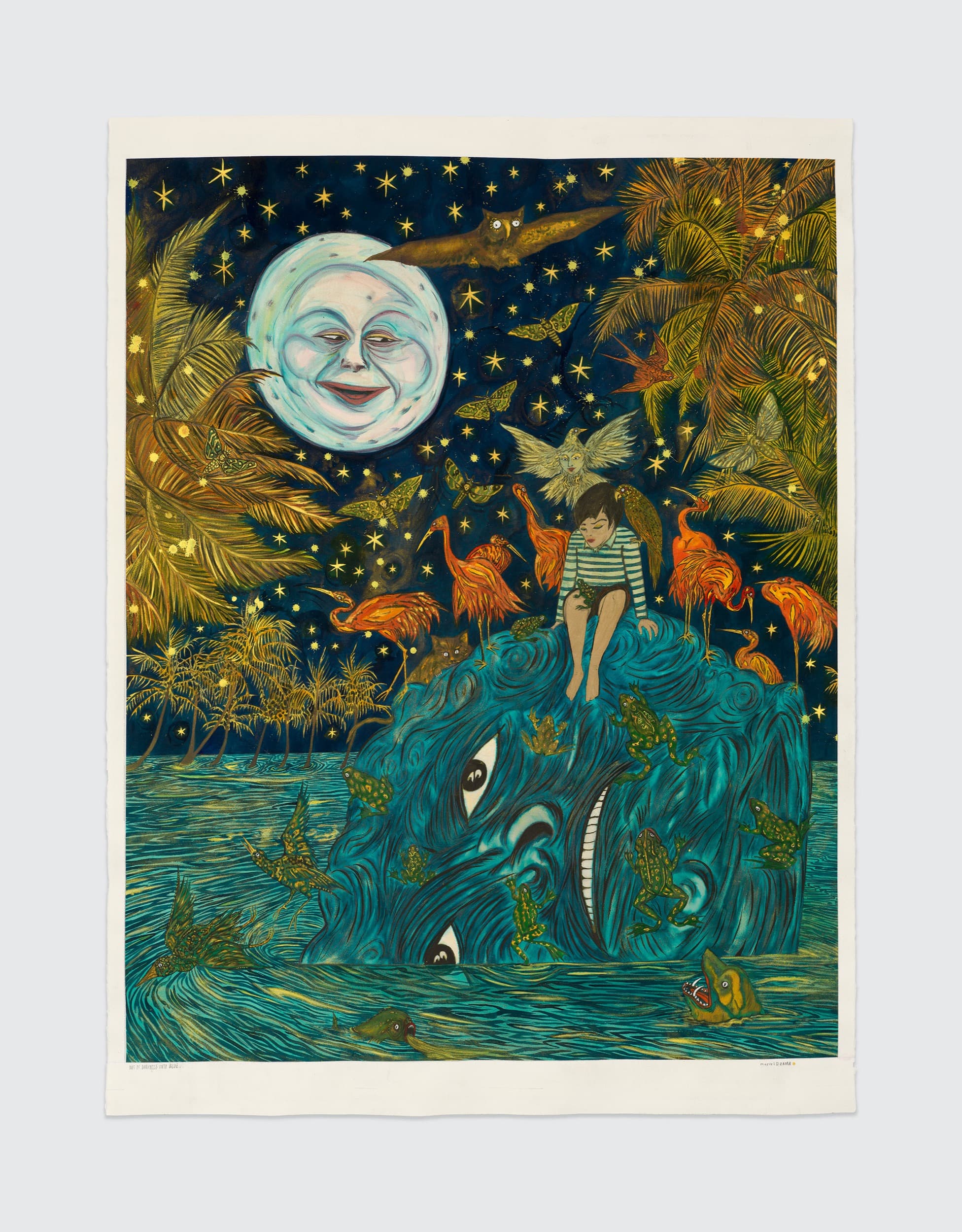
Marcel Dzama, Out of darkness into blue, 2025. © Marcel Dzama. Courtesy the artist and David Zwirner.
Jason Rosenfeld (Rail): Can you talk about your long relationship with David Zwirner?
Marcel Dzama: Well, I started at Zwirner in 1998. I got really lucky in 1997 when a curator from a nonprofit gallery in Winnipeg was asked to pick four artists to go to LA for this Absolut Vodka Biennale. My professor, Alison Norlen—who was also chosen as one of the artists—brought the curator, Wayne Baerwaldt, to see my thesis work, and he picked me.
Rail: So this was while you were still living in Winnipeg?
Dzama: In my parents’ house, even. I had just finished university art school, undergrad. I had an application to go work at Lowe’s, the hardware store. My plan was to take old house paint and use that. So then I had this great experience in LA showing at Bergamot Station with these four other artists. And I think I had a hundred drawings, and they were twenty dollars each, and the whole thing sold out. The LA Times wrote up my work. Richard Heller from the gallery in Bergamot Station asked if I would do a solo show there. And I had one in 1997 some four months after. Then I had a show in Berlin, and I think that’s where David saw it. I know his father saw it. But they didn’t know that, and they both liked it, so it was kind of funny. David called me at my parents’ house and asked me to have a show with him in New York. He liked that I did not know who he was.
Rail: When was your first show in SoHo?
Dzama: In ’98. I think, like January or somewhere around that. He had a staff of Angela Choon and four people, maybe?
Rail: This is your fifteenth show with David, and it’s kind of nice because it’s in LA.
Dzama: I haven’t shown there in twenty years, since Bergamot Station.
Rail: What do you remember about the Greene Street Zwirner days?
Dzama: Well, my first experience was walking into the gallery, and it was a John McCracken show. I thought, “Oh, I don’t think I’m in the right gallery,” because it was just all these mirrored kind of surfboard-shaped things, and I was thinking, “Maybe I’m in the wrong space.” [Laughs] And it was Hanna Schouwink at the front desk, and she’s like Nico from the Velvet Underground—this tall, beautiful woman, but very serious seeming at the time. [Laughs] I had brought two of my friends—one of them was in the Royal Art Lodge with me. I asked, “Is this David Zwirner Gallery?” [Laughs] She said, “Oh yeah, hey, Marcel!” [Laughs] In the side room, there was Raymond Pettibon, his homemade films—Weatherman 69 (1989) and a couple others. I knew his work. Heller showed him in the eighties. So he was probably the first living contemporary artist that I knew, because of the punk album covers.
Rail: How do you think about your evolution as an artist, both in terms of the form and the style, but also the media that you’re working with?
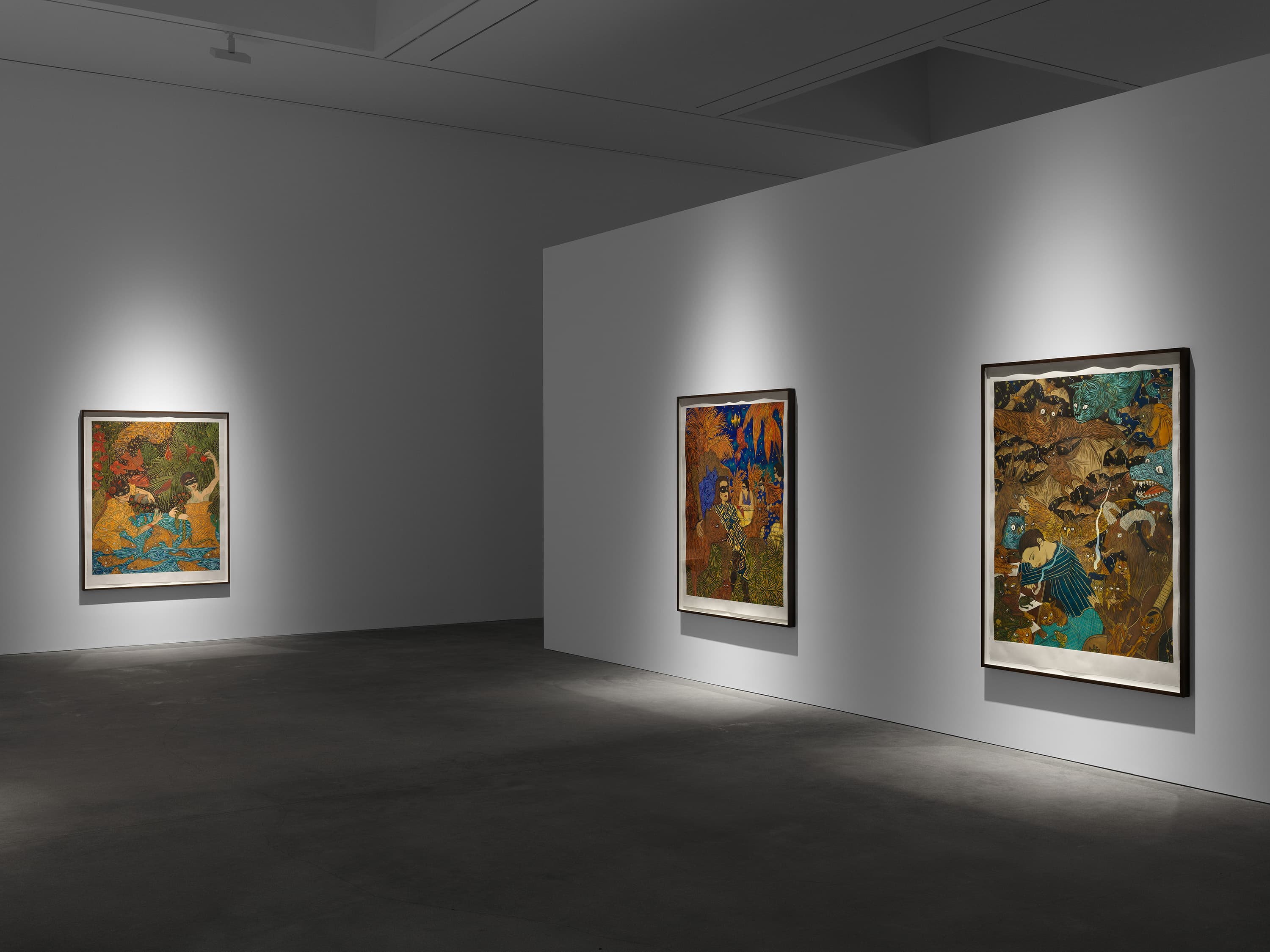
Installation view: Marcel Dzama: Empress of Night, David Zwirner, Los Angeles, 2025. Courtesy David Zwirner.
Dzama: I think a lot of it had to do with my location. I was really lucky when David brought me to New York. My wife and I were gonna move to Montreal, and David said, “Why have this in-between place? You’re gonna come to New York at some point.” I really enjoyed New York, and David actually let me stay in his place in the summers, two years before we moved, to see that it’s doable. And then I realized, “Oh, it’s just like little villages all attached together.” And so he made it really easy. We wanted to get out of Winnipeg. The Royal Art Lodge was falling apart at that point. And David let me use half of his SoHo apartment as a studio, for four years.
Rail: When did you move to New York?
Dzama: 2004. And then from that, just being in New York, the work got more and more dense—more characters, not so much background. Because when I was in Winnipeg, it was just two characters, white background, and some surrealist kind of interaction. Being in New York, in Manhattan—just being right in the center of everything—I noticed the drawings getting more and more cluttered with characters. I started having them floating, and stuff like that. And then at some point I organized them in ballet positions. I started going to the ballet, and I found all these old seventies ballet magazines in Williamsburg, at a stoop sale for a dollar each.
Rail: Did you or your wife have a dance background?
Dzama: I kind of grew up really poor, lower working-class, or maybe even lower than that, and ballet felt like a different world—I was intimidated by it. I slowly got into dance through those magazines because I was really into the Bauhaus at that point, and Oskar Schlemmer’s work. He did all these crazy costumes. Those were influencing the new drawings.
Rail: So the art became more complicated, with more people. You were doing these big panoramic designs, and different materials were available.
Dzama: The whole setup became more like a stage design. I even started drawing curtains on the sides, sometimes. And whereas in Winnipeg I was drawing hybrid animals and creatures, in New York I was drawing people in costumes, a bear costume, or a tree where you see feet sticking out.
Rail: You’re surrounded by people all the time. You’re alone but not alone when you’re walking around the city.
Dzama: Whereas in Winnipeg, you run into maybe ten people.
Rail: You know them all. It’s like a Richard Linklater film.
Dzama: Exactly. I was doing film in university. I took a film course there. But then when I moved to New York, it felt too hard to get people to work on anything. I also got obsessed with Marcel Duchamp around this point, because I was able to go to Philadelphia whenever I wanted and look at Étant donnés (1946–66). I remember seeing it as a kid in books, but not knowing what it was, thinking it was a collage, or maybe even like a little diorama.
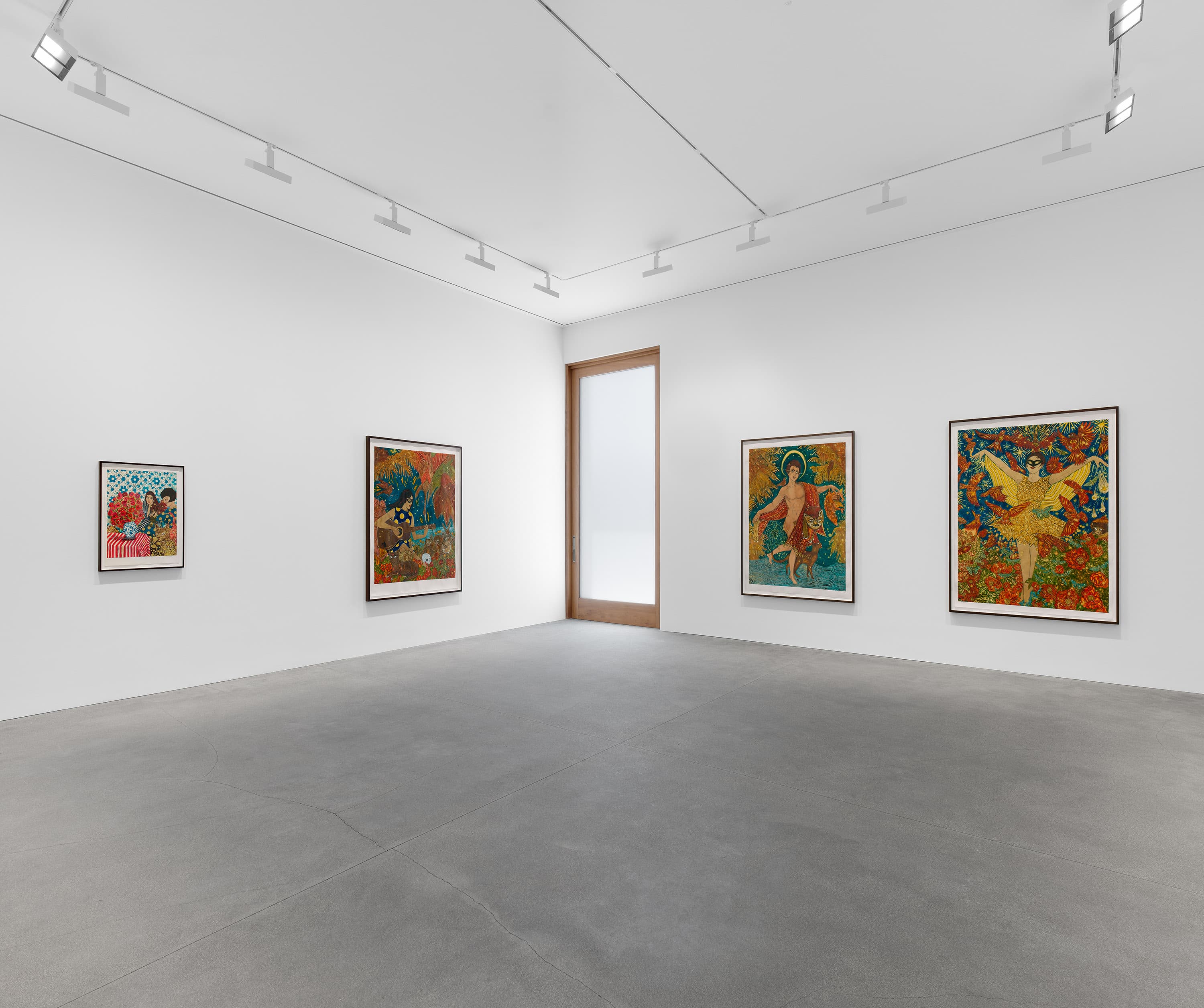
Installation view: Marcel Dzama: Empress of Night, David Zwirner, Los Angeles, 2025. Courtesy David Zwirner.
Rail: What was it about that that inspired you or influenced you to expand your media?
Dzama: That’s the very first contemporary artist I really heard of because I saw his name, and it was like mine, “Oh, Marcel!” I was in a French immersion school. They had stuff from Paris there and an art book that had Étant donnés in it. I was seven or eight or something like that. That’s just kind of a shocking image to see. And so that always stayed with me. I liked the other stuff, but it was just all over my head.
Rail: Is it the idea of creating a whole world—one which seems familiar, but slightly unstable?
Dzama: It was just having access to the art world. In Winnipeg, I was kind of playing with nature, pop culture, movies, and things like that. But in New York, I was able to just see contemporary art. The great thing in Winnipeg was you could see Inuit art there, which was really influential—seeing how a simple drawing could mean so much.
Rail: Or construct a kind of mythology. In a way, that’s what Duchamp does in that work. He creates a whole story—even gives it a kind of narrative with the title, with the numeration.
Dzama: Especially like with The Large Glass (1915–23). It adds some new reality, like a whole new mythology, in some ways just like the Inuit drawings.
Rail: How have you moved, in your last few shows, into these very opulent works on paper?
Dzama: I worked with the New York City Ballet in 2016 on Justin Peck’s The Most Incredible Thing. It was like a Hans Christian Andersen story. I got burnt out from that. At the same time, I had a collaborative show with Raymond, had two solo shows, made two short films all in that year, and worked on the ballet set design and costumes. I thought I would just have to draw the costumes, and they would go make them. But I had to visit the workshop every day and supervise and add to the colors and paint on the fabrics. It was a huge production with over sixty-five different costumes.
I got so burnt out that I wanted to just reset myself. I had this lucky opportunity where Louis Vuitton asked if I would do a travel book, and they said you can go anywhere you want. My wife and I really wanted to go to Morocco for the longest time. They set up different hotels and rented a car and drove to all these beautiful sites, and it was this perfect escape, because my son was five. Just seeing the colors of the textiles and carpets and the sunlight is so much brighter. That really changed the way I was thinking about color, it opened up color for me. Before that, I used very muted browns and reds. And then I became brighter, with yellow gold. I also started to get into Henri Matisse. I was doing smaller works, because it was just a travel book. Then I was collaborating with Raymond a lot for another show together. He used to draw quite small, but he started drawing a lot bigger. To collaborate with him, I needed to figure out how to size up. He showed me how to use dagger brushes. You could just dip them once, and then you have the ink the whole time. I was drawing on the wall with them. It was so nice, because before, everything was dripping. The brush gives you a lot more control. Drawing with him made me realize I could go larger than what I was doing. And then the pandemic happened. We left the city and moved to Long Island, in Southold, and being surrounded by nature made things much more peaceful. During the pandemic, I was trying to escape the fearful anxiety of it all by imagining I was traveling, and painting my memories of Morocco, and Mexico too, because I was going to Mexico earlier—working on ceramics.
Rail: And then you worked on the MTA commission called No Less Than Everything Comes Together (2021), which is at the Bedford Avenue stop on the L train, and is a series of four mosaic panels done by Mayer of Munich, who are incredible.
Dzama: Oh, they’re just so good. They showed me the whole process. I did this large drawing—big enough for them to blow it up. They print it out on a giant mesh thing. And then they have a giant mirror on the ceiling, and they can see what they’re doing. They’re placing each mosaic onto a printout of the drawing.
Rail: I am interested in how the imagery is related to what you’re doing in the present show, such as the moon, celestial elements, the palette.

Installation view: Marcel Dzama: Empress of Night, David Zwirner, Los Angeles, 2025. Courtesy David Zwirner.
Dzama: The mosaics are right after the New York City Ballet project, so this is like Morocco, New York City Ballet, and moon obsession together, and the sun. I was reading Walt Whitman’s “Crossing Brooklyn Ferry.” I like that whole idea that he was so excited to be with this group of people crossing the ferry, like when I first moved here. Just being on the subway with all these people was such an exciting experience.
Rail: I teach that poem. I do a class called “New York City Seminar,” which is for new students at Marymount Manhattan College. And the first class, we take the Staten Island Ferry, because it’s free, there and back. They get to see that the city is actually surrounded by water. They don’t realize that so much. And they see the harbor and the Verrazzano Bridge, and the ocean is right there, which they also don’t realize. It’s not like LA, where the sea is very present. And we read this poem, and it’s all about this flow of people and collapsing time.
Dzama: Absolutely. And it was still the first Trump years when I was making the mosaics. He was just trying to divide everyone so badly, so I wanted everyone to come together. And I put it in my proposal that I wanted to bring the sun and the moon underground, or something like that. [Laughs]
Rail: To bring light into the subterranean—which the MTA has been trying to do in a literal way. If you go to Fulton Street Transit Center, in downtown Manhattan, sometimes sunlight actually does get down into the tracks. It’s such an odd experience, because you don’t expect that.
Dzama: I really love when the train comes out of the tunnel into the light of the outside world.
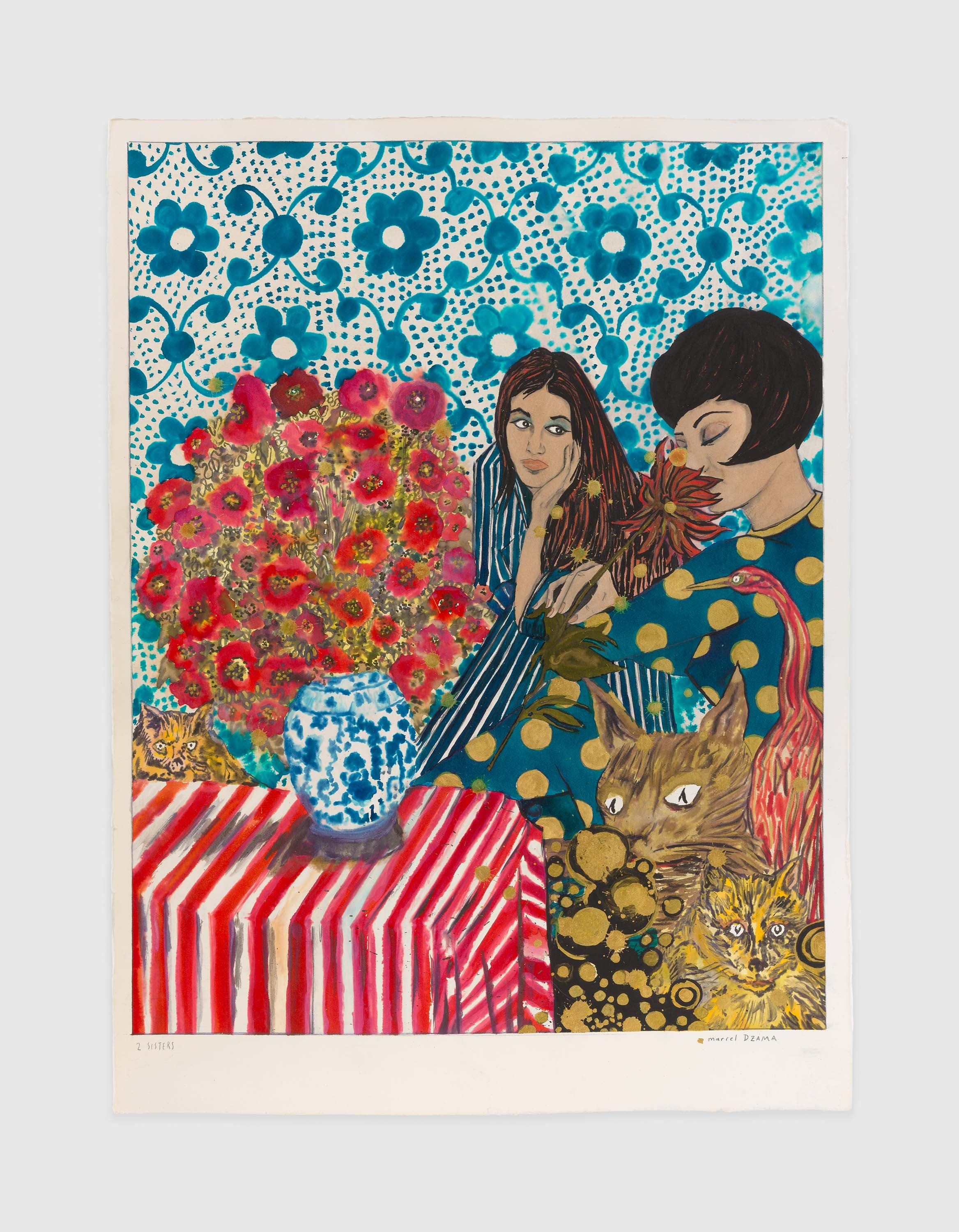
Marcel Dzama, 2 sisters, 2025. © Marcel Dzama. Courtesy the artist and David Zwirner.
Rail: Whitman writes about this idea of a “necessary film” which unites everybody. It feels as if that is where your art has moved. It’s about a kind of community.
Dzama: The older I get, I feel that. I used to be very cynical and apathetic when I was younger, if you look at the early work.
Rail: Well, there’s a lot of violence, and there’s a lot of gore. It’s done in a way that is Quentin Tarantino-esque, because it’s kind of half-humorous, jokey, but it’s also explicit.
Dzama: After the shooting at Sandy Hook, I stopped drawing guns entirely and also became a parent, so all that kicked in.
Rail: That kind of mod violence is gone.
Dzama: It disappeared. It comes out a little when collaborating with Raymond, because of that punk aesthetic.
Rail: Yeah, but there’s sometimes still these sorts of intimations of division, as in the animals in the work.
Dzama: Well, there’s a reality-based part that’s leaking into my work. Reality is the problem.
Rail: But there’s also the sublime, in nature’s response to us.
Dzama: A lot of it was Mother Nature’s—not revenge—but almost her disappointment. Not so much in the subway mosaics, but in the new work in general.
Rail: I see it as nature’s defense mechanism.
Dzama: Nature is a victim of our abuse.
Rail: She is, and she’s responding to it. She’s trying to make Earth uninhabitable. But these designs for the subway do so much—bringing in Whitman, the unification of the L, which connects Brooklyn and Manhattan, and these sort of choreographed scenes. I am always so happy to go to that station. There’s a kind of directness which comes out of your aesthetic, and the way that you talk about the works which are going to be in LA, that they’re about a kind of possibility of healing. And then the colors and the mosaics are totally in harmony with the way that you’ve been painting.
Dzama: I was just coming straight out of the Moroccan experience, and COVID hadn’t kicked in yet. But it did when it was being executed and installed.
Rail: And then the work accrues a different meaning, that idea of community, which was just slowly building back up, notwithstanding the division in the country.
Dzama: Yeah, everyone was scared to go back on the subway at the beginning, and it was a little iffy for a while, too.
Rail: We have kids who went through COVID, and they’re socially stilted a little bit. They’re aching for a kind of connection.
Dzama: Yes, I think so. My generation is very sarcastic and apathetic, and my son’s generation is more sincere. They’re more in touch with their actual emotions.
Rail: Even though so much of their lives are sort of siloed and on screens.
Dzama: Well, that part is a little disappointing.
Rail: But they have managed to find communities, you know, and they interact with their friends in different ways. As parents, I think that’s the thing we’re sort of having to deal with. My kid is not necessarily riding on his bike to go see his friends, but they’re hanging out at 12:30 a.m., doing whatever they do on the computer, and they’re laughing. That’s the necessary thing, or “film,” that they find their own way of connecting. So hopefully the show will have that kind of effect in LA. And the fact that you’re working on a large scale gives it maybe less of an intimacy, but more of a kind of embrace—an openness.
Dzama: Well, I do paint differently when I’m doing a larger one. It’s more of an epic. It’s just the grandness or like a climactic scene in a ballet or film. Whereas the little drawings are more intimate, and more spontaneous too. Because the one bad thing about the larger drawings is you really pre-plan them, and I have no plan when I start drawing with the little ones.

Installation view: Marcel Dzama: Empress of Night, David Zwirner, Los Angeles, 2025. Courtesy David Zwirner.
Rail: Is it a different material than you use for the smaller works?
Dzama: Yeah, it’s this liquid acrylic, with some pearlescent in it, which Raymond introduced me to as well.
Rail: But Pettibon doesn’t use a ton of color.
Dzama: No, he doesn’t, but he showed me the paint. He had this black, pearlescent ink. I don’t know if he was using it much, but I really got into it. I was mixing the pearlescent with every color.
Rail: The gold is exquisite in these works. Is it a special kind of paper?
Dzama: David Zwirner started buying me this paper, because I was using cardboard and things like that, and they said, “Maybe use this, it’s archival.” It’s just an Arches, but a thick stock. You can be rough with it. The stuff I was using was starting to buckle. Sometimes I’ll paint it on the wall, but usually I paint it on the floor. So I’ll put just cardboard on the floor, and tape the paper down to the cardboard.
Rail: Then you don’t get drips, and it gives you more control over the surface. Does it pool a lot?
Dzama: A little bit. Sometimes I’ll have a blow dryer and have it quite far away, because if you go too close, it starts to spread. That paper doesn’t buckle, because it’s so thick.
Rail: Works like Blue water blues (2024), a triptych, are gigantic—each of the images is nearly 70 inches wide, with three put together.
Dzama: I could fit two of the panels on the studio wall. So with triptychs I’ll put two beside each other, and then I’ll take one down, move one over, and then put the other beside it. And the good thing about painting all blue is that I can paint it on the wall, not on the floor, because it is much more natural to paint standing up than on the floor.
Rail: When you did the earlier drawings twenty years ago, were you doing them on a surface?
Dzama: All on a desk. They were watercolor or root beer. I still have the root beer somewhere. Every now and then it comes into play.
Rail: There are the big paintings and lots and lots of smaller works. How many works in this show?
Dzama: I’m not sure how many I did, because I ended up working on two shows at the same time. I did a show this year in the Pera Museum in Istanbul, Dancing with the Moon, and I sent all the more hardcore political ones there.
Rail: Joseph Stalin and Trump hugging, and Elon Musk with the salute and all that. Very direct representations. Keith Mayerson type things, right?
Dzama: Yeah. I kind of wanted to separate those two. The direct ones are more about the daily news, and I needed to do them to get that darkness out. For the LA show, I wanted to make them—they’re still a little political, but more hopeful. There is an escapism in it.

Installation view: Marcel Dzama: Empress of Night, David Zwirner, Los Angeles, 2025. Courtesy David Zwirner.
Rail: What is the idea of the title of the LA show, Empress of Night?
Dzama: I’ve been obsessed with the moon and that was just another version of it. My wife came up with that title. She was reading William Wordsworth’s “To the Moon,” a poem mostly about the moon and night. The trip to Morocco was where I got obsessed. We went to this place called Chefchaouen. It’s like the city just before the Atlas Mountains, and it’s all painted blue. And it was the day of the spring pink moon. It felt so close. I had never seen it that big in my life. It was some sort of supermoon. Will, my son, and I were just walking in the Kasbah, and when it first comes up, it looks a lot larger than when it’s up in the sky.
Rail: So the moon is an obsessive thing, and it creeps up in a lot of these images as it does in the subway project.
Dzama: And then it’s also a lot of my early art school films, where I tried to make them look like old black-and-white films. I was always obsessed with Georges Méliès’s film, A Trip to the Moon (1902). So whenever I draw the moon, I do that sort of face that the first moon had.
Rail: The cast of characters in Blue water blues—a triptych with a number of different women who are in an absolutely suffused aqueous situation, underwater with tons of sea life—seem related to the last couple shows. In terms of their costume, they always wear what I call the “Robin eye mask,” like Batman and Robin. [Laughter]
Dzama: Climate change was really on my mind. I had all these flood drawings during this time. At some point, I got rid of some of the negativity. When I was really young, I went to Vancouver and saw this weird underwater mermaid show. I was kind of thinking of that in the back of my head. The works that started this series were scenes of Mother Nature hiding from mankind, and usually a war or something terrible was happening above the water.
Rail: Where do you draw the fish from?
Dzama: I had bought my son these encyclopedias with animals. He wanted to be a marine biologist—not so much now, but two years ago. [Laughs]
Rail: Careers change quickly when you’re in your teens.
Dzama: They are also drawings of fish before people knew what they actually looked like, almost like a woodcut. Like an elephant seal from before they could even actually go see an elephant seal, as if some artist drew someone’s interpretation of what it looked like.
Rail: Like Albrecht Dürer’s The Rhinoceros (1515), where he just worked from other sources and made it his own. Sometimes you put the humans in choreographed poses, and other times they’re just kind of hanging there with the beasts, in these full-body polka dot suits.
Dzama: That was inspired by Francis Picabia, who did this ballet in Stockholm called Relâche. He also had a film called Entr’acte. At the beginning of the performance, there are just these people walking around in suits. Nothing happens. There’s a light show, and people in the audience get up, and they look like they’re leaving, but they go on the stage, and then they take off their regular clothes, and they also have these polka-dotted costumes.
Rail: You’re using gold paint for some of the polka dots, and some of them are doing sort of Black Widow kicks—acrobatic moves that resemble superhero poses.
Dzama: I was thinking of it as like an underwater ballet.
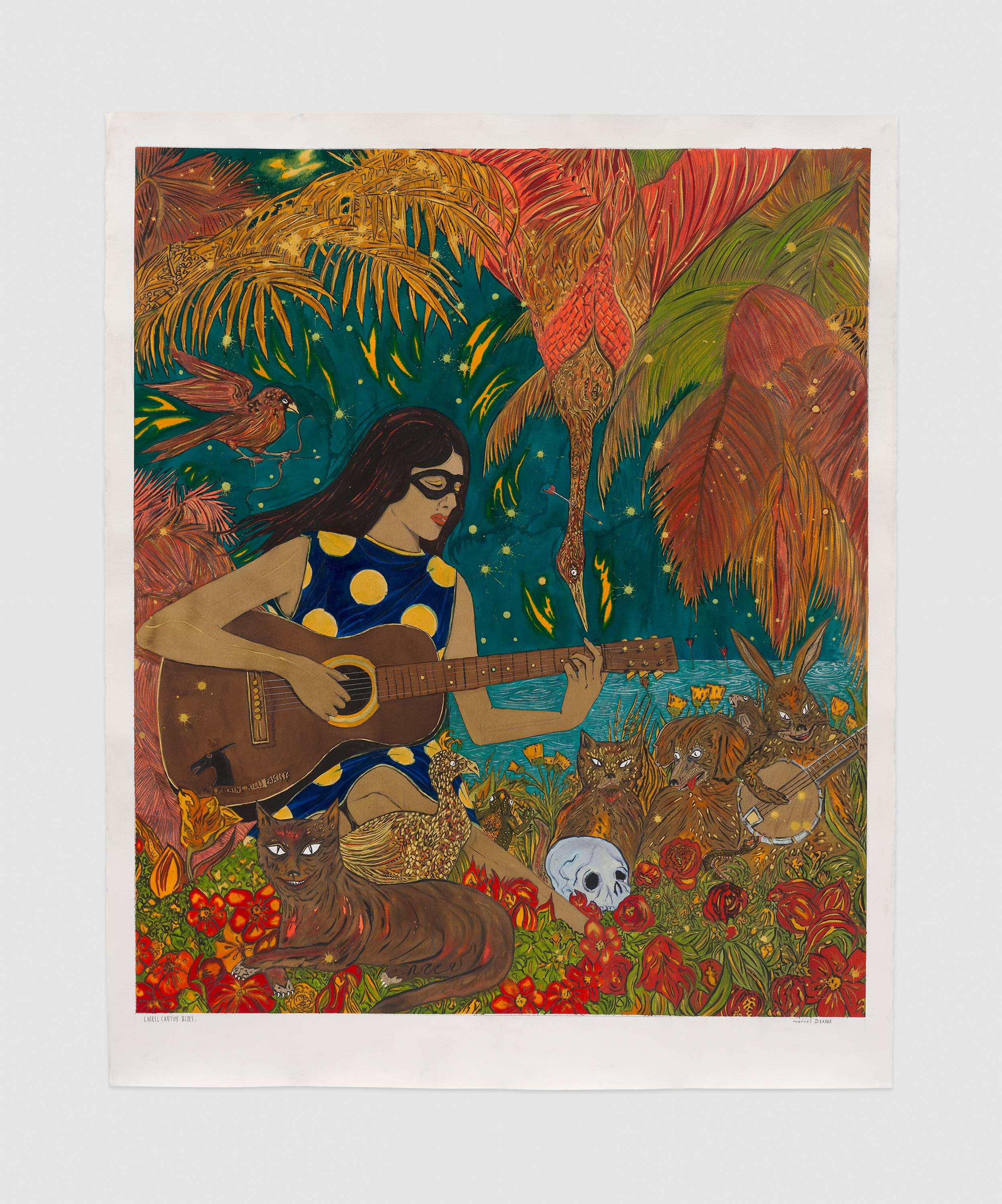
Marcel Dzama, Laurel Canyon blues, 2025. © Marcel Dzama. Courtesy the artist and David Zwirner.
Rail: They’re beautiful and inventive. So let’s talk about Laurel Canyon blues (2025), wherein it’s Monica Barbaro as Joan Baez. That’s the first thing I saw.
Dzama: It’s totally Joan Baez.
Rail: You saw A Complete Unknown?
Dzama: I saw the film after I made that work. I loved it. I thought it was really well done. But I’ve been obsessed with Bob Dylan forever, because I have this Joan Baez songbook. I was teaching my son guitar, and the cover of it is almost this image, where she’s out in a field somewhere and playing, and then I gave the Joan character the Woody Guthrie guitar that reads, “this machine kills fascists.” And then that’s the Duchamp symbol for the chess knight, a side profile of a horse. It’s a Stella Guitar, like Lead Belly and Kurt Cobain used to use.
Rail: There’s one small work in the show called To live on the moon (2023/25), where you’ve done your name in the Nirvana typeface.
Dzama: My son really got into Nirvana, so I’ve been listening to them again.
Rail: How does Laurel Canyon blues fit into the concept of the show?
Dzama: I was trying to do some more hopeful drawings, because I was also doing those more directly political Istanbul drawings. The small political drawings are like exorcisms to get the frustration and anger out of my system. This one is more hopeful. It’s still got the Woody Guthrie guitar and then the skull. The rabbit is more like Alice in Wonderland in feeling, with a Cheshire Cat.
Rail: In works such as He burnt all the liars and put out fires (2025), are the titles mostly your own invention?
Dzama: That one is actually another Nirvana influence, because there’s the song “Frances Farmer Will Have Her Revenge on Seattle,” and the lyrics “She’ll come back as fire to burn all the liars / Leave a blanket of ash on the ground.” I did this when Los Angeles had the fires, so I wanted some kind of saint that was putting them out. He’s holding this William Blake-esque devil and casting it aside. I am always into Blake.
Rail: He’s this kind of fey Hercules, with the Nemean lion skin on his shoulder, but also a kind of risen saint, because he has a halo around his head and is in a state of nudity.
Dzama: I wanted some sort of saint-like figure. He’s Herculean, but I wanted him to be more gender neutral. And then my cat makes an appearance.
Rail: The big cat is there on the bottom. And the lion skin has an awesome toupee, with teeth and claws.
Another one’s called Aurora borealis (or We must make her Queen to tame the wild dogs) (2024). The bevy of women who recur in these kinds of images and in the last show that I saw also, they have various polka dot outfits which we saw in the aqueous picture, Blue water blues. And then others are wearing these sort of mod sixties clothes.
Dzama: The dress I based on a little Berber carpet on my desk, but it’s not those colors. It’s brown and lighter brown. But it does have that sixties feel—you could see someone wearing that. I started this just before the 2024 election. I didn’t paint it until after, but I was really hoping Kamala Harris would win.
Rail: What are the strikes on her cheek?
Dzama: I was thinking of First Nations’ war paint. I just like that decor. And then a lot of singers now seem to be putting stickers on their faces, and I would see kids walking around with lots of little dots. It’s somewhere in the zeitgeist.
Rail: And there’s a kind of William Morris pattern on the chair in the background.
Dzama: Where would that be from? That might have been a tile or something that I had a picture of. When it gets that detailed, I usually am drawing from something.
Rail: And this is the aurora borealis effect, in the background.
Dzama: My mother sent me a picture of Winnipeg with some big northern lights event, and that was in my mind when I was doing this.
Rail: The use of color in these is really beautiful. Especially the overarching blue, which has a Renaissance feel, like frescoes in churches, against the gold backgrounds that were used in the late Gothic period. The blue freed artists to make work that was more directly narrative-driven, but also naturalistic.
Dzama: My son was collecting these strange stones. And he got a lapis lazuli. I was trying to recreate that. It’s as close as I can get with these acrylics.
Rail: There’s a fun quality to the works, but there’s also something lurking, and something cosmic, as in Dionysus & Eve (& the fermented forbidden fruit) (2024).
Dzama: They’re making wine from the forbidden fruit, and they killed a snake. And then there’s God, coming out of the sky.
Rail: Diving down, like Michelangelo’s God creating the planets in the Sistine Chapel, in a swirling gold form. But he also looks like a cross between the Michelin Man and the Sandman from Spider-Man.
Dzama: Yeah, I bet that’s an influence, because he’s kind of just a spiral shape. Some kind of cosmic being sprinkling them with stars.
Rail: Incredibly imaginative, but the women don’t care. They’re just pouring cordial glasses, and there’s one detail of a bloody fish.
Dzama: It’s stuck to her arm, giving her a hickey. This actually came about as an accident, but I really liked it. The red from his lips leaked. She was still wet, so it absorbed it. And I embrace it.
Rail: You embrace the accident. That’s what Jackson Pollock always said. And this supremely elegant pose of the woman on the right, who looks like a Giambologna sculpture. And then the red birds are everywhere. They have a phoenix-like quality.
Dzama: We have a lot of cardinals in our backyard. They’re always on my mind.
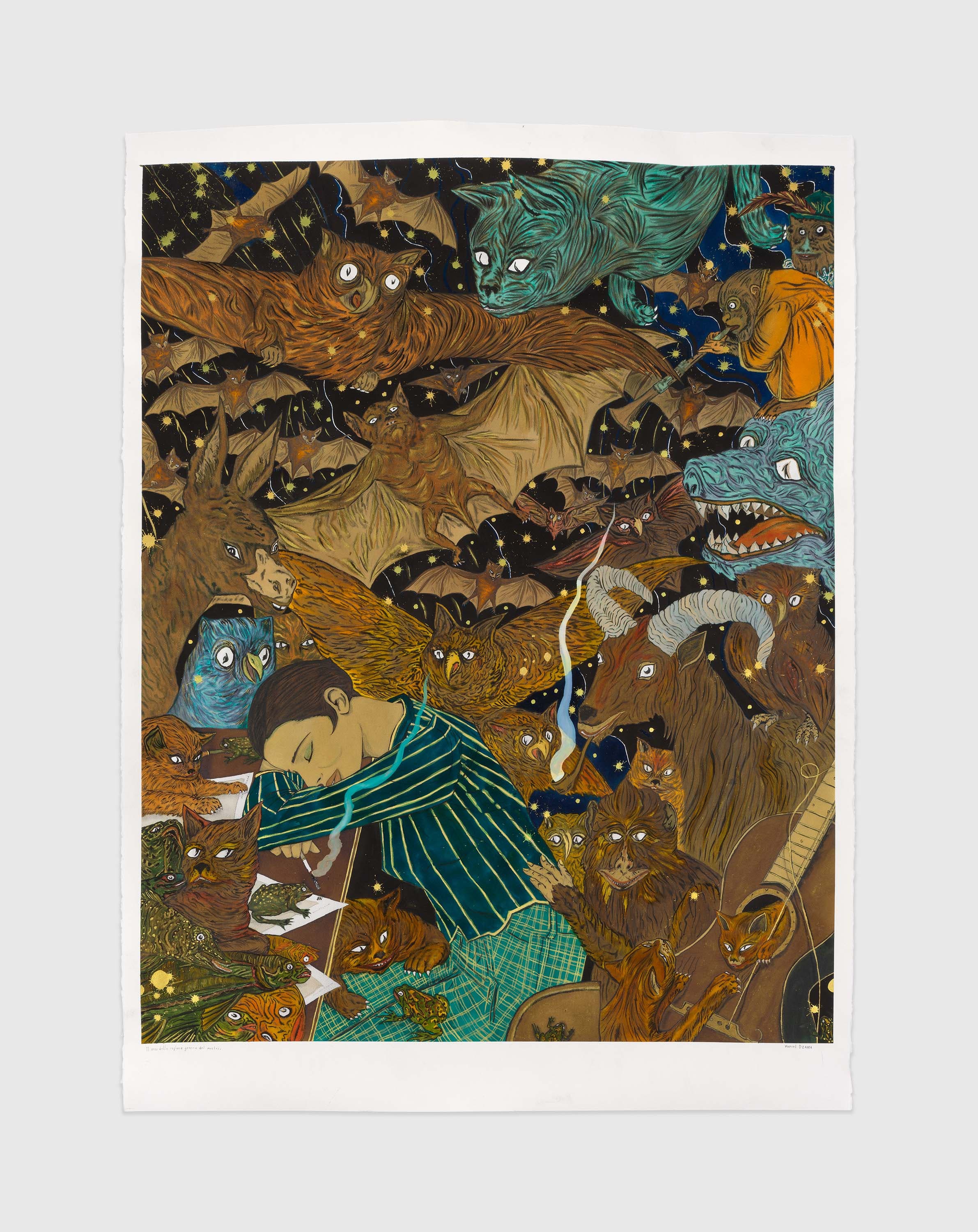
Marcel Dzama, The sleep of reason produces monsters, 2025. © Marcel Dzama. Courtesy the artist and David Zwirner.
Rail: Onto Francisco Goya. Your work, like his, is titled The sleep of reason produces monsters (2025). Now, you’ve been working with this Goya work forever, right?
Dzama: I’ve stolen every creature from it. And even the desk, I think. [Laughs]
Rail: How has it transformed into this particular image from 2025?
Dzama: In this one I was imagining myself—but not as myself, as this female character—just falling asleep as I was working, and then all the creatures that I’ve been drawing just kind of come to life.
Rail: And is there less of a sense of malevolence than from the source material? Because she looks quite content. So the sleep of reason is not so bad.
Dzama: Yeah. I was trying to hint at something slightly sinister, but I wanted it to still be hopeful. More of a mischievous feeling.
Rail: And she’s holding a lit cigarette with a very long ash—
Dzama: And it’s dropping onto the drawing—
Rail: But she has a little smile on her face. The animals in the background in the Goya work always look like they’re mocking him, because he has artist’s block.
Dzama: There are those characters in there. That cat is actually almost exactly like that, but I changed the eyes a bit.
Rail: But the cat’s surrounded by freaky fish.
Dzama: I really got into drawing fish when I was in Morocco. I went to the fish markets and took all these pictures. They have some really interesting fish there.
Rail: You signed it on the piece of paper under the cigarette ash and the toad. There’s a couple of prints or drawings under the donkey, who comes from Goya’s series “The Caprices” (1799) and all those scenes of the upper class, right? The upper class as donkeys.
Dzama: I think it is up on my wall over there, somewhere.
Rail: And then this awesome figure, which I think might be from Witches’ Sabbath (1797–98).
Dzama: Yes, it’s down there on the studio door. He’s just relaxing with a pipe.
Rail: Like an old host of a British serial.
Dzama: And then the dragon was lifted from Cerberus, the three-headed dog in William Blake’s painting of it, Cerberus (1824–27). It’s supposed to be a dog, but it kind of looks like a dragon. Then also the ghost of my cat coming down, this big cat. I was trying to paint him in the style of those Japanese paintings of ghosts and weird creatures.
Rail: And then there’s a musician, a little stumpy primate musician with a clarinet or something.
Dzama: I don’t know where … I might have just made him up. [Laughs]
Rail: And there’s a Wookiee-like figure with a feathered hat.
Dzama: Yeah, I love feathered hats. I was looking for an excuse to put it in.
Rail: So I saw this as like a more hopeful sort of image of Goya’s The Sleep of Reason Produces Monsters (1799), but then the election just disproved that entirely. You tried. What about The birth of a Phoenix (or It’s easy to fly without a broken right wing) (2025)?
Dzama: And this one’s straight out of a The Most Incredible Thing character’s costume. That’s a little political. But I was drawing directly from this costume and wanted to just use it as the main thing. Then it was also the fires in LA, and then Trump kind of messing everything up.
Rail: So this is a kind of rebuilding. People will respond to it, when they see it.
Dzama: Yeah, just wanted to spark a little bit of hope over there. [Laughs]
Rail: And there’s this little fire figure on her hand. There was a DC character, Firestorm—this guy with flaming hair.
Dzama: Oh yeah, I remember that guy. I used to have an action figure of him.
Rail: He was the response to the Human Torch in Marvel, because they were always responding to each other, the comic book companies. The main figure has this wonderful expression on her face, almost sort of self-satisfied, surrounded by gypsy moths and death’s-head moths.
Dzama: I have been drawing a lot of moths, because there are a lot of death’s-head moths in the Federico García Lorca play that is the inspiration for the movie in the show, To live on the Moon (For Lorca) (2023). In it, the moth comes to life. She’s kind of a main character, the moth queen. She gets revenge for Lorca on the fascists, turns them into toads, and crushes them. And then she turns Lorca’s dead body into the moon.
Rail: So there’s a real phoenix above, but the moths recur in a lot of these works, with falling stars and burning embers.
Dzama: When I was in art school in 1996, I had a house fire. And it felt like a real end of a chapter of my life. I felt like I became myself after this whole event, because it just erased a lot of my fear—I was very nervous when I went to university, because I had dyslexia. So whenever I wrote an exam, I was very nervous. And this chilled the hell out of me, the fire. Because I just lost everything, and instantly I was like, “Oh, nothing matters.”
Rail: Was it your family house?
Dzama: Yeah.
Rail: So everything was gone.
Dzama: I kind of feel like that was, like some weird phoenix moment. And then my thesis year was less than a year after. And that’s what led to me going to LA, so I had the worst year and then the best year. Hopefully LA will have the best year, next year.
Jason Rosenfeld Ph.D., is Distinguished Chair and Professor of Art History at Marymount Manhattan College. He was co-curator of the exhibitions John Everett Millais (Tate Britain, Van Gogh Museum), Pre-Raphaelites: Victorian Avant-Garde (Tate Britain and the National Gallery of Art, Washington, D.C.), and River Crossings (Olana and Cedar Grove, Hudson and Catskill, New York). He is a Senior Writer and Editor-at-Large for the Brooklyn Rail.