ArtJuly/August 2025In Conversation
TAKASHI MURAKAMI with Ed Schad

Portrait of Takashi Murakami, pencil on paper by Phong H. Bui.
Word count: 4554
Paragraphs: 38
Cleveland Museum of Art
May 25–September 7, 2025
Cleveland, OH
Gagosian
May 8–July 11, 2025
New York
In April, Ed Schad spoke with Takashi Murakami over Zoom. Schad was in Los Angeles; Murakami was at his studio in Saitama, Japan. They spoke on the eve of a presentation of Murakami’s work at Gagosian in New York, where the artist is currently showing a series of works centered on both Utagawa Hiroshige’s “100 Famous Views of Edo” (1856–58) and the concept of Japonisme as found through the late nineteenth century, especially in Whistler’s painting. Murakami has since also opened a show at the Cleveland Museum of Art, which is a larger survey of his work curated by Schad. The purpose of this interview is to give an audience in the United States some insight into the new projects that Murakami has been working on, especially since his exhibition last year in Kyoto, his largest ever in Japan.

Takashi Murakami, White Tiger Kyoto, 2023–24. Acrylic on canvas mounted on aluminum frame, 187 x 222 ⅖ inches. © 2023–2024 Takashi Murakami/Kaikai Kiki Co., Ltd. All Rights Reserved.
Ed Schad (Rail): I wanted to start in Kyoto. I admit I was surprised to hear that you live in Kyoto, as I associate your work so much with Tokyo, especially with its rise as an economic power after World War II and cultural energies like anime and manga that rode the wave of that ascendance.
Takashi Murakami: In 2011, the Tōhoku earthquake resulted in the Fukushima nuclear power plant exploding. There were worries about radiation. Saitama, where my studio is located, is very close to Fukushima. So early on, I immediately closed the studio and told my staff not to come to work there. I moved to Moto-Azabu, where my Kaikai Kiki office and gallery are located, and explored creating work there. But within two days of my arrival, the cherry trees suddenly lost all their leaves, and this was not a good sign. When I started researching, I saw that many people with influence and intellectuals were all moving to Kyoto. A kind of fear was the reason why I moved my family temporarily to Kyoto. Gradually, I started to like having a home base in Kyoto because of its amazing history and specific culture. The people of Kyoto were very peculiar and strange. Our real estate agent, to take an example, not only gave us the keys but would come almost every day with some item or just to have a long chat with us. This is very different from the usual Japanese sensibility. I have to struggle with this culture every day. There’s a huge energy to reject outsiders. They seem to welcome you and later you feel like you are a thorn in their skin. They slowly try to push you out. I knew about this tendency in Kyoto people conceptually, but I didn’t really know until I was actually there. So I’m still trying to, you know, put my roots there.
Rail: When I visited your installation at the Kyoto City KYOCERA Museum of Art, I had been approaching your work for many, many years through the lens of American museums. I had seen a large exhibition of your work at MOCA in Los Angeles in 2008, and then later the exhibition The Octopus Eats Its Own Leg, at the MCA Chicago, which traveled to Vancouver, Canada, and Fort Worth, Texas. I had recently seen your Unfamiliar People exhibition in San Francisco, as well as curated one of my own in 2022. But seeing your monumental exhibition in Kyoto, a lot of the associations that you have made to a traditional, classical Japanese painting started to step forward and become legible for me. You begin the show with a monumental diptych, Rakuchū-Rakugai-zu Byōbu: Iwasa Matabei RIP (2023–24), and when I saw the work, I suddenly had to bring two Takashi Murakamis together: the Takashi Murakami that has been responding to global culture through the lens of cultural energies like anime and manga after World War II, and the Takashi Murakami who finds echoes of the contemporary moment in sort of a deep sense of Japan’s past.
Murakami: Rakuchū Rakugai-zu Byōbu is truly a famous painting. My mentor Nobuo Tsuji has spent a lot of pages on it in his book, Kisō no keifu [Lineage of Eccentrics]. Considering the genius of Iwasa Matabei, I felt that someone like me should never copy or try to imitate it. I actually avoided Matabei’s work and, for many years, was more drawn to the painters that Tsuji called “eccentric painters” like Hakuin Ekaku (1685–1768) and Soga Shohaku (1730–81). They were a bit easier to imitate. Itō Jakuchū (1716–1800) was so close to my sensibility, it wasn’t even really a matter of imitation. But Matabei, I actively avoided working with. When Shinya Takahashi, the general manager of Kyoto City KYOCERA Museum of Art, specifically asked me to copy that work, I felt, “Oh, maybe this is a karmic thing, and that maybe I have to, at last, work with all the artists in Tsuji’s book.” In my opinion, my version of that painting is not that great, but because of Matabei’s amazing skill, when people were praising the completed work I made, they were vicariously praising Matabei. I realized again his genius.
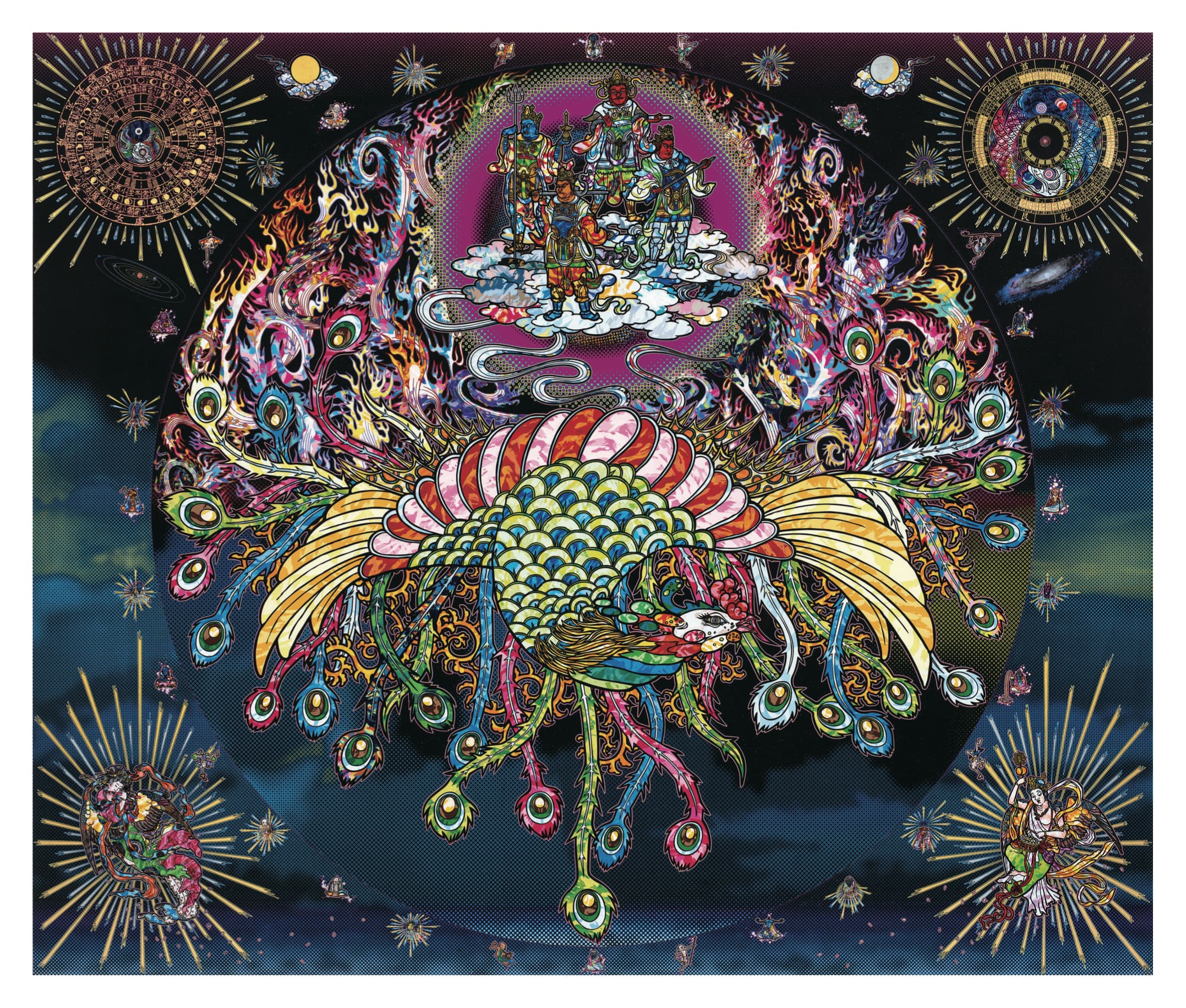
Takashi Murakami, Vermillion Bird Kyoto, 2023–24. Acrylic on canvas mounted on aluminum frame, 187 x 222 ⅖ inches. © 2023–2024 Takashi Murakami/Kaikai Kiki Co., Ltd. All Rights Reserved.
Rail: We have spoken in the past of the status that a copy has in Japan, that, for instance, it is not unusual or out of place to see a copy of a national treasure standing in for an original work in a museum. Practically, most treasures are too fragile and too old to be on continuous view, but it is also more than that, more like the copy can transmit what the original is meant to transmit. This bothers us in the West, but less so in Japan. We have also spoken of a copy as a way of both affirming and breaking from a teacher. Your idea of a person vicariously reaching back to Matabei through your work seems in this vein.
Murakami: Matabei captured all the details of people’s different jobs during a moment in the city of Kyoto, the landscape of the town, even more details than have been recorded in writing. So it really was just like I was using someone else’s genius to boost my work. It is difficult to do a copy of old works like these because so much of the original tints and paintings have rubbed off and a lot of the details are missing. If you fill in too many details or imitate too many of the missing lines, then it seems to become your own work and it has less to do with the older artist. However, two to three years ago I started to use AI to recreate those details more faithfully and get much closer to the older artist’s work. This use of AI to fill in the details of an older work made it possible later for me to work with Hiroshige’s prints when the Brooklyn Museum asked me.
Rail: I remember visiting your studio in Saitama right after seeing the Kyoto exhibition and seeing the mock-ups of the Hiroshige prints, and it definitely seemed that they flowed out of the Kyoto project, even down to details. In your version of Matabei, among the people of thirteenth-century Kyoto, we find characters that you have developed wandering among them, specifically your Flower Parent and Child. I experienced the same technique when I saw your Hiroshige exhibition in Brooklyn, where there were Murakami characters hidden throughout. This is a willful distortion of the past with the present, a personal intervention in a tradition of Japanese art that is often not interested in such interventions (which some might label irreverent). So it was fascinating to me when you mentioned that doing such projects reminded you of some of the earliest experiences you had with art, not with Japanese art, but with Western art. You specifically talked about Horst Janssen, the printmaker who made a wonderful series of very eccentric, very wild prints called Hokusai’s Spaziergang (1971–72) that were on one hand copies, but on another important hand were grotesque distortions, a sort of necessary mistranslation.
Murakami: My father was in the Self-Defense Force and when I was little, he would, probably not intentionally, talk a lot about World War II. Especially when we were watching TV, he would talk about how and why Japan lost and why the Vietnam War was happening. What is the purpose of these events for the United States? And then there were incidents involving political figures, like Prime Minister Kakuei Tanaka accepting bribes from the Lockheed Corporation. So as a child, I thought Japan seemed to be operated, in a way, according to the will of the United States. I was always wondering why the Japanese cultural figures could not be proud of their own culture, and then suicide of Yukio Mishima was in the news. I read what he had talked about in his speech before the suicide and what he had written in a newspaper after seppuku (ritual suicide). I always felt the sadness of the Japanese people. In the seventies, the animation Space Battleship Yamato came out, which is the story where they recover a sunken battleship and that becomes the spaceship. From there, the spaceship goes on a journey to rescue the destiny of Earth. So it really is sort of an embodiment of the Japanese complex. Though Space Battleship Yamato came out before Star Wars and was a true space odyssey, it was Star Wars that received global attention. That felt strange to me, considering Space Battleship Yamato came out first and its contents are much more complex. So those were the things that I had in mind as a young person. And that’s when I met Horst Janssen’s work. His work was straightforwardly, innocently saying that Japanese woodblock prints were amazing and proceeded to make copies of them. And in the process, he was changing and transforming them into something grotesque. He was German and he was also from a defeated country, so I thought his mentality might be more like Japan than other Western countries. With Janssen, I understood that if you like something about a culture, then you not only want to imitate it but also want to be completely immersed in that worldview. So, I understood for the first time, that’s okay. And that can be done. I learned later that Janssen would also wear Japanese clothing when he was drawing. At first, I was just sort of interested in his work, but it became a model for how to interact with the complexities of culture.
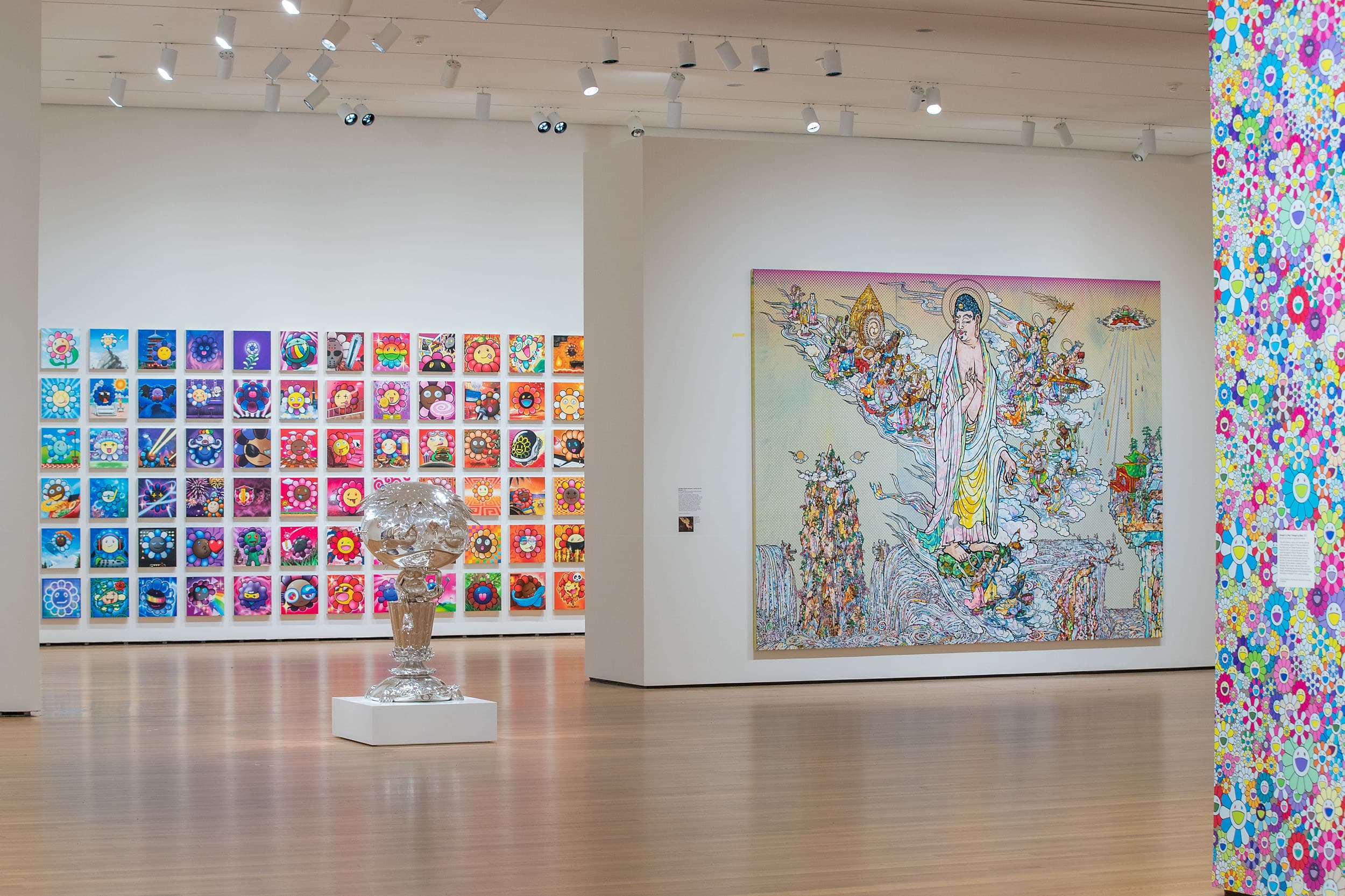
Installation view: Takashi Murakami: Stepping on the Tail of a Rainbow, Cleveland Museum of Art, Cleveland, Ohio, 2025. © 2025 Takashi Murakami/Kaikai Kiki Co., Ltd. All Rights Reserved. Photo: David Brichford.
Rail: I was surprised by the influence of Janssen, as I had never heard about him in relation to your work. However, what you are describing makes sense to me. You have said to me before that Janssen would “eat culture,” and so much of your work eats culture, taking in creative energies whether they come from manga, anime, fashion, or, recently, trading cards. There is a sense in which you enter the logic and mechanisms of the culture that you are referencing, out of mimicry, out of spirit perhaps, and at times, critique.
Murakami: I understood the way Janssen was using his pen, the way he must have moved his pen to draw all those works. I had been drawing in the manga style at the time, seriously training. So around when I was nineteen, I suddenly realized that to experience art is to sort of re-experience or follow the experience of the artist. If you can follow how he moved the pen in your head, then you can experience that artwork. In a sense, the subject didn’t matter. I felt that Janssen knew how his viewers would experience the way he was moving his pen. The moment I realized that, my drawing greatly improved. So after trying for two years, I managed to get into art university, but I never had any experience that topped that experience. I really felt my experience of Janssen’s drawing was very important. However, when I finished university and became an artist, Janssen was nowhere to be seen. You don’t see them in museums or anywhere. I thought that maybe when I encountered his work, it was sort of a glitch, where a curator had their own ideas, introduced his work, and then it never became popular.
Rail: As your career developed, you went to New York in the early nineties and you encountered the work of other artists like Jeff Koons and Haim Steinbach. And we spoke recently that you like the term Simulationism. There’s a point where you started using the strategies that you saw in Simulationism to think about the cultural production of Japan after World War II. I wanted to ask you about this period in your life.
Murakami: When I was studying contemporary art, I was exposed to what people were calling New Painting: Jean-Michel Basquiat, Julian Schnabel, and David Salle. The artists who were influenced by New Paintings were always spoken about in a very critical way, especially by the previous generation. I was reading that criticism in Japanese in magazines. The curse of Marcel Duchamp was becoming potent, the idea that it was basically impossible to make art at all. Everything had become more and more conceptual. In that context, New Painting arrived and there was this moment where people were still producing paintings even when a prevailing idea was that you can no longer create art, or physical art. In between those two camps was where I thought Simulationism belonged. So, as a Japanese artist, what was I supposed to express? Since these Americanisms emerged as a nihilistic criticism within America—a country at the pinnacle of global economic power—I thought it might be worth examining the causes of Japan’s own not-so-positive aspects from a similar perspective. This led me to adopt a satirical stance, viewing everything through the lens of manga, anime, and video games. Tracing the history of manga, I saw that illustrations used to satirize the Edo shogunate or found in the humorous books of the Meiji era embodied a similar nihilistic stance effectively. First in this spirit of self-mockery, as well as satirizing how Japanese artists were creating works imitating the American word “art” that was all the rage at the time, I created works like Mr. DOB (dobojite dobojite oshamanbe), Hiropon (1997), and My Lonesome Cowboy (1998).
Rail: In describing the work of this era—whether it is the work of somebody like Schnabel or Koons—you often say that one of the links between New Painting and Simulationism is the idea of “bad taste.” I have been thinking about what you might mean by that and what I think mostly about is the idea of art going off its usual paths, of pivoting away from a certain modernist march of painting and swerving into any and every form of cultural production no matter how outlandish and no matter how hard to look at. These energies become the stuff of art. Although they did not look “acceptable” at the time, instead they looked decidedly counter-cultural and bizarre, they did seem to take a spirit of pop into further and further realms of content and allowance.
Murakami: Paul Schimmel curated the exhibition Helter Skelter in Los Angeles. I saw works by Paul McCarthy where a man was having sex with a tree. And then there’s also another artist that I can’t remember, but there’s the huge fetus made of Styrofoam. I thought that was also Simulationism, even magnifying the bad taste of Simulationism. I saw that Mike Kelley made a Kaiju (strange creature) from the Ultraman series called Keronia. And then I saw that Japanese manga and Kaiju can be in bad taste in this way. And it really made sense to me.
Rail: It seems that ultimately your early work points to this interrelatedness between the economies of Japan and the United States and the distortions that happen in between those cultures. Mike Kelley was, on one hand, pursuing and evoking a subculture with his Kaiju, but he was also expressing the flow of Japanese culture into the United States to be transformed. Thus, as someone who is Japanese, you could express similar distortions but from a different directional force of influence, from the United States back to Japan. Now you are looking at a period that is very similar to the nineteenth century with Hiroshige.
There do seem to be certain echoes. As with World War II, there was an era defining tragedy. Edo experienced a great earthquake and fire in 1855. The ships from the West arrived and forced Japan into engaging global markets in selling their goods across the world. Thus, Hiroshige’s prints as well as ordinary goods like Japanese wrapping paper are flowing into Europe, are flowing into Paris. This is a similar moment of interconnectedness and rupture that occurred when you were a child. I want to engage more with your interest in Hiroshige, as he impacted first Vincent van Gogh and Claude Monet, later Paul Gauguin. The idea of Western modernism itself comes from some of these interactions, from some of these economic structures and interrelatedness that happened in the nineteenth century.
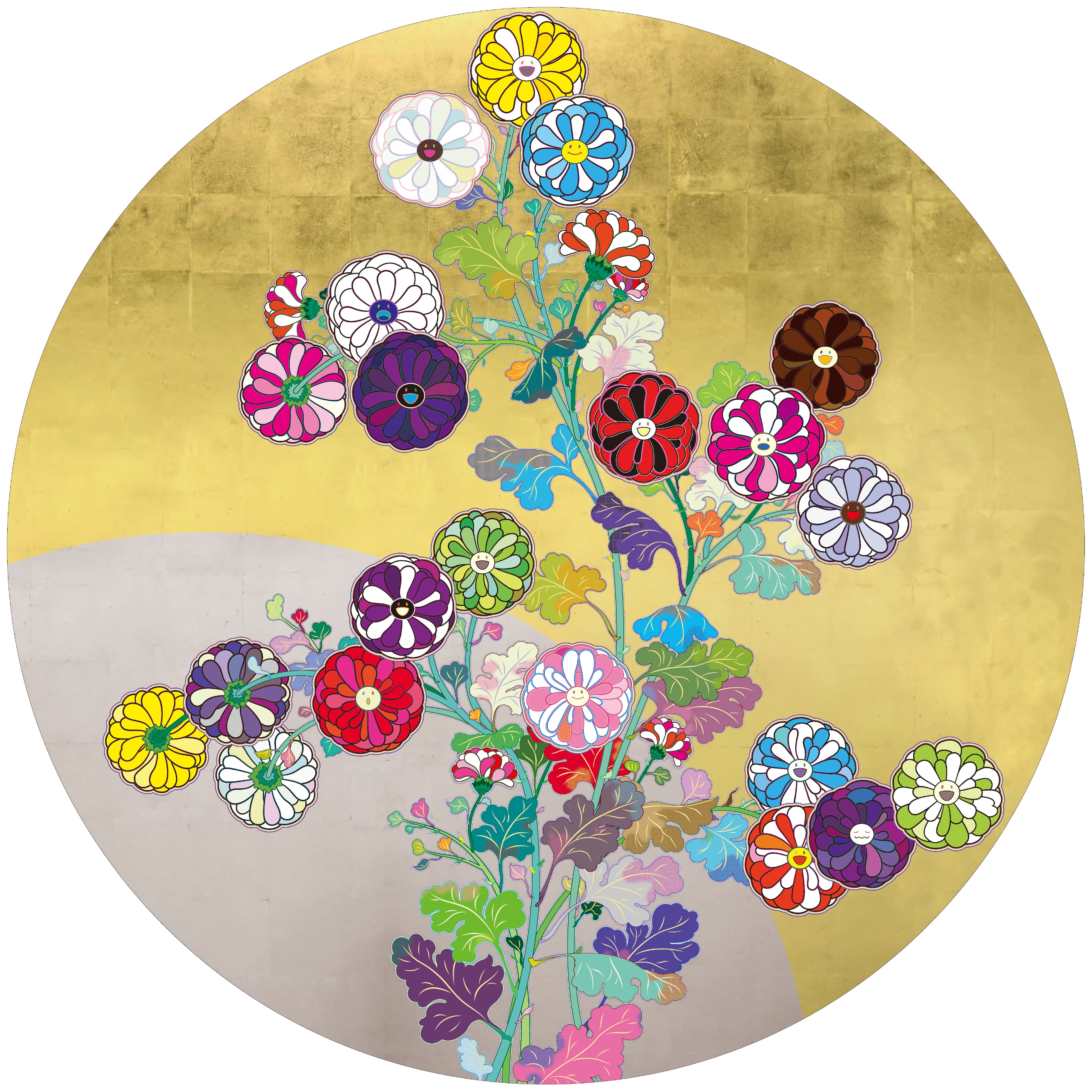
Takashi Murakami, Kansei Hokkyō Kōrin Flowers, 2025. Acrylic, platinum, and gold leaf on canvas mounted on wood panel, 59 × 59 inches. © 2025 Takashi Murakami/Kaikai Kiki Co., Ltd. All Rights Reserved.
Murakami: The fact that I began to work with Hiroshige was an utter coincidence. It wasn’t strategic. I had been bored with what I was doing, and then Joan Cummins from the Brooklyn Museum came to me with a brand new idea and subject. I thought that maybe if the museum thinks that working with Hiroshige’s “One Hundred Famous Views of Edo” (1856–58) is something I should do, it must be something that I should tackle. Joan saw something worth exploring. What I became really interested in was how I could use AI to shorten the time that we could produce works because no matter how many studio staff I had, it would be impossible to produce one hundred works in a month. And with the help of AI, the process was much, much, much faster.
However, my portion of the Brooklyn show didn’t seem to have much of an impact and it wasn’t really picked up critically. I didn’t feel like the show itself had that much response, but for me personally, there was a huge impact because I started thinking about how Van Gogh must have felt when he encountered Hiroshige’s works for the first time. There’s Hiroshige’s rainy scene, for example, where the viewing angle is tilted very dramatically, the only work like that in all the prints in the series. If you are coming from the background of European painting, from one-point-perspective-based rules, then what you knew was basically destroyed by these prints. That’s the kind of impact and shock that I felt in making these Hiroshige works. That’s why I thought I could continue exploring in this vein. It’s really about what the Impressionists and other artists were thinking about at the time that they were making their work. I am latching onto the brains of these artists that are very experienced, and I feel like it’s much richer and it’s a completely different process.
Rail: So with the Hiroshige project, over the course of only about two years, you have started moving from a direct engagement with specific Japanese national treasures, like Matabei, into a direct engagement with famous Western artworks. This is a big development, and not something that might be easy for audiences to understand. Could you talk more about the transition?
Murakami: A couple years ago, I went to Orsay and when I saw Monet’s painting, Woman with a Parasol, Facing Left (1886), I felt that I could also feel how he used the brushes in his time as I felt with Janssen when I first saw his work. It used to be that I could only have this experience with pens and drawings, but now I could do it with the brushes as well, perhaps because my paintings have improved over time. I began to think that probably Van Gogh had this kind of experience with Hiroshige, the contrast between how his brushes moved and Hiroshige’s very calculated layout and composition. That’s what makes Van Gogh’s take on Hiroshige brilliant.
Many Parisian art salons were astonished by the compositional techniques, colors, and themes found in Japanese ukiyo-e, as well as in crafts and kimono designs. This influence played a key role in the birth of Impressionism and Art Nouveau. In the world of painting, artists like Van Gogh, Monet, and Gauguin were profoundly affected. At the time, European artists prided themselves on being at the cutting edge of perspective techniques and painting methods. However, when they encountered the visuals printed on the wrapping paper used to package porcelain imported from Japan—an unfamiliar and distant land they had considered uncivilized—the acutely perceptive artists were struck with a bolt out of the blue. It must have felt like an earth-shattering realization.
Van Gogh, deeply moved by the Japanese sensibility, mistakenly believed that it was because the Japanese people led humble and Zen-like lives that they had been able to create such revolutionary art. This misconception may have led him to shave his own head to look like a Buddhist monk. Monet, on the other hand, was so inspired that he built a Japanese-style garden and made it the subject of his paintings.
In a way, the impact of Japonisme led to a reevaluation of pictorial flatness, setting the stage for the later emergence of abstract painting. In the Gagosian works, I’m inserting little UFOs in the paintings as a way of leading the viewer by the hand towards the revolutionary nature of this period.
Rail: It’s very interesting to me that while you’re working with Hiroshige and Van Gogh, the twentieth anniversary of the Louis Vuitton collaboration is happening at the same time. It might not be too far-fetched to think about that dynamism that Monet, Van Gogh, and others were finding in Japanese culture flowing into France in the late nineteenth century, the wonder of that feeling of encountering something strange and new, along the same lines as the Japanese origins of the LV monogram.
Murakami: In 2002, right after my solo exhibition opened at the Fondation Cartier pour l’art contemporain in Paris, Marc Jacobs, who was then the Artistic Director of Louis Vuitton, saw the exhibition and contacted me.
“In two years, Louis Vuitton will celebrate its 150th anniversary,” Marc told me, “To mark the occasion, we want to completely renew the monogram and create a new monogram for the twenty-first century. The original monogram was inspired by Japanese family crests (kamon), and there’s a detailed explanation of this at Louis Vuitton’s La Galerie in Asnières—please check it out. Since the pattern has its roots in Japan, I want you, Takashi, to be the one to redesign it.”
That was the first time I learned that Louis Vuitton’s monogram design was inspired by Japanese family crests. Understanding this history, I strongly felt that the monogram was a true symbol of Japonisme deeply embedded in Western culture.
After our meeting, I visited La Galerie in Asnières, and right at the entrance, there was a large presentation on Japanese family crests. There was also an explanation stating that the Damier pattern was derived from Japan’s traditional Ichimatsu pattern, a checkerboard design of alternating black and white squares. This pattern dates to the Edo period, when the popular kabuki actor Sanogawa Ichimatsu wore it as part of his stage costume, which led to its widespread recognition.
From that moment on, the monogram dominated my thoughts. In order to trace the roots of the family crest designs, I conducted extensive research on patterns from China, South Asia, and even Indian chintz textiles. As I worked on reconstructing the monogram, I developed approximately two hundred new pattern designs and sent them to Marc. This process led to the creation of the Monogram Multicolore.
Later, Marc sent me a sketch of a panda he had copied from my painting Tan Tan Bo Puking - a.k.a. Gero Tan (2002), with a question, “What is this?” That’s when I realized he liked my Panda character. From there, new characters were born—Superflat Panda, Flower Hat Man, and Onion Head. Things moved incredibly fast, and by the October fashion show, we had already created giant balloon installations of these characters.
Ultimately, then, we could say that the Monogram Multicolore followed a circular trajectory: Japanese family crests led to the LV emblem, which subsequently led to the emblem being redesigned by a Japanese artist—me!

Installation view: Takashi Murakami: Stepping on the Tail of a Rainbow, Cleveland Museum of Art, Cleveland, Ohio, 2025. © 2025 Takashi Murakami/Kaikai Kiki Co., Ltd. All Rights Reserved. Photo: David Brichford.
Rail: I think that in this context, what you are doing in Cleveland makes a lot of sense. There, you are collaborating with the team from the FX series Shōgun to build a replica of the Yumedono from the Horyuji Temple complex in Nara. It is one of the most ambitious projects that I can think of in the United States in many years. The building is almost forty feet tall, completed with painstaking accuracy, and it is not only physically ambitious but also conceptually and historically so. The Yumedono is intricately involved with one of Japan’s most important figures, Prince Shōtoku Taishi, who converted his father the Emperor to Buddhism and opened the door for Buddhism to enter Japan legally. The story of Prince Shōtoku is essential to Japanese history and over more than a thousand years, his story has been intricately linked with religious and political power. But the twist is that you came to engage with his story through falling in love with an American television series based on an American novel interpreting Japan.
Murakami: The temple project has been a dream. The Cleveland Museum of Art has a famous collection of Japanese art, and they have several Prince Shōtoku Taishi related works. Working with the Shōgun staff has already really opened up new doors for me. My last exhibition at Gagosian in London was deeply influenced by Shōgun. In one scene, Toranaga (based on Tokugawa Ieyasu) meets with Toyotomi Hideyoshi character inside Osaka Castle, where an array of exceptional period paintings appears on display. Watching that scene, I felt an overwhelming sensation as if I were present in that space, surrounded by those masterpieces. The experience was so moving that it brought me to tears. Inspired by that deep emotional response, I merged it with my creative vision to produce paintings based on it.
Within Shōgun’s story, I was reminded of the Japanese philosophy of seppuku, as conveyed in American literature and drama. Whatever the authenticity of this portrayal, I found it deeply thought-provoking as I navigate modern society, especially when characters offer prepared death poems right before they commit seppuku. They take control of their own life story by the way they end it. As I contemplate the concept of death during what feels like a personal, existential journey toward my own end, this theme has provided meaningful insights into the way we approach the fleeting moments of life when viewed through the lens of death. This has also led me to a new perspective on storytelling, which I feel will ultimately connect to my work for the Cleveland exhibition.
Ed Schad is Curator and Publications Manager at The Broad in Los Angeles. His writing has been included in Art Review, Frieze, Modern Painters, Flash Art, and the Los Angeles Review of Books. He teaches at Claremont Graduate University.