ArtNovember 2024In Conversation
BRUCE NAUMAN with Michael Auping
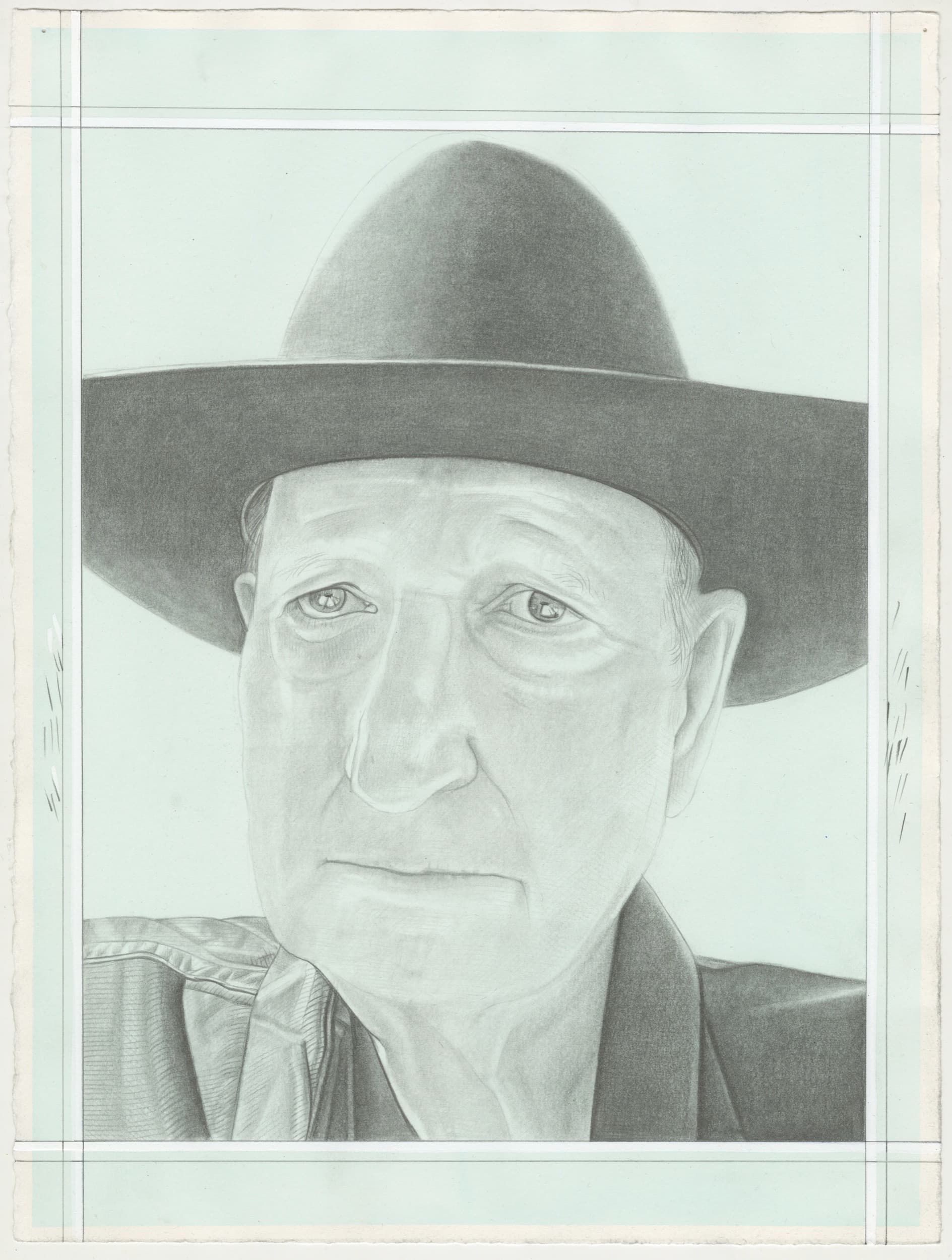
Portrait of Bruce Nauman. Pencil on paper by Phong H. Bui.
Word count: 3313
Paragraphs: 73
Sperone Westwater
October 25–December 14, 2024
New York
Michael Auping is an independent curator and writer. He has known Bruce Nauman since 1977, when they were both in Southern California. He continued to collaborate with the artist, and his late wife, painter Susan Rothenberg, during their years in New Mexico. On the occasion of Nauman’s exhibition, Begin Again, the artist spoke with Auping about his new work. Apropos the show’s title, their conversation covered not only the present, but aspects of the artist’s early life and career. Along the way, details and connections enlighten how art and life are intimately woven together in Nauman’s process. His feelings about Rothenberg’s passing are also touched on in a discussion of a series of unusual drawings he did after her death. All in all, it is a wide-ranging and unusually personal interview with the artist.
Michael Auping (Rail): There’s going to be a lot of work in this show.
Bruce Nauman: It’s going to be dense.
Rail: And the animals are back. Let’s start with them. Remind me how you came by these animal forms.
Nauman: They’re taxidermy molds. Taxidermists use them. They stretch the skins of the animals over these forms.
Rail: They’re strange just in the simple description of them being the inside of a now dead animal—a little creepy. But it’s interesting how they tap into a theme you have explored for a long time. Early on you made material molds of spaces—spaces contained in, around, or under objects. They were molds made by you. Is that basically what we have here, the interior space of dead animals?
Nauman: I hadn’t thought about that, actually, but that’s basically true. I guess you can’t teach an old dog new tricks.
Rail: I remember when I first saw one of these animal pieces at the Carnegie International in Pittsburgh in the eighties. It freaked me out a bit. It was that piece called Carousel (Stainless Steel Version) (1988). A machine was dragging four of these forms around in a circle. Even Susan [the artist’s late wife, Susan Rothenberg] thought those were troubling.

Bruce Nauman, Carousel (Stainless Steel Version), 1988. Stainless steel, cast aluminum, polyurethane foam, electric motor, 72 x 241 inches. Glenstone Museum, Potomac, MD. © 2024 Bruce Nauman / Artists Rights Society (ARS). Courtesy Sperone Westwater, New York.
Nauman: Yeah, she didn’t like them. Although she did keep one.
Rail: I think there is an attraction/repulsion dynamic going on with the animal pieces, especially these new ones. They don’t seem to be as tortured. They seem more alive and rambunctious. They also suggest narratives beyond dead animals. It looks like there is some fighting going on between a few of them. But there is also a kind of playfulness. When you are making these, how do you think of them, as a formal arrangement of materials or as the animals interacting with each other?
Nauman: Both.
Rail: So you do see them interacting when you are making them?
Nauman: I don’t see them as making a narrative. They’re not that specific. These are the interior forms that are underneath the skins of the animals. They’re about the inside. They don’t have ears, eyes, teeth, tails, or paws. In a lot of ways, they are abstract gestures interacting. They are in between realism and abstraction. That interests me.
Rail: There is an abstract element, but to me they are animated in a way that is not what I would call abstract. I’m not sure what I would call it. I can’t help but wonder where these animal poses or gestures come from.
Nauman: Well, part of it is found. I got these forms by ordering them from a catalog. They come from a place called Second 2 Nature in Louisiana. Taxidermists use them in the process of mounting animals as trophies. The forms of all kinds of animals come in different poses—running, rising up, crawling under fences, all kinds of actions. I manipulate some of it too. But in the stripped-down state that I present them people are going to form their own ideas of what these gestures mean.
Rail: In one of my typical turn-abouts in my encounters with your works, I see some of these new works as being about affection between forms, or in some cases, it could be erotic.
Nauman: I would call it intimate.
Rail: Having known you for a very long time, I do think that intimacy, to some extent, comes from your close relationship with animals. It’s that seemingly ironic relationship that some hunters have with the animals they hunt. I know you used to hunt, and I remember you telling me some hunting incidents, one involving a big bear.
Nauman: I did shoot a black bear once, which we had to skin and bone out. We wrapped the meat in the skin and carried it out. We didn’t have horses that trip. My friend George was a trapper, hunter, painter and knife maker. We mostly hunted deer. We did skin and butcher them sometimes.
Rail: That’s the kind of raw intimacy I’m talking about. But to my mind, this new show takes that to a different level. I would describe this new work as a playful intimacy. I’m thinking of 2 plaster coyotes horizontal (2024), where you have two coyotes balancing on each other’s paws, one floating upside down, the other balancing on top. I see it as a kind of playful eroticism. It’s very touching.
Nauman: Yeah, literally touching. That one seems to be a popular one. What I like about it is the hole created between the animal bodies. You can look right through it. An action with a hole in it.
Rail: There always seems to be a hole in your work that we fall into where we are confronted with opposite emotions. Along with the playfulness, there is the suggestion of violence. In 2 plaster foxes (2024), the animals are in each other’s faces, and look like they are boxing or slapping each other. And Plaster coyote with inverted head and hammer (2024) makes me think the coyote has been beaten by the axe handle, or killed by the axe. And for some reason I usually think of violence when I see a hammer.

Bruce Nauman’s Studio, 2024. © 2024 Bruce Nauman / Artists Rights Society (ARS). Courtesy Sperone Westwater, New York.
Nauman: For me, the axe and the hammers are all just tools. These sculptures were literally hanging around my studio, suspended by wires. There were times when we had to move them. The axe handle was used as a kind of handling device to move them around without having to set them on the ground, like you would carry a puppet around. The hammers were a way of weighing down the wire, which came in spools. The hammers kept the wire from recoiling. I ended up tying the wires around hammers I had around, and their weight kept it from recoiling. They were just part of the process of making, so I decided they should stay there in the sculpture. I had no idea I had so many hammers around the studio. I must not be able to make art without hammers. [Laughter] I ended up having to buy a lot of new hammers. I got something like twelve used hammers for nine dollars on eBay.
Rail: You also used a lot of wire to hang them up. It seems like the wire does more than just hold the animals off the ground. It extends off the animal bodies like a form of drawing.
Nauman: That’s the way I see it. I like how the wires work as gestures. The animal forms are held together and held up with different types of wire I happen to have around. They are of different gauges, and types, depending on the weight of the piece. There is some galvanized, some stainless steel and some old bailing wire I have around. Sometimes it occurs to me they feel like different thicknesses of line. But I’m not trying to be deliberate about drawing in space. It’s just how they come out when we tie them together, and if I like it I leave it. The other important thing for me is that the wire allows the bodies to move.
Rail: All these sculptures move?
Nauman: Yes, to different degrees. Hanging them with the wire allows them to twist and turn. That’s part of the reason I hang them. Also, I don’t like bases generally.
Rail: In that case, we could be talking about dancing animals, not fighting animals. Animals twisting around in space. I know you have talked about your interest early in your career in contemporary dance—Meredith Monk, Trisha Brown, Lucinda Childs, Yvonne Rainer. Do you see some of that re-emerging in these new works?
Nauman: I wouldn’t argue against that observation.
Rail: Let’s talk about drawing. You have a fair number of drawings in this show.
Nauman: In a way, this show is a lot about drawing, but it’s a complicated story. Hopefully not too long. The beginning of the story is that I felt like I had forgotten how to draw. It really troubled me. So I began to practice. I had some left-over foxes—for the most part whole forms of foam (one had a broken leg we had to repair). And I set them up on a base, cardboard box, and I did some still lifes on it. The initial intention was just to do drawings. I would draw a still-life. And I would repeat that process of making a still-life and drawing it. In the middle of that, when I felt I was getting somewhere with the drawing, I decided to do some drawings of Susan.
Rail: I was going to ask you about those later. You have them all untitled, and that threw me a bit, on a number of levels. Why untitled? We are all going to recognize Susan. Or maybe that’s your point? Anyway, it confused me.
Nauman: I have a hard time talking about it, and I guess titling those drawings is a part of that. So, anyway, I made two drawings of her from a photograph I took of her just after she died here at the house. One of the drawings was upside down, and the other right side up. I did the upside down one because I thought it would be easier emotionally, thinking the process would be a little more abstract. I’d never done drawings like these.
Rail: Portraits?
Nauman: Yeah, basically. Figurative portraits of someone very important to me. Then I did some without her face. It was of just her hair moving around the space where her face would be.
Rail: They are very moving to me, and also really stunning as drawings. Every line is a distinct gesture of a thread of hair.
Nauman: I was very surprised at how they turned out. One of them is the best drawing I have ever done, at least I think so. It stopped me in my tracks. I told my assistant, Chelsea Weathers, “I don’t want to draw anymore. I can’t do this anymore.” It affected me to the extent that I just stopped working for a bit. And then one day Chelsea looked over at a still life I had done sitting on the box, and said that it could be a sculpture. I said, well, that used to be my profession. So I moved forward thinking about sculpture again.
Rail: It sounds like you were at a crisis point.
Nauman: Yeah. I assume it happens to all artists, but I don’t remember having one like this in the studio before. Anyway, I ordered some fox figures, and started working with them, using whole forms and putting them together in different configurations. Some interesting images started coming forward, so I decided to scale them up, and ordered some larger coyote forms. The sculpture started coming together, almost as a group installation. As I said before, I can’t really tell you what my specific thoughts were in regards to their configurations. I know it must have been emotional, but at that point I was happy I was making some things again. And eventually I was able to finish the series of Susan drawings, and move on with sculpture at the same time. So there was a symbiotic relationship between drawing and sculpture that made the works in this show. But not the typical preliminary drawing into sculpture narrative.
Rail: When did the plaster forms come about? They have an eerie quality.
Nauman: That was sort of the last step to this story. With the help of Ellen Babcock, I started making plaster casts. It’s a common sculptural material. Artists have used plaster molds to copy other art for centuries. I like how the whiteness of plaster abstracts things, but also has its own aura.
Rail: Yeah, there is an odd “lightness” or ghost-like quality to these. In some cases, it’s like they are flying around the room.
Nauman: The irony is that plaster is fairly heavy. It’s not as light as it looks.
Rail: There seems to be a quality of light about this whole show that is different from other shows I’ve seen of yours. I’m not sure how I would describe it. How would you describe it?
Nauman: I’m not sure. I’ve never been interested in depicting light. I like trying to create it, hopefully a new type of light. I like light that makes you not sure about it. I’m not romantic about it, or I don’t think I am. I just want to look at a light that is not necessarily obvious, whether it’s understated or difficult to look at.
Rail: That may be the type of light I’m seeing. Let’s also talk about the nature of the drawing gestures. It seems to me your drawing style has varied over the years. Sometimes it has been very simple and bold, and sometimes it’s more subtle. Here it is gestural and feathery, seemingly casual but very precise. They are made with silverpoint. Why that medium? It’s supposed to be a difficult medium—very precise and delicate.

Bruce Nauman, Foxes on a box, 2023. Silverpoint on prepared paper, 41 5/8 x 29 3/8 inches. Courtesy the artist. © 2024 Bruce Nauman / Artists Rights Society (ARS). Courtesy Sperone Westwater, New York.
Nauman: Well, it is and it isn’t. It depends on what you want to use it for. It can be very delicate but also very forceful. I’ve been using it for a while. Many years ago I saw a portrait of Marcel Duchamp by Joseph Stella. It was done with silverpoint. It was very precise but also very strong as an image. It felt amplified. At the time, I thought to myself, a pencil can’t quite do that.
Rail: What exactly is silverpoint?
Nauman: It’s basically silver wire in a pencil holder. As with most drawing, you have to pay attention, but when you do with this medium, I feel like there is more variation potential than with pencil—not always, but sometimes.
Rail: You use both silver and goldpoint. What is the difference in effect?
Nauman: Well, they both have an interesting grayness. The goldpoint isn’t a gold color. The silverpoint gets a little darker over time. The other thing is you have to prepare a ground on the paper that helps the paper accept the marks. You need to put a number of layers on the paper. I think that slows you down in the drawing process, and I like that. And the ground does have a certain kind of presence. There is ground-up bone meal in the material that can create a subtle light quality. I do a fair amount of scraping parts of the surface with a razor blade to bring out highlights, as well as allowing me to make corrections.
Rail: Along with the sculptures and drawings, you also have two videos in this show. You’ve been busy for an eighty-two-year-old man.
Nauman: Work or die.
Rail: It seems like you are exploring your early self in these videos. The video Walk with Tyger (2024) harks back to your early performance stuff, particularly the contrapposto walks.
Nauman: Yeah. It started there, and then a while back I did a 3D piece called Walking a Line (2019), and then not too long ago I did another 3D piece of the walking performance called Self-Portrait at 80 (2022). I’m walking through the mess that is my studio. And I reverse the right and left eye so the background and the foreground in the studio are switched. It’s very hard to watch.
Rail: But a nice metaphor for past and present, forward and back.

Bruce Nauman, Walk With Tyger, 2024 (still). 4K (UHD) 60fps video installation (color, stereo sound), continuous play; 1 4K (UHD) video source, 1 4K (UHD) video projector, 2 speakers; projection size: 129 3/4 x 225 inches; 15:28 minutes. Edition of 3. Courtesy the artist. © 2024 Bruce Nauman / Artists Rights Society (ARS). Courtesy Sperone Westwater, New York.
Nauman: In this newest piece, Walk With Tyger, I use the Walking a Line video with an overdub of a recording of me reciting the William Blake poem “The Tyger” (1794).
Rail: I don’t remember you ever mentioning William Blake in relation to your art. You don’t seem like a Blakean type. He is so romantic, and your work doesn’t strike me as romantic. More emotionally analytic.
Nauman: I’ve been interested in Blake and his work for some time, and I’d been thinking for some time about using that poem, just waiting for the right time. There are a number of images and themes in it that interest me. It includes hands and feet and eyes. And it plays with symmetry and balance. The last stanza is a repetition of the first. The video is about fifteen minutes long, and there is a section when I read the last stanza and use that stanza as the first stanza, then I read the whole thing over again, so it becomes a kind of continuous loop.
Rail: I always thought of “The Tyger” as a high-level children’s poem. Everything seems to be going along fine as a bedtime story and then he throws in more difficult concepts, pitting different perspectives and counterpoints against each other: beauty and ugliness, balance and imbalance.
Nauman: About halfway into the video the image flips upside down.
Rail: Walk With Tyger is a 2D video. The other video in the show is 3D. It’s a different kind of unbalancing. It’s titled Untitled (Turning, Swinging and Striking) Dedicated to Bruce Hamilton and Susanna Carlisle (2024).

Bruce Nauman, Untitled (Turning, Swinging and Striking) Dedicated to Bruce Hamilton and Susanna Carlisle, 2024 (still). 4K (UHD) 60fps 3D projection (color, stereo sound), continuous play; 1 4K (UHD) video source, 1 4K (UHD) video projector, 2 speakers; projection size: 126 1/4 x 206 inches; 2:05 minutes. Edition of 5. Courtesy the artist © 2024 Bruce Nauman / Artists Rights Society (ARS). Courtesy Sperone Westwater, New York.
Nauman: The sub-title refers to what is physically happening. I’m shuffling around the hanging plaster animals and bronze heads as a hanging ball peen hammer rotates around and occasionally strikes the bronze head, and there is what I think is a very beautiful sound. The head becomes like a bell.
Rail: Another one of the recurring themes in your work: sound. I don’t know how many people know that you began as a musician. And there were all those early sound pieces you did. It wasn’t just sound, though. In my mind it was on the edge between sound and music. I’ve been writing an essay called “The Songs of Bruce Nauman” for a couple of years now. I keep writing because I keep finding new “songs.”
Nauman: Sound, or music if that’s what you want to call it, has always been important in my work, and as you say from the very beginning. This piece was an accident of sound. We were working on something near the bronze heads and the hammer, which was tied to the hanging wire, accidentally swung around and hit one of the heads. So I made a video of the bronze heads being struck by the swinging ball peen hammer head. I sent it to my other assistant Ellen, and she said, “You’ve made a bell.”
Rail: So the hammer swings, and you wait for the sound.
Nauman: The silence between swings is important.
Rail: Cagean. Silence is sound.
Nauman: More or less. He’s usually somewhere in the background. His work was important to me.
Rail: “The end is the beginning,” someone said. This is unlike any other show I have seen of yours. It’s so broadly autobiographical. And I feel like there are a lot of emotional ups and downs with an atmosphere of reverie.
Nauman: I have no idea how this show will be received. But I never do.
Michael Auping has been a curator of contemporary art for close to fifty years. He has worked with some of the most important artists of our time, including Lucian Freud, Jenny Holzer, Agnes Martin, Bruce Nauman, Susan Rothenberg, Ed Ruscha and Frank Stella.