ArtNovember 2024Essay
Paula Modersohn-Becker: Ich bin Ich / I Am Me
Thoughts on Paula Modersohn-Becker
Word count: 3585
Paragraphs: 31
Installation view, Paula Modersohn-Becker: Ich bin Ich / I Am Me at the Neue Galerie, 2025. Courtesy the Neue Galerie.

Art Institute of Chicago
October 12, 2024–January 12, 2025
Chicago
“I can feel it again now: love never ceases even when everything else comes to an end. […] For isn’t art also love?“1
I Am Me
Paula Modersohn-Becker (1876–1907) holds a unique place in art history, bridging the late nineteenth and early twentieth centuries, a period in Europe marked by the transition from Post-Impressionism to Expressionism. Despite her undeniable significance, reflected partially in the fact that a museum was dedicated to her in Bremen as early as 1927 (the first in the world devoted to a female artist no less), her work has never been the focus of a US museum retrospective, until now. Organized by the Neue Galerie New York and the Art Institute of Chicago, the touring exhibition Paula Modersohn-Becker: Ich bin Ich / I Am Me currently provides the long-overdue opportunity to closely examine her oeuvre on this side of the Atlantic, swiftly garnering the attention it deserves. Growing up in Hamburg, where the local Kunsthalle holds stunning examples of Modersohn-Becker’s work, I have long been in awe of the profound sense of humanity it beholds, as well as of its pioneering proto-feminist stance. After all, in Modersohn-Becker’s Germany, women were still denied the right to vote, excluded from public art academies, and had limited access to higher education, property ownership, or financial independence for that matter. Not a review, this text rather aims to introduce the artist through a brief biographical sketch and a discussion of two of her most iconic portraits: one featuring herself at the height of her powers and another, depicting her closest female friend, the sculptor Clara Rilke-Westhoff (1878–1954). It aims to combine both an overview and a more nuanced examination.
Ambitious Confidence
Ambitious and confident, Paula Modersohn-Becker possessed unwavering determination to overcome the entrenched societal norms of her time. While equipped with a great sense of humor, warmth, courage, and a seemingly ceaseless zest for life, she took herself seriously in an environment where for women, art was often relegated to a mere pastime until marriage. Yet Modersohn-Becker defied these conventions with remarkable resolve. Even when she married the established, older, and recently widowed painter Otto Modersohn (1865–1943) at the age of twenty-five, instantly becoming stepmother to his three-year-old daughter Elsbeth, her drive remained undiminished. In fact, it was the union with her husband, which included the provision of her keeping a separate studio, that was instrumental in enabling her to maintain artistic independence as an adult. Despite the challenges of balancing family life and work, Modersohn-Becker remained steadfastly committed to pursuing her rights as both an individual and an artist. She was seeking the essence of life in both the day-to-day and her work. Her keen observational skills, refined through an array of private art lessons in different places, enabled her to portray not just the likeness but the intrinsic qualities of her subjects, ranging from family members and friends to herself. Indeed, the more her career progressed, the more it manifested as a profound exploration of self, rendered through assured lines on paper or broad, vivid brushstrokes on canvas that convey psychological depth and intimacy. Meanwhile, her diaries and numerous letters, some of which were released only a few years after her passing, are filled with passionate reflections on art and existence. Combined with her over one thousand drawings and circa seven hundred paintings, they manifest as a stunning record of a most passionate quest for self-discovery and the steadfast belief in art as a pathway to true consciousness.
Childhood
The source of Modersohn-Becker‘s confidence is rooted in her upbringing. Born in 1876 in Dresden-Friedrichstadt, Germany, as the third of seven children, she was raised in a cultured, middle-class family. Her father, an engineer, and her mother, from an aristocratic lineage with a rich intellectual and artistic heritage, fostered her early interest in art early on. While her childhood was mostly harmonious, one fateful event stands out. At the age of ten, while playing with a group of six children, Modersohn-Becker and some of the others were buried in a large sand pit near Dresden. Her eleven-year-old cousin Cora died through suffocation and the tragedy profoundly impacted Modersohn-Becker. In writing to Rilke years later, she would remember her cousin’s sudden death as “the first real event” in her life, which marked her initial awareness of life’s fragility.2 Indeed, Modersohn-Becker’s work, particularly her portraits of children, with whom she felt a true kinship, stands as a testament to her acute awareness of life's transience. Whether she depicted them freely playing in nature or posed in quiet surroundings, alone or in small groups, she resisted the romanticization of youth. Instead, her compositions seem grounded in the realization that the innocence of childhood is impermanent. The children in her paintings seem to exist in a brief, paused moment. It is this notion of fleetingness that adds a layer of poignancy. Her work succeeds in simultaneously capturing the passage of time and the essence of the present moment.
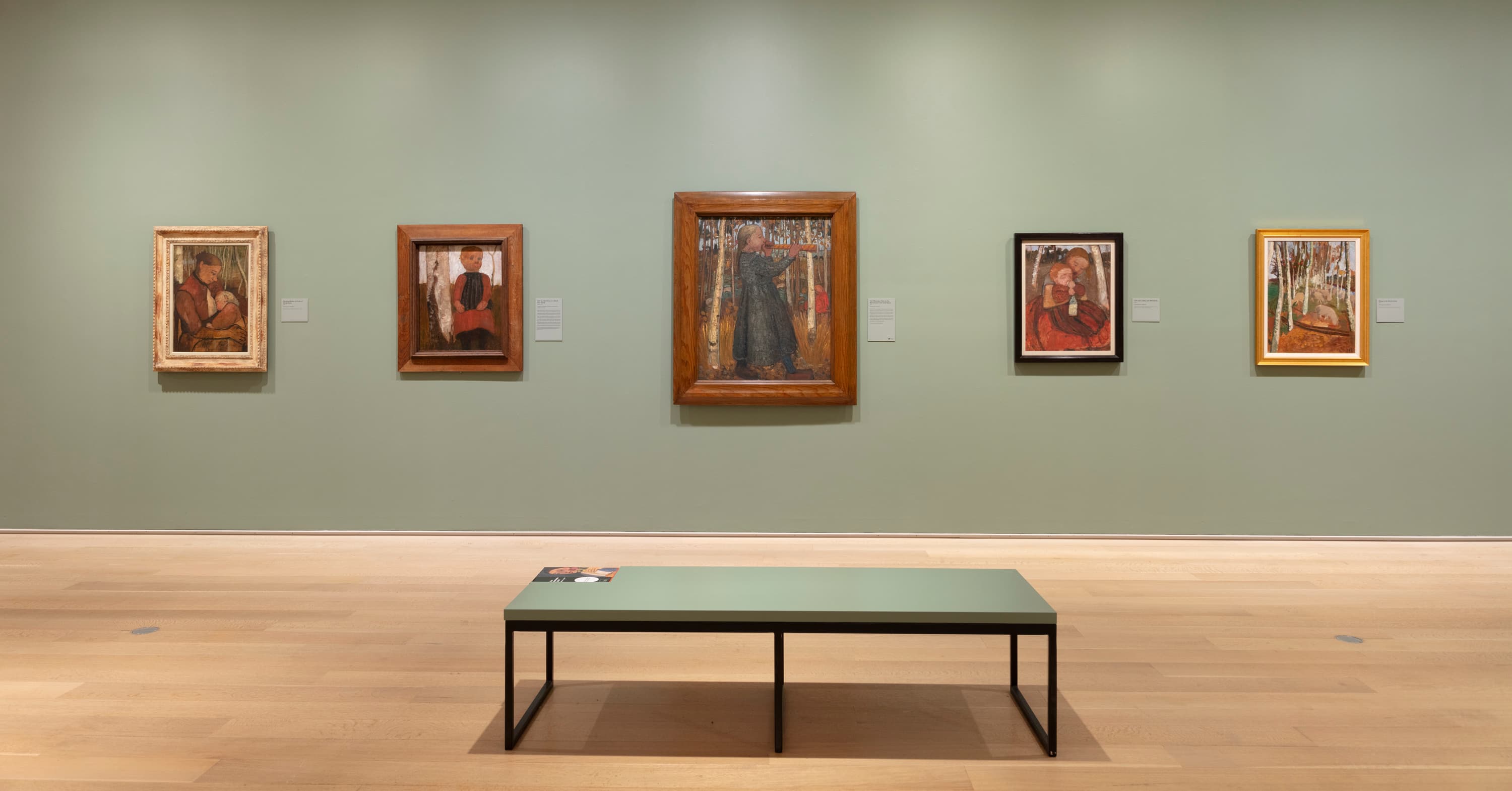
Installation view: Paula Modersohn-Becker: I Am Me at the Art Institute of Chicago, 2024. Courtesy the Art Institute of Chicago.
In 1888, a few years after the accident, the family relocated to Bremen. A city known for its vibrant cultural life, it further shaped Modersohn-Becker’s artistic development. Encouraged by her parents, who hosted a regular salon of artists, writers, and other cultural figures, she began to take formal drawing lessons. At sixteen, she spent seven months with her aunt’s family in England, where she studied drawing at London’s St. John’s Wood Art School. Upon returning to Germany, she attended the School of Women Artists in Berlin and, in 1898, she took drawing lessons with Fritz Mackensen in Worpswede. She complemented her studies by frequently exploring museums and exhibitions in Berlin, Dresden, and Vienna, for example, admiring works by Rembrandt, Titian, Rubens, Dürer, Cranach, and Holbein. In addition, she visited Max Klinger in his studio in Leipzig. The only brief and much-resented distractions from her work were imposed by her father in an attempt to secure his daughter’s future. She attended a teachers’ training college in Bremen, graduating in September 1895. Then, in 1901, at her parents’ request, Becker took cooking lessons in Berlin to prepare for married life. Modersohn-Becker viewed both of these occasions as painful detours from her artistic aspirations and in fact abandoned the latter prematurely.
Worpswede
Some artists are intrinsically intertwined with the places where they lived, and Modersohn-Becker counts among that group. The village of Worpswede, located in the Teufelsmoor (Devil’s Moor) in Lower Saxony, with its distinctive landscape, has long been synonymous with her work. By the late nineteenth century, it had become a retreat for avant-garde artists and writers escaping the encroaching industrialization. Otto Modersohn, Fritz Mackensen, Heinrich Vogeler, Clara Westhoff (later Rilke-Westhoff), Marie Bock, Ottilie Reylaender, and Rainer Maria Rilke are among those who contributed to the vibrant community that Modersohn-Becker was a central part of. After an initial visit in 1897, she began to spend most of her time in Worpswede from the following year on, depicting its landscape, people, and scenes of rural life, frequently employing an earthy palette evocative of the moors and its strong light: “...the misty landscape, the green meadows, and the radiant fields of mustard. [...] And finally came the brown heath, with happy, sparkling birches here and there, a strange mixture of melancholy and frivolity.”3
Modersohn-Becker’s work was deeply influenced not only by the distinctive landscape of Worpswede, but also by the personal connections she established there. In addition to her quickly progressing relationship with Otto Modersohn, her friendships with Clara Rilke-Westhoff and Rainer Maria Rilke were most influential. In the late 1890s, the two women had forged a deep friendship while studying with Mackensen, sharing a passion for modernist ideas and the works of French artists, especially Cézanne and Gauguin in particular. Rilke-Westhoff did not lag behind Modersohn-Becker in regard to her determination and confidence. At the age of seventeen, she had left Bremen to attend a private art school in Munich, pleading with local officials for the inclusion of female art students at nude drawing classes at the academy (to no avail). An excellent stone carver, she had impressed Max Klinger and Rodin enough to be invited to train under them in Leipzig in 1899 and Paris in 1900 and 1905, respectively. In 1899, Rilke-Westhoff completed a portrait of Modersohn-Becker in clay. The stunning bust renders the artist as being simultaneously introspective and full of life. It was exhibited in a group exhibition at the Bremer Kunsthalle late that year, in which Modersohn-Becker participated as well. After a devastating review in a local newspaper in December, which singled out her work in particular, Modersohn-Becker left for Paris on New Year’s Eve. There, she joined Rilke-Westhoff, who had arrived earlier. They spent the early months of 1900 together, exploring the city, attending classes, and strengthening their bond of mutual support and encouragement.
In November 1905, when Modersohn-Becker portrayed Rilke-Westhoff, both women were at entirely different stages in their lives. Both had married in 1901, although Rilke-Westhoff’s union with Rainer Maria Rilke was more troubled. By this time, Rilke-Westhoff had already given birth to their daughter Ruth but was spending long periods living apart from her constantly traveling husband. Any former notions of lightheartedness had given way to a more serious, contemplative outlook. In Bust of the Sculptor Clara Rilke-Westhoff (1905), Modersohn-Becker renders her with her head slightly turned to the left, illuminated by the soft morning light from a nearby window. She is wearing a simple white dress, airy yet well-fitting, that seems to set her aglow. The portrait is cropped at the bust, leaving unclear whether she is seated or standing. Therefore, our attention is drawn to her slightly curved torso and head, especially her averted gaze. Yet, while she appears lost in distant thoughts, her physical strength is evident, and her proud presence remains intact. The portrait’s exceptional quality lies in its embedded sense of distance, which, despite the intimacy, reflects the significant shift that had occurred in the relationship between Modersohn-Becker and Rilke-Westhoff at that time. The formerly close friends, who once saw each other frequently and had supported each other‘s work, had become more distant after marriage, largely due to Rilke-Westhoff’s retreat into her own private world when facing financial difficulties, motherhood, and a husband who required solitude to work. Modersohn-Becker had watched with dismay as her once headstrong friend’s life changed. Her letters and diary entries from that period reflect feelings of neglect and disappointment over the couple’s return to traditional gender roles. To Rilke-Westhoff, she wrote explicitly: “I don’t know much about the two of you; but it seems to me that you have shed too much of your old self and spread it out like a cloak so that your king can walk on it. I wish for your sake and for the world and for art and also for my sake that you would wear your own golden cape again.”4
Installation view, Paula Modersohn-Becker: Ich bin Ich / I Am Me at the Neue Galerie, 2025. Courtesy the Neue Galerie.

However, by the time Modersohn-Becker painted this portrait, any misgivings were largely behind them. Reflecting on the sittings that were held in the natural morning light, Paula recalled to her mother, “Her little girl, Ruth, is playing next to us. (...) I’m happy that I can get together frequently with Clara Rilke this way. In spite of everything she is still, of all my friends, the one I care most about.”5 The portrait marks a moment of emotional reconciliation, capturing both women’s renewed connection. In addition, it serves as a powerful gesture of encouragement to Rilke-Westhoff, who, as a largely single mother balancing the demands of home and work, had matured both as an individual and as an artist. Furthermore, she had recently spent more time with Rodin in Paris and was, according to Modersohn-Becker, “still very much under the influence of his personality and his great simple way of expressing his thoughts.”6 Stylistically, Modersohn-Becker seems to echo Rilke-Westhoff’s admiration of simplicity in her portrait as well. Her approach is direct and her presentation of her subject without distraction. There are no household objects or furnishings that could divert the viewer’s attention. That is, except for a single red rose, which Rilke-Westhoff is delicately holding in her left hand. The flower is in bloom but not fully, possibly symbolizing the promising possibilities that Modersohn-Becker still saw within her friend’s reach. It may also be an indirect reference to Rilke’s poetry, where the rose often serves as a metaphor for purity, inner harmony, and confidence.
In her writings, Modersohn-Becker often expressed a desire to make her intuitions about her subjects visible. By highlighting Rilke-Westhoff as a timeless beauty and acknowledging the complex evolution of their friendship, she celebrates her as a strong, modern woman whose talents she had believed in from the beginning. The portrait is a testament to their enduring solidarity and a reflection of Modersohn-Becker’s empathetic, forgiving, and enthusiastic nature.
Paris
Paula Becker in her “lily” studio, Worpswede, ca. 1900 Photo: © Paula-Modersohn-Becker-Stiftung, Bremen.

As much as Modersohn-Becker enjoyed Worpswede, she was also passionately and repeatedly drawn to Paris for its artistic freedom and innovation. Between her first visit in 1900 and her last in 1906, she spent several formative months there. Indeed, it was in the museums and galleries of Paris that she encountered many influential impulses, particularly as she began striving for new ideas that no longer aligned with the more traditional artists of Worpswede. For instance, she had discovered the work of Cézanne at Ambroise Vollard as early as 1901 and studied Titian, Botticelli, Velázquez, Corot, Rousseau, Millet, and Degas at the Louvre. Close examinations of Tanagra figurines and Fayum mummy portraits followed. She was increasingly taken by Post-Impressionism, Symbolism, and the early stages of Fauvism, frequenting the Société des Beaux-Arts, Musée du Luxembourg, and the Galerie Bernheim-Jeune, or visiting the studios of Maurice Denis, Édouard Vuillard, and Charles Cottet, for example. At the Salon des Indépendants in March 1905, she explored the work of Matisse as well as the coinciding retrospective exhibitions of Seurat and van Gogh. While she had enrolled at the progressive Académie Colarossi in 1900 and 1903, and had taken anatomy classes at Académie Julian in 1905, as well as anatomy and life drawing courses at the École des Beaux-Arts in the spring of 1906, she began to work largely independently after that. One might argue that Modersohn-Becker didn’t fully trust her abilities until 1906. Her previous lack of confidence was largely due to not having received the traditional academic art education that male art students of the time enjoyed.
Hence, it was during her final stay in 1906, initially an attempt to settle in Paris independently for good, that her mature style began to crystallize. Seeking to emancipate herself as an artist and to establish an identity distinct from her roles as a wife and stepmother, she left Otto Modersohn unannounced in February 1906, shortly after her 30th birthday. In Paris, she rented a small studio at 14, avenue du Maine, and the following months would prove the most productive period of her career. She informed Rilke, “And now, I don’t even know how I should sign my name. I’m not Modersohn and I’m not Paula Becker anymore either. I am Me, and I hope to become Me more and more. That is surely the goal of all our struggles.”7 Although she worked in seclusion at times, she spent time with her sister Herma, who was also in Paris for several months, as well as with the German sculptor Bernhard Hoetger, his wife Lee, and Rilke. Her portraits from this period, including those of Lee Hoetger and Rilke, increasingly featured simplified forms and strong outlines, reminiscent of the Fayum mummy portraits she studied at the Louvre. In addition, she began to spend more time on each composition, experimenting with form and color while rethinking her palette overall: “great style in form also demands a great style in color.”8
It was during this time that she painted some of her seminal works, including Self-Portrait on Sixth Wedding (Anniversary) Day (1906), suspected to be the first nude self-portrait by a female artist in history. In this painting, Modersohn-Becker presents herself with a blend of confidence and vulnerability. She is looking at herself and, by extension, at us with calm anticipation. Set against a light green background, she appears radiant with the smooth hazel and amber tones that define her hair, eyes, and necklace. Unlike many of her portraits, no flowers have been added to the composition, even though her left hand appears to be holding something with thumb and pointer finger touching. On closer inspection, the impasto may suggest the shape of a leaf beneath the paint, but this detail has since been obliterated, allowing us to study her overall body language instead. For instance, her right arm rests on the lower part of her ribcage, just beneath her breasts, while her left arm curves around her stomach and lower abdomen. The latter is slightly protruding, suggesting pregnancy perhaps, which at this stage would have been a wish and not yet reality. It is also possible that her gently cradling hands symbolize an embrace of her new identity, a gesture of self-assurance rather than fertility. The act of caressing herself is sensual but not salacious, self-soothing rather than seductive. This work represents a stage in Modersohn-Becker’s broader quest for self-discovery, expressing her own personal desires rather than appealing to those of anyone else, including her husband.

Paula Modersohn-Becker, Self-Portrait on the Sixth Wedding Day, 1906. Oil on Canvas. Courtesy the Paula Modersohn-Becker Museum, Bremen.
Perhaps, Self-Portrait on Sixth Wedding (Anniversary) Day was meant as an affirmation of sorts, visualizing her own strength and determination despite life’s unavoidable responsibilities, which caught up with her later that year. At the end of 1906, having realized that it was impossible for her to live a life of financial independence in Paris and after months of correspondence with her husband and various family members, all of whom had urged her to reconsider her breakup, Modersohn-Becker was ready to reconsider her life in Worpswede. In a letter to Rilke-Westhoff, she wrote: “I shall be returning to my former life but with a few differences. I, too, am different now, somewhat more independent, no longer so full of illusions. (...) Apart from the eternal worries about money, it is precisely the freedom I have had which was able to lure me away from myself. I would so much like to get to the point where I can create something that is me.”9 In an act of reconciliation, Otto Modersohn joined her in Paris in late October 1906 for the winter and to discuss how they could shape their life together going forward. Looking at Self-Portrait on Sixth Wedding (Anniversary) Day,” one cannot help but wonder whether it is a reflection of her resolve to return to a more domestic setting, including motherhood, or a reminder of her commitment to her work.
The tragedy of Modersohn-Becker’s life lies in her untimely death the following year. On November 2, 1907, she gave birth at home in Worpswede. After three weeks of bed rest and shortly after preparing to introduce her infant daughter to relatives and friends, she suddenly succumbed to an embolic aneurysm. The moment when her life seemed poised for a new chapter, it closed as abruptly as it did unexpectedly. As Modesohn-Becker had only sold a few of her works during her lifetime, it was through the support of Otto Modersohn and various friends that her work was preserved. In 1908, on the first anniversary of her death, Rainer Maria Rilke wrote the longform poem Requiem for a Friend in her memory. In the years immediately following, memorial exhibitions were held at the Kunsthalle in Bremen, Kunstsalon Paul Cassirer in Berlin, and Galerie Arnold in Dresden in 1908 and 1909, followed by further exhibitions at the Folkwang Museum in Hagen and Neuer Kunstsalon in Munich in 1913, among others. On the tenth anniversary of her death in 1917, the Kestnergesellschaft in Hanover organized a large exhibition of her works, on the occasion of which a selection of her letters and diaries were published, revealing her life, feelings, and friendships to a public audience. Meanwhile, since 1909 and to this day, a bronze cast of Rilke-Westhoff’s portrait of Modersohn-Becker has marked her grave in Worpswede.
The prevailing strength of Paula Modersohn-Becker’s work resides in her ability to bestow her subjects with a sense of intimacy. Even more than a century later, we can trace her passion for life and empathetic view of the world. Her personality weaves through each composition, irrevocably linking her with her subjects. This is evident in the paint handling, the occasional scratching of thick layers of paint with the back of her brush, but especially in the details. An avid reader of poetry, she used flowers while being well aware of their inherent symbolism, for example. She also consciously used hands to convey her subjects’ physical presence and strength, rather than their age or socio-economic background. Her works are layered and filled with subtexts, making their exploration and interpretation so bountiful. Most importantly, we encounter Paula Modersohn-Becker in her work. It has forever preserved her spirit and passionate devotion to life in its fibers. Personal yet universally resonant in its existential drive to leave a mark, it continues to vibrate to this day.
1. Letter from Paula Modersohn-Becker to Clara Rilke-Westhoff, May 13, 1901. Cited in: Paula Modersohn-Becker, The Letters and Journals, eds. Günter Busch and Liselotte von Reinken, trans. Arthur S. Wensinger and Carole Clew Hoey (Evanston, IL: Northwestern University Press, 1998), 259.
2. Ibid, 203.
3. Ibid, 108.
4. Ibid, 268.
5. Ibid, 375.
6. Ibid, 375.
7. Ibid, 384.
8. Ibid, 396.
9. Ibid, 413.
Stephanie Buhmann is a curator and author living in New York. She holds the position of Head of Visual Arts, Architecture and Design at the ACFNY.