Rita Ackermann: Splits
Word count: 938
Paragraphs: 5
On View
Hauser & WirthSplits
May 2–July 26, 2024
New York
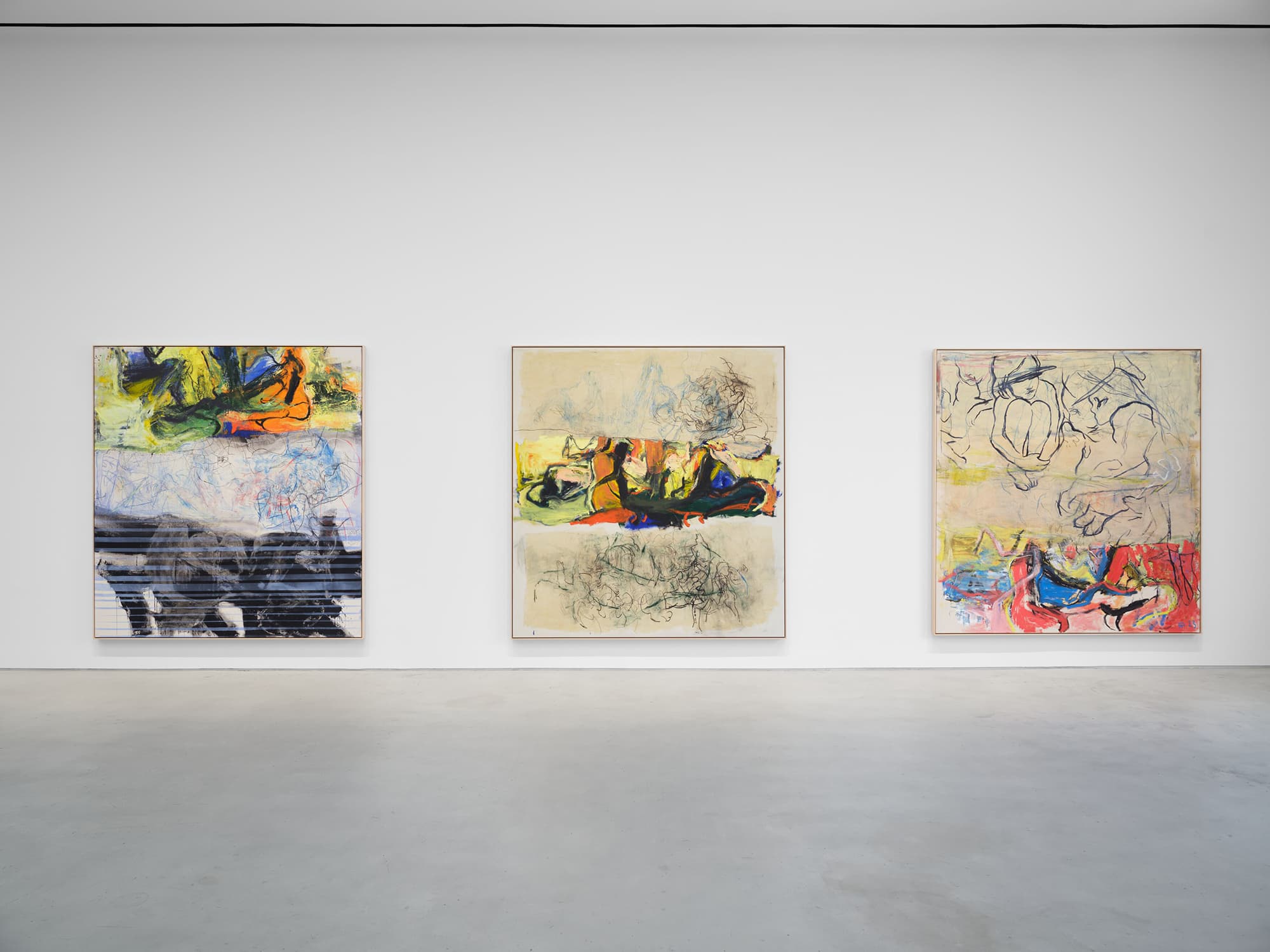
Rita Ackermann’s recent series of paintings, “Splits,” utilizes leitmotifs and a painterly vocabulary that the artist has been developing since the 1990s: doe-eyed and coquettish nymphets, filmic references, erasure, and the Bildungsroman or coming-of-age narrative. “Splits” also marks a development in both Ackermann’s adolescent figures and her abstracted approach to the pictorial field. The teenage girls of Ackermann’s New Museum window project, Who Are We? What Are We? Where Did We Come From? (1994), have been transmogrified into adumbrated and scrawled sprite-eared cherubs, caught in paint skeins and impasto. In “Splits,” Ackermann also parcels the picture plane into uneven horizontal triads, a framing device of internal bands reminiscent of Mark Rothko’s The Omen of the Eagle (1942) and the cinematic device of montage. The horizontal format itself is not new for Ackermann. She also employed it in her New Museum composition, which itself appropriates Paul Gauguin’s horizontal Where Do We Come From? What Are We? Where Are We Going? (1897–98). However, the triad of stacked bands—some parallel, others scabrous and overflowing—is a novel compositional development that furthers the painted collage combinations inaugurated by Ackermann’s Vertical Horizon (2009).
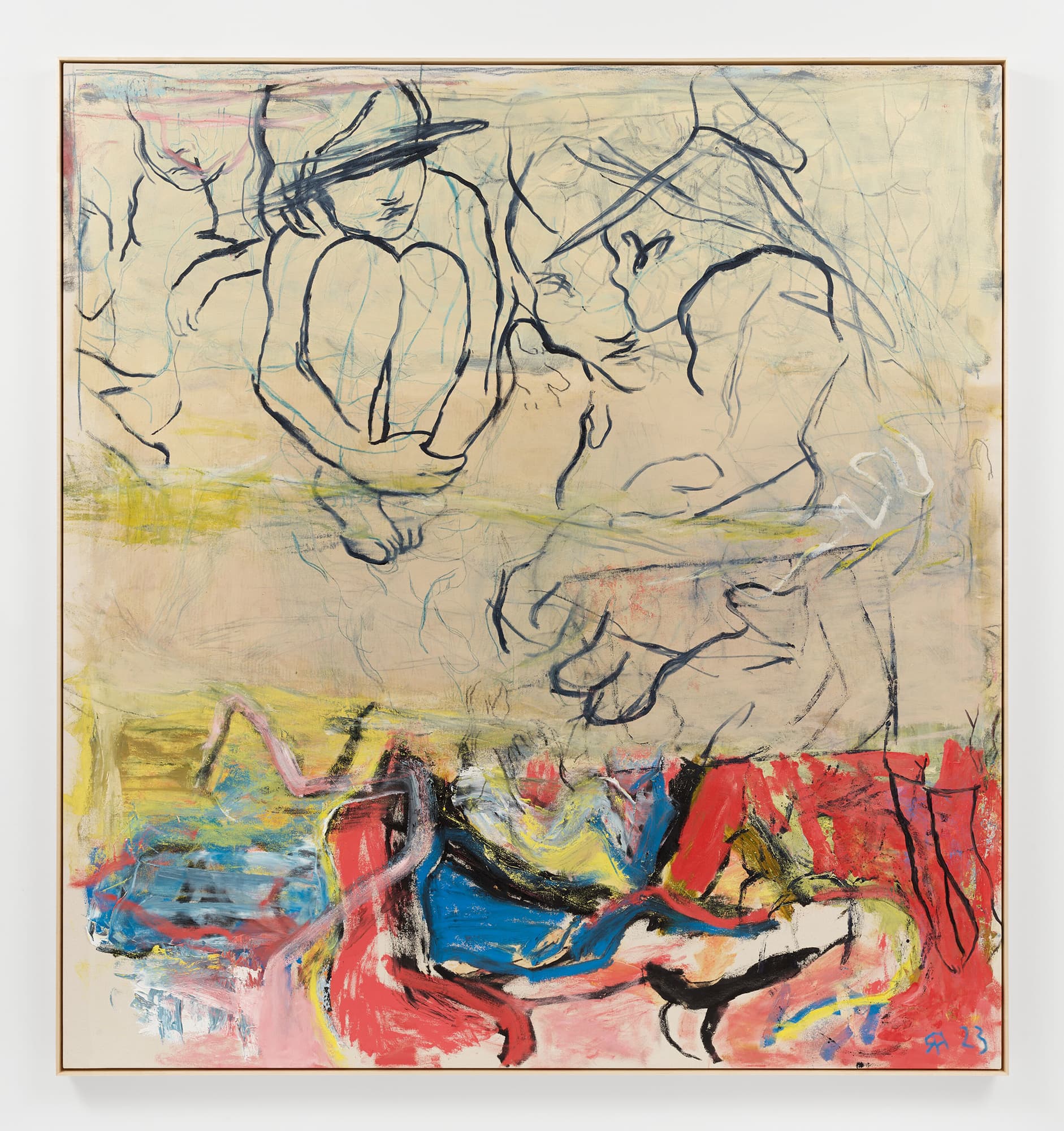
Ackermann’s use of the abstract, gestural, and corrugated band is limited to the canvas’s upper or lower third in works like Without Narrative (2023), Mouchette’s Manners (2023), Sacred Indirection (2023), and Shut Eye (2023). In Shutters (2023), two colorful bands bookend the top and lower thirds. Although segmented, Ackermann’s painterly flurry of vermillion, obsidian, pink, and mauve gestures slip into the figurative space of the cherub-nymphets, overcoating and at times altogether occluding them. A wry finger or the hint of an ear reveals their presence below. The charged brushstroke invites viewers to interpret Ackermann’s abstractions as psychologically charged and, perhaps, metaphorical. Yet the abstract elements do not serve any narrative function and are discontinuous from the pictorial space occupied by the figures. Ackermann does not suggest any rapprochement between her distinct spatial planes, relying throughout “Splits” on the commixture of two realities that, paradoxically, remain distinct.
The space Ackermann’s nymphets occupy is internally constrained by the demands of narrative, a fact that is made clear in Reversed Angles (2023). Here, a cast of nubile recumbent cherubs lay splayed along the ground, engrossed in vaguely eroticized, albeit juvenile, play. Here, Ackermann evokes Balthus who, as a student of Rilke, was similarly fond of the Bildungsroman and often manipulated the line that separates youthful naïveté from witting sexual decision. Elsewhere, as in Mouchette’s Manners (2023)—the title a reference to Bresson’s characteristically inhibited and remote 1967 film, which tells the story of an isolated farmgirl’s sexual trauma—Ackermann’s nymphets slip between the canvas’ upper and middle thirds. An adolescent girl with free-flowing hair, perhaps modelled on Bresson’s Mouchette, tucks her chin behind her knees. A scrawled streak of black lines charts over her eyes, this anonymizing-effect hiding any possible tears. In Shutters (2023), Ackermann’s youth are figured as pentimenti, a set of repeated almond eyes and gap-toothed smiles augured by the collision of eddying black scratches. This scene, which occupies the central band, is bookended by gray-blue horizontal striations below—the titular “shutters”—and a torrent of amber, orange, and faint yellow all-over lines above, holding the narrative in abeyance. Viewed through makeshift windowpane-shutters, the central rectangular field suggests voyeurism, further indicating the enduring importance of cinematic narrative in Ackermann’s work. There is, however, a calculated lack of relation between the performance of Ackermann’s bodies and her performance of paint. If there is any relationship between the disembodied abstractions, purged of illusionism, and the adolescents, it is mostly formal. Yet in the best works of this series, Ackermann uses gesture instrumentally, revealing and occluding details. As with Mouchette’s eyes, this allows her narratives to enjoy a cold, Bressonian ambiguity.
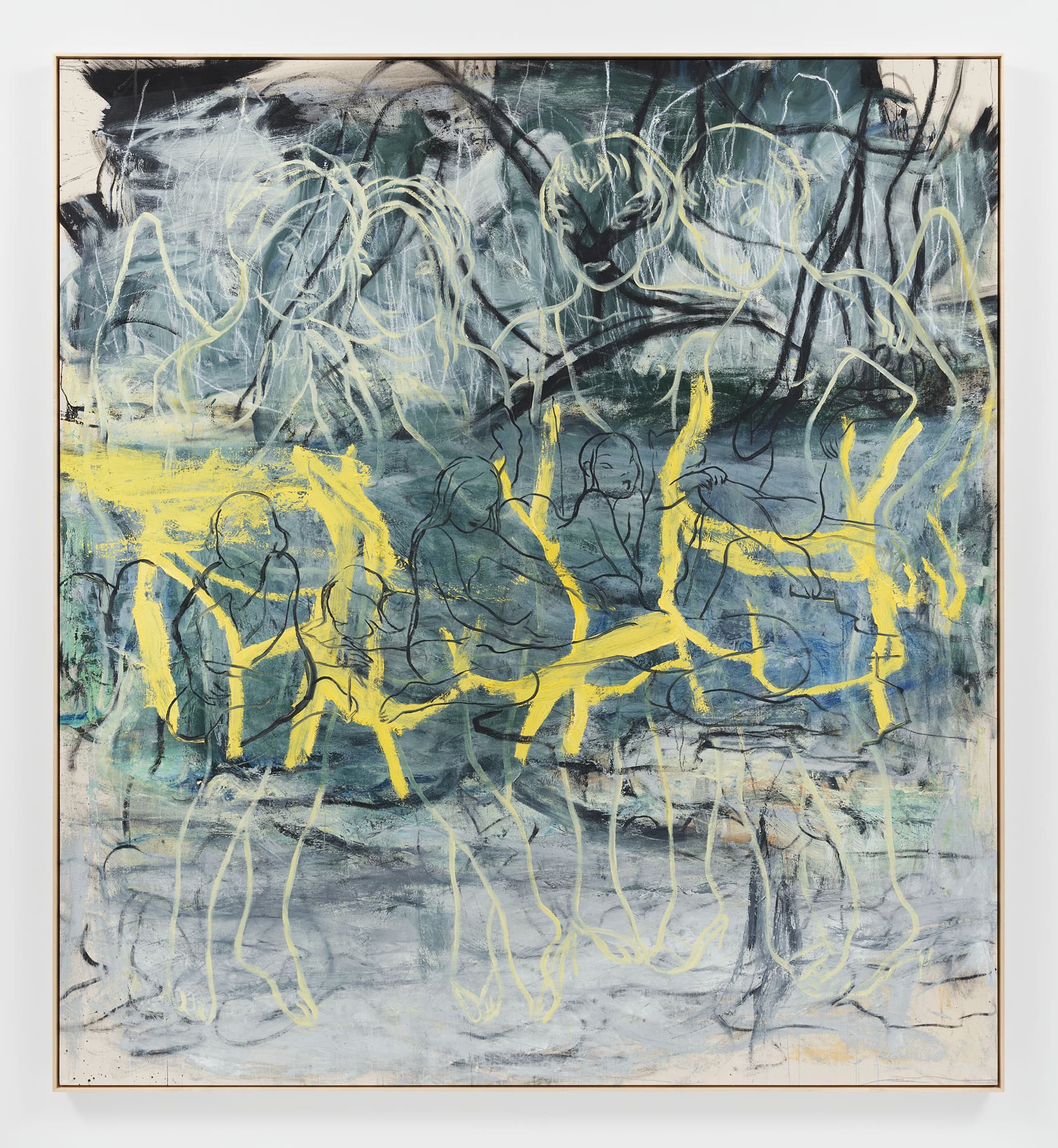
What is clear is that Ackermann’s abstract gestural elements, even where they function as a container, do not occupy the same metaphysical stratum as her cherubs and adolescents. Her blocks and strewn streaks of paint never serve as the ground upon which her young girls rest, nor are they the source, path, or nexus of their movements. In Reversed Angles (2023), Ackermann’s darting electric lines bound and direct our eyesight, illuminating the incised adolescents. Viewing this painting, I thought of Roberto Matta’s psychologically introspective “inscapes” and “psychological morphologies” from the late 1930s and early-to-mid 1940s, although they, unlike Ackermann’s image, remain architecturally coherent in their pictorial construction. The distinction is crucial. Matta sought an answer to what, in 1948, James Thrall Soby called the “perspective problem” of “De Chirico’s linear system,” and in so doing proposed illusory “third” and “fourth” dimensions of implied movement and “astral light” that allowed him to create works in which no element is disparately cleaved from another, either metaphysically or optically, each cueing the rest in a reticulated network. In Ackermann’s “Splits,” however, the so-called “perspective problem” remains either unsolved or abdicated. This is seemingly intentional given Ackermann’s penchant for “canceling expectations” (as she tells Donatien Grau in a 2023 interview). Ackermann’s spatial semblances are thus not only “split” but sundered, foreclosing any homology between the performance of gesture and the performance of depicted bodies. But her instrumental use of gesture, particularly where it appears to license acts of occlusion, indicates the latent presence of a rationality that is at odds with what might initially appear to be a cold, unequivocal formalism. Such decisions make for the strongest works in the show.
Ekin Erkan is a writer, curator, and researcher whose writing has appeared in the Journal of Value Inquiry, the International Journal of Philosophical Studies, and Hyperallergic, among others.