Emilie Stark-Menneg: Thread of Her Scent
Word count: 896
Paragraphs: 11

On View
Farnsworth Art MuseumThread of Her Scent
February 17–September 22, 2024
Rockland, ME
The energetic, irrepressible canvases of Emilie Stark-Menneg are at once familiar and strange. They are eye-catchingly seductive; and upon longer, closer looking, become cheerfully subversive. These are restless worlds where momentum cancels color; where surprise counts far more than meaning. Is meaning.
Emilie Stark-Menneg’s most recent work is a series of paintings loosely based on the famous Unicorn Tapestries at the Metropolitan Museum of Art Cloisters in New York, as well as related tapestries, The Lady and the Unicorn, from the Musée de Cluny in Paris. The Cluny series includes six panels devoted to the five senses: touch, sight, smell, taste, and sound, plus a sixth tapestry with the words, “À mon seul désir,” (to my only desire). Her series of unicorn paintings offer a freely imagined open-endedness that may not be so distant from how the original tapestries were seen during an age transitioning from medieval mysticism to secular humanism.
Both Met and Cluny tapestries are populated by varied human and animal inhabitants—hunters, ladies, dogs, birds, and other creatures. They are collectively set into a “millefleur” or “thousand-flower” background design symbolizing the abundance of nature. And while the unicorn tapestry makers remain unidentified, weaving and fabric arts have long been associated with women’s art, likely predating and partly responsible for the rise of civilization world-wide.
Stark-Menneg’s re-invention of these monumental late medieval masterworks—reflected in the sheer size of her own canvases—suggest a kind of romantic combing through the artist’s personal treasure chest of meaningful images and materials—portraits of herself and her life partner (artist John Bisbee), flowers and foliage, honey bees, the full moon’s reflection on a night sea, rabbits, even loose drawings perhaps plucked from fondly recalled cartoons and children’s TV series. There are flocked textures sprinkled with glitter, and recurring unicorns and their horns throughout. A central fact of her “Unicorn Tapestry” series is that other than the artist’s say-so they are neither tapestries nor about unicorns.
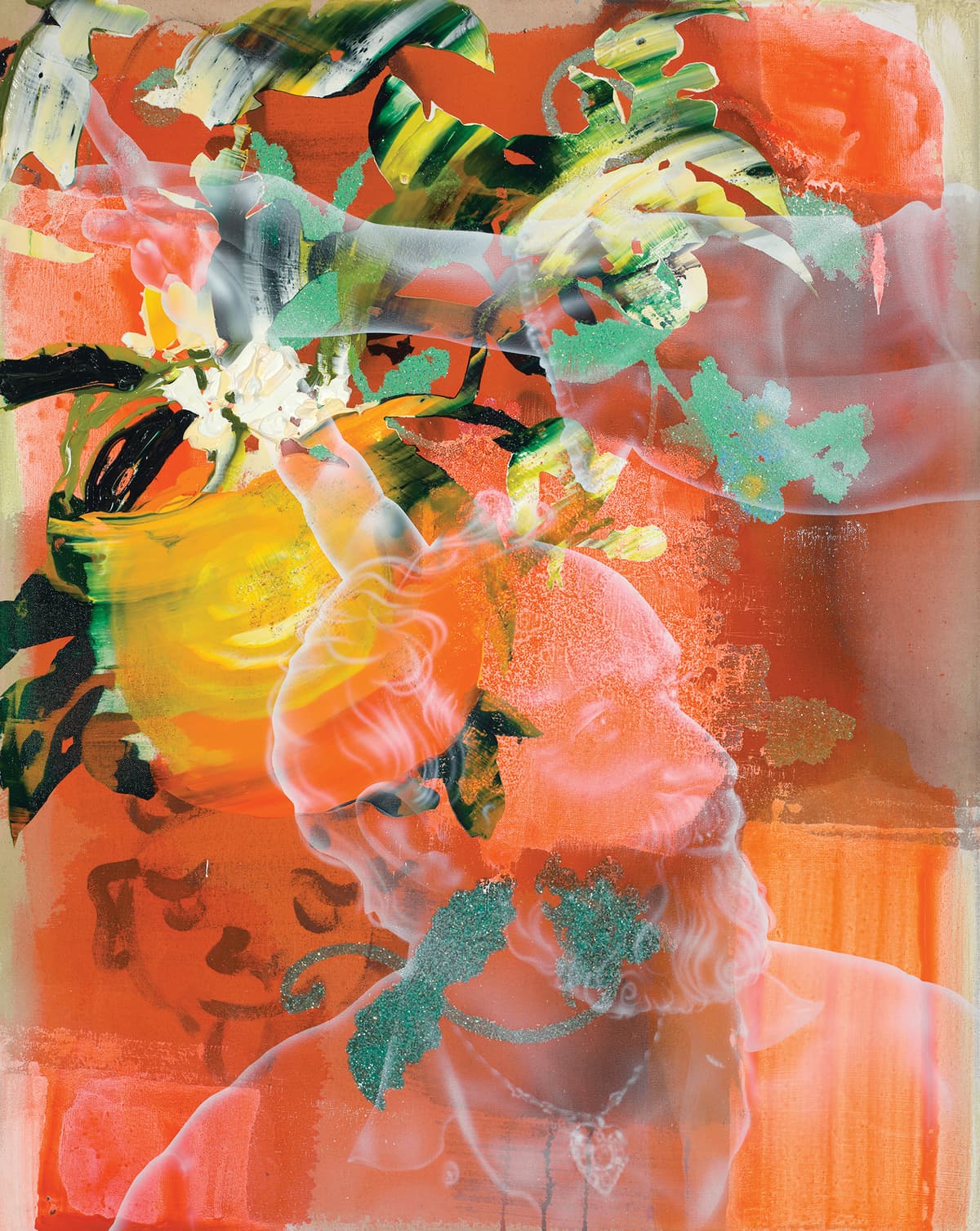
The silver glitter distantly mimics silver threads woven into the original tapestries—serving as worldly reminders of ornate courtly splendor, emblems of wealth and opulent array. A sense of frenetic movement resulting from long hours and intense hand labor is ever-present in Stark-Menneg’s work.
It is telling that the unicorn is visually elusive in Stark-Menneg’s paintings. Unicorns appear to emerge or peek from within or from underneath other surfaces with a kind of holographic, there-but-not-there presence. The animal is momentarily seen in some panels, missing altogether in others. Layers of semi-transparent washes obscure and release flora and fauna, modernist abstractions of the original millefleur designs. Watery, blue-greens lap over large expanses of sky or vegetation within individual panels. She struggled with unifying the tonal range for the series moving from hot sunny oranges to deep purple, dark greens and bubble-gum blue against Barbie pink. These high-keyed shifts among panels are those encountered incessantly in mediated postmodern life—glossy magazines, TV and movie animation, and internet photos and iPhone advertising. These colors and the wild scattering of rioting daylilies, lilacs, blueberries and strawberries are where we might expect to find semi-white-translucent unicorns doing their utmost trying to escape notice.
In the original telling of unicorn tales the spiral horn purifies those sources of water it touches. It is why the unicorn is hunted and sought by high-born ladies and their courtly admirers. Ricocheting allusions to art, history, nature and contemporary culture aside, capturing unicorns amounts to what novelist John Fowles once characterized as the black paradox at the heart of the human condition: the fulfillment of the desire is at once the death of desire.
For Stark-Menneg the five senses are agents of transformation in an age of flickering hand-held screens. Thus, the five senses embody the chase—never the capture. We sense what connects her unicorn’s “threads” is endless, unrequited desire.
Her high-keyed, on-the-edge-of-clashing, colors have been aptly described as rambunctious. Rich, saturated blues traverse yellow-orange skies. Popsicle colors land in grass, flowers and fruit and the occasional carnival ride unicorn. A kind of flashing, jump-cut, Tik-Tok, dub-stepping dance movement appears eliding into layered depths and unbounded ambiguity, spatially and metaphorically. Whooshing, wide brushstrokes not so much cancel a horizon as mark space for another time and another place she is still thinking about.

I won’t comment here on the unicorn horns growing out of John Bisbee’s head, as seen in Sun Stroke and Lilac Wine, (both 2024) except to notice that art worth remembering is nearly always local and personal. And, here it is loving, too. Some unicorns do get caught. Quoting Philip Guston, Stark-Menneg searches for that place where “the paintings will tell you period what to do.” And informs us, as if this wasn’t immediately apparent looking at her art, “I fully believe in fantasy.” Like the unicorns being endlessly chased on merry-go-rounds or prancing across medieval tapestries, she deeply loves “things that are impossible.” Perhaps, the only conceivable impossibility for Emilie Stark-Menneg is not painting, not dancing in the tumbling, cleansing, transformative laundromat of her color-washed dreams.
Chris Crosman primarily writes about living Maine artists for his local Maine newspapers. He is the former founding chief curator at Crystal Bridges Museum of American Art in Arkansas and former director of the Farnsworth Museum in Rockland, Maine for seventeen years.