Nancy Princenthal

Nancy Princenthal is a New York-based writer whose Agnes Martin: Her Life and Art received the 2016 PEN/Jacqueline Bograd Weld Award for Biography. She is also the author of Unspeakable Acts: Women, Art, and Sexual Violence in the 1970s and Hannah Wilke, and her essays have appeared in monographs on Doris Salcedo, Alfredo Jaar, Willie Cole and Gary Simmons, among others. A longtime Contributing Editor (and former Senior Editor) at Art in America, she has also written for the New York Times, Hyperallergic and elsewhere, and taught at Bard College, Princeton University, Yale University, and the School of Visual Arts.

Dike Blair’s art is thoroughly cosmopolitan—deeply informed, intensely considered, and visually impeccable. Working at small scale, Blair attends closely to relations among his paintings, sequencing them in what he sees as snippets of conversation rather than extended narratives. We met on a cold January day in a backroom at Karma’s new Chelsea gallery, where the paintings for his current exhibition were temporarily hung, aptly enough, on sliding screens.
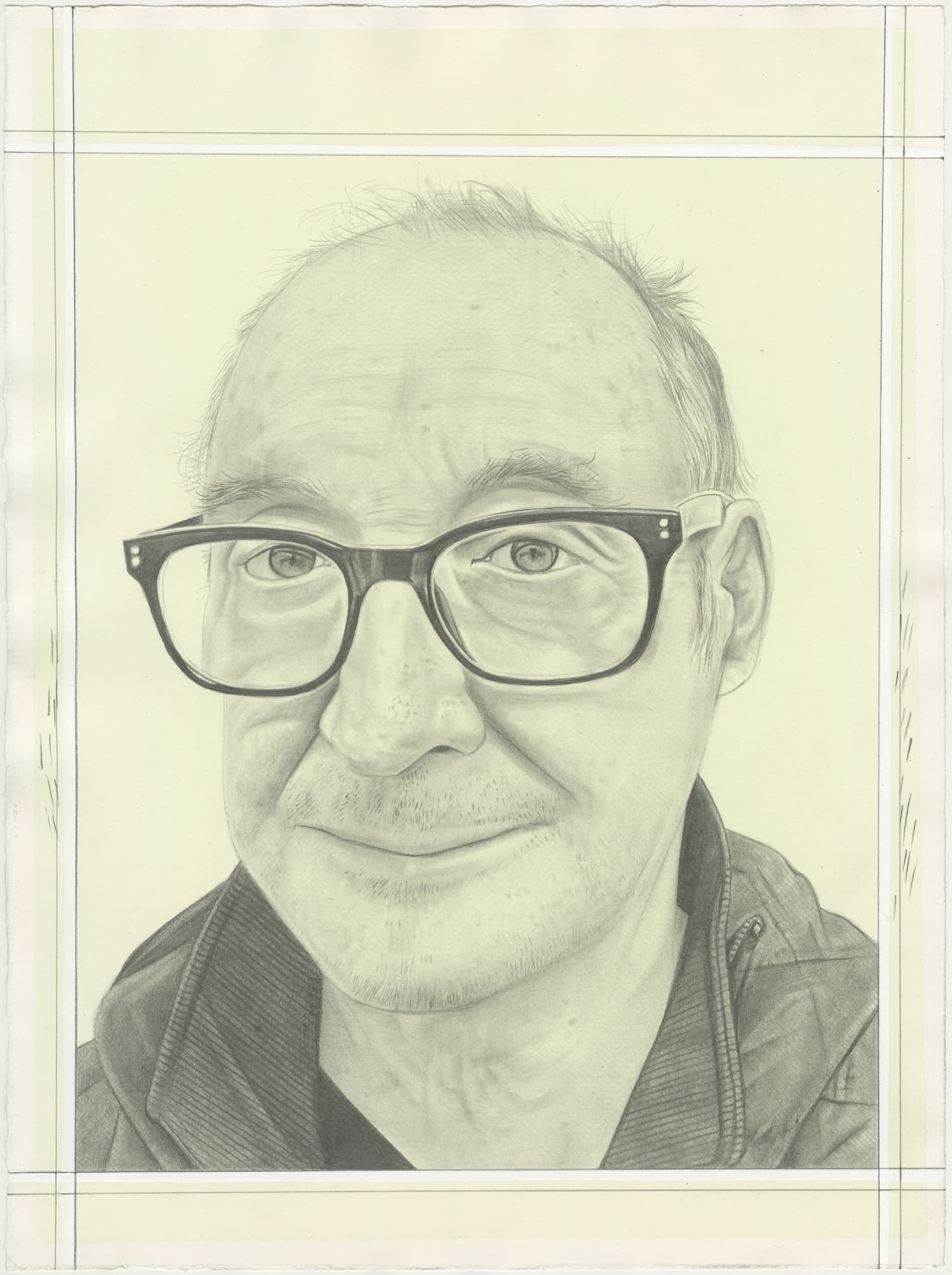
Portrait of Dike Blair, pencil on paper by Phong H. Bui.

In 2011, The Clock seemed plausibly comprehensive, or at least representative, in its sampling of popular filmmaking. It reached back to the medium’s birth and forward to the present. Now, it feels like a decidedly closed circle, its daylong loop shaped like a clock face, or an old-fashioned can of celluloid. It seems an artifact of a period when the media circus was just a little quieter, jump cuts slower, and the boundary between fact and fiction more secure. Of course, my temporal position has shifted too.

Christian Marclay, The Clock (detail), 2010. Single-channel video with sound, 24 hours. © Christian Marclay. Courtesy Paula Cooper Gallery, New York.
Suzanne McClelland has been exploring relationships among visual, written, and spoken language figures and their coded representation throughout her career as a painter.
Portrait of Suzanne McClelland, pencil on paper by Phong H. Bui.
Is discrimination against the old rampant, in an ever more youth-besotted culture? Maybe not. As political and corporate worlds are keenly aware, the world’s population is rapidly—in some places dramatically—aging. The art world is paying attention, too. See, for instance, the proliferation of belated exhibitions celebrating senior artists, many of them long-neglected women, including Carmen Herrera, Etel Adnan, Howardena Pindell and Faith Ringgold.
Alice Neel, Self-Portrait, 1980. Oil on canvas, 53 1/4 x 39 3/4 x 1 inches. Courtesy the National Portrait Gallery, Smithsonian Institution. © The Estate of Alice Neel.
The dominance of women in this Biennale is unquestionably cause for jubilation. Its importance can’t be exaggerated. Similarly momentous is its embrace of artists from beyond the cosmopolitan centers of the West.
Miriam Cahn, unser süden sommer 2021, 5.8.2021, 2021. Room installation composed of 28 paintings and works on paper. Mixed techniques. Dimensions variable. With the additional support of Swiss Arts Council Pro Helvetia. 59th International Art Exhibition - La Biennale di Venezia, The Milk of Dreams. Courtesy La Biennale di Venezia. Photo: Marco Cappelletti.
Shocking but true: Artists Space, essential model for a generation of feisty, funky, youth-driven nonprofits, is nearly half a century old. More surprising still, initially it depended entirely on government support, at a time when both the governor of New York (Nelson Rockefeller) and the US president (Richard Nixon, newly re-elected) were Republicans. Promising to make up for a dearth of opportunity for young artists, Artists Space’s founders rounded some up and offered them the chance to call the shots, all on the state’s dime.
Hito Steyerl, Liquidity, Inc.. HD video with sound, 30 mins. Installation view: Hito Steyerl, Artists Space, 2015. Courtesy Artists Space, New York. Photo: Matthew Septimus.
Breathtakingly beautiful, like all of Janet Biggs’s work, A Step on the Sun (2012) is also—again characteristically—a haunting account of several kinds of mortal danger.
Portrait of Janet Biggs, pencil on paper by Phong Bui.
Among the people I’ve had the very good fortune to know, and want to recognize, are a couple of formidable teachers (Leo Steinberg, Rosalind Krauss); a few artists who early on prodded me by their wisdom and invention (Scott Burton and Siah Armajani); and one editor, who, I’m guessing, I won’t be the only person to thank, profusely: the inimitable and indomitable Betsy Baker.
It’s possible that one of the most important things Linda Nochlin has done is to have launched her best-known salvo in the form of a question. “Why Have There Been No Great Women Artists?” was not just an indictment (though it was that, and a forceful one). It was also an invitation.
Why is feminism resurgent now? One answer may be the galloping growth of an economic inequality that no amount of effort or merit can overcome.
There is a wonderful documentary called Agnes Martin: With My Back to the World, produced near the end of the artist’s long life by the filmmaker Mary Lance.
With Her Back to the World and Her Face to the Camera
Verbal language has, arguably, gotten the jump on visuality.
Portrait of Nancy Princenthal. Pencil on paper by Phong Bui.
It is an odd, bracing time to be writing art criticism. I used to think of the job as starting with a dialogue between writer and artist, an exchange that might widen to engage other interested artists and writers (and, ideally, interested bystanders as well). It has always seemed like an enormous privilege, and also a huge stroke of luck, to participate in this kind of discussion.

Close

Home