Jurriaan Benschop

Jurriaan Benschop is a writer and curator who is based in Athens and Berlin.

Can guilt serve as a compelling incentive for mounting an exhibition? For some of the artists exhibiting in Why Look at Animals? A Case for the Rights of Non-Human Lives at the National Museum of Contemporary Art Athens (EMST), it nurtured the work.
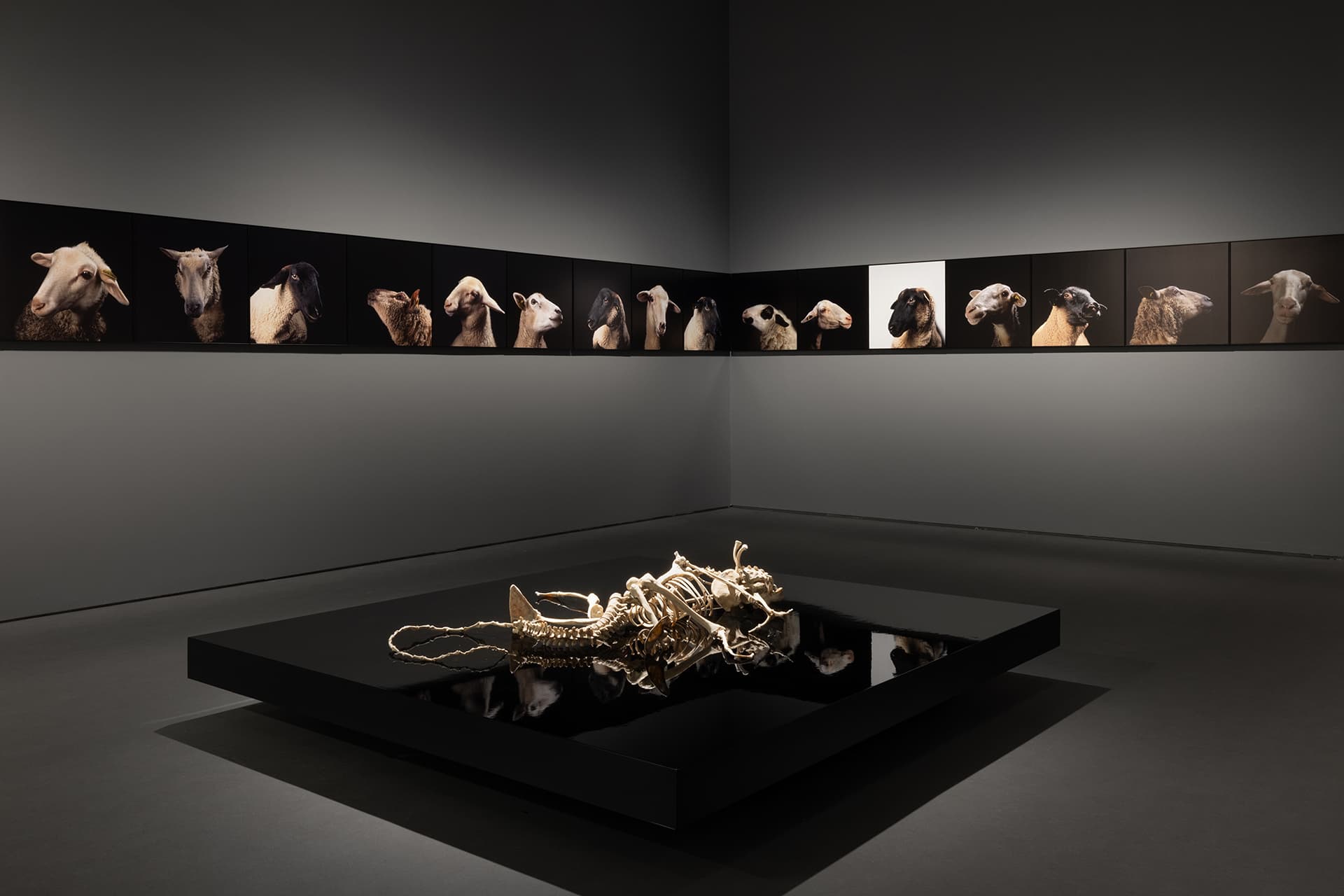
Installation view: Why Look at Animals? A Case for the Rights of Non-Human Lives, National Museum of Contemporary Art, Athens, Greece, 2025–26. Courtesy the artists and National Museum of Contemporary Art, Athens, Greece. Photo: Paris Tavitian.

Two of Lammert’s Rudolf Zwirner portraits (out of more than five hundred) are on view in the exhibition REVOLUTIONSSPLITTER (“Revolution Splinter”) at the municipal Galerie Pankow in Berlin. The exhibition shows a number of Lammert’s own works on paper, but they are embedded within selections from his private collection of drawings by other artists, mainly French, from the eighteenth and nineteenth centuries. Why this remarkable set up?

Mark Lammert, Rudolf Zwirner, 2017. Charcoal on paper, 15 x 12 inches. Courtesy the artist and Galerie Pankow.

Vida y Muerte [Life and Death] showcases around seventy paintings plus some ceramic works Miquel Barceló has made over the last forty years, with a focus, though not exclusively, on the still life genre.

Miquel Barceló, Gran cena española, 1985. Mixed media on canvas. © Miquel Barceló / VG Bild-Kunst, Bonn 2024. © Photo: Museo Nacional Centro de Arte Reina Sofía, Madrid.
Until the end of June, Miquel Barceló has an exhibition of his ceramic works at La Pedrera, the signature building of Antoni Gaudí in Barcelona. On the occasion, the Rail spoke with the artist, who, since his appearance in the 1970s, has been working in diverse media such as sculpture, painting, printmaking, and ceramics.
Portrait of Miquel Barceló. Pencil on Paper by Phong H. Bui.
Should there ever be the need for an artist who can envision the apocalypse, Mat Collishaw would probably be the right man to call. This thought came up after I saw some of his work in Valencia, in the newly opened Centro de Arte Hortensia Herrero (CAHH), a private collection gone public, with an impressive list of artists, both Spanish and international.
Georg Baselitz at Centro de Arte Hortensia Herrero. Courtesy the author.
During the opening days of the Venice Biennale, in a classic hotel on the Grand Canal, U.S. artist Mark Bradford was reflecting on the issue of inclusive art history. An interesting conversation evolved about how an artist can, against his will, be stereotypically tied to a generalized identity, and be excluded from institutions, or included in discourses where he does not feel at home.
Installation view: UNITED STATES OF AMERICA, Tomorrow is Another Day, 57th International Art Exhibition - La Biennale di Venezia, Viva Arte Viva. Photo: Francesco Galli. Courtesy La Biennale di Venezia
One thing Documenta curator Adam Szymczyk should without doubt be credited for is bringing Documenta to Athens. By situating half the exhibition in one of Europe’s presently crisis-plagued countries—in the midst of discussions about migration policy, continental cohesion, and moral obligations—an urgency that it could not have developed in Kassel alone is attained, and harnessed.
Installation view: Olaf Holzapfel, various materials. Photo: Stathis Mamalakis.
In the first room of Alice Neel, Collector of Souls at Gemeentemuseum Den Haag, displaying a dozen or so small-sized early paintings from the 1930s, one already can apprehend Neel’s legacy as a portraitist. Her asymmetrical portrait of a woman, Elenka (1936), and the calm and frontal Gerhard Yensch (1935) bring you close to her subjects.
Bridget Riley is one of the last living Modern artists. At the age of 83, her curiosity for the visible and for the art of the past keeps engaging her in new work, without loss of urgency.
Bridget Riley, "Horizontal Vibration," 1961. Emulsion on board, 17 1/2 × 55 1/2 ̋. Private collection. © Bridget Riley 2014. All rights reserved. Courtesy David Zwirner, London.

Close

Home